If you've spent years behind the wheel of a 2013 XJ Supercharged — savoring that 5.0L V8's 470 horsepower and 15 MPG combined thirst — the jump to an electric vehicle is a seismic shift in ownership economics and daily routine. The supercharged Jag drinks roughly $3,200 in premium fuel annually (at 12,000 miles/year and $4.00/gallon). A comparable luxury EV sedan, charged at home on off-peak electricity, can slash that to under $600. But that savings hinges entirely on understanding EV charging: the levels, the hardware, the home electrical work, and the connectors.
This guide breaks down everything a former internal-combustion luxury sedan owner needs to know about charging an EV in 2026 — from Level 1 trickle charging to 350 kW DC fast stations, home installation realities, and what you'll actually pay per mile.
Charging Levels Explained: Speeds, Power, and Range Added Per Hour
The single most important distinction in EV literacy is kW (kilowatts) versus kWh (kilowatt-hours). Think of it like plumbing: kW is the flow rate of water through the pipe (power), and kWh is the total volume in the tank (energy). A 77 kWh battery holds 77 units of energy; a 19.2 kW Level 2 charger delivers energy at that rate. Never use them interchangeably.
| Level | Voltage | Max Power (kW) | Miles of Range Added Per Hour | Best Use Case |
|---|---|---|---|---|
| Level 1 | 120V (standard outlet) | 1.4–1.9 kW | 3–5 mi/hr | Overnight top-ups for PHEVs or low-mileage drivers |
| Level 2 | 240V (dryer-style outlet) | 7.2–19.2 kW | 25–65 mi/hr | Daily home and workplace charging |
| DC Fast Charging | 400V–800V+ (commercial) | 50–350 kW | 150–900 mi/hr (peak) | Road trips and rapid top-ups |
For context: a luxury EV sedan like the BMW i5 eDrive40 (84.3 kWh usable battery, EPA range 295 miles) would take roughly 10 hours from empty to full on a 9.6 kW Level 2 charger, but only about 22 minutes from 10–80% at a 205 kW DC fast charger. That DC speed isn't sustained — charging curves taper significantly above 80% State of Charge (SoC) to protect battery health. Expect the final 80–100% to take as long as the initial 10–80%.
Home Level 2 Charger Installation: Electrical Requirements and Real Costs
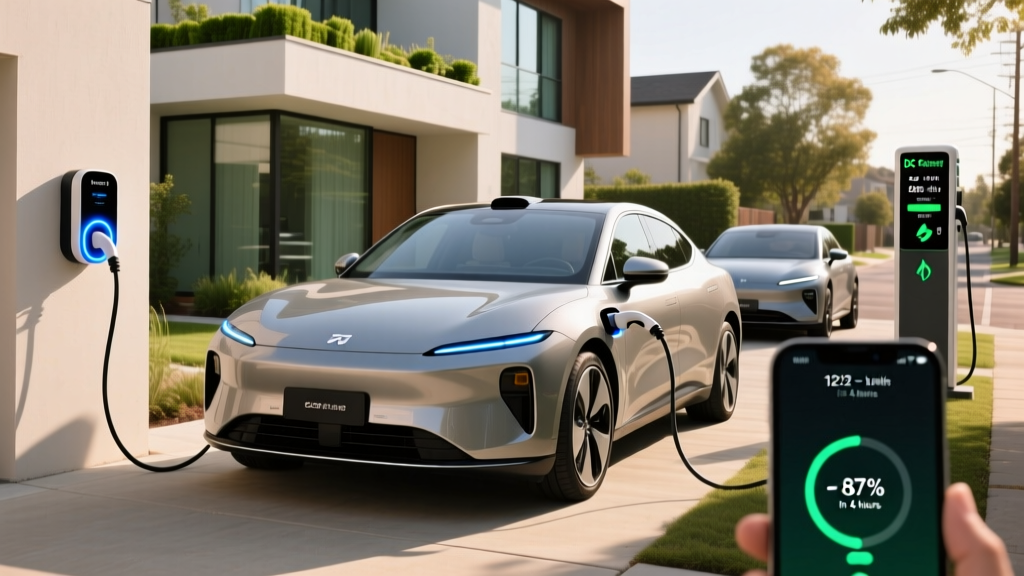
Most EV owners charge at home 80–90% of the time. A Level 2 home station is the single highest-impact upgrade you can make. Here's what it actually requires.
Electrical Specifications
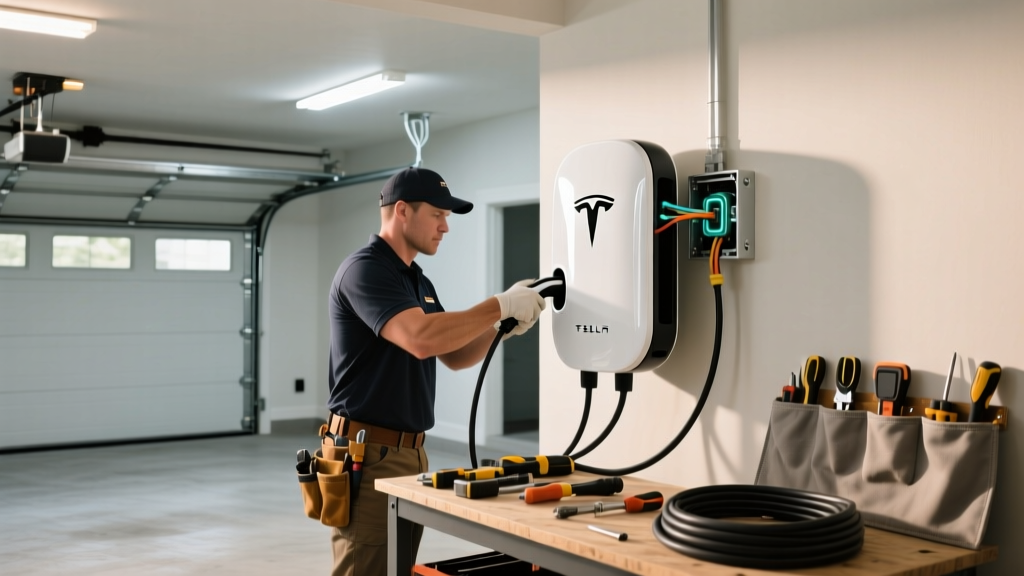
A typical Level 2 home charger runs on a dedicated 240V circuit — the same voltage as your electric dryer or oven. Common configurations:
- 40-amp circuit / 32-amp continuous draw: Delivers 7.7 kW. Adequate for overnight charging of most EVs with 60–100 kWh batteries.
- 50-amp circuit / 40-amp continuous: Delivers 9.6 kW. The sweet spot for luxury EV sedans with larger batteries.
- 60-amp circuit / 48-amp continuous: Delivers 11.5 kW. Required to max out chargers like the ChargePoint Home Flex or Tesla Wall Connector at full output.
- 80-amp circuit / 64-amp continuous: Delivers 15.4–19.2 kW. Needed for vehicles with high onboard charger capacity (e.g., Hummer EV, certain fleet vehicles). Rare in residential.
Per the National Electrical Code (NEC), continuous loads (like EV charging) can only use 80% of a circuit's rated amperage. So a 50-amp breaker supports 40 amps of continuous charging.
Panel Upgrade Reality
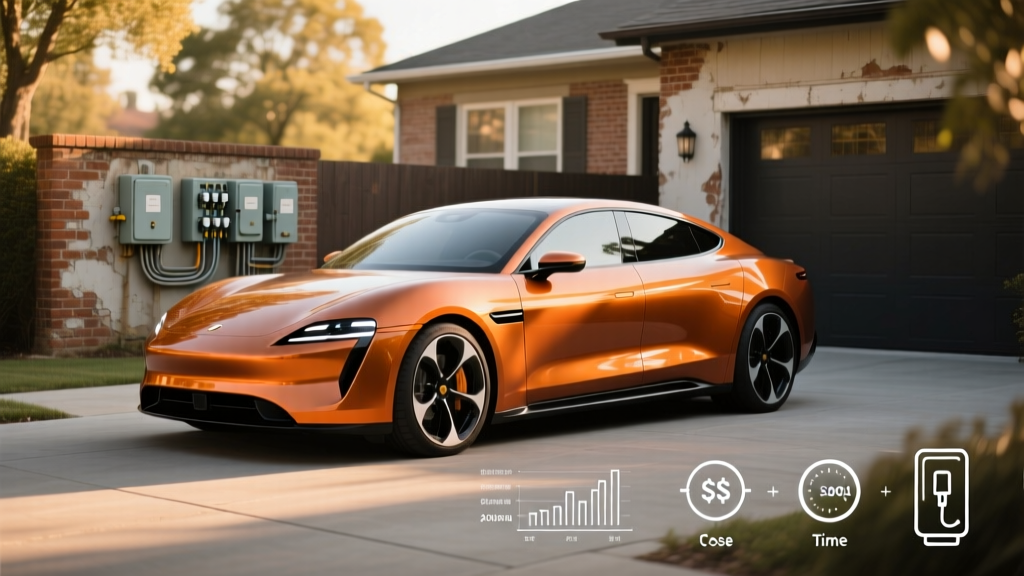
Homes built before 2000 often have 100-amp or 150-amp main electrical panels. Adding a 50-amp EV circuit may exceed available capacity, especially if you already run electric HVAC, a dryer, and an electric oven. A panel upgrade to 200 amps typically costs $1,500–$3,500 before the EV circuit is even added. Have a licensed electrician perform a load calculation before committing to hardware.
| Cost Component | Low Estimate | High Estimate | Notes |
|---|---|---|---|
| Level 2 charger hardware | $350 | $750 | Wi-Fi smart chargers (ChargePoint, Emporia, Wallbox) |
| Electrician labor (simple install) | $400 | $800 | Short run from panel to garage, same wall |
| Electrician labor (complex run) | $800 | $2,000+ | Long conduit runs, attic/crawlspace routing, detached garage |
| Permit and inspection | $50 | $300 | Varies by municipality |
| Panel upgrade (if needed) | $1,500 | $3,500 | 100A to 200A service upgrade |
| Total (no panel upgrade) | $800 | $3,550 | Most homes with 200A service |
| Total (with panel upgrade) | $2,300 | $7,050 | Older homes with 100A/150A service |
The IRS §30D tax credit does not cover home charger installation for most taxpayers after 2022. However, the Residential Clean Energy Credit (25C) and some state/utility rebates may offset $200–$500 of equipment costs. Check your utility's website — many offer $250–$500 rebates for smart Level 2 chargers that participate in demand-response programs.
Connector Compatibility: NACS, CCS1, and CHAdeMO in 2026
The connector landscape has consolidated dramatically. As of the 2025–2026 model years, the North American Charging Standard (NACS), pioneered by Tesla, has become the dominant connector. Ford, GM, Rivian, Hyundai, Kia, BMW, Mercedes-Benz, and Volvo have all adopted NACS on new vehicles. CCS1 (Combined Charging System) persists on some 2023–2024 models and at legacy public chargers. CHAdeMO is effectively dead for new vehicles (Nissan Ariana switched to CCS, then NACS).
| Connector Type | Brands Using It (2026 Models) | Public Charger Availability | Adapter Needed? |
|---|---|---|---|
| NACS (Tesla-style) | Tesla, Ford, GM, Rivian, Hyundai, Kia, BMW, Mercedes, Volvo, Polestar | Tesla Supercharger network (25,000+ stalls), growing Electrify America and ChargePoint NACS stalls | No — native on 2025+ models. CCS-to-NACS adapters available for older CCS cars (~$200). |
| CCS1 | 2023–2024 legacy models (older Ioniq 5, EV6, Mustang Mach-E, ID.4) | Electrify America, EVgo, ChargePoint DC stations | NACS-to-CCS1 adapter needed for Tesla Superchargers (~$200–$250). |
| CHAdeMO | Discontinued (Nissan Leaf was last major user) | Declining; some legacy EA and ChargePoint stalls | No commercially available NACS adapter; avoid for new purchases. |
If you're buying a 2025 or 2026 EV, it almost certainly has a NACS port. The critical question is whether your local public DC fast chargers have NACS cables — Tesla Superchargers do, and other networks are retrofitting. For CCS1-equipped vehicles, the Tesla-approved CCS Combo 1 Adapter unlocks the Supercharger network.
Charging Cost Per Mile: EV vs. Your Old Supercharged V8
The 2013 Jaguar XJ Supercharged averaged about 15 MPG combined. At $4.00/gallon premium, that's $0.267 per mile in fuel alone. Let's compare that to typical EV charging costs across scenarios, using a luxury EV sedan averaging 3.0 miles per kWh (roughly 105 MPGe, typical for a BMW i5 or Mercedes EQE).
| Charging Scenario | Cost per kWh | Cost per Mile (3 mi/kWh) | Annual Cost (12,000 mi) | Savings vs. XJ Supercharged |
|---|---|---|---|---|
| Home Level 2 — off-peak utility rate | $0.09–$0.13 | $0.03–$0.04 | $360–$480 | $2,720–$2,840 |
| Home Level 2 — standard rate (no TOU plan) | $0.14–$0.18 | $0.047–$0.06 | $564–$720 | $2,480–$2,636 |
| Public Level 2 (workplace/shopping) | $0.20–$0.35 | $0.067–$0.117 | $804–$1,404 | $1,796–$2,396 |
| DC Fast Charging (Electrify America, EVgo) | $0.35–$0.55 | $0.117–$0.183 | $1,404–$2,196 | $1,004–$1,796 |
| 2013 XJ Supercharged (15 MPG, $4.00/gal premium) | N/A | $0.267 | $3,200 | Baseline |
Even in the worst-case scenario — exclusive DC fast charging at peak rates — the EV costs less per mile than the supercharged V8. But the real savings come from home charging on a time-of-use (TOU) plan. Enrolling in your utility's TOU rate and charging between 11 PM and 6 AM can cut your "fuel" bill by 85% compared to the Jag.
According to fueleconomy.gov, the average 2026 EV achieves 97–120 MPGe combined, translating to 2.8–3.5 miles per kWh depending on weight, aerodynamics, and drivetrain.
Charging Time Examples: What to Expect with Common Battery Sizes
Charging time depends on three variables: battery capacity (kWh), charger power output (kW), and the vehicle's onboard charger limit (for Level 2) or charge-curve acceptance rate (for DC fast charging). Here are realistic estimates for popular luxury EV sedans and crossovers:
Level 2 Home Charging (0–100%)
- Tesla Model 3 Long Range (82 kWh usable, 11.5 kW onboard charger): ~7.5 hours at 11.5 kW / 48A
- BMW i5 eDrive40 (84.3 kWh, 11 kW onboard): ~8 hours at 11 kW
- Mercedes EQE 350+ (90.6 kWh, 9.6 kW onboard): ~9.5 hours at 9.6 kW
- Hyundai Ioniq 6 Long Range (77.4 kWh, 10.9 kW onboard): ~7.5 hours at 10.9 kW
DC Fast Charging (10–80%)
- Tesla Model 3 Long Range: Peak ~250 kW, 10–80% in ~25 minutes at a V3 Supercharger
- Hyundai Ioniq 6 (800V architecture): Peak ~350 kW, 10–80% in ~18 minutes at a 350 kW station
- BMW i5 (400V architecture): Peak ~205 kW, 10–80% in ~30 minutes
- Mercedes EQE: Peak ~170 kW, 10–80% in ~32 minutes
The Hyundai/Kia/Genesis 800V platforms (E-GMP) charge noticeably faster than 400V architectures because they sustain higher power longer before tapering. On a road trip, this translates to 5–8 fewer minutes per stop — meaningful over a 1,000-mile drive.
Recommended Home Level 2 Chargers for 2026
ChargePoint Home Flex
- Power Output: Up to 12 kW (50A) — configurable from 16A to 50A via DIP switches
- Connector: NACS (2025+ models); CCS1 on older stock
- Cable Length: 23 feet
- Smart Features: Wi-Fi, ChargePoint app scheduling, Alexa integration, TOU optimization, energy tracking
- Price: $549–$649
- Best For: Multi-EV households, utility demand-response programs
Tesla Wall Connector (Gen 4)
- Power Output: Up to 11.5 kW (48A)
- Connector: NACS native; J1772 adapter included
- Cable Length: 24 feet
- Smart Features: Wi-Fi, over-the-air updates, Tesla app integration, power-sharing with second Wall Connector on same circuit
- Price: $425–$475
- Best For: Tesla owners, best value per kW
Emporia Vue EV Charger
- Power Output: Up to 11.5 kW (48A)
- Connector: NACS (2025+), J1772/CCS1 adapter available
- Cable Length: 24 feet
- Smart Features: Wi-Fi, Emporia app, solar integration (pair with Emporia Vue energy monitor), load management, V2H-ready
- Price: $399–$499
- Best For: Solar-panel owners, budget-conscious smart-charger buyers
Wallbox Pulsar Plus
- Power Output: Up to 11.5 kW (48A)
- Connector: NACS and J1772 variants available
- Cable Length: 25 feet
- Smart Features: Wi-Fi + Bluetooth, Wallbox app, Power Boost (dynamic load sharing with home panel), Eco-Smart solar mode
- Price: $499–$599
- Best For: Homes with tight electrical capacity (Power Boost avoids panel upgrades)
Safety, Code, and Installation Considerations
EV charging is a high-draw, continuous electrical load — more demanding than most household appliances. Cutting corners here risks fire, failed inspections, and voided insurance. Non-negotiable requirements:
- Dedicated circuit: Your Level 2 charger must have its own breaker — not shared with outlets, lights, or other appliances. A 50-amp charger needs a dedicated 50-amp (or higher) breaker.
- GFCI protection: NEC 2020 and later require GFCI (Ground Fault Circuit Interrupter) protection for all EV charging outlets. Hardwired chargers have built-in GFCI; plug-in units on NEMA 14-50 outlets require a GFCI breaker (~$50–$80 extra).
- Outdoor rating: If your charger is mounted outside or in an unsealed garage, ensure it carries a NEMA 4 or IP65 rating. All recommended chargers above meet this standard.
- Permit and inspection: Most jurisdictions require an electrical permit for EV charger installation. The inspection verifies wire gauge, breaker sizing, grounding, and GFCI compliance. Skipping this can void homeowner's insurance in the event of a fire.
- Wire gauge: 6 AWG copper for 50-amp circuits; 4 AWG for 60-amp. Your electrician will size this based on run length and local code.
- NEMA 14-50 vs. hardwired: A NEMA 14-50 outlet offers portability (take the charger when you move) but requires GFCI breaker. Hardwired installs eliminate the GFCI breaker requirement and reduce failure points — preferred for permanent installations.
Frequently Asked Questions
How much does it cost to install a home EV charger?
For a home with an existing 200-amp panel and a short conduit run, expect $800–$1,750 total (charger + electrician + permit). If your panel needs upgrading from 100A to 200A, add $1,500–$3,500. Complex installations (detached garages, long underground conduit runs) can reach $3,000–$5,000. Always get three quotes from licensed, EV-experienced electricians.
How fast will each charging level add range?
Level 1 (120V standard outlet): 3–5 miles per hour. Level 2 (240V, 40–50 amp): 25–40 miles per hour. DC Fast Charging (150–350 kW): effectively 150–300+ miles in 20–30 minutes at peak, though the charge curve tapers above 80% SoC. For a 300-mile EV, overnight Level 2 charging fully replenishes the battery in 7–10 hours.
Which connector/charger is compatible with my EV?
Check your vehicle's charge port. 2025–2026 models from Tesla, Ford, GM, Hyundai, Kia, BMW, Rivian, Volvo, and Mercedes use NACS. Older (2023–2024) EVs from these brands may have CCS1 — you'll need a NACS-to-CCS adapter (~$200) to use Tesla Superchargers. CHAdeMO is obsolete; no new vehicles use it. For home Level 2, match the charger's connector to your car's port or use the included adapter.
How much does charging cost per mile vs. gas?
Home charging on off-peak rates costs $0.03–$0.04 per mile for a typical luxury EV sedan (3 mi/kWh). Compare that to the 2013 XJ Supercharged at 15 MPG and $4.00/gallon premium: $0.27 per mile. That's a 6–8x difference. Even exclusive DC fast charging ($0.12–$0.18/mi) undercuts the V8 significantly.
What electrical upgrades might I need?
The most common upgrade is a panel capacity increase from 100A or 150A to 200A ($1,500–$3,500). You may also need: a new dedicated circuit with correct wire gauge (6 AWG for 50A), a GFCI breaker for NEMA 14-50 outlets ($50–$80), and conduit routing if the panel is far from the garage. Homes with solar panels or battery storage (e.g., Tesla Powerwall) may need a load-management device to prevent circuit overload. Wallbox's Power Boost and Emporia's load-sharing features handle this dynamically without a panel upgrade.
Is a smart charger worth the premium over a dumb charger?
Yes, for most owners. Smart chargers ($350–$650) offer scheduled charging during off-peak TOU windows, energy monitoring, remote start/stop, and utility demand-response participation (which can earn $50–$150/year in credits). A basic "dumb" Level 2 charger ($200–$300) simply delivers power with no scheduling or monitoring — you'll manually manage charge timing through the car's infotainment system instead.