If you're coming from a supercharged Jaguar — the 5.0-liter V8 F-TYPE, the XJR, or the supercharged F-PACE SVR — and considering Jaguar's electric future (the I-PACE, or the upcoming all-electric GT lineup), the single biggest ownership shift isn't horsepower delivery. It's fueling. Instead of pulling into a gas station, you'll be managing kilowatts, connectors, and charging schedules.
This guide breaks down everything a Jaguar supercharged-to-EV transitioner needs to know about charging: the three charging levels and what they mean in real miles per hour, what a home Level 2 installation actually costs (including the panel upgrade scenario nobody warns you about), which connector your Jaguar uses, and whether charging is genuinely cheaper than filling a supercharged V8 with premium fuel.
Understanding EV Charging Levels: kW, Miles Per Hour, and Real Expectations
The most critical distinction in EV charging is between kW (kilowatts) and kWh (kilowatt-hours). kW measures power — how fast energy flows into your battery, like water pressure from a hose. kWh measures energy — the total capacity stored in your battery, like the size of the tank. A 90 kWh battery charged at 7 kW will take roughly 13 hours from empty to full. That same battery at 150 kW DC fast charging can reach 80% in under 40 minutes.
Here's how the three charging levels translate to real-world range recovery:
| Level | Voltage / Amperage | Power (kW) | Miles of Range Per Hour | Best Use Case |
|---|---|---|---|---|
| Level 1 | 120V / 12A | ~1.4 kW | 3–5 mi/hr | Overnight top-off, emergency backup |
| Level 2 | 240V / 32–48A | 7.7–11.5 kW | 25–44 mi/hr | Daily home charging, workplace |
| DC Fast Charging | 400–800V DC | 50–350 kW | 150–800+ mi/hr (peak) | Road trips, rapid top-ups |
A few realities that spec sheets gloss over: DC fast charging rates are peak numbers, not sustained rates. Most EVs charge fastest between 10–50% state of charge, then taper significantly above 80% to protect the battery. A charger rated at 150 kW might only deliver that rate for 10–15 minutes before stepping down to 50–70 kW for the final stretch. This is why manufacturers quote "10–80%" charging times rather than 0–100%.
Home Level 2 Charger Installation: Electrical Requirements and Costs
For most EV owners, a home Level 2 charger is the backbone of daily charging. You'll need a 240-volt circuit — the same voltage your electric dryer or oven uses — with sufficient amperage to support continuous charging loads.
Electrical Requirements
- Circuit: Dedicated 40A or 50A breaker (continuous loads require a circuit rated 125% above the charger's draw, so a 32A charger needs a 40A circuit; a 40A charger needs a 50A circuit)
- Wiring: 6 AWG copper for 50A circuits; 8 AWG for 40A
- Outlet type: NEMA 14-50 (most common for EV chargers) or hardwired connection
- Panel capacity: Your main electrical panel must have enough spare capacity — typically 200A service is required for a 50A EV circuit alongside existing loads
The Panel Upgrade Reality
Many older homes — particularly those built before 2000 — have 100A or 150A main panels. Adding a 50A continuous EV load to a 100A panel that's already serving an electric range, dryer, and HVAC system may exceed safe capacity. A panel upgrade to 200A service typically costs $1,500–$3,500 depending on your utility's requirements, local labor rates, and whether new service conductors are needed.
Before budgeting for a charger, hire an electrician for a load calculation (sometimes called a "service calculation" per NEC Article 220). This determines whether your existing panel can handle the EV load or if an upgrade is mandatory.
| Cost Component | Simple Install (panel nearby, no upgrade) | Complex Install (long run or panel upgrade) |
|---|---|---|
| Level 2 charger hardware | $350–$700 | $350–$700 |
| Electrician labor (run conduit, wire, install outlet/hardwire) | $400–$1,000 | $1,200–$2,500 |
| Electrical permit | $50–$200 | $50–$200 |
| Panel upgrade (if needed) | $0 | $1,500–$3,500 |
| Total estimated cost | $800–$1,900 | $3,100–$6,900 |
The wide range reflects real variability. A garage with the panel on the same wall might need only 15 feet of wire. A detached garage or a condo parking space could require 80+ feet of conduit and wire, plus trenching.
Connector Compatibility: What Plug Does Your Jaguar Use?
The EV charging connector landscape in North America has shifted dramatically. Here's what applies to Jaguar models:
| Connector | Used By | Jaguar Compatibility |
|---|---|---|
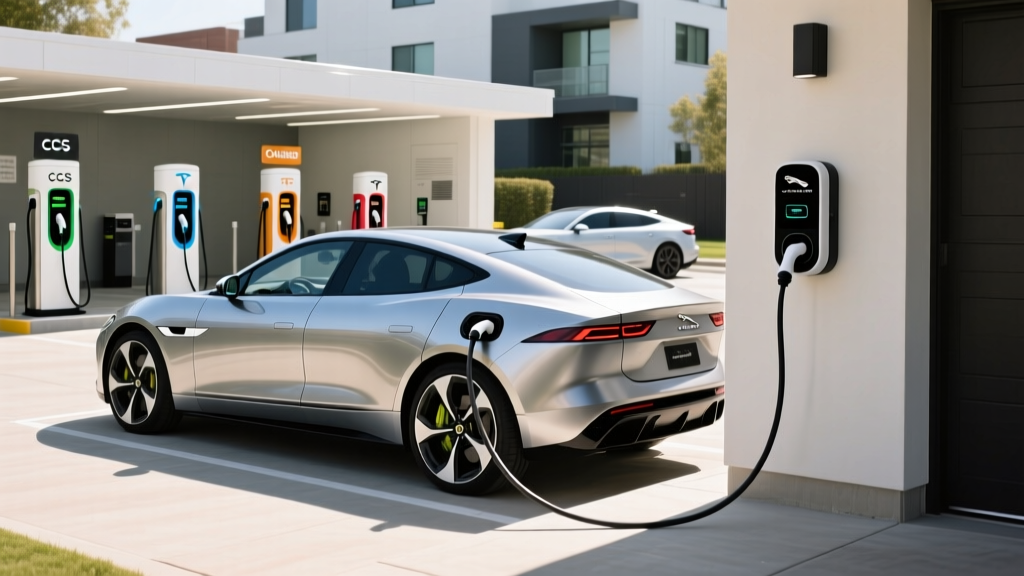
| J1772 (Level 1 & 2 AC) | All non-Tesla EVs (legacy standard) | Native on I-PACE — plug directly into any public Level 2 station |
| CCS1 (DC Fast) | Most non-Tesla EVs through 2024 | Native on I-PACE for DC fast charging |
| NACS (Tesla / North American Charging Standard) | Tesla (all years); Ford, GM, Rivian, Volvo, and others from 2025+ | I-PACE requires a CCS-to-NACS adapter for Tesla Supercharger access |
| CHAdeMO | Nissan LEAF (legacy) | Not compatible — not relevant for Jaguar |
For former supercharged Jaguar owners: If you're buying a used I-PACE (2019–2024 model years), it has a CCS1 port for DC fast charging and a J1772 inlet for Level 2. You can access Electrify America, EVgo, and ChargePoint DC stations natively. To use the Tesla Supercharger network — which remains the most reliable public DC network — you'll need a CCS-to-NACS adapter ($200–$300 from Tesla or third-party manufacturers). Confirm adapter compatibility with your specific model year before purchasing.
Jaguar's next-generation EVs (the announced electric GT lineup, expected 2026–2027) are anticipated to adopt NACS natively, aligning with the broader industry shift.
Charging Cost Per Mile: EV vs. Supercharged V8 Gas
This is where the transition from a supercharged 5.0L Jaguar gets compelling. A supercharged F-TYPE R or F-PACE SVR requires premium fuel (91+ octane) and averages 16–19 MPG combined in real-world driving. At $4.50/gallon premium, that's roughly $0.25–$0.28 per mile in fuel alone.
| Charging Scenario | Cost per kWh | Cost per Mile (I-PACE at ~2.1 mi/kWh) | Annual Cost (12,000 mi) |
|---|---|---|---|
| Home charging (national avg. residential rate) | $0.16/kWh | $0.076/mi | $912 |
| Home off-peak / time-of-use rate | $0.09/kWh | $0.043/mi | $516 |
| Public Level 2 (ChargePoint, etc.) | $0.25–$0.40/kWh | $0.12–$0.19/mi | $1,440–$2,280 |
| DC Fast Charging (Electrify America, EVgo) | $0.35–$0.55/kWh | $0.17–$0.26/mi | $2,040–$3,120 |
| Supercharged V8 (premium gas, 17 MPG avg.) | $4.50/gal | $0.265/mi | $3,180 |
The takeaway: even exclusive public DC fast charging is competitive with supercharged V8 fuel costs. Home charging — especially on a time-of-use plan that lets you charge overnight at off-peak rates — cuts fuel costs by 75–85%. According to fueleconomy.gov, the Jaguar I-PACE achieves 76 MPGe combined, translating to roughly 44 kWh per 100 miles of driving.
One caveat often missed: DC fast charging costs have risen in many markets. Some networks now charge idle fees if you remain plugged in past 80–90% SoC, and subscription plans (like Electrify America's Pass+) can reduce per-kWh rates by 20–25% if you charge publicly more than twice monthly.
Charging Time Examples: What to Expect With Common Battery Sizes
Here are realistic 10–80% charging times for representative EVs, including the I-PACE, based on manufacturer data and independent testing:
- Jaguar I-PACE (90 kWh pack, 84.7 kWh usable, ~100 kW peak DC): 10–80% in approximately 45 minutes on a 150 kW DC station. On Level 2 at 7.4 kW: ~10.5 hours for a full charge.
- Tesla Model Y Long Range (75 kWh usable, 250 kW peak DC): 10–80% in approximately 22 minutes on a V3 Supercharger. On Level 2 at 11.5 kW: ~6.5 hours full charge.
- Hyundai Ioniq 5 (77.4 kWh usable, 240 kW peak DC via 800V): 10–80% in approximately 18 minutes on a 350 kW station. On Level 2 at 10.9 kW: ~7 hours full charge.
- Ford F-150 Lightning Extended Range (131 kWh usable, 150 kW peak DC): 10–80% in approximately 41 minutes on a 150 kW DC station. On Level 2 at 11.5 kW: ~11.5 hours full charge.
The I-PACE's ~100 kW DC peak is modest by 2026 standards. If road trips are a priority, factor in longer stops compared to 800V-architecture rivals. The charging curve also matters: the I-PACE sustains roughly 80–100 kW between 10–50% SoC, then tapers to 50–60 kW above 60%, and drops further above 80%. For practical road-tripping, plan stops at 15–20% SoC and charge only to 75–80% to minimize time at the charger.
Recommended Home Level 2 Chargers for Jaguar EVs
These chargers are compatible with the I-PACE's J1772 inlet and represent strong options across price and feature tiers:
ChargePoint Home Flex
- Power output: Up to 11.5 kW (48A) on a 60A circuit, or configurable down to 16A for lower-capacity panels
- Connector: J1772 (native for I-PACE)
- Cable length: 23 feet
- Smart features: Wi-Fi, scheduling, energy tracking, Alexa integration, amperage adjustable via app
- Price: ~$550–$650
- Best for: Flexibility — adjustable amperage means it works even if your panel can't support a full 48A circuit
Emporia Level 2 EV Charger
- Power output: Up to 11.5 kW (48A)
- Connector: J1772
- Cable length: 24 feet
- Smart features: Wi-Fi, energy monitoring with included whole-home energy monitor, solar integration, scheduling
- Price: ~$350–$400
- Best for: Budget-conscious buyers who still want smart energy tracking
Grizzl-E Smart
- Power output: Up to 10 kW (40A) on a 50A circuit
- Connector: J1772
- Cable length: 24 feet
- Smart features: Wi-Fi, OCPP protocol support, usage tracking, built-in GFCI protection
- Price: ~$450–$550
- Best for: Cold climates — rated to -40°F, IP67 outdoor rating, heavy-duty build
Wallbox Pulsar Plus
- Power output: Up to 11.5 kW (48A)
- Connector: J1772
- Cable length: 25 feet (longest in class)
- Smart features: Wi-Fi + Bluetooth, Power Sharing (daisy-chain two chargers on one circuit), compact form factor
- Price: ~$550–$650
- Best for: Two-EV households sharing a single circuit
For all of these chargers, hardwired installation is preferred over a NEMA 14-50 receptacle if your installation location is permanent. Hardwired connections avoid the NEC requirement for GFCI breakers on receptacles (which can cause nuisance tripping with some EVs) and eliminate one failure point.
Safety, Code, and Permit Considerations
EV charging involves sustained high-current electrical loads — typically 3–10 hours of continuous draw at 32–48 amps. This is more demanding than most household circuits and warrants careful attention to electrical code compliance:
- Dedicated circuit: Your EV charger must be on its own dedicated circuit — no sharing with outlets, lighting, or other appliances. NEC Article 511 governs EV charging installations.
- GFCI protection: If you install a receptacle (NEMA 14-50), the 2023 NEC requires GFCI protection for 14-50 outlets in garages. Many EV chargers have built-in GFCI protection, and double-GFCI (breaker + charger) can cause nuisance trips. Hardwiring avoids this issue entirely.
- Outdoor rating: If your charger is mounted outside, ensure the unit is rated IP65 or higher (splash-proof) and that the electrical connection uses weatherproof conduit fittings.
- Permit and inspection: Most jurisdictions require an electrical permit for EV charger installations. The inspection verifies wire gauge, breaker sizing, grounding, and load calculations. Permits typically cost $50–$200. Skipping the permit risks insurance denial if an electrical fire occurs.
- Utility notification: Some utilities require notification when installing an EV charger, especially if your service is near capacity. Many also offer rebates ($200–$1,000) or discounted time-of-use rates for EV owners — check with your provider before installing.
Always use a licensed electrician. EV charging circuits carry enough current to pose serious fire and shock hazards if improperly installed. The National Electrical Code (NEC) and local amendments govern all requirements.
Frequently Asked Questions
How much does it cost to install a home EV charger?
A straightforward Level 2 installation with the panel nearby and no upgrade needed typically runs $800–$1,900 total (charger + electrician + permit). If your home needs a panel upgrade to 200A service or a long conduit run, expect $3,100–$6,900. Get at least two quotes from licensed electricians and request a load calculation before committing.
How fast will each charging level add range?
Level 1 (120V standard outlet): 3–5 miles of range per hour — adequate only for overnight top-offs if your daily drive is under 30 miles. Level 2 (240V): 25–44 miles per hour depending on amperage — enough to fully recharge most EVs overnight. DC Fast Charging: 150–800+ miles per hour at peak rates, but taper significantly as the battery fills. Plan road-trip stops around 10–80% charging windows for best efficiency.
Which connector/charger is compatible with my Jaguar?
The Jaguar I-PACE (2019–2024) uses J1772 for Level 1 and Level 2 AC charging, and CCS1 for DC fast charging. It is natively compatible with Electrify America, EVgo, and ChargePoint networks. To access Tesla Superchargers, you need a CCS-to-NACS adapter. Jaguar's next-generation EVs (expected 2026–2027) will likely adopt NACS natively.
How much does charging cost per mile vs. gas?
Home charging at the national average residential rate ($0.16/kWh) costs approximately $0.076 per mile in an I-PACE. A supercharged Jaguar V8 on premium fuel at 17 MPG costs roughly $0.265 per mile. Home charging saves $0.19/mile, or about $2,280 per year at 12,000 miles. Even public DC fast charging at $0.45/kWh ($0.21/mile) remains cheaper than supercharged V8 fuel costs.
What electrical upgrades might I need?
The most common upgrade is a panel replacement from 100A or 150A to 200A service ($1,500–$3,500). You may also need: a new dedicated circuit with appropriate wire gauge (6 AWG for 50A), a NEMA 14-50 receptacle or hardwired junction box, and possibly conduit runs if the charger is far from the panel. In rare cases, your utility may need to upgrade the service drop to your home. A licensed electrician's load calculation will identify all requirements before work begins.
Does the IRS offer any incentives for home charger installation?
The Residential Clean Energy Credit (IRC §25D) does not cover EV chargers. However, the Alternative Fuel Vehicle Refueling Property Credit (IRC §30C) was extended through 2032 and provides up to $1,000 (30% of cost, capped) for home EV charging equipment installed in eligible census tracts. Eligibility depends on your address — check the IRS guidance or consult a tax professional before claiming.
Transitioning from a supercharged Jaguar to an electric one means trading exhaust note for efficiency, and gas stations for charging schedules. The good news: with a properly installed Level 2 home charger and a time-of-use electricity plan, your "fuel" cost drops by 75% or more, and you wake up every morning with a full battery — something no supercharged V8 ever offered.