Jaguar's all-electric lineup — anchored by the I-PACE and the newly reimagined electric GT models rolling out for 2026 — demands a charging strategy that matches its performance. If you're looking to keep your supercharged Jaguar EV charged efficiently at home and on the road, this guide breaks down every kilowatt, connector, and cost you need to know.
The Jaguar I-PACE (final model year 2024 in the U.S., with the next-generation electric Jaguar GT arriving as an announced 2026 model) uses a 90 kWh usable battery pack with NMC chemistry and a CCS1 connector. Understanding how to feed that battery — whether from a garage wallbox or a highway DC fast charger — is the difference between effortless ownership and frustrating bottlenecks.
Charging Levels Explained: kW Speeds and Miles Per Hour
Before we talk equipment, let's clarify the most common point of confusion in EV charging: kW (kilowatts) measures power — the rate at which energy flows into your battery. kWh (kilowatt-hours) measures energy — the total capacity stored. Think of kW as the width of a hose and kWh as the size of the bucket. A wider hose (higher kW) fills the bucket faster, but they are not interchangeable units.
Here's how each charging level performs with a Jaguar I-PACE (90 kWh battery, ~3.2 mi/kWh efficiency):
| Level | Voltage | Power (kW) | Miles Added/Hour | Best For |
|---|---|---|---|---|
| Level 1 | 120V AC | 1.4 kW | ~4-5 mi/hr | Overnight top-off, emergencies |
| Level 2 (Home) | 240V AC | 7.2-11.5 kW | ~23-37 mi/hr | Daily home charging |
| DC Fast Charging | 400V+ DC | Up to 100 kW (I-PACE) | ~180-220 mi/hr (peak) | Road trips, quick stops |
The I-PACE's onboard charger is rated at 11 kW (single-phase) or up to 7.2 kW on typical U.S. split-phase 240V residential service. That means even if you install a 48-amp Level 2 wallbox delivering 11.5 kW, the I-PACE will accept roughly 7.2 kW — adding about 23 miles of range per hour of charging. The next-generation electric Jaguar GT (announced, preliminary specs) is expected to feature an upgraded onboard charger and 800V architecture, which should significantly improve both Level 2 acceptance rates and DC fast-charge speeds.
DC Fast Charging: What Jaguar Owners Actually Get
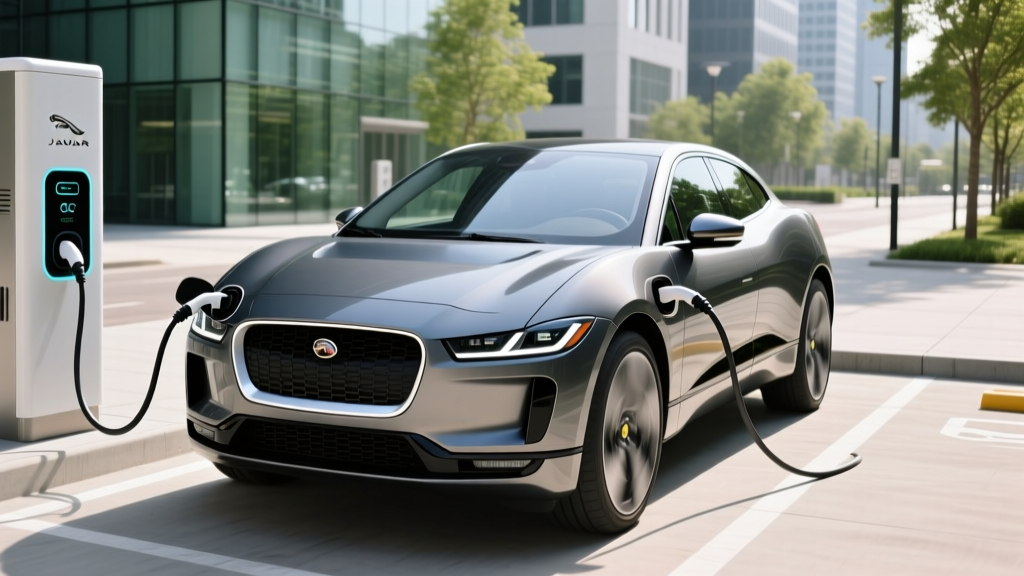
The I-PACE supports DC fast charging at up to 100 kW peak via its CCS1 connector. Here's what that looks like in practice:
- 10-80% charge time: approximately 45-50 minutes at a 100+ kW station
- Peak charge rate: 100 kW sustained from roughly 10-50% SoC
- Charge curve taper: above 60% SoC, the rate drops to ~60 kW; above 80%, it falls to ~30 kW
- Miles added in 20 minutes: roughly 80-100 miles (starting from a low SoC)
This is where the I-PACE shows its age compared to newer EVs with 800V architectures (Hyundai Ioniq 5, Porsche Taycan) that peak at 240-350 kW. Jaguar's upcoming electric GT platform is expected to adopt 800V, potentially enabling 10-80% times under 20 minutes. Until then, I-PACE owners should plan road-trip stops around 40-50 minute charging breaks — a reasonable lunch stop, but not a quick pit stop.
For the latest charging station availability along your route, the Alternative Fuels Data Center maintains a comprehensive map of public DC fast chargers nationwide.
Home Charger Installation: Requirements, Costs, and Gotchas
Installing a Level 2 home charger is the single highest-impact upgrade for any EV owner. For a supercharged Jaguar that you want ready every morning, here's what's involved electrically:
Electrical Requirements
- Voltage: 240V (standard U.S. residential split-phase, same as a dryer or oven)
- Amperage: 32A circuit minimum (delivers 7.7 kW); 48A circuit preferred (delivers 11.5 kW) for future-proofing
- Dedicated circuit: required by NEC — no sharing with other appliances
- Breaker sizing: 40A breaker for 32A chargers; 60A breaker for 48A chargers (NEC requires 125% overhead for continuous loads)
Panel Upgrade Reality
Many homes built before 2000 have 100A electrical panels. Adding a 48A EV circuit may push total load beyond safe capacity, requiring a panel upgrade to 200A — which costs $1,500-$3,000 before the charger install even begins. Homes with existing 200A panels usually have sufficient headroom, but a licensed electrician must perform a load calculation to confirm.
| Component | Typical Cost Range | Notes |
|---|---|---|
| Level 2 Charger (Equipment) | $350 - $750 | Smart Wi-Fi chargers; basic models from $250 |
| Electrician Labor | $600 - $2,000 | Depends on panel-to-garage distance, conduit run |
| Permit & Inspection | $50 - $250 | Required in most jurisdictions; varies by municipality |
| Panel Upgrade (if needed) | $1,500 - $3,000 | 100A to 200A service upgrade |
| Total (No Panel Upgrade) | $1,000 - $3,000 | Most common scenario for modern homes |
| Total (With Panel Upgrade) | $2,500 - $6,000 | Older homes with 100A service |
Some utilities offer rebates of $250-$500 for Level 2 charger installation, and certain states provide additional incentives. Check your local utility's EV program before scheduling work.
Safety and Code Considerations
- GFCI protection: NEC 2020 and later requires GFCI breakers for EV circuits in garages — confirm your electrician follows current code
- Outdoor rating: if your charger mounts outside, it must carry a NEMA 4 or NEMA 4X rating for weather resistance
- Cable management: 25-foot cables are standard; ensure the cable reaches your charge port without stretching across walkways
- Load management: some smart chargers (e.g., Emporia Vue-linked models) can dynamically adjust draw based on total home load, avoiding panel upgrades
Connector Compatibility: CCS1, NACS, and Adapter Needs
The Jaguar I-PACE uses the CCS1 (Combined Charging System) connector, which has been the standard for most non-Tesla EVs sold in the U.S. However, the industry is rapidly shifting toward NACS (North American Charging Standard), Tesla's connector design, which major automakers are adopting for 2025-2026 models.
| Connector | Used By | Jaguar Compatibility |
|---|---|---|
| CCS1 | I-PACE, most 2018-2024 EVs (Ford, GM, VW, Hyundai) | Native on I-PACE |
| NACS (Tesla) | Tesla all models; Ford, GM, Rivian, Volvo 2025+ models | Adapter required for I-PACE (CCS-to-NACS, ~$200-$300) |
| CHAdeMO | Nissan Leaf, Mitsubishi Outlander PHEV (legacy) | Not compatible; largely discontinued at new stations |
What this means for Jaguar owners: The I-PACE can charge natively at Electrify America, EVgo, ChargePoint, and most non-Tesla DC fast networks using CCS1. If you want access to Tesla Supercharger stations (now opening to non-Tesla EVs via the "Open Supercharging" program at select locations), you'll need a CCS-to-NACS adapter. Jaguar's next-generation electric GT is expected to ship with NACS natively, based on the brand's announced alignment with the standard.
For home Level 2 charging, the connector is J1772 (the AC portion of CCS1), which is universal across all U.S. EVs — no adapter needed for home wallboxes.
Cost to Charge: Per-Mile Economics vs. Gasoline
One of the strongest ownership arguments for a supercharged Jaguar EV is the per-mile fuel cost. Here's how charging scenarios compare against a gasoline equivalent (we'll use a Jaguar F-PACE at 24 MPG combined as the baseline):
| Scenario | Rate | Cost per kWh | Cost per Mile (I-PACE at 3.2 mi/kWh) |
|---|---|---|---|
| Home Off-Peak (utility TOU rate) | $0.09/kWh | $0.09 | $0.028 |
| Home Standard Rate | $0.14/kWh | $0.14 | $0.044 |
| Public Level 2 (ChargePoint, etc.) | $0.25-$0.40/kWh | $0.32 avg | $0.10 |
| DC Fast Charging (Electrify America) | $0.35-$0.55/kWh | $0.45 avg | $0.14 |
| Gasoline (F-PACE, $3.50/gal, 24 MPG) | — | — | $0.146 |
At home on off-peak rates, the I-PACE costs roughly one-fifth per mile compared to its gasoline sibling. Even on DC fast chargers at highway rates, the per-mile cost is competitive with premium gasoline. The breakeven point against gas is almost immediate for home-charging owners — and over 5 years at 12,000 miles/year, the fuel savings alone can exceed $5,000.
For the latest electricity rate data by region, the U.S. Energy Information Administration publishes average residential prices monthly.
Recommended Home Chargers for Your Jaguar EV
Here are three proven Level 2 wallboxes that pair well with the I-PACE and upcoming Jaguar electric models:
ChargePoint Home Flex
- Power Output: Up to 12 kW (50A circuit), adjustable down to 16A for smaller panels
- Connector: J1772 (universal Level 2)
- Cable Length: 23 feet
- Smart Features: Wi-Fi, app scheduling, Alexa integration, utility TOU optimization
- Price: ~$550
- Why for Jaguar: Adjustable amperage means you can install on a 32A circuit now and upgrade later without replacing the unit
Emporia Level 2 EV Charger
- Power Output: Up to 11.5 kW (48A circuit)
- Connector: J1772
- Cable Length: 24 feet
- Smart Features: Wi-Fi, real-time energy monitoring, integrates with Emporia Vue whole-home panel monitor for load management
- Price: ~$400
- Why for Jaguar: Best value smart charger; the load-management feature can avoid a panel upgrade by dynamically reducing charge rate when other appliances draw heavily
Grizzl-E Smart
- Power Output: Up to 10 kW (40A circuit)
- Connector: J1772
- Cable Length: 24 feet
- Smart Features: Wi-Fi, OCPP-compatible, NEMA 4X outdoor rated
- Price: ~$450
- Why for Jaguar: Built for harsh climates — if your Jaguar parks outside in snow or rain, the Grizzl-E's extreme-weather durability is a genuine advantage
All three chargers deliver sufficient power for the I-PACE's 7.2 kW onboard charger acceptance rate, and they provide headroom for future Jaguar models with higher acceptance rates. The key decision factor is your home's electrical capacity: if you have a 200A panel with spare capacity, go 48A for maximum future-proofing. If you're on a 100A panel without an upgrade budget, the ChargePoint Home Flex at 32A is the pragmatic choice.
Charging Time Reference: What to Expect
Here are approximate charge times for the I-PACE's 90 kWh battery across common scenarios:
- Level 1 (120V, 1.4 kW), 20-80%: approximately 38-40 hours — only practical for overnight maintenance or emergencies
- Level 2 (240V, 7.2 kW), 10-80%: approximately 9-10 hours — ideal for overnight charging; plug in at 9 PM, fully charged by 7 AM
- Level 2 (240V, 11.5 kW), 10-80%: approximately 6-7 hours — faster than the I-PACE can accept, but future-proof for upcoming models
- DC Fast (100 kW peak), 10-80%: approximately 45-50 minutes — the charge curve tapers significantly above 60% SoC
- DC Fast (50 kW), 10-80%: approximately 80-90 minutes — typical of older 50 kW stations still common in rural areas
A critical point for road-trip planning: charging from 80-100% on a DC fast charger takes nearly as long as charging from 10-80%. The battery management system dramatically reduces charge rate above 80% to protect cell longevity. Unless you absolutely need a full battery for the next leg, disconnect at 80% and drive — you'll save 30-40 minutes at the station.
Frequently Asked Questions
How much does it cost to install a home EV charger for my Jaguar?
Expect $1,000-$3,000 total for a standard installation (charger + electrician + permit) if your home has a 200A electrical panel with available capacity. If a panel upgrade from 100A to 200A is required, add $1,500-$3,000, bringing the total to $2,500-$6,000. Always get a load calculation from a licensed electrician before committing to a 48A circuit.
How fast will each charging level add range to my Jaguar I-PACE?
Level 1 (120V) adds roughly 4-5 miles per hour. Level 2 (240V at 7.2 kW, the I-PACE's max acceptance) adds about 23 miles per hour. DC fast charging at peak rate (100 kW) can add roughly 180-220 miles per hour, but only for the first portion of the session before the charge curve tapers.
Which connector is compatible with my Jaguar I-PACE?
The I-PACE uses CCS1 for DC fast charging and J1772 for Level 2 AC charging. These are compatible with Electrify America, EVgo, ChargePoint, and most public networks. For Tesla Supercharger access (where available to non-Tesla vehicles), you'll need a CCS-to-NACS adapter ($200-$300). The upcoming electric Jaguar GT is expected to adopt NACS natively.
How much does charging cost per mile vs. gas for a Jaguar?
Home charging at off-peak rates costs roughly $0.03/mile — about one-fifth the cost of gasoline in a Jaguar F-PACE ($0.15/mile at $3.50/gal and 24 MPG). Even public DC fast charging at $0.45/kWh averages $0.14/mile, essentially matching gasoline costs. The savings advantage is overwhelmingly in home charging.
What electrical upgrades might I need for a home charger?
The most common upgrade is a panel capacity increase from 100A to 200A service, required when your existing panel lacks headroom for a dedicated 40A or 60A EV circuit. Some homes also need conduit runs from the panel to the garage (if the panel is on the opposite side of the house), which adds labor cost. Load-management devices can sometimes avoid panel upgrades entirely by dynamically adjusting charger draw.
Is the Jaguar I-PACE still available in 2026?
The I-PACE was discontinued in the U.S. after the 2024 model year. Jaguar's next-generation all-electric GT is announced for the 2026 model year with a completely new platform, expected 800V architecture, NACS connector, and significantly faster charging. Final specs, pricing, and availability remain preliminary — check Jaguar's official channels for updates before making purchase decisions.
For current federal EV tax credit eligibility on new electric Jaguar models (when available), the IRS §30D guidelines detail income caps, MSRP limits, and battery-sourcing requirements that change periodically. Consult a tax professional for your specific situation.