If you own a non-Tesla electric vehicle with a CCS1 charge port, you have likely encountered a public Level 2 station with only a J1772 connector. Or perhaps you are shopping for a used J1772-only home charger and wondering whether it will work with your new CCS-equipped EV. The answer almost always involves understanding the relationship between these two connector standards — and whether you need a J1772 to CCS adapter to bridge the gap.
This guide breaks down every connector type, every charging level, the real cost of home installation, and exactly how much you will pay per mile to charge versus fueling a gas car. We will also cover which specific chargers and adapters to buy in 2026.
Understanding EV Connectors: J1772, CCS1, NACS, and CHAdeMO
Before buying any adapter, you need to know which connector your EV uses and which connectors are available at the stations you frequent.
| Connector | Used For | Charging Level | EV Brands (2026) |
|---|---|---|---|
| J1772 | AC Level 1 & Level 2 charging | 1.4 kW – 19.2 kW | All non-Tesla EVs (via CCS1 port AC pins) |
| CCS1 | AC + DC fast charging (Combo) | AC: up to 19.2 kW; DC: 50–350 kW | Ford, GM, Hyundai, Kia, VW, BMW, Rivian (pre-2025), Volvo |
| NACS (Tesla) | AC + DC charging (Tesla standard) | AC: up to 48A/11.5 kW; DC: up to 350 kW | Tesla; Ford, GM, Rivian, Volvo, Mercedes, others (2025+ adoption) |
| CHAdeMO | DC fast charging (legacy) | 50–100 kW | Nissan Leaf (discontinued), Mitsubishi Outlander PHEV |
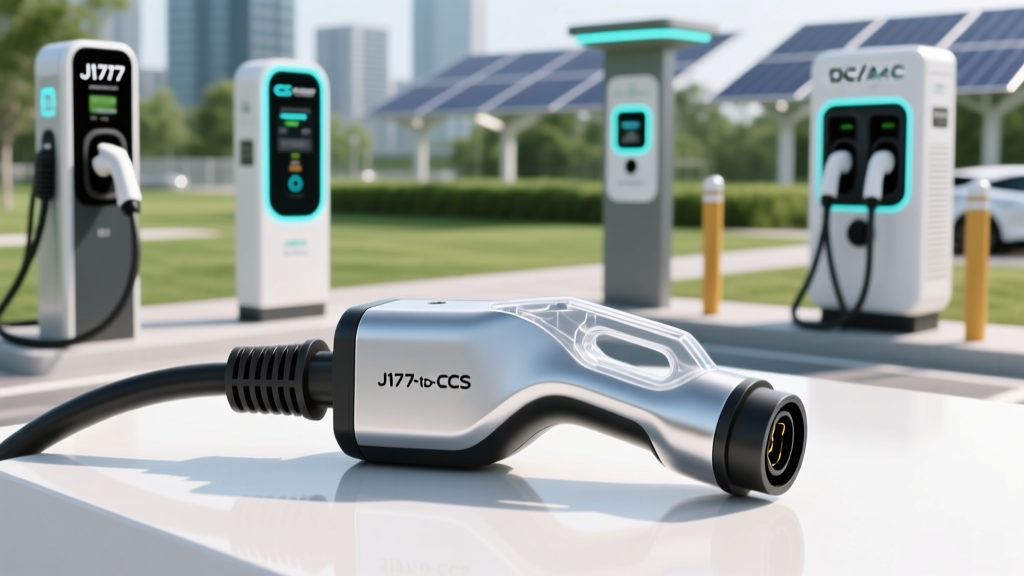
Here is the critical distinction: J1772 is the AC charging portion of the CCS1 connector. A CCS1 port is essentially a J1772 connector with two additional DC pins below it. This means every CCS1-equipped EV can already accept a J1772 plug for Level 2 AC charging without any adapter — the J1772 plug fits directly into the upper portion of your CCS1 inlet.
So when do you actually need a J1772 to CCS adapter? The most common scenario is the reverse: you have a J1772-only vehicle (older EVs or specific models) and need to use a CCS DC fast charger. However, this is electrically impossible for DC charging — a J1772 inlet lacks the DC pins required for fast charging. The adapter only works for AC Level 2 charging from a CCS cable to a J1772 port, which is a niche situation.
More practically, in 2026 the adapter most buyers need is a CCS1 to NACS adapter (or vice versa) as automakers transition to Tesla's North American Charging Standard. If your 2026 EV has a NACS port and you encounter a CCS-only DC fast charger, you need a CCS-to-NACS adapter. Ford, GM, and Rivian include these adapters with qualifying vehicles, and aftermarket options from brands like Lectron and A2Z are available for $150–$300.
Charging Levels Explained: How Fast Each Level Adds Range
EV charging is measured in kilowatts (kW), which represents the rate of power delivery. The energy stored in your battery is measured in kilowatt-hours (kWh). Think of kW as the speed of water flowing through a hose and kWh as the total volume of the tank you are filling.
| Level | Voltage | Power (kW) | Miles of Range Added Per Hour | Typical Use Case |
|---|---|---|---|---|
| Level 1 | 120V AC | 1.4 kW (12A) | 3–5 miles/hour | Emergency top-up, PHEV overnight charging |
| Level 2 (standard) | 240V AC | 7.2 kW (32A) | 20–28 miles/hour | Most home chargers, workplace charging |
| Level 2 (high-power) | 240V AC | 11.5 kW (48A) | 32–44 miles/hour | High-amperage home chargers (requires 60A circuit) |
| DC Fast (50 kW) | 200–500V DC | 50 kW | ~150–200 miles/hour | Older public DC stations |
| DC Fast (150 kW) | 200–500V DC | 150 kW | ~400–600 miles/hour | Electrify America, EVgo, common highway chargers |
| DC Fast (350 kW) | 200–920V DC | 350 kW (peak) | ~700–1,000+ miles/hour (peak) | Hyundai Ioniq 5, Porsche Taycan, Lucid Air on compatible stations |
Real-world charging time examples:
- 77 kWh battery (Ford Mustang Mach-E Extended Range): Level 2 at 11.5 kW charges 10–80% in roughly 7.5 hours. A 150 kW DC fast charger achieves 10–80% in approximately 35 minutes.
- 84 kWh battery (Hyundai Ioniq 5 Long Range): Level 2 at 11.5 kW takes about 8 hours for 10–80%. On a 350 kW DC fast charger, 10–80% takes roughly 18 minutes thanks to its 800V architecture — though sustained rates taper significantly above 60% State of Charge.
- 60 kWh battery (Chevrolet Equinox EV base): Level 2 at 7.2 kW charges 10–80% in about 6.5 hours. DC fast at 150 kW takes roughly 28 minutes.
A note on charge-curve taper: no EV sustains its peak DC charge rate for the entire session. A vehicle rated for 240 kW peak might only hold that rate between 10–40% SoC, then taper to 150 kW by 60%, and drop below 50 kW past 80%. This is why manufacturers quote 10–80% times rather than 0–100% — charging the final 20% can take as long as the first 70%.
Home EV Charger Installation: Requirements, Costs, and Panel Upgrades
Installing a dedicated Level 2 home charger is the single biggest quality-of-life upgrade for EV ownership. Here is exactly what is involved electrically and financially.
Electrical Requirements
Most Level 2 home chargers require a 240V dedicated circuit. The circuit amperage must be 125% of the charger's continuous draw, per the National Electrical Code (NEC Article 625):
- 32A charger (7.7 kW) → requires a 40A circuit (10 AWG wire minimum, 8 AWG recommended for long runs)
- 40A charger (9.6 kW) → requires a 50A circuit (6 AWG wire)
- 48A charger (11.5 kW) → requires a 60A circuit (4 AWG wire)
If your electrical panel has spare capacity — typically 2 or more open breaker slots and sufficient amperage headroom (most modern 200A panels can accommodate a 40–60A EV circuit) — the installation is straightforward. If your panel is maxed out at 100A or 150A, you may need a panel upgrade to 200A, which is the most expensive variable in the entire process.
Installation Cost Breakdown
| Component | Simple Install (panel nearby, no upgrade) | Complex Install (long wire run, sub-panel) | Panel Upgrade Scenario |
|---|---|---|---|
| Level 2 Charger (hardware) | $350 – $700 | $350 – $700 | $350 – $700 |
| Electrician labor | $300 – $800 | $800 – $2,000 | $500 – $1,000 |
| Electrical permit | $50 – $200 | $50 – $200 | $100 – $300 |
| Wire and conduit materials | $50 – $200 | $200 – $600 | $100 – $300 |
| Panel upgrade (if needed) | — | — | $1,500 – $4,000 |
| Total range | $750 – $1,900 | $1,400 – $3,500 | $2,550 – $6,300 |
Always hire a licensed electrician familiar with NEC Article 625 (EV charging systems). Many utilities offer rebates of $250–$1,000 for home charger installation — check with your local provider. The federal Alternative Fuel Vehicle Refueling Property Credit (IRC §30C) covers up to 30% of home charging equipment and installation costs (capped at $1,000), but eligibility depends on census-tract requirements and is subject to change. Consult a tax professional for your specific situation.
Safety and Code Considerations
- Dedicated circuit: Your EV charger must be on its own breaker — never share a circuit with other appliances.
- GFCI protection: NEC 2020 and later require GFCI protection for outdoor receptacles used for EV charging. Hardwired chargers have GFCI built into the unit.
- Outdoor rating: If your charger is installed outdoors, ensure it carries a NEMA 4 or NEMA 4X rating for weather resistance. Most quality chargers (ChargePoint, Emporia, Wallbox) meet this standard.
- NEMA 14-50 vs. hardwired: A NEMA 14-50 outlet gives you portability to take the charger when you move, but hardwired installations support higher amperage (48A+) and eliminate the outlet as a potential failure point.
Which Connector and Charger Is Compatible with Your EV?
The 2026 connector landscape is in active transition. Here is how to determine what you need.
| Your EV's Charge Port | Home Level 2 Charging | Public DC Fast Charging | Adapter Needed? |
|---|---|---|---|
| CCS1 (most non-Tesla, pre-2025) | J1772 plug fits directly | CCS1 plug at station | CCS-to-NACS adapter if using Tesla Superchargers |
| NACS (Tesla; Ford/GM/Rivian 2025+) | NACS plug or J1772 with NACS adapter | NACS at Tesla Superchargers | J1772-to-NACS adapter for non-Tesla Level 2 stations; CCS-to-NACS for CCS stations |
| CHAdeMO (Nissan Leaf) | J1772 plug fits directly | CHAdeMO plug (declining availability) | No adapter available for CHAdeMO-to-CCS DC charging |
The key takeaway for J1772 to CCS adapter seekers: if your EV has a CCS1 port, every J1772 Level 2 plug at public stations and in home chargers will plug directly into your car. You do not need an adapter for AC charging. The adapter question only arises for DC fast charging across incompatible standards (CCS vs. NACS), and those adapters are specifically labeled CCS-to-NACS or NACS-to-CCS — not J1772-to-CCS.
Cost to Charge: Home vs. Public vs. Gas
Charging cost depends on your electricity rate, the charger type, and whether you can charge during off-peak hours. Below are realistic 2026 scenarios based on national averages.
| Scenario | Rate ($/kWh) | Vehicle Efficiency (kWh/mi) | Cost Per Mile | Equivalent Gas Price (at 28 MPG) |
|---|---|---|---|---|
| Home, off-peak (time-of-use) | $0.08 | 0.30 | $0.024 | $0.67/gallon |
| Home, standard rate | $0.16 | 0.30 | $0.048 | $1.34/gallon |
| Public Level 2 (ChargePoint, EVgo) | $0.25 – $0.49 | 0.30 | $0.075 – $0.147 | $2.10 – $4.12/gallon |
| DC Fast (Electrify America, EVgo) | $0.35 – $0.55 | 0.30 | $0.105 – $0.165 | $2.94 – $4.62/gallon |
| Tesla Supercharger (2026 avg) | $0.30 – $0.45 | 0.28 (Model Y) | $0.084 – $0.126 | $2.35 – $3.53/gallon |
| Gas vehicle (28 MPG combined) | — | — | $0.114 (at $3.20/gal) | Baseline |
The numbers are clear: home charging during off-peak hours delivers fuel cost equivalent to $0.67/gallon gasoline. Even public DC fast charging at premium rates is often cheaper per mile than gasoline at 2026 pump prices. The break-even point where DC fast charging exceeds gas cost per mile occurs only at rates above roughly $0.55/kWh with a less-efficient EV.
For a vehicle driven 12,000 miles per year, charging exclusively at home at $0.16/kWh costs approximately $576 annually. A comparable 28 MPG gas vehicle at $3.20/gallon costs $1,371. That is a savings of roughly $795 per year — before factoring in reduced EV maintenance (no oil changes, fewer brake replacements due to regenerative braking).
Equipment Recommendations: Best Home Chargers for 2026
These chargers are selected based on reliability, smart features, power output, and value. All support J1772 connectors natively, and NACS-ported EVs can use the included or separately purchased adapter.
Emporia Vue EV Charger
- Power: 48A (11.5 kW) on a 60A circuit
- Connector: J1772 (NACS version available)
- Cable length: 24 feet
- Smart features: Wi-Fi, app scheduling, energy monitoring, solar integration
- Price: ~$399
- Best for: Budget-conscious buyers wanting maximum power and smart features
ChargePoint Home Flex
- Power: Configurable up to 50A (12 kW) on a 60A circuit; can be set lower for smaller panels
- Connector: J1772 (NACS version available)
- Cable length: 23 feet
- Smart features: Wi-Fi, Alexa integration, flexible amperage setting, charge scheduling
- Price: ~$599
- Best for: Homes with varying panel capacity; the adjustable amperage avoids a panel upgrade
Wallbox Pulsar Plus
- Power: 40A (9.6 kW) on a 50A circuit
- Connector: J1772
- Cable length: 25 feet
- Smart features: Wi-Fi + Bluetooth, load balancing (ideal for homes with limited panel capacity), compact design
- Price: ~$549
- Best for: Tight garage spaces and shared-circuit homes needing load management
Tesla Wall Connector (Universal)
- Power: 48A (11.5 kW) on a 60A circuit
- Connector: NACS native; includes J1772 adapter in the box
- Cable length: 24 feet
- Smart features: Wi-Fi, OTA updates, power sharing between two units on one circuit
- Price: ~$450
- Best for: NACS-ported EVs; the included J1772 adapter handles guest vehicles and resale flexibility
Frequently Asked Questions
Do I need a J1772 to CCS adapter to charge my CCS-equipped EV at home?
No. Every CCS1 port accepts a J1772 plug directly for AC Level 2 charging. The CCS1 connector is simply a J1772 connector with two additional DC fast-charging pins below it. Any J1772 home charger will plug into your CCS1 vehicle without an adapter.
How much does it cost to install a home EV charger?
A straightforward installation with an existing 200A panel and a short wire run typically costs $750–$1,900 total (charger + electrician + permit). If you need a panel upgrade from 100A to 200A, expect $2,550–$6,300 total. Get at least two quotes from licensed electricians, and ask specifically about NEC Article 625 compliance.
Can I use a J1772 charger on a Tesla or NACS-ported vehicle?
Yes, with a J1772-to-NACS adapter. Tesla has sold this adapter for years (~$95), and many 2025+ NACS-adopting automakers include one with the vehicle. The adapter handles AC Level 1 and Level 2 charging only — it does not enable DC fast charging from a CCS cable.
How much does charging cost per mile compared to gas?
Home charging at the national average rate of $0.16/kWh costs roughly $0.048/mile for an EV averaging 3.3 miles/kWh (0.30 kWh/mile). A 28 MPG gas vehicle at $3.20/gallon costs $0.114/mile. Home charging is approximately 58% cheaper per mile. Off-peak rates can push EV fueling cost below $0.03/mile.
What electrical upgrades might I need for a Level 2 charger?
If your panel is already 200A with open breaker slots, you likely need only a new dedicated 40–60A circuit. If your panel is 100A or nearly full, you may need a panel upgrade ($1,500–$4,000) or a smart load-management device that shares capacity between your charger and other large appliances. An electrician can perform a load calculation to determine your exact needs.
Is a NEMA 14-50 outlet or hardwired installation better?
A NEMA 14-50 outlet offers portability and is required if you plan to take the charger when you move. However, it is limited to 40A continuous draw (48A charger maximum). Hardwired installations support 48A+ chargers and eliminate the outlet connection as a potential heat or failure point. For a permanent garage installation, hardwired is preferred.