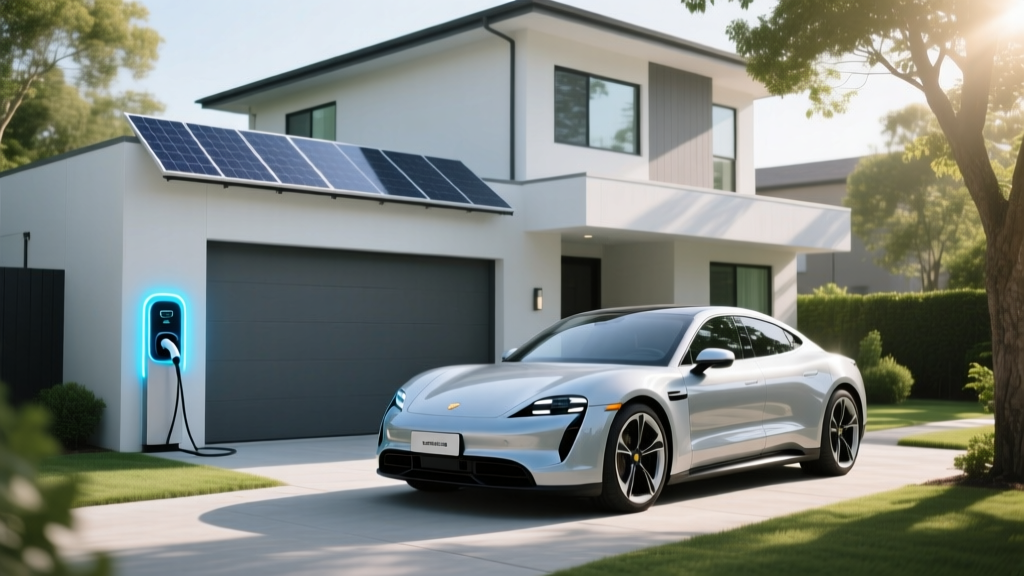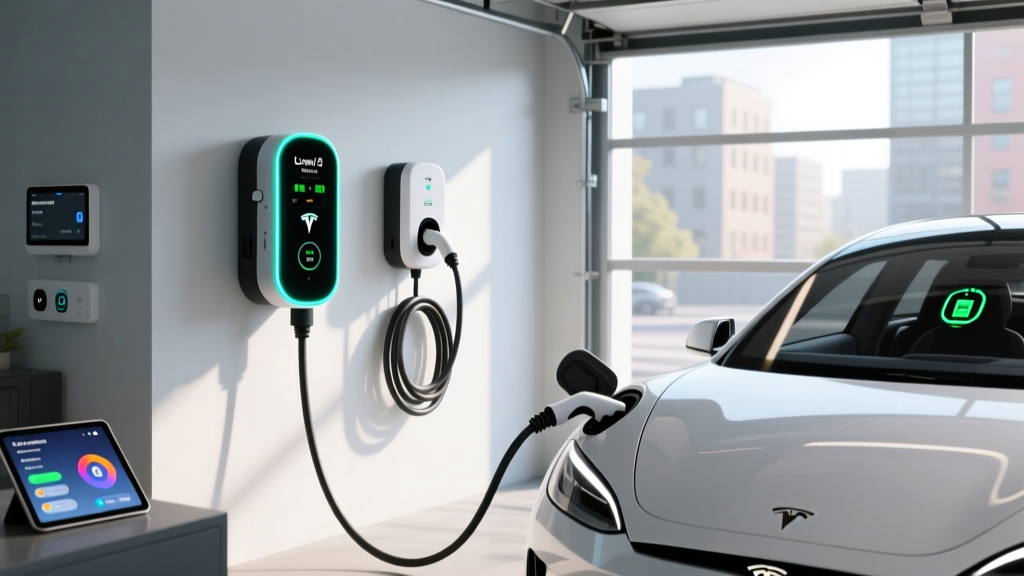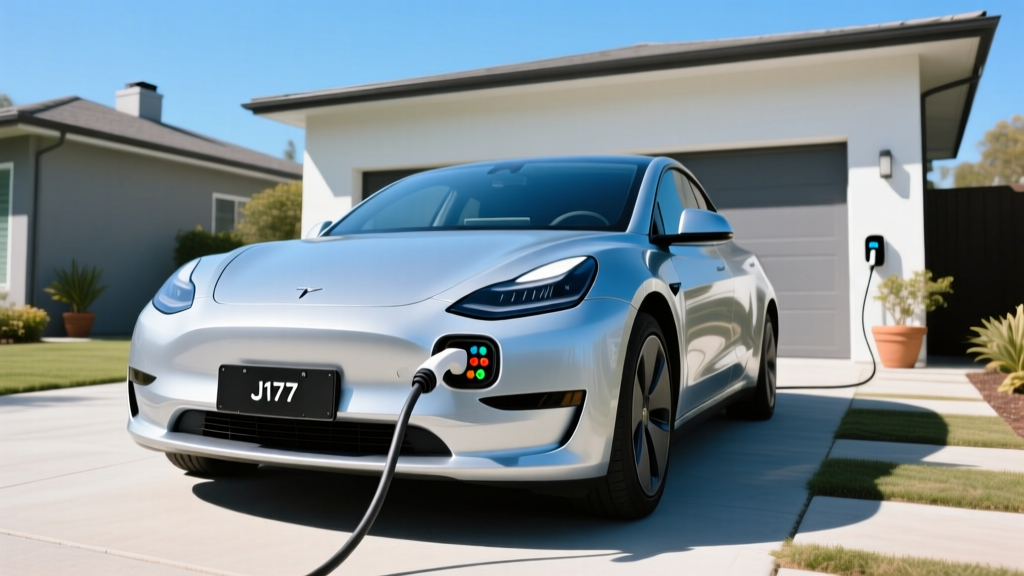
If you own or are shopping for an electric vehicle in North America, you will encounter the J1772 connector — formally known as the SAE J1772 standard — whether you realize it or not. It is the universal plug for all Level 1 and Level 2 AC charging on every non-Tesla EV sold in the United States, and even Tesla vehicles can use it with an adapter. Despite the rapid adoption of the NACS (North American Charging Standard) for DC fast charging, the J1772 connector remains the backbone of home and destination charging in 2026.
This guide breaks down exactly what the J1772 connector does, how fast it charges, what it costs to install a home station, which EVs use it, and how it fits into the shifting landscape of NACS, CCS1, and CHAdeMO connectors. We will also cover the electrical requirements, real installation costs, and specific equipment recommendations so you can budget accurately.
What Is the J1772 Connector and Why Does It Matter?
The SAE J1772 connector is a five-pin AC charging plug standardized by the Society of Automotive Engineers. It delivers single-phase alternating current (AC) to your vehicle's onboard charger, which then converts that AC into direct current (DC) to store in the battery. Every EV sold in the U.S. — whether it is a Chevrolet Equinox EV, Hyundai Ioniq 5, Ford F-150 Lightning, or BMW iX — has a J1772 inlet for AC charging, or ships with an adapter to accept one.
The connector handles two primary charging tiers:
- Level 1: 120V AC, typically 12 amps (1.4 kW) — the cordset that ships with most EVs for standard household outlets.
- Level 2: 240V AC, ranging from 16 amps (3.8 kW) up to 80 amps (19.2 kW) — the home wall connector or public AC station that most EV owners rely on for daily charging.
A critical distinction: the J1772 connector delivers AC power. It is not used for DC fast charging. For rapid public charging, vehicles use separate DC connectors — CCS1, CHAdeMO, or NACS — which bypass the onboard charger and send DC directly to the battery. Understanding the difference between kW (power, the rate of energy delivery) and kWh (energy, the total capacity stored in your battery) is essential here. A 48-amp Level 2 station delivers up to 11.5 kW of power; charging a 77 kWh battery from 10% to 80% at that rate takes roughly 5 hours.
Charging Levels and Speeds: How Much Range Does J1772 Add?
The speed at which a J1772 connector adds range depends on the voltage, amperage, and your vehicle's onboard charger capacity. Most 2026 EVs have onboard chargers rated between 7.2 kW and 11.5 kW, meaning even if your wall station can output 19.2 kW, the car will only accept what its onboard charger allows.
| Level | Voltage | Max Amperage | Max Power (kW) | Approx. Miles Added/Hour | Typical Use Case |
|---|---|---|---|---|---|
| Level 1 | 120V AC | 12A | 1.4 kW | 3–5 mi/hr | Emergency, overnight trickle, PHEV top-up |
| Level 2 (basic) | 240V AC | 16A–32A | 3.8–7.7 kW | 14–30 mi/hr | Budget home install, apartment chargers |
| Level 2 (standard) | 240V AC | 40A–48A | 9.6–11.5 kW | 32–44 mi/hr | Most home wall connectors, workplace |
| Level 2 (high-power) | 240V AC | 64A–80A | 15.3–19.2 kW | 50–70 mi/hr | High-capacity onboard chargers (e.g., F-150 Lightning extended range at 19.2 kW) |
| DC Fast Charging | 400–800V DC | N/A | 50–350 kW | 150–1,200+ mi/hr | Public highway charging (CCS1/NACS/CHAdeMO — not J1772) |
Real-world charging time examples (10% to 80% State of Charge):
- Hyundai Ioniq 5 (77.4 kWh battery, 10.9 kW onboard charger): ~4.5 hours on a 48-amp / 11.5 kW J1772 Level 2 station.
- Chevrolet Equinox EV (85 kWh battery, 11.5 kW onboard charger): ~5 hours on a 48-amp station.
- Toyota RAV4 Prime PHEV (18.1 kWh battery, 6.6 kW onboard charger): ~1.7 hours on a 32-amp station; ~2.5 hours on a 120V Level 1 outlet.
- Ford F-150 Lightning Extended Range (131 kWh battery, 19.2 kW onboard charger option): ~5 hours on an 80-amp / 19.2 kW station; ~9.5 hours on a 48-amp station.
Home Charger Installation: Electrical Requirements and Costs
Installing a Level 2 J1772 home charging station is the single biggest improvement most EV owners can make for daily convenience. But the total cost varies enormously depending on your home's electrical panel, the distance from the panel to the charging location, and local permit requirements.
Electrical Requirements for a Level 2 J1772 Station
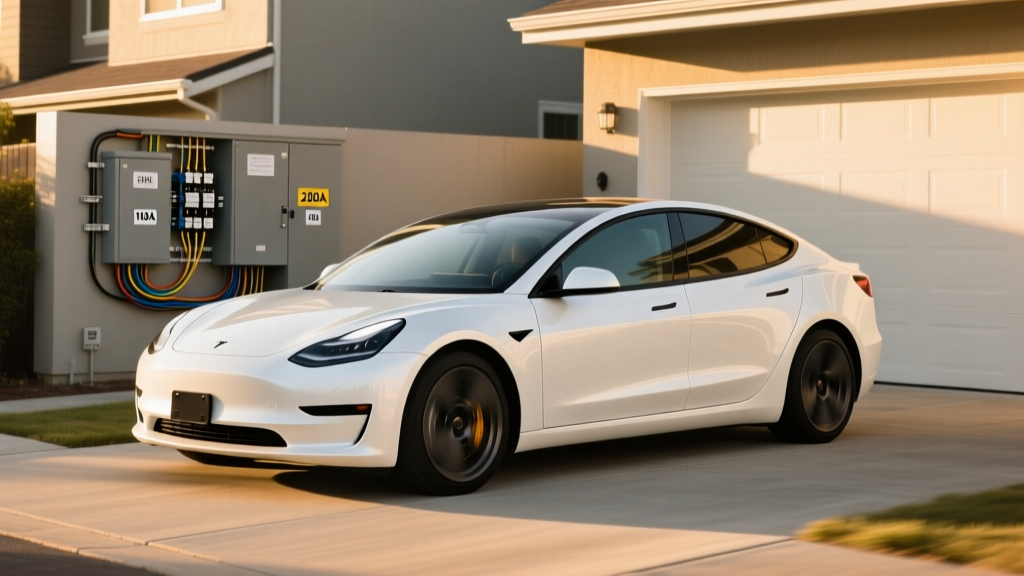
A standard 48-amp Level 2 charger requires a dedicated 60-amp, 240-volt circuit. The National Electrical Code (NEC) requires that continuous loads — which EV charging qualifies as — not exceed 80% of a circuit breaker's rated capacity. That is why a 48-amp charger needs a 60-amp breaker (48 ÷ 0.8 = 60).
Key specifications your licensed electrician will evaluate:
- Panel capacity: Most modern homes have 200-amp main panels. If your panel is already near capacity (common in older homes with electric heating, dryers, and ranges), you may need a panel upgrade to 300–400 amps, or a load-management device that shares capacity between the EV charger and other appliances.
- Wire gauge: Typically 6 AWG copper for a 60-amp circuit; 4 AWG for longer runs to reduce voltage drop.
- Dedicated circuit: The charger must have its own breaker — no sharing with other outlets or appliances.
- GFCI protection: NEC 2020 and later require GFCI protection for EV charging outlets (if using a plug-in station rather than hardwired). Hardwired installations typically integrate ground-fault protection internally.
- Permit: Most municipalities require an electrical permit for a new 240V circuit, with inspection after installation.
Installation Cost Breakdown
| Component | Simple Install (panel nearby, no upgrade) | Complex Install (long wire run, panel upgrade) |
|---|---|---|
| Level 2 charger equipment (48-amp, J1772) | $400–$700 | $400–$700 |
| Electrician labor (2–4 hours simple; 6–10+ hours complex) | $300–$800 | $1,200–$3,000 |
| Materials (wire, conduit, breaker) | $100–$300 | $300–$800 |
| Electrical permit and inspection | $50–$200 | $50–$200 |
| Panel upgrade (if needed: 200A → 400A) | N/A | $2,000–$5,000 |
| Total estimated cost | $850–$2,000 | $3,950–$9,700 |
The federal Residential Clean Energy Credit (IRC §25C) was modified under recent legislation, and the Alternative Fuel Vehicle Refueling Property Credit (§30C) may offer up to $1,000 for home charging equipment installed in eligible census tracts. Check irs.gov and consult a tax professional to confirm your eligibility, as income limits and location-based requirements apply.
Connector Compatibility: J1772, NACS, CCS1, and CHAdeMO
The connector landscape has shifted dramatically since Tesla opened its Supercharger network and the NACS connector was adopted as an industry standard for DC fast charging. Here is how the J1772 connector fits in:
| Connector | Type | Used For | Vehicles | Adapter Needed? |
|---|---|---|---|---|
| J1772 | AC | Level 1 & Level 2 home/public charging | All non-Tesla EVs; Tesla with J1772 adapter (included) | Tesla owners need J1772-to-NACS adapter for non-Tesla AC stations |
| NACS (Tesla) | AC + DC | Level 2 AC + DC fast charging | All Tesla vehicles; Ford, GM, Rivian, Hyundai, and others starting 2025–2026 model years | Legacy CCS1 vehicles need NACS adapter for Tesla Superchargers |
| CCS1 (Combo) | DC | DC fast charging | Most pre-2025 non-Tesla EVs; 2026 models transitioning to NACS | Newer NACS vehicles need CCS1 adapter for Electrify America and other CCS1 networks |
| CHAdeMO | DC | DC fast charging | Nissan Leaf (discontinued after 2025); legacy models only | No adapter available to other standards; network declining |
The bottom line for 2026: The J1772 connector remains universal for Level 2 AC charging. Even vehicles that have adopted the NACS port for DC fast charging still accept J1772 for AC Level 2 charging (NACS integrates AC pins within the same connector). If you are installing a home Level 2 charger, a J1772 station will work with virtually every EV on the road, including Teslas (with the included adapter). For future-proofing, some manufacturers now offer dual-connector stations with both J1772 and NACS plugs.
Cost to Charge: J1772 Home Charging vs. Gas vs. Public DC
One of the strongest arguments for home Level 2 charging via J1772 is cost. Electricity prices vary by region, but charging at home is almost always cheaper per mile than gasoline — and significantly cheaper than public DC fast charging.
| Scenario | Energy Cost | Vehicle Efficiency | Cost Per Mile |
|---|---|---|---|
| Home Level 2 (J1772) — national avg. electricity | $0.16/kWh | 3.0 mi/kWh (100 MPGe) | $0.053 |
| Home Level 2 — off-peak / time-of-use rate | $0.09/kWh | 3.0 mi/kWh | $0.030 |
| Home Level 2 — high-cost state (CA, HI avg.) | $0.30/kWh | 3.0 mi/kWh | $0.100 |
| Public Level 2 (J1772) — ChargePoint, etc. | $0.25–$0.49/kWh | 3.0 mi/kWh | $0.083–$0.163 |
| DC fast charging — Electrify America / EVgo | $0.35–$0.55/kWh | 2.8 mi/kWh (highway) | $0.125–$0.196 |
| Gasoline vehicle (28 MPG combined) | $3.40/gallon | 28 MPG | $0.121 |
| Gasoline vehicle (truck, 19 MPG combined) | $3.40/gallon | 19 MPG | $0.179 |
At the national average electricity rate of roughly $0.16/kWh (per EIA data), a typical EV achieving 3 miles per kWh costs about 5.3 cents per mile to charge at home. That compares to 12 cents per mile for a 28-MPG gas car at $3.40/gallon. Over 15,000 miles per year, that is roughly $1,000 in annual fuel savings.
Off-peak time-of-use (TOU) rates offered by many utilities can drop home charging costs to $0.08–$0.10/kWh, making the per-mile cost as low as 3 cents. This is where a smart J1772 charger with scheduled charging becomes valuable — it can delay charging to off-peak hours automatically.
Best J1772 Home Chargers for 2026: Equipment Picks
We evaluate home chargers on power output, cable length, smart features (Wi-Fi, scheduling, load management), build quality, and price. All of the following use the J1772 connector natively and are compatible with every non-Tesla EV (and Tesla vehicles with the included J1772 adapter).
ChargePoint Home Flex
- Power: Up to 12 kW (50A) on a 60A circuit; configurable down to 16A for lower-capacity panels
- Connector: J1772
- Cable length: 23 feet
- Smart features: Wi-Fi, app scheduling, Alexa integration, energy tracking, load sharing with second unit
- Price: ~$550–$650
- Best for: Most homeowners wanting a reliable, flexible smart charger
Emporia Level 2 EV Charger
- Power: Up to 11.5 kW (48A) on a 60A circuit
- Connector: J1772
- Cable length: 24 feet
- Smart features: Wi-Fi, app with detailed energy monitoring, solar integration, TOU scheduling
- Price: ~$350–$400
- Best for: Budget-conscious buyers with solar panels or whole-home energy monitoring
Grizzl-E Smart
- Power: Up to 11.5 kW (48A); dip-switch configurable to 16/24/32/40A
- Connector: J1772
- Cable length: 24 feet
- Smart features: Wi-Fi, OCPP support, adjustable amperage, rugged aluminum case
- Price: ~$450–$550
- Best for: Cold climates and outdoor installs (rated to -40°F); built in Canada
Wallbox Pulsar Plus
- Power: Up to 11.5 kW (48A) on a 60A circuit
- Connector: J1772
- Cable length: 25 feet
- Smart features: Wi-Fi + Bluetooth, app scheduling, Power Sharing (load management with second unit), compact size
- Price: ~$500–$600
- Best for: Tight spaces and multi-charger households needing load balancing
Hardwired vs. plug-in: Chargers rated above 40 amps (like a 48A unit) are often hardwired directly to the circuit rather than using a NEMA 14-50 outlet. Hardwiring eliminates the GFCI breaker requirement (the charger handles ground-fault protection internally) and avoids the known issue of some NEMA 14-50 receptacles overheating under continuous EV-charging loads. We recommend hardwiring for any install above 40 amps.
Safety, Code, and Outdoor Installation Considerations
EV charging is a continuous, high-amperage load that runs for hours — fundamentally different from the short bursts your dryer or oven draws. Proper installation is not optional; it protects your home from fire risk and ensures your insurance coverage remains valid.
Key safety requirements and best practices:
- Dedicated circuit: Never share the EV charger's circuit with other appliances. A 60-amp dedicated circuit is standard for a 48-amp charger.
- NEMA 14-50 outlet quality: If using a plug-in charger, specify a commercial-grade or industrial-grade 14-50 receptacle (Hubbell, Bryant, or Cooper). Residential-grade outlets from big-box stores have been linked to overheating under continuous EV loads.
- Outdoor rating: All recommended chargers above carry NEMA 4 or NEMA 4X ratings, meaning they are sealed against rain, snow, and dust. The J1772 connector itself is rated for outdoor use and includes a drain channel in the plug design.
- Cable management: A 23–25 foot cable is heavy when wet or icy. Install a cable holster or retractable mount to keep the connector off the ground and protected.
- Surge protection: Consider a whole-home surge protector or a charger with integrated surge protection, especially in areas with frequent lightning or grid instability.
- Permit and inspection: Skipping the permit to save $100–$200 risks code violations, failed home inspections during a future sale, and potential insurance claim denials. Always pull the permit.
Frequently Asked Questions
How much does it cost to install a home EV charger with a J1772 connector?
A straightforward installation with a nearby 200-amp panel typically costs $850–$2,000 total (equipment + electrician + permit). If your panel needs upgrading or the wire run is long, expect $3,950–$9,700. The charger itself costs $350–$700; the rest is labor, materials, and permits.
How fast will each charging level add range through J1772?
Level 1 (120V) adds 3–5 miles per hour — adequate for PHEVs with small batteries but too slow for most BEVs. Level 2 at 48 amps (11.5 kW) adds roughly 32–44 miles per hour, easily replenishing a daily commute overnight. Level 2 at 80 amps (19.2 kW) can add 50–70 miles per hour for vehicles with high-capacity onboard chargers like the F-150 Lightning.
Which connector is compatible with my EV?
Every non-Tesla EV sold in North America uses the J1772 connector for Level 1 and Level 2 AC charging. Tesla vehicles include a J1772-to-NACS adapter in the glovebox. For DC fast charging, check whether your vehicle uses CCS1 (most pre-2025 non-Tesla EVs), NACS (Tesla and 2025+ Ford, GM, Rivian, and others), or the now-declining CHAdeMO (Nissan Leaf).
How much does charging cost per mile compared to gas?
At the U.S. average electricity rate of $0.16/kWh and a vehicle efficiency of 3 mi/kWh, home charging costs about 5.3 cents per mile. A comparable gas vehicle at 28 MPG and $3.40/gallon costs 12.1 cents per mile — more than double. Off-peak utility rates can push EV charging below 3 cents per mile.
What electrical upgrades might I need for a Level 2 J1772 charger?
Most homes with a 200-amp panel can accommodate a 60-amp dedicated circuit for a 48-amp charger without upgrades. Older homes with 100-amp or 150-amp panels, or homes with multiple high-draw electric appliances (heat pump, electric range, dryer), may need a panel upgrade to 300–400 amps, costing $2,000–$5,000. A load-management device like the Emporia VUE or a charger with built-in load sharing can sometimes avoid a panel upgrade entirely.
Can I use a J1772 charger with a Tesla vehicle?
Yes. Every Tesla ships with a J1772-to-NACS adapter (or a J1772-to-Tesla adapter for pre-2025 models). Plug the J1772 connector into the adapter, and the adapter into your Tesla's charge port. Charging speeds will be limited by the Tesla's onboard charger capacity — typically 11.5 kW (48A) for Model 3/Y and up to 17.2 kW for Model S/X on 240V.
Is the J1772 connector being phased out in favor of NACS?
Not for AC charging. NACS replaces CCS1 and CHAdeMO for DC fast charging, and it integrates AC pins within the same connector. However, the J1772 connector remains the standard plug on virtually all Level 2 public and home charging stations. Most new home chargers still ship with J1772, and dual J1772/NACS stations are emerging. The installed base of J1772 infrastructure — millions of home and public ports — ensures it will remain relevant for decades.