The Short Answer: Yes, but the Gap Depends on How You Charge
Every prospective EV buyer asks the same question: is Tesla charging cheaper than gas? The answer in 2026 is a qualified yes — but the margin ranges from massive savings to near-parity depending on whether you charge at home on off-peak electricity or rely exclusively on DC fast-charging networks. A Tesla Model Y Long Range charged at home on a national-average residential rate costs roughly $0.04 per mile, while fueling a comparable gas-powered compact SUV at $3.40/gallon and 28 MPG combined runs about $0.12 per mile. That's a 67% savings per mile driven.
However, if you rely solely on Tesla Superchargers at $0.35–$0.50/kWh, the gap narrows to roughly $0.10–$0.14 per mile — competitive with, and sometimes slightly above, a fuel-efficient gas car. The real savings unlock when you can charge at home. Below, we break down the exact numbers, the equipment you need, and the installation costs that determine whether those savings actually materialize in your budget.
Charging Levels Explained: Speeds, Power, and Miles Added Per Hour
Before calculating costs, you need to understand the three charging tiers available to Tesla owners and how they differ in power delivery. Remember: kW (kilowatts) measures power — how fast energy flows into your battery. kWh (kilowatt-hours) measures energy — the total capacity of your battery. Think of kW as the flow rate of a hose and kWh as the size of the bucket.
| Charging Level | Voltage / Amperage | Power (kW) | Miles of Range Added Per Hour | 10–80% Charge Time |
|---|---|---|---|---|
| Level 1 (120V household outlet) | 120V / 12A | ~1.4 kW | ~3–5 mi/hr | ~40+ hours |
| Level 2 (240V home or public) | 240V / 40–48A | 9.6–11.5 kW | ~30–44 mi/hr | ~5.5–7 hours |
| DC Fast Charge (Supercharger V3/V4) | 400V+ architecture | 150–250 kW peak | ~500–1,000 mi/hr (peak) | ~18–28 minutes |
A few real-world caveats: DC fast-charging speeds follow a charge curve — your Tesla will peak at 250 kW only at a low state of charge (around 10–20%) and progressively taper as the battery fills. Above 80% SoC, speeds drop sharply to protect battery health. That's why we measure fast-charging time from 10–80%, not 0–100%. Level 2 home charging delivers consistent power throughout the session since the onboard charger manages the rate.
Cost Per Mile: Tesla Charging vs. Gas — The Full Math
To answer "is Tesla charging cheaper than gas" with actual numbers, we need to compare energy cost per mile across realistic scenarios. Here's how a 2026 Tesla Model Y Long Range (EPA-estimated 320 miles, ~75 kWh usable battery, ~130 MPGe combined) stacks up against a 2026 Toyota RAV4 AWD (EPA 30 MPG combined) using national averages.
| Charging / Fueling Scenario | Rate | Cost Per Mile (Tesla Model Y) | Cost Per Mile (RAV4 Gas, 30 MPG) |
|---|---|---|---|
| Home charging (national avg.) | $0.16/kWh | $0.040 | — |
| Home off-peak (TOU rate) | $0.08–$0.10/kWh | $0.020–$0.025 | — |
| Public Level 2 (e.g., ChargePoint) | $0.25–$0.35/kWh | $0.063–$0.088 | — |
| Tesla Supercharger (avg.) | $0.35–$0.50/kWh | $0.088–$0.125 | — |
| Gasoline (national avg.) | $3.40/gallon | — | $0.113 |
| Gasoline (California avg.) | $4.60/gallon | — | $0.153 |
Key takeaways:
- Home charging is where the savings live. At $0.16/kWh national average (per U.S. EIA data), a full charge of the Model Y's 75 kWh battery costs about $12 and delivers ~320 EPA miles. Over 15,000 annual miles, that's roughly $600/year in electricity vs. $1,700/year in gasoline.
- Off-peak TOU (Time-of-Use) rates can halve your home charging cost. Many utilities offer $0.06–$0.10/kWh overnight. Schedule your Tesla to charge between midnight and 5 AM for the lowest rates.
- Exclusive Supercharger use brings cost-per-mile close to gas parity — and in high-cost states like California, it can actually exceed the cost of fueling an efficient hybrid. If you can't charge at home, a PHEV may be a smarter financial choice.
- Solar-charged miles drop the cost even further. If you have rooftop solar at an effective $0.06–$0.08/kWh (amortized), your cost per mile falls to $0.015–$0.020.
Home Charger Installation: Costs, Electrical Requirements, and Panel Upgrades
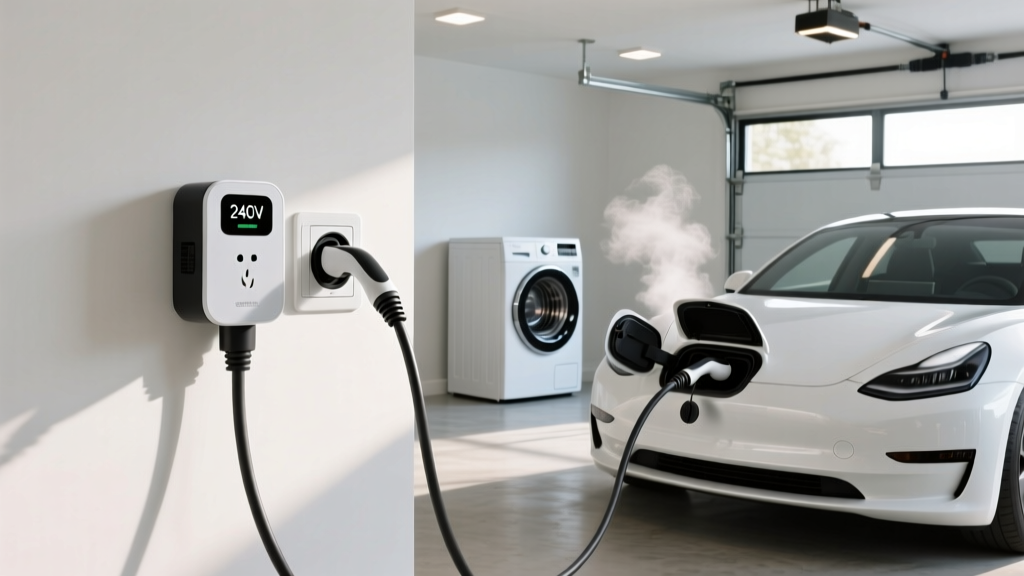
The savings above assume you can install a Level 2 home charger — which requires a 240V dedicated circuit, similar to what an electric dryer or oven uses. Installation costs vary dramatically based on your home's electrical panel capacity, the distance from the panel to your garage or driveway, and local permitting requirements.
How much does it cost to install a home EV charger?
For a typical single-family home with adequate panel capacity, expect to spend between $800 and $2,500 for a complete Level 2 installation. If your panel needs upgrading, costs can reach $4,000–$6,000+.
| Component | Typical Range | Notes |
|---|---|---|
| Level 2 Charger Equipment | $350–$700 | Tesla Wall Connector, ChargePoint, Emporia, Grizzl-E |
| Electrician Labor (240V/50A circuit) | $400–$1,500 | Depends on run length, conduit, wall penetration |
| Electrical Permit | $50–$250 | Varies by municipality; required in most jurisdictions |
| Panel Upgrade (if needed) | $1,500–$4,000 | Needed if panel is 100A or has no spare breaker slots |
| Total (no panel upgrade) | $800–$2,450 | Most homes with 200A panels fall here |
| Total (with panel upgrade) | $2,300–$6,450 | Older homes with 100A service |
What electrical upgrades might I need?
Your home's electrical panel is the bottleneck. Here's what to check:
- Panel amperage: Modern homes typically have 200A service, which easily supports a 40–48A EV charger alongside normal household loads. Older homes with 100A panels often need an upgrade to safely add a high-amperage charger circuit.
- Available breaker slots: A Level 2 charger requires a dedicated double-pole breaker (240V). If your panel has no open slots, you may need a sub-panel or tandem breakers for other circuits.
- Load calculation: A licensed electrician will perform a NEC Article 220 load calculation to ensure your panel can handle the added draw. This is required for permit approval in most jurisdictions.
- Conduit and wire run: If your parking spot is far from the panel (e.g., a detached garage or long driveway), the wire run increases labor cost. Runs over 50 feet may require larger-gauge wire to prevent voltage drop.
Pro tip: The federal Alternative Fuel Vehicle Refueling Property Credit (IRC §30C) offers a 30% tax credit on home charger equipment and installation costs, up to $1,000, subject to income and census-tract eligibility. Consult a tax professional to confirm your eligibility.
Connector Compatibility: NACS, CCS, and the 2026 Charging Landscape
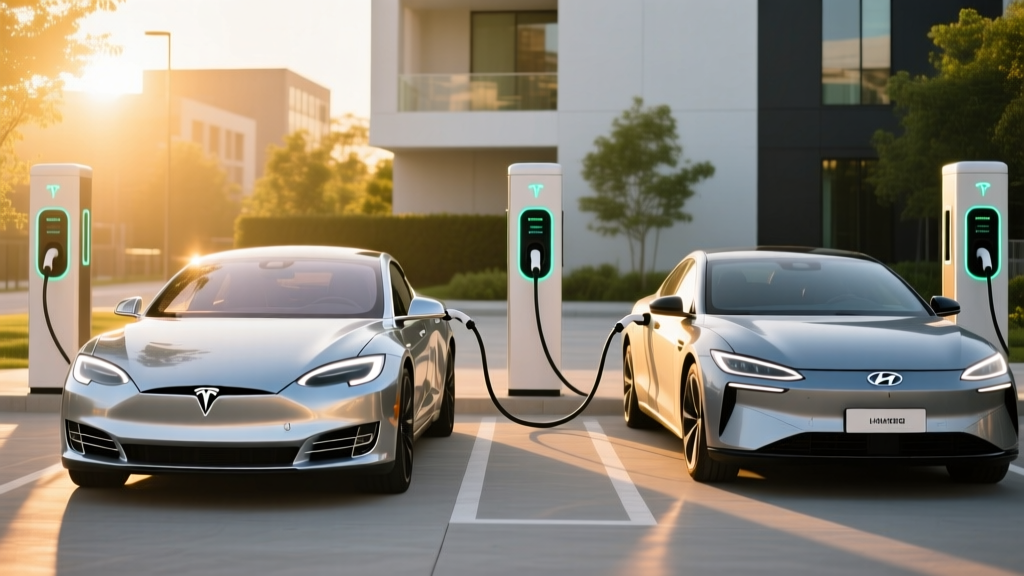
The connector landscape has shifted dramatically since 2024, when Ford, GM, Rivian, and most other automakers committed to adopting the North American Charging Standard (NACS) — Tesla's proprietary connector, now open-sourced and standardized as SAE J3400. By 2026, virtually all new EVs sold in North America ship with a native NACS charge port.
| Connector Type | Native On (2026 Models) | Adapter Needed? | Notes |
|---|---|---|---|
| NACS (SAE J3400) | Tesla (all), Ford, GM, Rivian, Hyundai/Kia (2025+), Volvo, Polestar, BMW, Mercedes | No — native for most 2025+ EVs | Access to Tesla Supercharger network directly |
| CCS1 | Legacy 2023–2024 models (pre-NACS transition), some VW ID.4 | NACS-to-CCS adapter for Supercharger access (~$200–$250) | Electrify America, EVgo stations still offer CCS1 |
| CHAdeMO | Discontinued (Nissan Leaf ended production) | Limited adapter options | Network shrinking; not recommended for new buyers |
If you own a 2022–2024 Tesla, your vehicle has a native NACS port and full Supercharger access. If you own a non-Tesla EV from the 2023–2024 model years with CCS1, you'll need a NACS-to-CCS adapter (available from Tesla, Ford, or third parties like Lectron for ~$200–$250) to use Superchargers. By 2026, most public charging networks (Electrify America, EVgo, ChargePoint) have added NACS connectors alongside legacy CCS1.
Recommended Home Chargers for Tesla and NACS-Equipped EVs
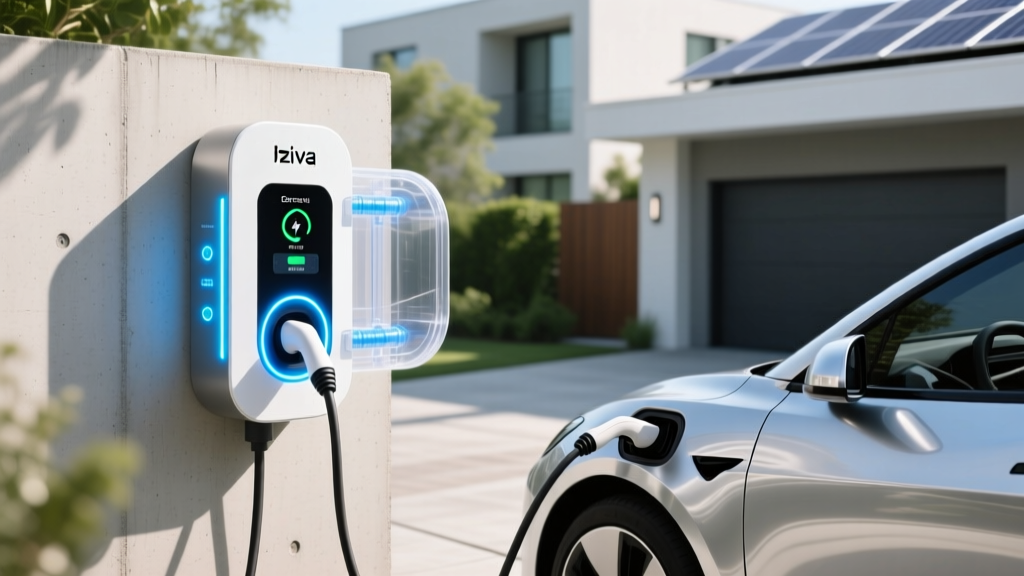
Not all Level 2 chargers are created equal. Here are the top picks for 2026, selected for power output, build quality, smart features, and value:
Tesla Wall Connector (Gen 4)
- Power Output: 11.5 kW (48A) on a 60A circuit
- Connector: Native NACS
- Cable Length: 24 ft
- Smart Features: Wi-Fi, OTA updates, Tesla app integration, load sharing with multiple units, Powerwall integration
- Price: ~$475
- Best For: Tesla owners who want seamless ecosystem integration
Emporia Vue Level 2 Charger
- Power Output: 11.5 kW (48A) configurable down to 16A
- Connector: NACS (J3400) native, J1772 available
- Cable Length: 24 ft
- Smart Features: Wi-Fi, Emporia app, solar-aware scheduling, energy monitoring, load management
- Price: ~$399
- Best For: Solar-panel owners and budget-conscious buyers wanting smart features
ChargePoint Home Flex (NACS model)
- Power Output: Up to 12 kW (50A) on a 60A circuit
- Connector: NACS native (2025+ model)
- Cable Length: 23 ft
- Smart Features: Wi-Fi, Alexa/Google integration, ChargePoint app, flexible amperage via dip switch
- Price: ~$599
- Best For: Multi-EV households wanting flexible amperage and broad app ecosystem
Grizzl-E Smart (NACS)
- Power Output: 10 kW (40A)
- Connector: NACS native
- Cable Length: 24 ft
- Smart Features: Wi-Fi, EV Energy app, OCPP-compatible, adjustable amperage
- Price: ~$449
- Best For: Cold-climate owners — rated to -40°F, rugged aluminum enclosure
All chargers above require a dedicated 240V circuit with a NEMA 14-60 or hardwired connection. Hardwired installations are preferred for 48A+ chargers, as NEMA 14-60 receptacles are rated for 50A continuous draw, and the NEC requires circuits to be rated at 125% of continuous load — meaning a 48A charger needs a 60A breaker.
Safety, Code Compliance, and Outdoor Installation
EV charging draws sustained high current for hours — far longer than a dryer cycle. Proper installation isn't optional; it's a safety requirement.
- Dedicated circuit: Your Level 2 charger must have its own dedicated double-pole breaker. Never share the circuit with other appliances.
- GFCI protection: The 2023 NEC (Article 625) requires GFCI protection for all EV charging outlets rated 150V to ground or less and 60A or less. Most jurisdictions now enforce this. Hardwired chargers with internal GFCI protection satisfy this requirement.
- Outdoor-rated equipment: If your charger is installed outside (driveway, exterior wall), it must carry a NEMA 4 or NEMA 4X rating for weather resistance. All chargers listed above meet this standard.
- Wire gauge: A 60A circuit typically requires 6 AWG copper wire (THHN in conduit) or 4 AWG if the run exceeds 50 feet. Your electrician will size this based on the actual run length and local code amendments.
- Permitting and inspection: Most municipalities require an electrical permit and a post-installation inspection. Skipping this step can void homeowner's insurance coverage for electrical fires and create issues when selling your home.
Supercharger vs. Gas on Road Trips: When the Gap Narrows
Home charging economics are clear. But what about road trips, where you're exclusively using Tesla Superchargers or third-party DC fast-charging networks?
On a 500-mile road trip in a Model Y Long Range, you'll need roughly one full charge en route. At Supercharger rates averaging $0.38/kWh (Tesla's variable pricing ranges from $0.25 at off-peak rural stations to $0.50+ at urban peak locations), charging ~60 kWh costs about $23. The same trip in a RAV4 at 30 MPG would consume ~16.7 gallons at $3.40/gallon, or $57.
Even on the road, Tesla charging remains cheaper — but the gap narrows from 3:1 to roughly 2.5:1. Where it erodes further:
- Peak-hour Supercharger pricing in California and the Northeast can push rates to $0.50+/kWh, making the cost per mile ($0.125) comparable to a 28 MPG gas car.
- Idle fees: Tesla charges $1.00/minute if your car remains plugged in after reaching its charge limit at a busy station. Always monitor your session.
- Towing: If you're towing with a Model Y or Cybertruck, efficiency drops by 40–60%, dramatically increasing per-mile charging cost and making gas trucks more competitive on long hauls.
Frequently Asked Questions
How fast will each charging level add range to my Tesla?
Level 1 (120V) adds roughly 3–5 miles per hour — fine for overnight top-ups if you drive under 30 miles daily. Level 2 (240V, 48A) adds 30–44 miles per hour and fully replenishes a Model Y overnight. DC fast charging (Supercharger V3/V4) can add up to 200 miles in 15 minutes at peak power, though the charge curve tapers significantly above 80% SoC.
How much does charging cost per mile vs. gas in 2026?
At the national average electricity rate of $0.16/kWh, a Tesla Model Y costs about $0.04/mile to charge at home. A comparable gas SUV at 30 MPG and $3.40/gallon costs $0.11/mile. On exclusive Supercharger use at $0.38/kWh, the Tesla costs $0.10/mile — still cheaper, but the gap narrows. According to fueleconomy.gov, the Model Y Long Range achieves 130 MPGe combined, translating to roughly 26 kWh/100 miles.
Which connector and charger is compatible with my EV?
All 2026 Tesla models use the native NACS (J3400) connector. Most non-Tesla EVs from 2025+ also ship with NACS. Older CCS1-equipped EVs (2022–2024 model years from Ford, GM, Hyundai, Kia) require a NACS-to-CCS adapter (~$200–$250) for Supercharger access. CHAdeMO is effectively discontinued with the end of Nissan Leaf production.
How much does it cost to install a home EV charger?
Expect $800–$2,500 for a standard installation with a 240V/50A dedicated circuit if your electrical panel has sufficient capacity (200A service with open breaker slots). If your home has a 100A panel or needs a sub-panel, costs rise to $2,300–$6,450. The IRC §30C tax credit covers 30% of equipment and installation up to $1,000, subject to eligibility requirements. Always get a quote from a licensed electrician and confirm permit requirements with your local building department.
What electrical upgrades might I need for a home charger?
The most common upgrade is a panel replacement from 100A to 200A service ($1,500–$4,000). Other potential needs include adding a sub-panel, upgrading the service drop from your utility, or installing a smart load-management device (like the Emporia VUE or Tesla Powerwall integration) that dynamically limits charger draw when other household loads are high. A licensed electrician will perform a load calculation per NEC Article 220 to determine what's required.
Is Tesla Supercharging cheaper than gas on road trips?
Generally yes, but the advantage is smaller than home charging. At an average Supercharger rate of $0.38/kWh, a Model Y costs roughly $0.10/mile on the road vs. $0.11–$0.15/mile for a gas SUV depending on fuel prices. In states with expensive electricity or during peak pricing hours, the costs can be nearly equal. Plan your charging stops using Tesla's built-in route planner to optimize for price and availability.
Does cold weather affect charging cost?
Yes. In freezing temperatures, EV efficiency drops 15–30% due to battery heating demands and increased aerodynamic drag (denser cold air). This means you'll use more kWh per mile, raising your cost per mile. Preconditioning your Tesla while plugged in at home mitigates this by warming the battery using grid power rather than battery energy. See the IIHS and EPA test data for cold-climate range expectations.