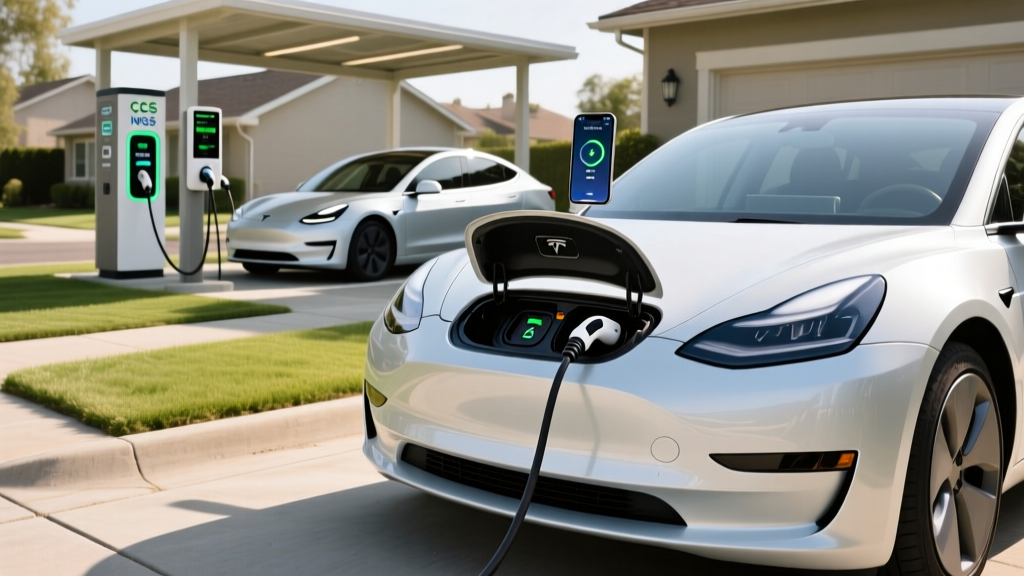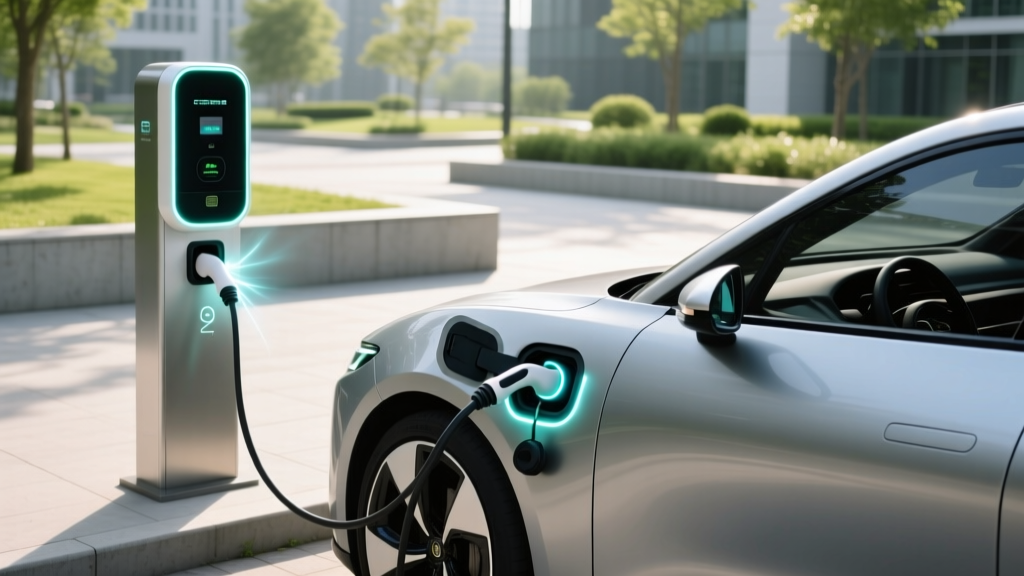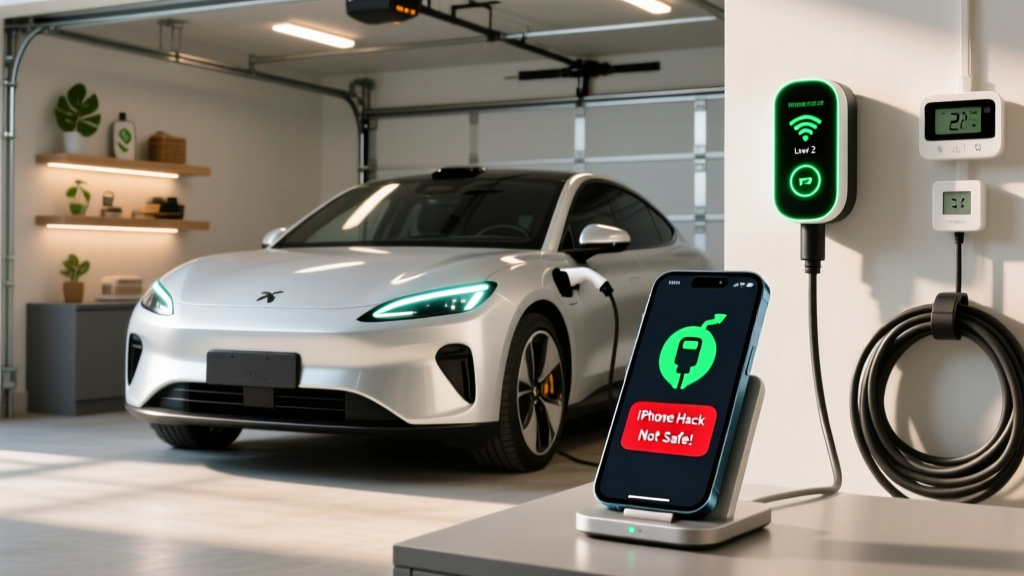
Search TikTok or YouTube long enough and you'll find videos promising an "iPhone hack charger" trick — usually some combination of hidden settings, shortcut automations, or accessory workarounds that supposedly unlock faster or free device charging. None of these tricks apply to electric vehicles, and trying to cobble together consumer electronics hacks for high-voltage EV charging is a fast path to a tripped breaker, a melted outlet, or worse. This guide cuts through the noise with the real numbers behind EV charging: what each level actually delivers, what your home electrical panel can handle, and which chargers are worth the money in 2026.
Why "iPhone Hack Charger" Tricks Don't Translate to EVs
The viral iPhone hack charger videos typically exploit iOS Shortcuts or accessibility toggles to change charging animations or battery percentage displays. An iPhone charges at roughly 20-27 watts via USB-C. An EV Level 2 home charger operates at 7,200 to 11,500 watts — that's 300 to 500 times more power. There is no software shortcut, hidden menu, or accessory hack that changes the physics of how your EV's onboard charger accepts AC power or how a DC fast charger negotiates a session with your battery management system.
What does work is understanding three things: your car's maximum charge acceptance rate (measured in kilowatts, or kW — the power flowing at any moment), your battery's capacity (measured in kilowatt-hours, or kWh — the total energy stored), and your home's electrical infrastructure. Get those right and you'll charge efficiently, safely, and cheaply. No hacks required.
Charging Levels Explained: Speeds, kW, and Miles Per Hour
Every EV owner needs to internalize three charging tiers. The table below uses a mid-size EV with roughly 3.5 miles per kWh efficiency (similar to a Tesla Model Y or Hyundai Ioniq 5) as the baseline.
| Level | Voltage | Power (kW) | Miles of Range Per Hour | Typical Use Case |
|---|---|---|---|---|
| Level 1 | 120V AC | 1.0–1.4 kW | 3–5 mi/hr | Overnight top-up, PHEVs, low-mileage drivers |
| Level 2 | 240V AC | 3.3–19.2 kW | 12–70 mi/hr | Home daily charging, workplace, public AC stations |
| DC Fast Charge | 200–900V DC | 50–350 kW | 150–800+ mi/hr (peak) | Road trips, highway corridors, rapid top-ups |
A few critical nuances the table alone can't convey:
- Peak kW is not sustained kW. A charger rated at 250 kW may only deliver that rate between 10-30% State of Charge (SoC). Above 80%, the charge curve tapers sharply to protect battery cells. Expect a 250 kW-capable EV to average closer to 100-130 kW over a full 10-80% session.
- Your car limits Level 2 speed, not just the charger. A 48-amp Level 2 wallbox can deliver 11.5 kW, but if your EV's onboard charger maxes at 7.6 kW (common on base-trim models), that's all you'll get. Always check your vehicle's onboard charger spec.
- Level 1 is viable for PHEVs. A plug-in hybrid with 8-18 kWh of usable battery can fully replenish overnight on a standard 120V outlet. For a BEV with a 75-100 kWh battery, Level 1 adds only 30-50 miles overnight — workable only if your daily driving stays under that threshold.
How Much Does It Cost to Install a Home EV Charger?
This is where the real financial planning happens. A Level 2 home charger installation isn't just buying a wallbox — it's an electrical project with multiple cost layers.
| Cost Component | Low End | Typical | High End | Notes |
|---|---|---|---|---|
| Level 2 Charger (Equipment) | $250 | $500 | $750 | 32A–48A smart charger, NACS or J1772/NACS combo |
| Electrician Labor | $400 | $800 | $1,500 | Varies by run length from panel to garage/carport |
| Materials (conduit, wire, junction box) | $100 | $250 | $500 | Longer runs and outdoor mounts cost more |
| Permit & Inspection | $50 | $150 | $300 | Required in most jurisdictions; varies by municipality |
| Panel Upgrade (if needed) | $1,500 | $2,500 | $4,500 | 100A→200A service upgrade; common in pre-2000 homes |
| Total (no panel upgrade) | $800 | $1,700 | $3,050 | Most homes with 200A service fall in this range |
| Total (with panel upgrade) | $2,300 | $4,200 | $7,550 | Older homes or those adding solar + EV + heat pump |
The federal Residential Clean Energy Credit does not cover EV chargers as of 2026 — that provision (the Alternative Fuel Vehicle Refueling Property Credit, §30C) expired for most residential installations after 2025. Some state and utility rebates still apply; check your local utility and the DOE's AFDC database for current programs in your zip code.
What Electrical Upgrades Might I Need?
A Level 2 charger drawing 40 amps requires a dedicated 50-amp circuit (NEC code mandates that continuous loads cannot exceed 80% of a breaker's rated capacity — so a 40A charger needs a 50A breaker). Here's what determines whether your home is ready:
Panel Capacity
Homes with 200-amp service typically have enough headroom for a 50A EV circuit alongside existing loads (HVAC, electric range, dryer). Homes with 100-amp service — common in houses built before the 1990s — often need an upgrade. A licensed electrician will perform a load calculation (NEC Article 220) to determine your panel's remaining capacity. If you're already near the limit with existing appliances, a panel upgrade or a smart load-management device like the Emporia Smart Load Center or Span Drive can avoid a full service upgrade.
Circuit and Wiring
Your electrician will run 6 AWG copper wire (or 4 AWG aluminum) in conduit from the panel to the charger location. For outdoor installations, the charger must carry a NEMA 4 or NEMA 4X weather-resistance rating, and the circuit requires a GFCI breaker per NEC 2023/2026 code updates for outdoor receptacles and hardwired EVSE in garages.
NEMA 14-50 Outlet vs. Hardwired
A NEMA 14-50 receptacle (240V, 50A) offers portability — you can unplug the charger and take it when you move. Hardwired installations allow up to 48A continuous draw (on a 60A breaker) and eliminate the GFCI nuisance-trip issues that have plagued some 14-50 installations. For maximum charge speed and reliability, hardwired is the 2026 best practice.
Connector Compatibility: NACS, CCS1, and CHAdeMO in 2026
The connector landscape has consolidated dramatically. Tesla's North American Charging Standard (NACS) is now the dominant connector for new EVs sold in the US, with Ford, GM, Rivian, Volvo, Hyundai, and others adopting it for 2025-2026 model-year vehicles.
| Connector | Brands Using It (2026 Models) | DC Fast Charge Availability | Adapter Needed? |
|---|---|---|---|
| NACS (Tesla standard) | Tesla (all), Ford (F-150 Lightning, Mustang Mach-E 2025+), GM (Equinox EV, Blazer EV, Silverado EV), Rivian, Hyundai (Ioniq 5/6 2026+), Volvo, Polestar | Tesla Supercharger network (250-350 kW), Electrify America (select), third-party NACS stations | CCS→NACS adapter for legacy CCS vehicles at NACS stations ($100-$200) |
| CCS1 (Combined Charging System) | Volkswagen (ID.4), BMW (iX, i4), Stellantis, some 2024-2025 Hyundai/Kia models | Electrify America, EVgo, ChargePoint, most non-Tesla networks | NACS→CCS adapter (e.g., Lectron, A2Z) for NACS vehicles at CCS stations |
| CHAdeMO | Nissan Leaf (discontinued), Mitsubishi Outlander PHEV (legacy) | Limited and shrinking network | No adapter widely available; CHAdeMO is effectively legacy |
If you're buying a new EV in 2026, a NACS-equipped vehicle gives you the broadest fast-charging access via Tesla's Supercharger network — over 25,000 stalls in North America, consistently the most reliable public network by uptime metrics. For home Level 2 charging, most wallboxes now ship with a NACS connector or the universal J1772/NACS combo plug.
Equipment Picks: Best Level 2 Home Chargers for 2026
These recommendations reflect real-world installation experience, reliability data, and feature sets that matter for daily EV ownership.
Emporia Vue Level 2 EV Charger
- Power Output: 48A (11.5 kW) hardwired / 40A (9.6 kW) plug-in
- Connector: NACS or J1772 (configurable)
- Cable Length: 24 ft
- Smart Features: Wi-Fi, scheduling, solar integration via Emporia Vue energy monitor, load sharing with Emporia Smart Load Center
- Price: ~$399 (hardwired), ~$349 (plug-in)
- Best For: Solar homeowners, budget-conscious buyers wanting full smart features
ChargePoint Home Flex (2025 refresh)
- Power Output: Up to 50A (12 kW) hardwired; adjustable 16A-50A
- Connector: NACS or J1772 (swappable pigtail)
- Cable Length: 23 ft
- Smart Features: Wi-Fi, Alexa/Google Home, detailed app with session history, utility demand-response programs
- Price: ~$599
- Best For: Multi-EV households, utility program participants
Tesla Wall Connector (Gen 4)
- Power Output: 48A (11.5 kW) hardwired
- Connector: NACS native
- Cable Length: 24 ft
- Smart Features: Wi-Fi, OTA updates, power sharing between two Wall Connectors on one circuit, vehicle integration with Tesla app
- Price: ~$475
- Best For: Tesla owners wanting seamless ecosystem integration
Grizzl-E Smart
- Power Output: 40A (9.6 kW)
- Connector: J1772 (NACS adapter included)
- Cable Length: 24 ft
- Smart Features: OCPP-compatible, app scheduling, adjustable amperage
- Price: ~$449
- Best For: Canadian/US cold-climate owners (rated to -40°C), rugged outdoor installs
How Much Does Charging Cost Per Mile vs. Gas?
The economics depend entirely on where and when you charge. Below is a realistic comparison using a mid-size EV (3.5 mi/kWh) and a mid-size gas car (28 MPG combined) with gas at $3.30/gallon.
| Charging Scenario | $/kWh | Cost Per Mile (EV) | Gas Equivalent (28 MPG) | Annual Savings vs. Gas (12,000 mi) |
|---|---|---|---|---|
| Home, off-peak utility rate | $0.09 | $0.026 | $0.118 | $1,104 |
| Home, average residential rate | $0.16 | $0.046 | $0.118 | $864 |
| Home, peak time-of-use rate | $0.30 | $0.086 | $0.118 | $384 |
| Public Level 2 (ChargePoint, etc.) | $0.25–$0.49 | $0.071–$0.140 | $0.118 | -$264 to $564 |
| DC Fast Charge (Electrify America) | $0.40–$0.56 | $0.114–$0.160 | $0.118 | -$504 to $48 |
The takeaway is unambiguous: home charging on off-peak rates delivers the lowest per-mile cost in any vehicle category. Public DC fast charging at current pricing often matches or exceeds gasoline cost per mile. This is why a home Level 2 installation isn't just a convenience — it's the economic foundation of EV ownership.
Charging Time Examples for Common Battery Sizes
These estimates assume a 10-80% session, which is the practical fast-charging window (charging above 80% slows dramatically to protect cell health).
| Battery Size (usable kWh) | Example Vehicle | Level 2 @ 11.5 kW (0-100%) | DC Fast 10-80% (peak kW) |
|---|---|---|---|
| 18 kWh | Toyota RAV4 Prime (PHEV) | ~2 hours | N/A (most PHEVs lack DC fast charge) |
| 58 kWh | VW ID.4 Standard | ~5.5 hours | ~28 min (peak 135 kW) |
| 75 kWh | Tesla Model Y Long Range | ~7 hours | ~25 min (peak 250 kW) |
| 84 kWh | Hyundai Ioniq 5 (2026) | ~7.5 hours | ~18 min (peak 350 kW, 800V architecture) |
| 100 kWh | GMC Sierra EV | ~9 hours | ~35 min (peak 350 kW) |
| 131 kWh | Ford F-150 Lightning Extended | ~12 hours | ~41 min (peak 155 kW) |
Real-world caveat: Cold weather (below 32°F / 0°C) can slow DC fast charging by 20-40% if the battery isn't preconditioned. Most modern EVs precondition the battery when you navigate to a charger — always use the car's built-in navigation to a DC station rather than just driving there cold. Level 2 home charging times are less affected because the slower rate generates less heat stress.
Safety, Code, and the Things That Go Wrong
The most common home-charging mistakes aren't exotic — they're basic electrical oversights:
- Using a standard 120V extension cord for Level 1. Most household extension cords are 16 AWG and will overheat under sustained 12A draw. If you must use an extension cord for Level 1, it needs to be 12 AWG or thicker, rated for outdoor use, and no longer than 25 feet.
- Skipping the permit. Unpermitted electrical work can void homeowner's insurance coverage in the event of a fire and will surface as a code violation during a home sale inspection.
- Ignoring GFCI requirements. NEC 2023 (and continued in 2026 adoptions) requires GFCI protection for EVSE on both indoor and outdoor circuits in many jurisdictions. Hardwired installations with built-in GFCI in the EVSE unit itself can simplify compliance.
- Overlooking the dryer/range conflict. If your panel is near capacity and you already have an electric dryer, electric range, and HVAC, adding a 50A EV circuit may trip the main breaker under simultaneous load. Smart load-management systems (like the Emporia Smart Load Center) can shed non-essential loads automatically.
Frequently Asked Questions
Can I charge my EV with just a regular wall outlet?
Yes, but slowly. A standard 120V household outlet delivers Level 1 charging at about 1.0-1.4 kW, adding roughly 3-5 miles of range per hour. This works for PHEVs (which have small 8-18 kWh batteries that recharge fully overnight) and for BEV owners who drive under 30-40 miles per day and can charge every night. For anything beyond that, Level 2 at 240V is the practical baseline.
Do I need a Tesla-specific charger if I own a Tesla?
Not necessarily. The Tesla Wall Connector is excellent and natively uses the NACS plug, but any NACS-equipped Level 2 charger (ChargePoint Home Flex, Emporia Vue) will charge a Tesla at full speed. What you do want is a NACS connector — avoid J1772 chargers unless you're willing to use the J1772-to-NACS adapter that ships with every Tesla.
How fast will each charging level add range?
Level 1 (120V): 3-5 miles per hour. Level 2 (240V, 48A): 30-45 miles per hour depending on vehicle efficiency. DC Fast Charge (150-350 kW): 150-800+ miles per hour at peak, but only sustained for a portion of the session. A practical 10-80% DC fast session takes 18-45 minutes depending on battery size and peak charge rate.
Is it worth getting a smart charger or is a dumb charger fine?
A smart charger (Wi-Fi connected, app-controlled) is worth the $50-$100 premium for three reasons: (1) scheduling lets you charge during off-peak utility hours automatically, (2) session tracking helps you monitor electricity costs, and (3) utility demand-response programs in some regions pay you $5-$15/month for allowing the utility to briefly pause your charging during peak grid events. A non-smart charger works perfectly for charging — it just doesn't optimize cost.
What if my home only has 100-amp electrical service?
You have three options: (1) upgrade to 200A service ($1,500-$4,500 depending on your utility and local requirements), (2) install a lower-amperage Level 2 charger (16A/3.8 kW) that fits within your existing panel capacity, or (3) use a smart load-management system that dynamically limits charger draw when other appliances are running. Option 3 can avoid a panel upgrade entirely in many cases. Have a licensed electrician perform an NEC Article 220 load calculation to determine what's feasible.
Does the federal tax credit cover home charger installation?
As of 2026, the federal Alternative Fuel Vehicle Refueling Property Credit (§30C) has expired for most residential installations. The Residential Clean Energy Credit covers solar, batteries, and geothermal — but not EV chargers. Some state and utility programs still offer rebates of $250-$1,000 for Level 2 equipment and installation. Check your utility's website and the Alternative Fuels Data Center for current incentives in your state.