If you own a Hyundai Ioniq 5 or are considering one, you've probably wondered whether plugging into a standard 120V household outlet is viable — or if you need to invest in a Level 2 home charger. The answer depends on your daily driving habits, your home's electrical infrastructure, and how much patience you have. Let's run the numbers.
Hyundai Ioniq 5 Battery Specs at a Glance
Before calculating charge times, we need to know what we're filling. The 2025–2026 Hyundai Ioniq 5 is available with two battery packs:
| Spec | Standard Range (RWD) | Long Range (RWD / AWD) |
|---|---|---|
| Battery Capacity (usable) | 58 kWh | 77.4 kWh |
| Chemistry | NMC | NMC |
| EPA Range | 220 mi | 303 mi (RWD) / 260 mi (AWD) |
| Real-World Highway Range* | ~180–195 mi | ~250–270 mi (RWD) |
| Max DC Fast Charge | ~175 kW | ~240 kW |
| 10–80% DCFC Time | ~24 min | ~18 min |
| Onboard AC Charger | 10.9 kW | 10.9 kW |
*Real-world highway range assumes 70–75 mph speeds, moderate temperatures. Cold weather (below 32°F) can reduce range 20–30%. Source: fueleconomy.gov
How Long Does the Ioniq 5 Take to Charge on 120V (Level 1)?
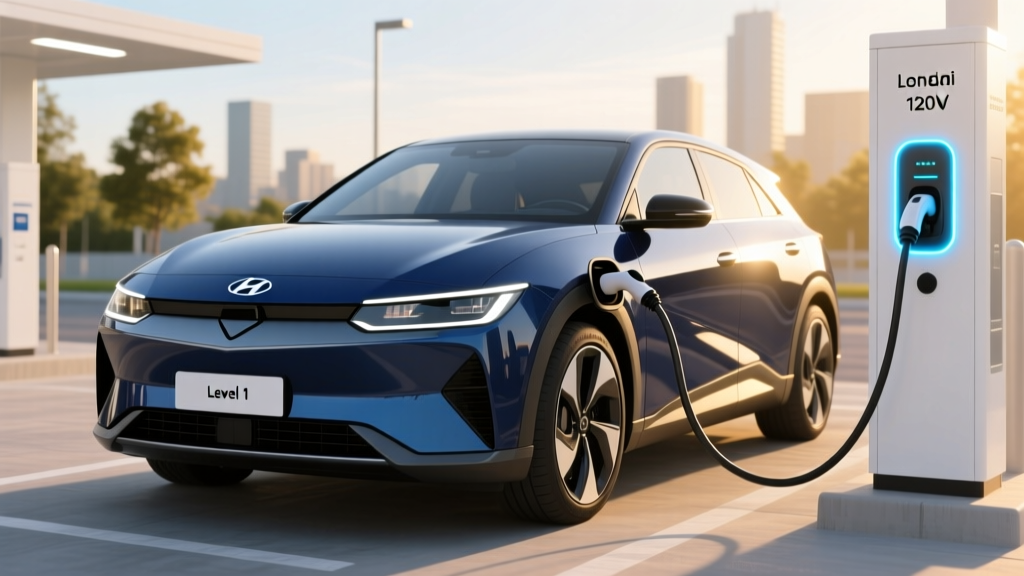
A standard 120V household outlet delivers roughly 1.2 to 1.4 kW of power (12 amps continuous on a 15-amp circuit, or 16 amps on a 20-amp circuit). This is what the EV world calls Level 1 charging.
Here's the critical distinction: kW (kilowatts) measures power — how fast energy flows. kWh (kilowatt-hours) measures energy — how much the battery holds. Think of kW as the speed of water from a hose, and kWh as the size of the bucket you're filling.
For the Long Range Ioniq 5 with its 77.4 kWh battery:
- At 1.4 kW: a full 0–100% charge takes ~55 hours
- A typical daily top-up of 20–30 miles (~5–8 kWh) takes 4–6 hours
- Recovering from 20% to 80% (~46 kWh) takes ~33 hours
For the Standard Range Ioniq 5 with its 58 kWh battery:
- At 1.4 kW: a full 0–100% charge takes ~41 hours
- A 20–30 mile top-up (~5–8 kWh) takes 4–6 hours
- Recovering from 20% to 80% (~35 kWh) takes ~25 hours
Charging Levels Explained: Speeds and Miles Per Hour
| Level | Voltage | Power (kW) | Miles of Range Added Per Hour | Typical Use Case |
|---|---|---|---|---|
| Level 1 | 120V AC | 1.2–1.4 kW | 3–5 mi/hr | Overnight trickle for short commutes |
| Level 2 (Home/Public) | 240V AC | 3.3–19.2 kW | 12–65 mi/hr | Daily home charging, workplace, shopping |
| DC Fast Charging | 400–800V DC | 50–350 kW | 150–700+ mi/hr (peak) | Road trips, quick top-ups |
The Ioniq 5's onboard AC charger maxes out at 10.9 kW, meaning even if you plug into a 48-amp Level 2 station delivering 11.5 kW, the car will only accept 10.9 kW. On a 240V/48A circuit, you'll add roughly 35–40 miles of range per hour — filling the Long Range battery from 20% to 80% in about 4.5 hours.
Level 2 Home Charger Installation: Requirements and Costs
If you decide Level 1 isn't sufficient (and for most Ioniq 5 owners, it won't be), here's what a Level 2 installation entails.
Electrical Requirements
- Circuit: Dedicated 240V circuit, typically 40A or 50A (a 40A circuit delivers ~9.6 kW continuous; a 50A circuit delivers ~12 kW continuous — though the Ioniq 5 caps at 10.9 kW)
- Breaker: Double-pole breaker sized 125% above continuous load (50A breaker for a 40A charger, 60A breaker for a 48A charger)
- Wire gauge: 6 AWG copper for 50A; 4 AWG for 60A
- Panel capacity: Most homes need 200A service minimum. Older homes with 100A panels will likely need a panel upgrade — a significant added cost.
Installation Cost Breakdown
| Item | Cost Range | Notes |
|---|---|---|
| Level 2 Charger (Equipment) | $300–$700 | Smart Wi-Fi chargers; dumb units from ~$200 |
| Electrician Labor | $400–$1,500 | Depends on run length from panel to garage |
| Electrical Permit | $50–$200 | Required in most jurisdictions |
| Panel Upgrade (if needed) | $1,500–$3,500 | 100A → 200A upgrade; not always necessary |
| Total (No Panel Upgrade) | $750–$2,400 | Typical scenario for modern homes |
| Total (With Panel Upgrade) | $2,250–$5,900 | Older homes or high-load situations |
Always get 2–3 quotes from licensed electricians. Ask specifically about your panel's remaining capacity — a good electrician will calculate your existing loads before recommending an upgrade.
Connector Compatibility: NACS vs. CCS1
The Hyundai Ioniq 5 was originally equipped with a CCS1 (Combined Charging System) port for both Level 2 AC and DC fast charging. However, Hyundai has been transitioning to the NACS (North American Charging Standard / Tesla connector) on newer model years.
| Model Year | Native Connector | Tesla Supercharger Access | Adapter Needed? |
|---|---|---|---|
| 2022–2024 Ioniq 5 | CCS1 | Via adapter (Hyundai provides or sells) | CCS-to-NACS adapter for Superchargers |
| 2025–2026 Ioniq 5 | NACS (native on new production) | Direct access to Tesla Superchargers | NACS-to-CCS adapter for legacy CCS stations |
For Level 2 home charging, both connector types use the same J1772 signaling underneath. Most Level 2 home chargers ship with a J1772 connector (compatible with CCS vehicles) or a NACS connector. Check your vehicle's port before ordering a charger — or buy a charger with an interchangeable/adapter-friendly plug.
Cost to Charge the Ioniq 5: Home vs. Public vs. Gas
Let's compare the real cost per mile across charging scenarios, using the Long Range Ioniq 5's efficiency of roughly 3.0 miles/kWh (based on EPA data showing ~114 MPGe combined).
| Scenario | Cost per kWh | Cost per Mile | Cost to "Fill" (0–80%, ~62 kWh) |
|---|---|---|---|
| Home (national avg electricity) | $0.16/kWh | $0.053/mi | $9.92 |
| Home (off-peak TOU rate) | $0.09/kWh | $0.030/mi | $5.58 |
| Public Level 2 (ChargePoint, etc.) | $0.25–$0.49/kWh | $0.083–$0.163/mi | $15.50–$30.38 |
| DC Fast Charging (EA, EVgo) | $0.35–$0.55/kWh | $0.117–$0.183/mi | $21.70–$34.10 |
| Gas Car (28 MPG avg, $3.40/gal) | — | $0.121/mi | $36.30 (equiv.) |
Home charging on an off-peak rate delivers fuel costs at roughly one-quarter the price of gasoline per mile. Even DC fast charging at the most expensive networks is generally competitive with or cheaper than gas — though frequent DCFC use isn't ideal for long-term battery health.
Recommended Level 2 Home Chargers for the Ioniq 5
Since the Ioniq 5's onboard charger peaks at 10.9 kW, a 48-amp Level 2 charger (delivering 11.5 kW) is the sweet spot — you'll max out the car's AC acceptance. Here are three strong options:
ChargePoint Home Flex
- Power: Up to 12 kW (50A / 240V)
- Connector: J1772 (NACS adapter included)
- Cable Length: 23 ft
- Smart Features: Wi-Fi, app scheduling, energy tracking, Alexa
- Price: ~$549
- UL Listed, NEMA 4 outdoor rated
Emporia Vue Level 2 Charger
- Power: Up to 11.5 kW (48A / 240V)
- Connector: J1772
- Cable Length: 24 ft
- Smart Features: Wi-Fi, app control, solar integration, TOU scheduling
- Price: ~$399
- UL Listed, indoor/outdoor rated
Tesla Wall Connector (Gen 4)
- Power: Up to 11.5 kW (48A / 240V)
- Connector: NACS native
- Cable Length: 24 ft
- Smart Features: Wi-Fi, OTA updates, power sharing, access control
- Price: ~$425
- UL Listed, NEMA 4 outdoor rated
Best for 2025+ Ioniq 5 with native NACS port. Older CCS Ioniq 5 needs a NACS-to-J1772 adapter.
Safety and Electrical Code Considerations
EV charging is a high-draw, continuous-load application. Cutting corners here is a fire risk. Key requirements:
- Dedicated circuit: Your Level 2 charger must be on its own dedicated double-pole breaker — no sharing with other appliances.
- GFCI protection: The 2023 NEC (National Electrical Code) requires GFCI protection for EV receptacles. Hardwired chargers typically have GFCI built in; receptacle-based installs need a GFCI breaker.
- Outdoor rating: If your charger is outside (carport, driveway), it must be rated NEMA 3R or NEMA 4 for weather resistance.
- Permit and inspection: Most municipalities require an electrical permit and post-installation inspection. This protects you legally and ensures your homeowner's insurance won't deny a claim related to unpermitted work.
- Load calculation: A licensed electrician should perform a NEC Article 220 load calculation to confirm your panel can handle the charger plus existing loads (HVAC, electric oven, dryer, etc.).
Frequently Asked Questions
Can I charge my Ioniq 5 on a regular 120V outlet every night?
Yes, but with major caveats. A 120V outlet delivers roughly 1.4 kW, adding about 3–5 miles of range per hour. If you drive less than 30 miles daily and plug in for 10+ hours overnight, you'll roughly break even. But any day with extra driving — or a cold snap that reduces efficiency — and you'll start falling behind. Think of Level 1 as a stopgap, not a long-term strategy for a vehicle with a 77.4 kWh battery.
How much does it cost to install a Level 2 home charger?
Expect $750–$2,400 for a straightforward install (equipment + electrician + permit) in a home with adequate panel capacity. If your home has a 100A panel that needs upgrading to 200A, add $1,500–$3,500. Always get multiple quotes and verify the electrician is licensed and will pull a permit.
Is the Ioniq 5 compatible with Tesla Superchargers?
2025–2026 Ioniq 5 models with the native NACS port can use Tesla Superchargers directly. 2022–2024 models with CCS1 ports require a CCS-to-NACS adapter (Hyundai has offered these to owners). Check your vehicle's charge port shape: NACS is smaller and rounder; CCS1 is larger with two extra DC pins below.
Does DC fast charging damage the Ioniq 5 battery?
Occasional DC fast charging is fine — Hyundai's battery management system manages heat and charge curves to protect the pack. However, exclusive reliance on DCFC (never using Level 2) can accelerate degradation over years. Hyundai covers the battery with a 10-year/100,000-mile warranty against capacity loss below 70%. For daily use, Level 2 home charging is gentler on the battery.
What's the actual real-world range of the Ioniq 5 Long Range?
The EPA rates the Long Range RWD at 303 miles. In real-world highway driving at 70–75 mph, expect 250–270 miles. In cold weather (below freezing), that can drop to 200–220 miles due to battery chemistry limitations and cabin heating demands. The Ioniq 5 does include a heat pump (on most trims), which mitigates cold-weather losses compared to resistive heating — but physics still applies.
Do I qualify for a tax credit on home charger installation?
The federal Alternative Fuel Vehicle Refueling Property Credit (IRC §30C) covers up to 30% of home charger equipment and installation costs, capped at $1,000. However, eligibility depends on your census tract (must be a qualifying low-income or non-urban area as defined by the IRS). Check the latest IRS guidance or consult a tax professional — rules and qualifying tract maps update annually.