The Hyundai Ioniq 6 is one of the most aerodynamically efficient electric sedans on the road, and its EPA-estimated range is a major selling point. But that sticker number only matters if you can reliably replenish the battery. Whether you're squeezing every mile out of the 77.4 kWh pack or topping up the smaller 53.0 kWh battery, your charging setup directly determines whether you actually experience the Ioniq 6's full range potential day to day.
This guide walks through exactly what it takes to charge an Ioniq 6 at home and in public — with precise kW speeds, real installation costs, connector compatibility, and the per-mile economics that decide whether going electric actually saves you money.
Ioniq 6 Range and Battery Specs at a Glance
Before plugging in, it helps to know exactly what you're filling. The 2026 Hyundai Ioniq 6 continues with two battery options across its trim lineup. The Standard Range model uses a 53.0 kWh battery (rear-wheel drive), while the Long Range variants pack a 77.4 kWh usable battery in either RWD or dual-motor AWD configurations.
| Spec | SE Standard Range (RWD) | SE/SEL/Limited Long Range (RWD) | Long Range AWD |
|---|---|---|---|
| Battery (usable) | 53.0 kWh | 77.4 kWh | 77.4 kWh |
| Chemistry | NMC | NMC | NMC |
| EPA Range | ~240 mi | ~361 mi | ~316 mi |
| MPGe (combined) | ~140 MPGe | ~140 MPGe | ~117 MPGe |
| Max DC Fast Charge | ~180 kW | ~235 kW (800V architecture) | ~235 kW (800V architecture) |
| 10–80% DC Fast Charge | ~24 min | ~18 min | ~18 min |
| Onboard AC Charger | 10.9 kW | 10.9 kW | 10.9 kW |
Charging Levels Explained: How Fast Each Adds Ioniq 6 Range
The single most common confusion among new EV owners is mixing up kW (kilowatts — the rate of power delivery, like water pressure from a hose) and kWh (kilowatt-hours — the total energy stored in the battery, like the size of the tank). A 10 kW charger delivers 10 kWh of energy per hour. Your Ioniq 6 Long Range has a 77.4 kWh battery. These are not interchangeable units.
| Level | Power (kW) | Voltage / Amps | Miles of Range per Hour | 0–100% Time (77.4 kWh) | Best For |
|---|---|---|---|---|---|
| Level 1 (120V outlet) | 1.4–1.9 kW | 120V / 12–16A | 4–6 mi/hr | ~45–55 hours | Overnight trickle, emergencies, PHEVs |
| Level 2 (240V home/public) | 7.2–11.5 kW | 240V / 30–48A | 25–40 mi/hr | ~7–10 hours | Daily home charging, workplace |
| DC Fast Charging | 50–350 kW | 400–800V DC | 180–800+ mi/hr (peak) | 10–80% in ~18 min | Road trips, rapid top-ups |
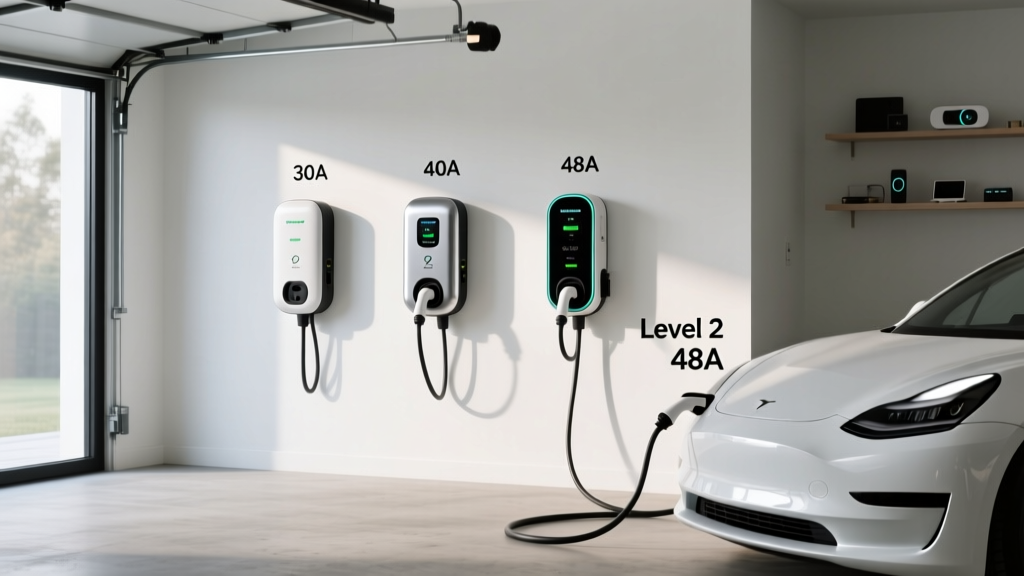
The Ioniq 6's onboard AC charger maxes out at 10.9 kW. That means even if you install a 48-amp (11.5 kW) Level 2 charger, the car will only accept ~10.9 kW. You won't damage anything — the car simply draws what it can — but there's no speed benefit to oversizing the charger beyond the vehicle's acceptance rate.
On the DC fast-charging side, the Ioniq 6's 800V electrical architecture (on Long Range models) is a genuine advantage. While many competitors peak around 150 kW on 400V systems, the Ioniq 6 can pull up to ~235 kW at compatible 350 kW chargers, filling from 10% to 80% in approximately 18 minutes under ideal conditions. Real-world charging curves taper above 80% SoC to protect the battery, so expect the final 20% to take significantly longer.
Home Charger Installation: Electrical Requirements and Costs
This is where most EV buyers hit their first real-world hurdle. A Level 2 home charger isn't a simple plug-in appliance — it requires a dedicated 240V circuit, and depending on your home's electrical panel, that may mean significant work.
Electrical Requirements for Ioniq 6 Home Charging
To unlock the Ioniq 6's full 10.9 kW Level 2 charging speed, you need a 240V circuit rated for at least 50 amps (which supports a continuous 40A draw — electrical code requires circuits to be rated 125% above the continuous load). A 48-amp charger needs a 60-amp breaker.
- Ideal setup: 240V / 50–60A dedicated circuit with NEMA 14-50 outlet or hardwired connection
- Minimum practical: 240V / 40A circuit (supports ~7.7 kW, adding ~28 mi/hr)
- Wire gauge: Typically 6 AWG copper for 50A, 4 AWG for 60A (your electrician will specify)
- GFCI protection: Required by NEC 2020+ for EV receptacles in garages; hardwired units often exempt
Do You Need a Panel Upgrade?
This is the make-or-break question for older homes. A typical Level 2 charger draws 40–48 amps continuously. If your home has a 100-amp main panel already running near capacity (electric range, dryer, HVAC), you may need a panel upgrade to 200 amps — or you may need to accept a lower-amperage charger on a shared or smaller circuit.
A licensed electrician will perform a load calculation to determine your panel's spare capacity. If you're already close to maxed out, options include:
- Upgrading to a 200A panel ($1,500–$3,500)
- Installing a lower-amperage circuit (e.g., 30A for ~5.8 kW charging)
- Using a smart panel or load-management device (e.g., Emporia Smart SPAN) that dynamically limits charger draw when other circuits are active
| Component | Low End | Typical | High End |
|---|---|---|---|
| Level 2 Charger (hardware) | $300 | $500–$650 | $800 |
| Electrician labor (standard install) | $400 | $600–$1,000 | $1,500 |
| Permit and inspection | $50 | $100–$250 | $400 |
| Panel upgrade (if needed) | $1,500 | $2,000–$2,500 | $3,500 |
| Total (no panel upgrade) | $750 | $1,200–$1,900 | $2,700 |
| Total (with panel upgrade) | $2,250 | $3,200–$4,400 | $6,200 |
Always get a permit. Unpermitted electrical work can void home insurance and create fire risk. Your electrician should pull the permit and schedule the inspection — this is standard practice and typically adds only $100–$250 to the project.
Connector Compatibility: NACS, CCS, and What the Ioniq 6 Uses
The connector landscape has shifted dramatically. As of 2025–2026, Hyundai has begun transitioning to the North American Charging Standard (NACS) for new vehicles, but many Ioniq 6 models on the road still use the CCS1 (Combined Charging System) connector. Here's what you need to know:
| Connector | Used For | Ioniq 6 Status | Network Access |
|---|---|---|---|
| CCS1 | AC Level 2 + DC Fast | Standard on 2023–2025 models; some 2026 builds | Electrify America, EVgo, ChargePoint DC |
| NACS (Tesla) | AC Level 2 + DC Fast | Expected on updated 2026+ production; adapter available for CCS vehicles | Tesla Supercharger network (15,000+ stalls) |
| CHAdeMO | DC Fast (legacy) | Not compatible — no adapter available | Limited legacy stations (Nissan Leaf, older vehicles) |
| J1772 | AC Level 1/2 only | Adapter included (J1772-to-CCS or J1772-to-NACS) | Public Level 2 stations, older home chargers |
Key takeaway: If your Ioniq 6 has a CCS1 port, you can access Tesla Superchargers using a Hyundai-provided or third-party CCS-to-NACS adapter (typically $200–$250). This dramatically expands your road-trip charging options. If you're buying new in 2026, confirm with your dealer which connector your specific build includes — the transition is happening mid-cycle.
For home Level 2 charging, the connector on your charger should match your car. Most new Level 2 chargers now ship with NACS or offer CCS/NACS options. If you buy a NACS charger and have a CCS vehicle (or vice versa), adapters solve the problem for AC charging.
Level 2 Charger Equipment Picks for the Ioniq 6
Since the Ioniq 6 accepts up to 10.9 kW on AC, a 48-amp charger is the sweet spot — it delivers 11.5 kW, and the car will draw its maximum 10.9 kW. Here are proven options with exact specs:
Emporia Vue / Emporia Level 2 Charger
- Power: 48A / 11.5 kW (hardwired) or 40A / 9.6 kW (NEMA 14-50)
- Connector: J1772 (NACS adapter available)
- Cable: 24 ft
- Smart features: Wi-Fi, scheduling, solar integration, energy monitoring
- Price: ~$399
- Best for: Budget-conscious buyers wanting smart features and energy tracking
ChargePoint Home Flex
- Power: Up to 50A / 12 kW (adjustable via DIP switches: 16A–50A)
- Connector: J1772 or NACS (select at purchase)
- Cable: 23 ft
- Smart features: Wi-Fi, app scheduling, Alexa, load sharing
- Price: ~$599–$699
- Best for: Flexibility across panel capacities; adjustable amperage
Tesla Wall Connector
- Power: 48A / 11.5 kW
- Connector: NACS (native); CCS vehicles need adapter
- Cable: 24 ft
- Smart features: Wi-Fi, OTA updates, power sharing between units
- Price: ~$475
- Best for: NACS-equipped Ioniq 6 owners; clean, reliable hardware
Grizzl-E Smart
- Power: 40A / 9.6 kW (NEMA 14-50) or up to 48A hardwired
- Connector: J1772 or NACS
- Cable: 24 ft
- Smart features: Wi-Fi, OCPP compatibility, adjustable amperage
- Price: ~$449–$549
- Best for: Cold-climate durability (rated to -40°F); outdoor installs
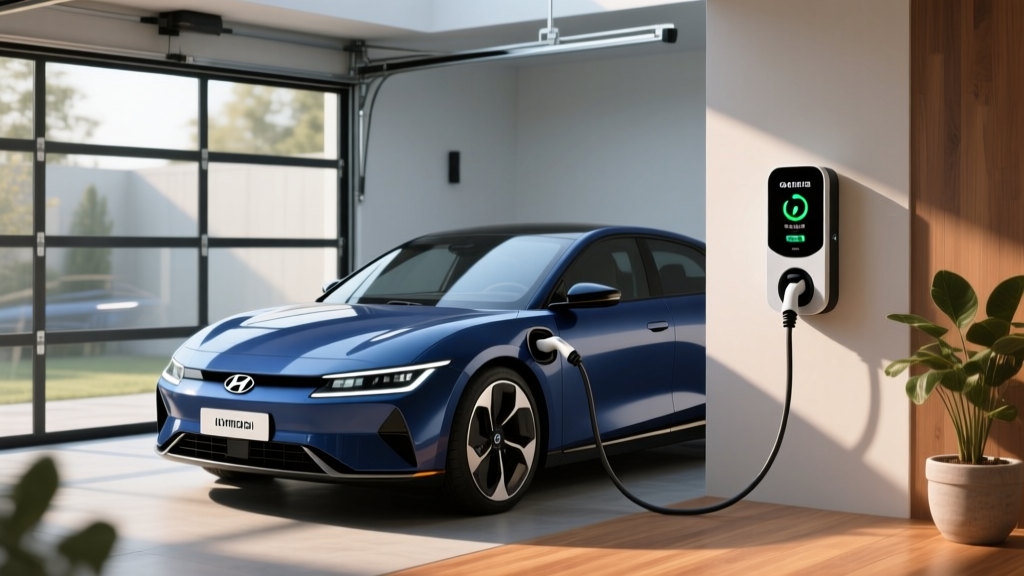
For the Ioniq 6 specifically, the ChargePoint Home Flex at 48A or the Tesla Wall Connector are top picks. Both deliver the full 10.9 kW the car can accept. If your electrical panel only supports a 40A circuit, the Grizzl-E or ChargePoint set to 32A still provides a very usable 7.7 kW — enough to fully recharge the 77.4 kWh battery overnight in about 10 hours.
Charging Cost Per Mile: Ioniq 6 vs. Gasoline Sedan
The economic case for home charging an Ioniq 6 is strong, but it depends heavily on your local electricity rates and whether you can charge during off-peak hours. Let's run the numbers against a comparable gasoline midsize sedan getting 30 MPG combined.
| Scenario | Rate | Ioniq 6 Cost/Mile | Gas Sedan Cost/Mile | Annual Savings (12,000 mi) |
|---|---|---|---|---|
| Home off-peak (national avg) | $0.13/kWh | $0.035 | $0.117 (at $3.50/gal) | ~$980 |
| Home off-peak (CA/East Coast avg) | $0.22/kWh | $0.059 | $0.117 | ~$700 |
| Home with time-of-use optimization | $0.08/kWh | $0.022 | $0.117 | ~$1,140 |
| Public Level 2 (avg) | $0.30/kWh | $0.081 | $0.117 | ~$430 |
| DC Fast Charging (avg) | $0.48/kWh | $0.129 | $0.117 | -$140 (gas cheaper) |
The Ioniq 6 Long Range RWD achieves roughly 3.7–4.0 miles per kWh in mixed driving (per fueleconomy.gov data). That efficiency is what makes home charging so economical — at the national average residential rate of ~$0.16/kWh, you're paying roughly $0.043 per mile.
The critical insight: DC fast charging exclusively is more expensive than gasoline at current rates. The economics only work if you charge primarily at home or at workplace Level 2 stations. Budget road-trippers should plan around Electrify America or EVgo subscription plans that reduce per-kWh DC rates to $0.31–$0.36/kWh.
Public Charging the Ioniq 6: Networks, Speeds, and the 800V Advantage
The Ioniq 6's 800V architecture is not just a spec-sheet number — it translates to meaningfully faster DC charging at high-power stations. On a 350 kW Electrify America stall, the Long Range Ioniq 6 can sustain 200+ kW through the middle of its charge curve (roughly 20–60% SoC), then tapering to ~100 kW by 80%. A 10–80% session takes approximately 18–20 minutes in moderate temperatures.
However, at a 150 kW station (which still represents a large share of public DC infrastructure), the Ioniq 6 will peak near 150 kW and the 10–80% session stretches to ~25–28 minutes. Always check the station's rated power before planning a stop.
Preconditioning matters. If you navigate to a DC fast charger using the Ioniq 6's built-in navigation, the battery thermal management system will begin warming (or cooling) the pack to optimize charge acceptance. Skipping preconditioning in cold weather can add 5–10 minutes to your charging session and reduce peak kW. Use the car's nav for charging stops whenever possible.
According to Hyundai's official specifications, the Ioniq 6's battery and powertrain are covered by a 10-year/100,000-mile warranty, which includes capacity retention coverage. This is among the strongest EV warranties available and reduces long-term degradation concerns significantly.
Safety, Permits, and Code Considerations
EV charger installations must comply with the National Electrical Code (NEC) Article 625. Key requirements include:
- Dedicated circuit: Your Level 2 charger must be on its own dedicated breaker — it cannot share a circuit with other appliances.
- GFCI protection: NEC 2020 and later requires ground-fault circuit interrupter protection for 125V and 250V receptacles used for EV charging. Hardwired chargers are often exempt from this requirement, which is one reason many electricians prefer hardwired installs.
- Outdoor rating: If your charger is installed outside (carport, driveway), the unit must carry a NEMA 4 or IP55+ weather rating. All chargers recommended above meet this standard.
- Cable management: NEC requires that the charging cable not create a tripping hazard. If your parking spot is far from the charger, consider a 24-foot cable and a wall-mounted holster.
- Permit requirement: Nearly all jurisdictions require an electrical permit for new 240V circuits. Fees typically run $50–$250. The inspection ensures your installation is safe and code-compliant.
Skip the permit and you risk voiding your homeowner's insurance coverage for any electrical fire, plus potential fines and forced removal during a home sale inspection. It's never worth it.
Frequently Asked Questions
How much does it cost to install a home EV charger for the Ioniq 6?
Expect $1,200–$1,900 for a standard Level 2 installation (charger + electrician + permit) if your electrical panel has spare capacity. If you need a 200A panel upgrade, the total can reach $3,200–$4,400. Always get at least two quotes from licensed electricians.
How fast will each charging level add range to my Ioniq 6?
Level 1 (120V) adds roughly 4–6 miles per hour — essentially useless for the 77.4 kWh battery. Level 2 (240V, 48A) adds approximately 35–40 miles per hour, fully recharging overnight. DC fast charging at 235 kW can add ~200 miles in 18 minutes (10–80% SoC).
Which connector does my Ioniq 6 use, and what chargers are compatible?
Most 2023–2025 Ioniq 6 models use CCS1. Some 2026 builds may ship with NACS. Check your specific vehicle. CCS vehicles can use Tesla Superchargers with a CCS-to-NACS adapter (~$200–$250). For home Level 2 charging, match your charger connector to your car's port or use an adapter.
How much does charging an Ioniq 6 cost per mile compared to gas?
At the national average residential electricity rate ($0.16/kWh), the Ioniq 6 Long Range costs approximately $0.043/mile to fuel at home. A comparable 30 MPG gas sedan at $3.50/gallon costs $0.117/mile. That's roughly $880–$980 in annual fuel savings for 12,000 miles of driving. DC fast charging exclusively, however, can exceed gas costs.
What electrical upgrades might I need for a Level 2 charger?
If your home has a 100-amp panel or is already near capacity, you may need a 200A panel upgrade ($1,500–$3,500). Alternatives include installing a lower-amperage circuit (30A for ~5.8 kW) or using a smart load-management system that dynamically limits charger draw. A licensed electrician will perform a load calculation to determine your options. Check with your utility — some offer rebates covering part of the installation cost, and the federal Alternative Fuel Vehicle Refueling Property Credit may cover up to 30% of home charging equipment and installation costs (capped at $1,000), subject to income and census-tract eligibility per IRS rules.