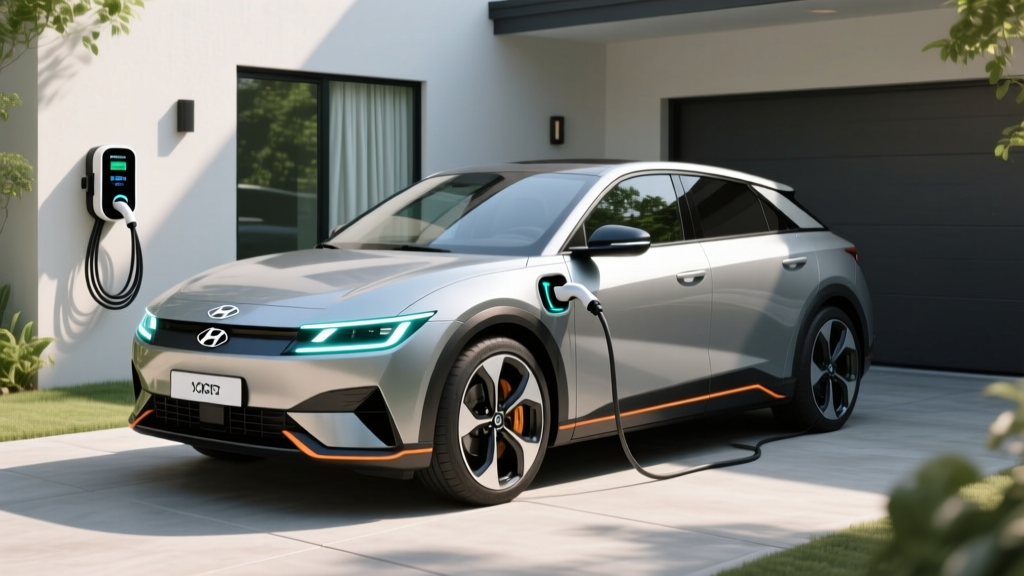
The Hyundai Ioniq 5 XRT pairs the rugged styling of Hyundai's adventure-oriented trim with the 84 kWh usable NMC battery and 800V architecture that made the Ioniq 5 lineup a charging benchmark. But the XRT's all-terrain tires, lifted suspension, and added cladding come with a measurable trade-off: reduced efficiency and shorter range compared to the standard Ioniq 5. If you're evaluating the Ioniq 5 XRT range for your daily commute or road-trip plans, you need the real numbers — not just the EPA sticker — plus a clear picture of what it takes to charge this SUV at home and on the road.
This guide breaks down the 2026 Ioniq 5 XRT's range and efficiency data, then walks through every charging scenario: Level 1 trickle charging, Level 2 home installation (with exact cost breakdowns and electrical requirements), and DC fast charging on public networks. We'll also cover the cost-per-mile math versus gas and recommend specific home charger equipment.
Ioniq 5 XRT Range: EPA Sticker vs. Real-World Expectations
The 2026 Hyundai Ioniq 5 XRT AWD carries an EPA-estimated range of 290 miles on its 84 kWh (usable) NMC lithium-ion battery pack. That's a noticeable drop from the Ioniq 5 SEL/Limited AWD, which achieves up to 320 miles EPA on the same battery — a penalty of roughly 30 miles attributable to the XRT's all-terrain tires, increased ride height, and body cladding that raises aerodynamic drag.
EPA Estimate: 290 miles
Highway driving (70-80 mph): Expect ~240–260 miles
Cold weather (below 32°F): Expect ~200–230 miles (20–30% reduction)
Mixed city/highway (moderate temps): ~265–280 miles
Real-world range depends heavily on speed, temperature, terrain, and HVAC use. Highway driving at 75+ mph and sub-freezing temperatures are the biggest range killers for any EV, and the XRT's less aero-efficient profile amplifies this.
The Ioniq 5 XRT's efficiency lands around 97 MPGe combined (approximately 34 kWh/100 mi), according to fueleconomy.gov. That's less efficient than the SEL AWD at 110 MPGe combined, but still competitive with other rugged-oriented EVs. For context, the Ford Mustang Mach-E with the extended-range AWD powertrain achieves 101 MPGe combined.
| Spec | Value |
|---|---|
| Battery (usable) | 84 kWh, NMC chemistry |
| EPA Range | 290 miles (AWD) |
| Efficiency | 97 MPGe / 34 kWh/100 mi |
| Peak DC Fast Charge Rate | ~240 kW (800V architecture) |
| 10–80% DCFC Time | ~18 minutes (ideal conditions) |
| Level 2 Charge Rate | 10.9 kW (onboard charger) |
| Horsepower | 320 hp (AWD dual motor) |
| 0–60 mph | ~5.2 seconds |
| Base MSRP | ~$50,900 (before incentives) |
| Battery/Powertrain Warranty | 10 years / 100,000 miles |
Charging Levels Explained: How Fast Will the Ioniq 5 XRT Gain Range?
EV charging is measured in kW (kilowatts), which represents the rate of power delivery — think of it as the size of the pipe filling your battery. Your battery's capacity is measured in kWh (kilowatt-hours), which represents the total energy stored — the size of the tank. Never confuse these: a 10 kW charger delivering power for one hour adds 10 kWh of energy to your 84 kWh battery.
Here's what each charging level looks like for the Ioniq 5 XRT's 84 kWh pack:
| Level | Power (kW) | Miles of Range per Hour | Full Charge Time (0–100%) | Best Use Case |
|---|---|---|---|---|
| Level 1 (120V) | ~1.4 kW | ~4 mi/hr | ~60 hours | Emergency / overnight trickle |
| Level 2 (240V, 32A) | 7.7 kW | ~22 mi/hr | ~11 hours | Home daily charging |
| Level 2 (240V, 48A) | 10.9 kW* | ~31 mi/hr | ~8 hours | Optimized home charging |
| DC Fast (150 kW) | 150 kW (peak) | ~350+ mi/hr (initial) | 10–80% in ~25 min | Road trips |
| DC Fast (250+ kW) | ~240 kW (peak) | ~500+ mi/hr (initial) | 10–80% in ~18 min | Fastest public charging |
*The Ioniq 5 XRT's onboard charger maxes at 10.9 kW, so a 48A/11.5 kW home charger will only deliver 10.9 kW to the battery. You still benefit from the full 10.9 kW rate, but installing a 60A circuit is recommended for a 48A continuous load per NEC derating rules.
The charging curve matters. The Ioniq 5 XRT's 800V architecture allows it to accept peak charge rates near 240 kW, but only between roughly 10% and 40% state of charge (SoC). Above 50%, the rate tapers to ~150 kW; above 80%, it drops sharply to ~50–70 kW to protect battery longevity. This is why we quote 10–80% times rather than 0–100% — charging the final 20% can take as long as the first 70%.
Home Level 2 Charger Installation: Electrical Requirements & Costs
For daily driving, a Level 2 home charger is the backbone of EV ownership. With the Ioniq 5 XRT's 84 kWh battery, even a modest 32A Level 2 charger adds enough range overnight to cover most commutes. But to maximize the 10.9 kW onboard charger, you'll want a 48A unit on a dedicated 60A circuit.
Electrical Requirements
- Voltage: 240V (standard residential split-phase, same as an electric dryer or oven)
- Amperage: 48A continuous load requires a 60A breaker per National Electrical Code (NEC) 125% derating rule
- Circuit: Dedicated — no sharing with other appliances
- Wire gauge: 6 AWG copper (or 4 AWG aluminum) for a 60A circuit, though some jurisdictions require 4 AWG copper
- GFCI protection: NEC 2020+ requires GFCI protection for EV outlets; hardwired chargers have internal GFCI
- Outdoor rating: If mounted outside, the charger must be NEMA 4 rated (weatherproof); all recommended units below qualify
Panel Upgrade Considerations
This is the cost variable most online guides gloss over. A 60A dedicated circuit draws significant capacity from your electrical panel. If your home has a 100A main panel (common in homes built before 1990), you may not have enough spare capacity for a 60A EV circuit alongside existing loads like central AC, electric range, and dryer. A licensed electrician will perform a NEC Article 220 load calculation to determine if your panel can handle the addition.
If a panel upgrade is needed — typically from 100A to 200A — expect to pay $1,500 to $3,500 for the upgrade alone, depending on your utility's requirements, local labor rates, and whether a new meter base is needed. Homes with 200A panels generally have sufficient headroom for a 60A EV circuit.
| Component | Cost Range | Notes |
|---|---|---|
| Level 2 Charger (48A smart unit) | $400 – $700 | Wi-Fi enabled, 25 ft cable |
| Electrician labor (standard install) | $500 – $1,500 | Varies by run length, conduit, wall type |
| Electrical permit | $50 – $200 | Required by most jurisdictions |
| Materials (conduit, wire, breaker) | $100 – $400 | 6 AWG copper, 60A breaker |
| Total (no panel upgrade) | $1,050 – $2,800 | Most homes with 200A panels |
| Panel upgrade (if needed) | $1,500 – $3,500 | 100A → 200A service upgrade |
| Total (with panel upgrade) | $2,550 – $6,300 | Older homes with 100A service |
Federal incentive note: The IRS §30D tax credit applies to the vehicle, not the charger. However, the Alternative Fuel Vehicle Refueling Property Credit (IRS §30C) can cover up to 30% of home charger equipment and installation costs (max $1,000), subject to income limits and census-tract eligibility. Consult a tax professional or IRS.gov for current-year eligibility.
Home Charger Equipment Recommendations for the Ioniq 5 XRT
These chargers are selected based on compatibility with the Ioniq 5 XRT's 10.9 kW onboard charger, reliability track records, smart features, and value. All units below support at least 48A output and come with a minimum 25-foot cable.
ChargePoint Home Flex
- Power: Up to 12 kW (50A) — adjustable via DIP switch
- Connector: NACS (native Tesla) or J1772 (CCS via adapter)
- Cable: 23 ft
- Smart features: Wi-Fi, app scheduling, Alexa integration
- Price: ~$550–$650
- Best for: Flexibility; NACS version future-proofs for Tesla Supercharger access
Emporia Level 2 EV Charger
- Power: Up to 11.5 kW (48A)
- Connector: J1772 (NACS adapter available separately)
- Cable: 24 ft
- Smart features: Wi-Fi, app with energy monitoring, solar integration
- Price: ~$400–$450
- Best for: Budget-conscious buyers; excellent energy tracking
Grizzl-E Smart
- Power: Up to 10 kW (40A) — adjustable down to 16A
- Connector: J1772 or NACS
- Cable: 24 ft
- Smart features: Wi-Fi, OCPP support, adjustable amperage
- Price: ~$450–$550
- Best for: Cold climates (rated to -40°F); rugged build quality
Our pick for the Ioniq 5 XRT: The ChargePoint Home Flex at 50A covers the XRT's 10.9 kW onboard charger ceiling and gives you NACS compatibility for direct Tesla Supercharger access without an adapter. If you're budget-focused, the Emporia delivers nearly identical performance at a lower price, though you'll need a J1772-to-NACS adapter for Supercharger use.
Connector Compatibility: NACS, CCS1, and the Ioniq 5 XRT
The 2026 Hyundai Ioniq 5 XRT ships with a CCS1 (Combined Charging System) port as standard. However, Hyundai has committed to transitioning to the NACS (North American Charging Standard / Tesla connector) across its EV lineup, and some 2026 model-year Ioniq 5 vehicles may ship with NACS depending on production date and trim. Verify your specific vehicle's port at purchase.
| Network / Connector | CCS1-Equipped XRT | NACS-Equipped XRT |
|---|---|---|
| Tesla Supercharger (NACS) | Requires NACS-to-CCS adapter (~$200–$250) | Native — no adapter needed |
| Electrify America (CCS1) | Native — no adapter needed | Requires CCS-to-NACS adapter |
| EVgo / ChargePoint (CCS1) | Native — no adapter needed | Requires CCS-to-NACS adapter |
| CHAdeMO (legacy Nissan Leaf) | Not compatible (network retiring) | Not compatible (network retiring) |
| Home Level 2 (J1772) | Native — J1772 plugs into CCS upper inlet | Requires J1772-to-NACS adapter (often included) |
Practical advice: If your XRT has CCS1, purchase a Hyundai-approved NACS adapter to access Tesla's Supercharger network, which remains the most reliable DC fast-charging network in the U.S. with over 25,000 stalls. If your XRT ships with NACS, keep the included CCS adapter in the frunk for Electrify America and other CCS-based networks.
Cost to Charge: Per-Mile Comparison vs. Gas
The Ioniq 5 XRT consumes approximately 34 kWh per 100 miles (its combined efficiency rating). Let's translate that into real dollars across common charging scenarios and compare to a gas equivalent.
| Scenario | Rate | Cost per 100 mi | Cost per Mile |
|---|---|---|---|
| Home charging (off-peak utility rate) | $0.12/kWh | $4.08 | $0.041 |
| Home charging (national avg. rate) | $0.17/kWh | $5.78 | $0.058 |
| Public Level 2 (ChargePoint/EVgo) | $0.30/kWh | $10.20 | $0.102 |
| DC Fast Charging (EA/Supercharger avg.) | $0.40/kWh | $13.60 | $0.136 |
| DC Fast Charging (peak pricing) | $0.55/kWh | $18.70 | $0.187 |
| Gas SUV (25 MPG combined, $3.50/gal) | $3.50/gallon | $14.00 | $0.140 |
The takeaway: Home charging on off-peak rates delivers fuel costs roughly one-third that of a comparable gas SUV. Even at public DC fast-charging rates, the XRT is competitive with gas on a per-mile basis — and dramatically cheaper if you charge at home most of the time. The key economic advantage of EV ownership is maximizing home charging. If you can't charge at home and rely entirely on public DC fast charging at peak rates, the cost advantage narrows significantly.
For a driver covering 12,000 miles per year with 80% home charging (at $0.14/kWh avg.) and 20% DC fast charging (at $0.40/kWh), the annual fuel cost is approximately $710. A comparable gas SUV at 25 MPG and $3.50/gallon costs $1,680/year — a savings of roughly $970 annually with the XRT.
Safety, Code Compliance, and Installation Best Practices
A Level 2 EV charger draws sustained high current for hours — this is one of the most demanding continuous loads in a residential electrical system. Cutting corners on installation is both a safety hazard and an insurance liability.
- Dedicated circuit: Your EV charger must be on its own breaker with no shared loads. A 48A charger requires a 60A breaker.
- Hardwired vs. plug-in: Hardwired installations (no outlet) are generally preferred for 48A+ chargers because they eliminate the NEMA 14-50 outlet as a failure point. If you choose a plug-in configuration, use an industrial-grade NEMA 14-50 receptacle (Hubbell or Bryant — not cheap residential-grade units that can overheat under sustained EV loads).
- GFCI protection: Required by NEC 2020 and later for receptacle-based EV charging. Hardwired chargers include internal ground-fault protection. Double-GFCI (breaker + charger) can cause nuisance tripping — your electrician will know how to handle this.
- Permit and inspection: Most jurisdictions require an electrical permit and final inspection for EV charger installations. This protects you, ensures code compliance, and is typically required for any insurance claim related to electrical fire.
- Outdoor mounting: All units recommended above are NEMA 4 rated for outdoor use. Mount the charger where the cable can reach your vehicle's charge port (rear quarter-panel on the Ioniq 5 XRT) without stretching across a walkway.
Frequently Asked Questions
How much does it cost to install a home EV charger for the Ioniq 5 XRT?
A standard Level 2 installation (48A charger, 60A circuit, no panel upgrade) typically runs $1,050 to $2,800 including equipment, electrician labor, permit, and materials. If your home needs a panel upgrade from 100A to 200A service, add $1,500 to $3,500. Always get at least two quotes from licensed electricians.
How fast will each charging level add range to the Ioniq 5 XRT?
Level 1 (120V) adds roughly 4 miles per hour — only practical for emergency top-ups. Level 2 (240V, 48A) adds about 31 miles per hour, fully replenishing the 84 kWh battery in roughly 8 hours. DC fast charging at a 250+ kW station can add up to 200+ miles in 18 minutes (10–80% SoC), though the rate tapers significantly above 80%.
Which connector and charger is compatible with my Ioniq 5 XRT?
The 2026 Ioniq 5 XRT uses either CCS1 or NACS, depending on production date. Check your vehicle's charge port: CCS1 has a wider, rounded rectangular shape with two DC pins below; NACS is the smaller Tesla-style connector. For home Level 2 charging, J1772 plugs into the upper portion of a CCS1 inlet, while NACS-equipped vehicles need a J1772-to-NACS adapter. For DC fast charging, you need an adapter to access the opposite network (NACS adapter for CCS1 vehicles to use Tesla Superchargers, or CCS adapter for NACS vehicles to use Electrify America).
How much does charging the Ioniq 5 XRT cost per mile compared to gas?
At the national average residential electricity rate of ~$0.17/kWh, the XRT costs about $0.058 per mile to fuel. A comparable gas SUV at 25 MPG and $3.50/gallon costs $0.14 per mile. Home charging saves roughly 60% on fuel costs; even public DC fast charging at $0.40/kWh ($0.136/mile) is marginally cheaper than gas.
What electrical upgrades might I need for a Level 2 charger?
The most common upgrade is a panel capacity increase from 100A to 200A if your existing panel doesn't have enough spare capacity for a 60A dedicated circuit. Your electrician will perform a load calculation per NEC Article 220. Other potential upgrades include replacing a Federal Pacific or Zinsco panel (known fire hazards that must be replaced regardless), adding a sub-panel if the main panel is full, or upgrading the service entrance wire. Homes built after 2000 with 200A panels rarely need upgrades.
Does the Ioniq 5 XRT qualify for the federal EV tax credit?
Eligibility for the IRS §30D clean vehicle credit (up to $7,500) depends on multiple factors: the buyer's modified adjusted gross income must fall below IRS thresholds ($150K single / $300K joint), the vehicle's MSRP must not exceed the $80,000 SUV cap, and the battery must meet critical-mineral and battery-component sourcing requirements that tighten annually. The Ioniq 5 XRT's MSRP (~$50,900) clears the cap, but battery sourcing compliance varies by model year. Check the latest eligibility list at IRS.gov and consult a tax professional before relying on the credit in your purchase decision. Point-of-sale transfer is available if you qualify.