The Hyundai Ioniq 5 isn't just an electric crossover — it's a mobile power station. With its Vehicle-to-Load (V2L) capability, the Ioniq 5 can supply up to 3.6 kW of AC power to external devices through a dedicated V2L adapter, turning its 77.4 kWh battery pack into a backup generator for camping, tailgating, job sites, or even emergency home power. But V2L is only one side of the charging story. To get the most out of an Ioniq 5 (or any modern EV), you need a clear picture of how charging works at home and on the road, what electrical upgrades your house might need, and which equipment is worth buying.
This guide covers the Ioniq 5 V2L adapter in practical detail, then expands into a full home-charging and public-charging reference — with exact numbers for costs, speeds, and compatibility so you can plan your setup with confidence.
What the Ioniq 5 V2L Adapter Does and How to Use It
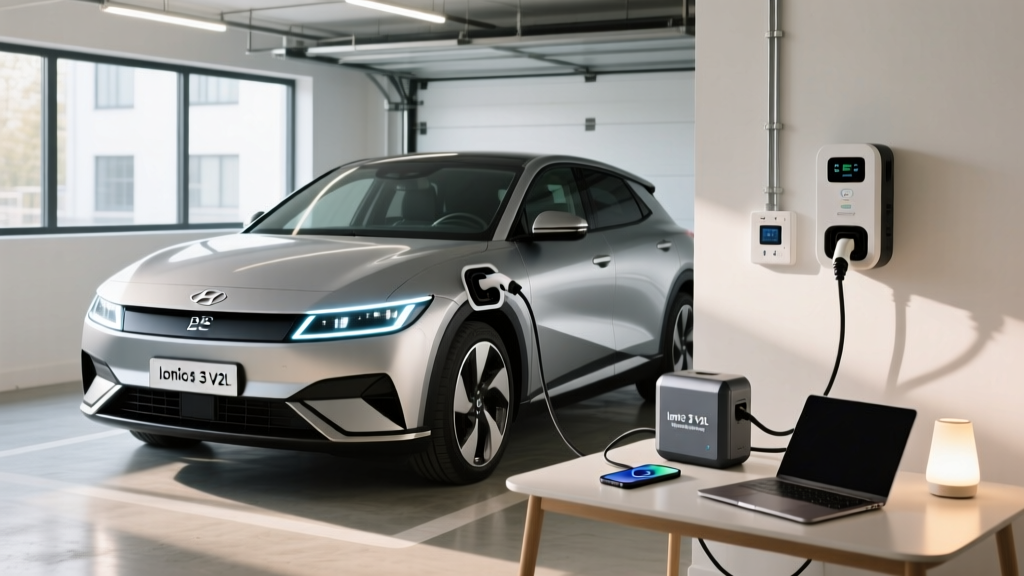
The Ioniq 5 V2L adapter plugs into the vehicle's external charge port (the same CCS1/NACS port you use for charging) and provides a standard 120V NEMA 5-15 household outlet on the other end. It effectively reverses the flow of electricity: instead of the grid filling the battery, the battery powers your devices.
- Max output: 3.6 kW (16A at 120V via adapter; up to 3.6 kW via interior V2L outlet on select trims)
- Outlet type: Standard NEMA 5-15 (120V) via external adapter
- Interior V2L outlet: Standard 120V outlet under rear seats (Limited trim, 2022–2026 model years)
- Battery capacity: 77.4 kWh usable (Long Range AWD/RWD)
- Reserve limit: User-configurable SoC floor (default ~20%) to protect driving range
Real-world applications: At 3.6 kW continuous output, you can simultaneously run a full-size refrigerator (~600W), a laptop charger (~90W), LED lighting (~50W), and a coffee maker (~1,200W) without tripping the limit. Over a weekend camping trip drawing an average 1.5 kW, the Ioniq 5's 77.4 kWh battery could supply roughly 50 hours of power before hitting a 20% SoC reserve — more than enough for three days off-grid.
Important limitations: The external V2L adapter is a separate accessory — Hyundai includes it standard on some trims but it must be purchased separately on others (approximately $150–$200 MSRP from Hyundai accessories). The V2L function will not operate if the vehicle's 12V auxiliary battery is depleted, and you should never draw sustained loads above 3.6 kW or use the adapter in wet conditions without weatherproof enclosures.
Charging Levels Explained: Speeds, Power, and Range Added
Before installing home equipment or planning road trips, you need to understand the three charging levels — and the critical distinction between kW (power, or how fast energy flows) and kWh (energy, or how much the battery stores). Think of kW as the width of a hose and kWh as the size of the bucket.
| Level | Power (kW) | Voltage / Amperage | Miles of Range per Hour | Best For |
|---|---|---|---|---|
| Level 1 | 1.0–1.9 kW | 120V / 12–16A | 3–5 mi/hr | Overnight top-ups, PHEVs, low-mileage drivers |
| Level 2 | 7.2–19.2 kW | 240V / 30–80A | 25–65 mi/hr | Daily home charging, workplace, destination |
| DC Fast | 50–350 kW | 200–920V DC | 150–1,200+ mi/hr (peak) | Road trips, highway corridors, quick top-ups |
Ioniq 5 specific charging speeds: The Ioniq 5's 800V battery architecture is one of its defining features. On a 350 kW DC fast charger, Hyundai rates the 77.4 kWh Long Range model for a 10–80% charge in approximately 18 minutes. In real-world testing, peak charge rates hit around 235–240 kW before tapering above 55–60% SoC — so sustained average power from 10–80% is closer to 150–170 kW. On a Level 2 home charger at 11 kW (the Ioniq 5's onboard charger limit), a full 0–100% charge takes roughly 7 hours.
The Ioniq 5 Long Range RWD carries an EPA-estimated 303 miles of range. In highway testing at 70 mph with moderate climate-control use, expect approximately 260–275 miles. In cold weather (below 30°F), range drops to roughly 220–250 miles due to battery heating demands and cabin HVAC load. These figures align with independent testing from fueleconomy.gov.
Home Charger Installation: Electrical Requirements and Costs
A Level 2 home charger is the backbone of convenient EV ownership. For the Ioniq 5, a 240V Level 2 station at 40–48 amps will fully recharge the 77.4 kWh battery overnight and is the sweet spot for cost and capability. Here's what the installation actually requires.
Electrical Panel and Circuit Requirements
A 48-amp continuous-load Level 2 charger requires a 60-amp dedicated circuit breaker (NEC Article 625 requires circuits rated at 125% of continuous load). This means your home's electrical panel needs at least 60 amps of spare capacity. Most modern 200-amp panels can accommodate this, but older homes with 100-amp service or panels already near capacity will need a panel upgrade — a significant additional cost.
Key considerations before installation:
- Panel capacity audit: Have a licensed electrician perform a load calculation per NEC Article 220. A 200A panel with gas appliances typically has room; all-electric homes may be tighter.
- Wire gauge: 6 AWG copper for 48A circuits; 4 AWG for 60A circuits on longer runs.
- Outlet vs. hardwired: A NEMA 14-50 outlet gives flexibility (you can unplug and take the charger if you move) but adds ~$50–$100 in parts. Hardwired installations are slightly cheaper and allow higher amperage without GFCI breaker requirements.
- GFCI protection: NEC 2020/2023 requires GFCI protection for EV receptacles — a 60A GFCI breaker costs $100–$150 more than a standard breaker.
- Permit: Most jurisdictions require an electrical permit for EV charger installation ($50–$200 depending on locality).
Installation Cost Breakdown
| Component | Simple Install (panel has capacity) | Complex Install (panel upgrade needed) |
|---|---|---|
| Level 2 charger (48A) | $400–$700 | $400–$700 |
| Electrician labor (2–6 hrs) | $300–$800 | $800–$2,000 |
| Wire, conduit, breaker, parts | $150–$400 | $300–$800 |
| Permit | $50–$200 | $100–$300 |
| Panel upgrade (100A → 200A) | N/A | $1,500–$3,500 |
| Total estimated cost | $900–$2,100 | $3,100–$7,300 |
Federal incentive note: The IRS §30C Alternative Fuel Vehicle Refueling Property Credit provides up to $1,000 (30% of equipment + installation costs, capped at $1,000) for home charger installations placed in service through 2032, subject to census-tract eligibility requirements. This is separate from the §30D vehicle purchase credit. Consult a tax professional for your specific eligibility.
Connector Compatibility: NACS, CCS1, and Adapter Requirements
The EV connector landscape has shifted dramatically. As of the 2025–2026 model years, the North American Charging Standard (NACS, originally Tesla's proprietary connector) has been adopted by nearly every major automaker. Here's where the Ioniq 5 stands:
| Connector Type | Ioniq 5 Compatibility | Adapter Needed? | Networks Accessible |
|---|---|---|---|
| CCS1 | Native (2022–2024 models); available on 2025+ via adapter | No (2022–2024); Yes (2025+ NACS models) | Electrify America, EVgo, ChargePoint DC |
| NACS | Native (2025+ models); adapter for 2022–2024 | No (2025+); Yes (2022–2024 CCS models) | Tesla Supercharger network (15,000+ stalls) |
| CHAdeMO | Not supported | No reliable adapter available | N/A (network largely discontinued) |
| J1772 (Level 2) | Via NACS-to-J1772 adapter (included with 2025+ models) | Yes (2025+); No (2022–2024 CCS) | All public Level 2 stations |
For 2025–2026 Ioniq 5 buyers: Hyundai transitioned the Ioniq 5 to the NACS port starting with the 2025 model year. This means native access to the Tesla Supercharger network without an adapter — a significant advantage for road-trip charging. However, to use older CCS1-equipped public chargers (which still make up a large portion of Electrify America and EVgo stations), you'll need a CCS1-to-NACS adapter. Hyundai provides one with new vehicle purchases in most markets; aftermarket adapters from brands like A2Z and Lectron cost $150–$250.
For 2022–2024 Ioniq 5 owners: Your vehicle has a native CCS1 port. Hyundai and third-party suppliers offer CCS1-to-NACS adapters (~$200–$250) enabling Supercharger access. Ensure any adapter you purchase is rated for the Ioniq 5's 800V architecture — not all adapters handle the higher voltage.
Cost to Charge: Home vs. Public vs. Gas Comparison
One of the strongest ownership arguments for the Ioniq 5 is fuel cost. The Long Range AWD model achieves an EPA-rated 110 MPGe combined (30 kWh/100 miles), making it one of the most efficient electric crossovers available. Here's what that translates to in dollars.
| Charging Scenario | Rate ($/kWh) | Cost per 100 Miles | Cost per Mile |
|---|---|---|---|
| Home (national avg electricity) | $0.17/kWh | $5.10 | $0.051 |
| Home (off-peak TOU rate) | $0.09/kWh | $2.70 | $0.027 |
| Public Level 2 (ChargePoint/EVgo) | $0.30/kWh | $9.00 | $0.090 |
| DC Fast (Electrify America) | $0.48/kWh | $14.40 | $0.144 |
| Tesla Supercharger (avg) | $0.35/kWh | $10.50 | $0.105 |
| Gas equivalent (25 MPG @ $3.40/gal) | — | $13.60 | $0.136 |
The bottom line: Charging at home on a standard rate saves roughly $8.50 per 100 miles compared to gas. Even DC fast charging at Electrify America is roughly cost-parity with gas. The savings compound dramatically for high-mileage drivers: at 12,000 miles per year, home charging saves approximately $1,020 annually versus a 25 MPG gas vehicle. Over five years, that's $5,100 in fuel savings alone — before factoring in reduced maintenance costs.
Recommended Level 2 Chargers for the Ioniq 5
Not all Level 2 chargers are created equal. For the Ioniq 5's 11 kW onboard charger, a 48-amp station is optimal. Here are three well-regarded options across price points, each with verified specifications.
Emporia Vue Level 2
- Power output: 48A / 11.5 kW (240V)
- Connector: J1772 (NACS adapter included with 2025+ vehicles)
- Cable length: 24 ft
- Smart features: Wi-Fi, app scheduling, energy monitoring, TOU optimization
- Price: ~$399
- Best for: Budget-conscious buyers who want smart scheduling
ChargePoint Home Flex
- Power output: Up to 50A / 12 kW (adjustable 16–50A via DIP switches)
- Connector: J1772 (NACS version available)
- Cable length: 23 ft
- Smart features: Wi-Fi, app control, Alexa integration, detailed session history
- Price: ~$549–$599
- Best for: Adjustable amperage for panel-constrained homes
Tesla Universal Wall Connector
- Power output: 48A / 11.5 kW (240V)
- Connector: NACS with integrated J1772 adapter (Magic Dock style)
- Cable length: 24 ft
- Smart features: Wi-Fi, OTA updates, power sharing with 2nd unit, scheduled charging
- Price: ~$599
- Best for: 2025+ NACS Ioniq 5 owners; multi-EV households
Editor's pick for Ioniq 5 owners: If you have a 2025+ NACS-equipped Ioniq 5, the Tesla Universal Wall Connector is the most seamless option — no adapter needed for daily home charging, and it's built to handle the Ioniq 5's 11 kW onboard charger limit perfectly. For 2022–2024 CCS1 models, the ChargePoint Home Flex with its J1772 connector and adjustable amperage is the most versatile choice, especially if your electrical panel has limited headroom.
Safety, Code Compliance, and Outdoor Installation
EV charging involves sustained high-current electrical loads — far beyond what a typical household appliance draws. Cutting corners on installation is both dangerous and a code violation. Here's what the National Electrical Code (NEC) requires and what you should insist on from your electrician.
- Dedicated circuit: Your Level 2 charger must be on its own dedicated circuit — no sharing with other outlets or appliances. This prevents overloads and nuisance tripping.
- GFCI protection: NEC 2020 and later requires ground-fault circuit interrupter protection on all EV charging receptacles. Hardwired chargers with built-in GFCI (like the Tesla Wall Connector) satisfy this without a separate GFCI breaker.
- Outdoor rating: If installing outdoors, the charger must carry a NEMA 3R or NEMA 4 rating (weather-resistant). All three chargers recommended above meet NEMA 4 or 4X standards.
- Cable management: NEC prohibits charging cables from running across walkways or driveways where they create a trip hazard. Wall-mount the charger close to your parking spot, and consider a cable holster or retractor.
- Load management: If your panel is near capacity but you want to avoid a costly upgrade, consider a smart panel-level load management system (like the Emporia Smart Panel or Span Drive). These devices dynamically throttle charger amperage when other household loads spike, keeping total draw within your panel's rating.
- Inspection: After installation, your local building department will typically require an inspection before the permit is finalized. Don't skip this — it's your protection against substandard work and is required for any insurance claims related to electrical fires.
Frequently Asked Questions
How much does it cost to install a home EV charger for the Ioniq 5?
A straightforward Level 2 installation on a panel with spare capacity typically costs $900–$2,100 all-in (charger, labor, parts, permit). If your home needs a panel upgrade from 100A to 200A service, total costs rise to $3,100–$7,300. Get at least three quotes from licensed electricians — prices vary significantly by region and job complexity.
How fast will each charging level add range to my Ioniq 5?
Level 1 (120V) adds roughly 3–5 miles per hour — adequate for plug-in hybrids but too slow for daily BEV use. Level 2 (240V, 48A) adds approximately 35–40 miles per hour to the Ioniq 5, fully recharging the 77.4 kWh battery in about 7 hours. DC fast charging at a 350 kW station can add 200+ miles in 18 minutes (10–80%), though actual speed depends on station power, battery temperature, and SoC taper.
Which connector does the 2025–2026 Ioniq 5 use, and what adapters do I need?
Starting with the 2025 model year, the Ioniq 5 uses the NACS connector natively. This gives direct access to Tesla Superchargers. For CCS1 public chargers (Electrify America, EVgo), you'll need a CCS1-to-NACS adapter (~$150–$250). For Level 2 public stations with J1772 connectors, a NACS-to-J1772 adapter is required — Hyundai typically includes one with new vehicles.
How much does charging the Ioniq 5 cost per mile compared to gas?
At the national average electricity rate of $0.17/kWh and the Ioniq 5's efficiency of 30 kWh/100 miles, home charging costs about $0.051 per mile. A comparable gas vehicle at 25 MPG and $3.40/gallon costs $0.136 per mile — nearly 2.7× more. Over 12,000 annual miles, home charging saves approximately $1,020 per year.
Can I use the Ioniq 5 V2L adapter to power my home during an outage?
The Ioniq 5's V2L adapter provides up to 3.6 kW through a standard 120V outlet — enough to run essential appliances (refrigerator, lights, phone chargers, a small space heater) individually or in modest combination. However, it is not a whole-home backup solution. You cannot back-feed V2L power into your home's electrical panel without a transfer switch and proper inverter setup, which Hyundai does not officially support. For full home backup, a vehicle with V2H (Vehicle-to-Home) capability — like the Ford F-150 Lightning with the Ford Charge Station Pro — is required. The Ioniq 5's V2L is best treated as a powerful portable generator, not a grid-tied backup system.
What electrical upgrades might my home need for a Level 2 charger?
The most common upgrade is a panel capacity increase if your existing 100A or 150A service doesn't have 60A of spare capacity for a dedicated charger circuit. Other potential upgrades include: running new conduit from the panel to the garage or carport (especially in homes where the panel is on the opposite side from the parking area), upgrading from a 100A to 200A main service ($1,500–$3,500), or installing a smart load-management system to avoid a panel upgrade entirely. A licensed electrician can perform a load calculation to determine exactly what your home requires.
Does DC fast charging degrade the Ioniq 5 battery faster than Level 2?
Modern battery management systems, including the Ioniq 5's advanced thermal preconditioning, have significantly reduced fast-charging degradation concerns. Hyundai's battery warranty covers 8 years / 100,000 miles with a capacity retention threshold of 70%. Real-world data from high-mileage Ioniq 5 owners shows typical degradation of 5–8% over 100,000 miles with mixed charging habits. That said, if most of your charging is at home, there's no reason to rely heavily on DC fast charging — save it for road trips to minimize cumulative thermal stress on the battery.