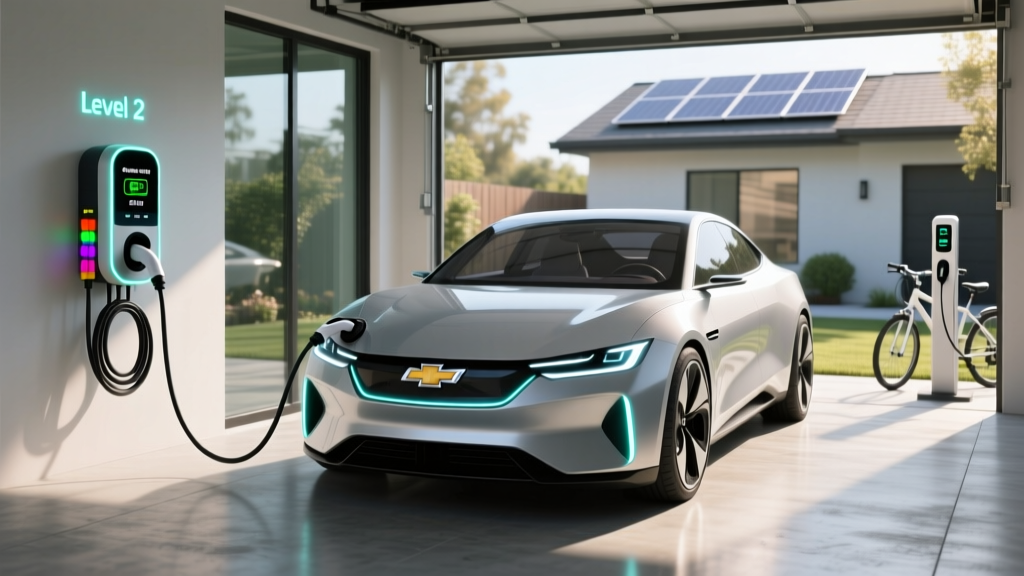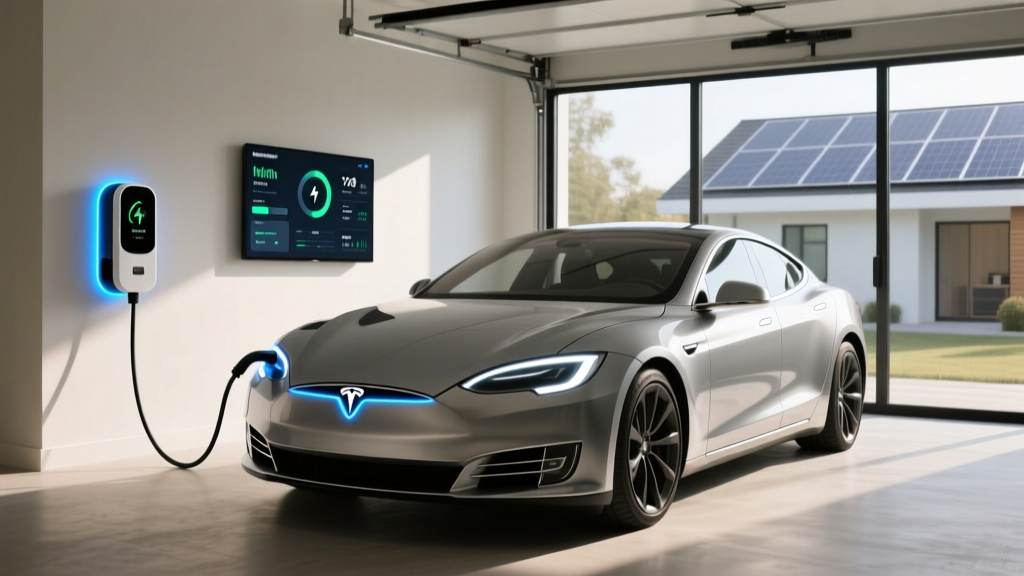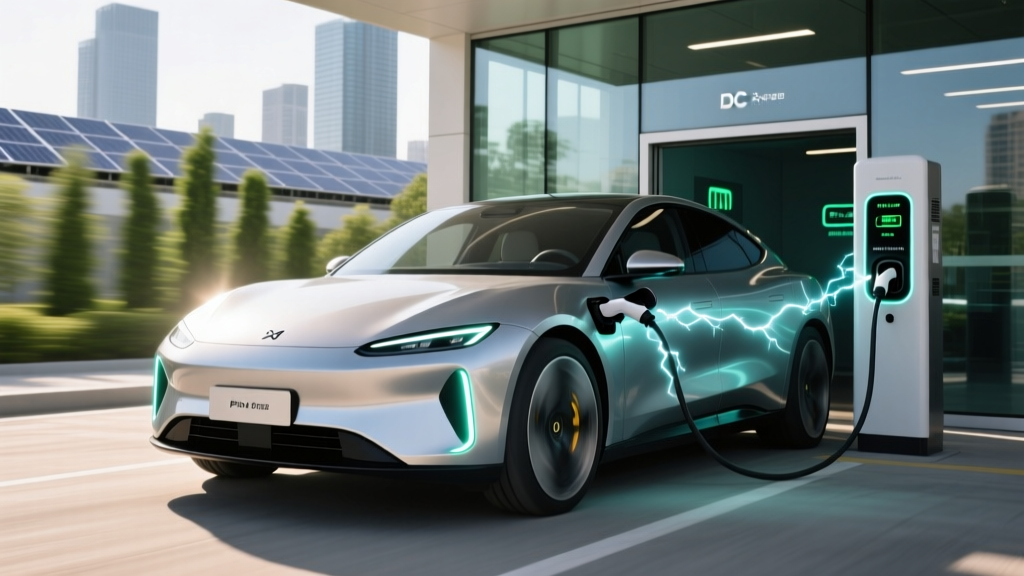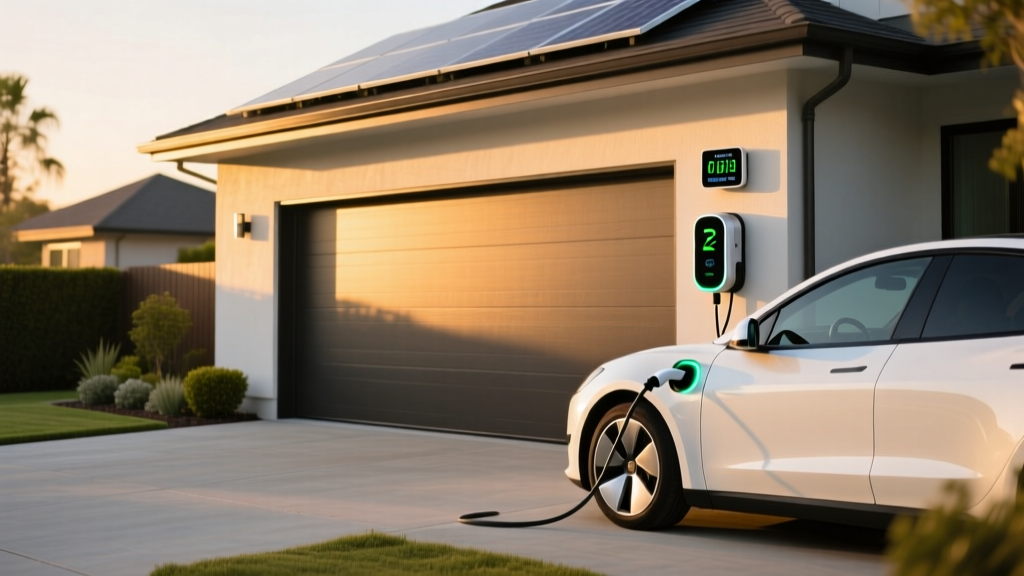
If you've bought or are considering a battery-electric vehicle, the single highest-impact ownership decision you'll make isn't which trim level to choose — it's how you'll charge at home. Public DC fast-charger networks have expanded dramatically, but 80–90% of all EV charging still happens in a driveway or garage. Investing in EV charging stations for residential use pays dividends in convenience, battery longevity, and cost-per-mile that no public network can match.
This guide breaks down exactly what it costs to install a home Level 2 charger in 2026, what electrical upgrades you might face, which connectors fit which vehicles, and which wall-mounted chargers deliver the best mix of power, reliability, and smart features. We'll also run the numbers on cost-per-mile versus gasoline so you can see the payback timeline clearly.
Charging Levels Explained: Speeds, Power, and Real-World Range Added
The first thing to nail down is the difference between kW (kilowatts) and kWh (kilowatt-hours). This is the most common EV literacy gap, and it matters when you're spending money on equipment:
- kW (kilowatts) = the rate of power delivery. Think of it as the width of the pipe. A 48-amp Level 2 charger delivers up to 11.5 kW of power.
- kWh (kilowatt-hours) = the total energy stored or delivered. Think of it as the volume of water in the tank. A 75 kWh battery holds 75 kWh of usable energy.
When you see a charger rated at 11.5 kW, that's how fast it can push energy into your battery per hour. The battery's kWh capacity determines how long a full charge takes. Here's how the three charging levels stack up:
| Level | Voltage | Max Power (kW) | Miles of Range Added/Hour | Typical Use Case |
|---|---|---|---|---|
| Level 1 | 120V AC | 1.2–1.9 kW | 3–5 miles | Overnight trickle; PHEVs; emergency backup |
| Level 2 | 240V AC | 3.3–19.2 kW | 12–75 miles | Home daily charging; workplace; destination |
| DC Fast Charge | 400–800V DC | 50–350+ kW | 150–1,200+ miles (theoretical/hr) | Road trips; highway corridors; 10–80% in 15–30 min |
Real-world context: Most EVs with 250–350 miles of EPA range have batteries between 60–100 kWh. A 48-amp (11.5 kW) Level 2 home charger will fully replenish a 75 kWh battery in roughly 7–8 hours — perfect for overnight charging. A 32-amp (7.7 kW) unit takes closer to 10 hours for the same pack.
How Much Does It Cost to Install a Home EV Charger?
Investing in EV charging stations for your home involves three cost layers: the charger hardware, the electrical labor, and any panel or wiring upgrades. Total costs vary widely depending on your home's existing electrical infrastructure.
| Component | Low-End Estimate | Typical Range | High-End / Complex Install |
|---|---|---|---|
| Level 2 Charger (hardware) | $300 | $400–$700 | $700–$1,000 |
| Electrician labor (new 240V circuit, ~50 ft run) | $500 | $800–$1,500 | $1,500–$3,000 |
| Electrical permit & inspection | $50 | $100–$250 | $250–$500 |
| Panel upgrade (100A → 200A service) | $1,500 | $2,000–$3,500 | $3,500–$5,000+ |
| Total (no panel upgrade) | $850 | $1,300–$2,450 | $2,450–$4,500 |
| Total (with panel upgrade) | $2,350 | $3,300–$5,950 | $5,950–$9,500+ |
The panel-upgrade variable is the biggest wildcard. Homes built before 1990 often have 100-amp service panels. Adding a 40–50 amp dedicated EV circuit on top of existing loads (HVAC, electric range, dryer) can exceed the panel's capacity. A licensed electrician will perform a load calculation per NEC Article 220 to determine if an upgrade is required. Don't skip this step — it's a code requirement and a safety necessity.
Some newer chargers and electrical panels support load-management software that dynamically limits EV charging when other circuits draw heavy power, potentially avoiding a panel upgrade. Systems like the Emporia VUE with Emporia Level 2 charger or the Span smart panel can manage this. Ask your electrician whether this is viable for your setup.
Electrical Requirements: What Your Home Needs for Level 2 Charging
A Level 2 home charger requires a dedicated 240-volt circuit, similar to what powers an electric dryer or oven. Here's what the installation involves:
- Voltage: 240V (split-phase, standard US residential)
- Amperage: 32A, 40A, or 48A circuits are most common. The breaker must be rated 125% above the continuous load — so a 40A charger needs a 50A breaker, and a 48A charger needs a 60A breaker.
- Wire gauge: Typically 6 AWG copper (for 50A breaker) or 4 AWG (for 60A breaker), depending on run length and local code.
- Dedicated circuit: The EV charger should have its own circuit — not shared with other appliances.
- GFCI protection: NEC 2020 and later require GFCI (Ground Fault Circuit Interrupter) protection for all EV charging outlets. Many hardwired chargers have built-in GFCI; if you're installing a NEMA 14-50 receptacle, a GFCI breaker is required.
- Outdoor rating: If mounting outdoors, the charger must carry a NEMA 4 or NEMA 4X rating for weather resistance. Most major chargers (ChargePoint, Emporia, Wallbox) meet this standard.
Hardwired vs. plug-in (NEMA 14-50): Hardwired installations eliminate the receptacle, reducing one potential failure point and often satisfying GFCI requirements through the charger's internal protection. A NEMA 14-50 outlet gives you portability — you can take the charger when you move — but requires a GFCI breaker ($50–$120 extra) and a quality industrial-grade receptacle. We recommend hardwired for permanent installations and 14-50 for renters or those planning to relocate.
Connector Compatibility: NACS, CCS, and CHAdeMO in 2026
The connector landscape has shifted dramatically. As of 2026, the North American Charging Standard (NACS) — originally developed by Tesla — has become the dominant connector for new EVs sold in North America. Most legacy CCS1 vehicles remain on the road, and adapters bridge the gap. Here's where things stand:
| Connector | Brands Using It (Native) | Adapter Needed? | Notes |
|---|---|---|---|
| NACS (Tesla-style) | Tesla, Ford, GM, Rivian, Volvo, Polestar, Mercedes-Benz, BMW, Hyundai, Kia, Subaru (2025+) | No (native on new models) | Standard for 2025+ models; access to Tesla Supercharger network |
| CCS1 | Legacy models: pre-2025 VW ID.4, BMW i4, older Ford/GM EVs | CCS-to-NACS adapter ($150–$250) for Supercharger access | Still widely available at Electrify America, EVgo public stations |
| CHAdeMO | Nissan Leaf (discontinued), Mitsubishi Outlander PHEV | Limited adapters available | Declining infrastructure; plan charging accordingly |
For home Level 2 charging: Most home chargers sold in 2026 ship with a NACS connector or offer it as a configurable option. If you drive a CCS1-equipped EV, you can buy a NACS-to-CCS adapter (from manufacturers like A2Z or Lectron, typically $150–$200) or choose a charger with a CCS1 cable. Check the charger's product page carefully — connector choice is now a configurable option on many units.
Cost to Charge: Per-Mile Economics vs. Gasoline
One of the strongest arguments for investing in EV charging stations at home is the per-mile fuel cost advantage. Here's a realistic comparison using 2026 national averages:
| Scenario | Rate | Cost Per Mile (250 Wh/mi EV) | Cost Per Mile (30 MPG Gas Car at $3.40/gal) |
|---|---|---|---|
| Home Level 2 (off-peak utility rate) | $0.09–$0.13/kWh | $0.023–$0.033 | $0.113 |
| Home Level 2 (standard residential rate) | $0.14–$0.18/kWh | $0.035–$0.045 | $0.113 |
| Public Level 2 (network pricing) | $0.25–$0.49/kWh | $0.063–$0.123 | $0.113 |
| DC Fast Charge (public) | $0.35–$0.65/kWh | $0.088–$0.163 | $0.113 |
Key takeaway: Home charging on an off-peak or standard residential rate delivers fuel costs at roughly one-quarter to one-third the per-mile cost of gasoline. Even public DC fast charging is often comparable to or slightly cheaper than gas on a per-mile basis — though frequent DC fast charging accelerates battery degradation and should be limited to road trips.
Many utilities now offer time-of-use (TOU) plans with deeply discounted overnight rates (often $0.07–$0.10/kWh between 10 PM and 6 AM). Pairing a smart charger with TOU scheduling — which chargers like the ChargePoint Home Flex and Emporia Vue handle natively — can push your effective fuel cost below $0.025/mile. Over 12,000 annual miles, that's roughly $300/year in electricity versus $1,360 in gasoline.
Charging Time Examples: 10–80% for Common Battery Sizes
EV batteries charge fastest between 10% and 80% state of charge (SoC). Above 80%, the charging curve tapers significantly to protect battery health — this is why DC fast-charger specs always quote 10–80% times. Here's what to expect at each level for common battery sizes:
| Battery Size | Example Vehicles | Level 1 (1.4 kW) | Level 2 (7.7 kW / 32A) | Level 2 (11.5 kW / 48A) | DC Fast (peak kW) |
|---|---|---|---|---|---|
| 58 kWh (usable) | VW ID.4 Standard, base Nissan Ariya | ~29 hours | ~5.3 hours | ~3.5 hours | ~22 min (135 kW peak) |
| 75 kWh (usable) | Tesla Model Y Long Range, Ford Mustang Mach-E Extended | ~37 hours | ~6.8 hours | ~4.6 hours | ~25 min (170 kW peak) |
| 92 kWh (usable) | Rivian R1S, GMC Sierra EV, Chevy Silverado EV | ~46 hours | ~8.4 hours | ~5.6 hours | ~30 min (200+ kW peak) |
| 115 kWh (usable) | GMC Hummer EV, Chevy Silverado EV Max | ~58 hours | ~10.5 hours | ~7 hours | ~35 min (350 kW peak, 800V) |
Real-world caveats: DC fast-charging times assume optimal battery temperature (preconditioned), ambient temps above 50°F, and a charger capable of sustaining the vehicle's peak rate. In cold weather (below 32°F), expect 10–80% times to increase by 20–40% unless the vehicle actively preconditioned the battery during navigation to the charger. Also, peak kW is rarely sustained for the entire session — a 250 kW-capable vehicle might peak at 240 kW at 15% SoC but taper to 60 kW by 70%.
Top Level 2 Home Chargers for 2026: Equipment Picks
Based on reliability data, power output, smart features, connector options, and price-to-performance ratio, here are the Level 2 chargers we recommend for home installation in 2026:
Emporia Level 2 EV Charger
- Power Output: 48A / 11.5 kW (240V)
- Connector: NACS (native); CCS1 with adapter
- Cable Length: 24 ft
- Smart Features: Wi-Fi, app scheduling, TOU rate optimization, energy monitoring (pairs with Emporia VUE panel monitor for load management)
- Price: ~$399 (charger only)
- Best For: Budget-conscious buyers wanting full smart features and load-management capability to avoid panel upgrades
ChargePoint Home Flex (2nd Gen)
- Power Output: Up to 50A / 12 kW (configurable 16A–50A via DIP switches)
- Connector: NACS or CCS1 (select at purchase)
- Cable Length: 23 ft
- Smart Features: Wi-Fi, ChargePoint app, Alexa integration, scheduling, detailed session history
- Price: ~$599
- Best For: Buyers wanting a proven brand with flexible amperage configuration and robust app ecosystem
Wallbox Pulsar Plus
- Power Output: 40A / 9.6 kW or 48A / 11.5 kW models available
- Connector: NACS or J1772 (CCS1 via adapter)
- Cable Length: 25 ft
- Smart Features: Wi-Fi + Bluetooth, myWallbox app, Power Sharing (link two chargers on one circuit), Eco-Smart solar integration
- Price: ~$449–$649 depending on amperage
- Best For: Two-EV households needing power-sharing on a single circuit; solar-panel owners
Tesla Wall Connector (Gen 4)
- Power Output: 48A / 11.5 kW
- Connector: NACS (native); J1772 adapter included for non-Tesla EVs
- Cable Length: 24 ft
- Smart Features: Wi-Fi, Tesla app, over-the-air updates, Power Sharing with additional Wall Connectors, vehicle-specific charge limits
- Price: ~$475
- Best For: Tesla owners; mixed fleets with NACS and J1772 vehicles
Safety, Electrical Code, and Installation Best Practices
EV charging draws significant continuous current for hours at a time — this is not the same as plugging in a phone. Follow these safety and code requirements to protect your home and ensure a compliant installation:
- Dedicated circuit only: Never share the EV charger circuit with other loads. Per NEC 625.40, EV supply equipment requires an individual branch circuit.
- Continuous load derating: EV charging qualifies as a continuous load (3+ hours). The circuit breaker must be rated at 125% of the charger's maximum draw. A 48A charger requires a 60A breaker.
- GFCI protection: Required for all receptacle-based (plug-in) installations per NEC 625.54. Hardwired chargers with internal GFCI protection may satisfy this requirement depending on local AHJ (Authority Having Jurisdiction) interpretation.
- Permit and inspection: Virtually all jurisdictions require an electrical permit for a new 240V circuit. The inspection verifies wire gauge, breaker sizing, grounding, and GFCI compliance. Budget $100–$300 for the permit fee and plan for a 1–3 week inspection timeline.
- Use a licensed electrician: This is not a DIY project for most homeowners. Improper EV charger wiring has been linked to electrical fires. Verify your electrician holds a current license and carries liability insurance. Ask specifically about their EV charger installation experience.
- Cable management: Wall-mount a cable organizer or holster to keep the charging cable off the garage floor. This prevents trip hazards, cable damage from vehicles, and connector contamination.
For more details on electrical code requirements, refer to the National Electrical Code (NFPA 70) and your local building department's EV-specific guidelines.
Frequently Asked Questions
How much does it cost to install a home EV charger?
A typical Level 2 home charger installation costs between $1,300 and $2,450 when no panel upgrade is needed. This includes the charger hardware ($300–$700), electrician labor for a new 240V dedicated circuit ($800–$1,500), and permits ($100–$250). If your home requires a panel upgrade from 100A to 200A service, add $2,000–$5,000 to the total. Homes with a nearby electrical panel and short wire runs will be at the lower end; long conduit runs, trenching, or sub-panel installations push costs higher.
How fast will each charging level add range?
Level 1 (120V) adds roughly 3–5 miles of range per hour — adequate for plug-in hybrids with 30–50 miles of electric range but impractical for full EVs. Level 2 (240V) at 32 amps adds approximately 25–30 miles per hour, and at 48 amps adds roughly 35–45 miles per hour, depending on vehicle efficiency. DC fast charging at 150–350 kW can add 100–300+ miles in a 20–30 minute session, though real-world speed depends on battery temperature, state of charge, and the vehicle's charge curve taper.
Which connector/charger is compatible with my EV?
For 2025–2026 model-year vehicles from Tesla, Ford, GM, Rivian, Hyundai, Kia, BMW, Mercedes, Volvo, and Polestar, the native connector is NACS. Older EVs (pre-2025) from VW, BMW, Ford, and GM typically use CCS1. The Nissan Leaf uses CHAdeMO. When buying a home charger, select the connector that matches your vehicle — or choose a NACS charger with a J1772/CCS adapter for flexibility. Check your vehicle's charge port or consult the manufacturer's spec sheet to confirm.
How much does charging cost per mile vs. gas?
Home Level 2 charging on a standard residential electricity rate ($0.14–$0.18/kWh) costs roughly $0.035–$0.045 per mile for an EV averaging 250 Wh/mile — about one-third the cost of a 30 MPG gasoline car at $3.40/gallon ($0.113/mile). With overnight off-peak utility rates ($0.09–$0.12/kWh), the EV cost drops to $0.023–$0.030 per mile. Public DC fast charging ($0.35–$0.65/kWh) is more expensive at $0.09–$0.16 per mile but still generally competitive with or cheaper than gasoline. See the U.S. Department of Energy's EV fuel cost comparison tool for state-specific calculations.
What electrical upgrades might I need?
The most common upgrade is a panel capacity increase from 100A to 200A service, required when the existing panel cannot support an additional 40–60A continuous load. Your electrician will perform a NEC Article 220 load calculation to determine this. Other potential upgrades include: running a new conduit from the panel to the garage or driveway ($500–$1,500 for long runs), installing a sub-panel closer to the charger location, upgrading the meter base (utility coordination required), or adding a smart load-management system to avoid a panel upgrade entirely. Homes with 200A or larger service typically need no panel upgrade for a single Level 2 charger.
Is there a tax credit for home EV charger installation?
The federal Alternative Fuel Vehicle Refueling Property Credit (IRS Form 8911) provides a credit of up to 30% of the cost of home EV charging equipment and installation, capped at $1,000 per tax year. However, eligibility is restricted to equipment installed in census tracts that are classified as low-income or non-urban. Verify your address eligibility before counting on this credit. State and utility rebates may also apply — check your local utility's EV programs and your state energy office for additional incentives.