The Real Cost to Install a Tesla Home Charger in 2026
If you own a Tesla—or any EV with a NACS connector—the single most impactful upgrade you can make is a Level 2 home charging station. But the question every new EV owner asks is: what does it actually cost to install a Tesla home charger? The honest answer spans a wide range depending on your home's electrical panel, the distance from that panel to your garage or driveway, and which charger hardware you select.
Based on current 2026 pricing, a straightforward Tesla Wall Connector installation on an existing 60-amp circuit typically runs $800 to $1,700 total (equipment plus labor). If your home needs an electrical panel upgrade or a new dedicated circuit run over a long distance, costs can climb to $2,500–$4,500+. Below, we break down every line item so you can budget accurately and avoid surprises.
Before diving into costs, let's clear up the most common EV confusion. kW (kilowatts) measures power—the rate at which energy flows, like water pressure in a hose. kWh (kilowatt-hours) measures energy—the total amount stored or delivered over time, like gallons in a bucket. A 48-amp charger delivers up to 11.5 kW of power. A Tesla Model Y Long Range has a ~75 kWh usable battery. Charging that battery from empty at 11.5 kW would take roughly 6.5 hours. We'll use kW for charge rates and kWh for battery capacity throughout this guide.
Charging Levels Explained: Speeds, Costs, and What You Need
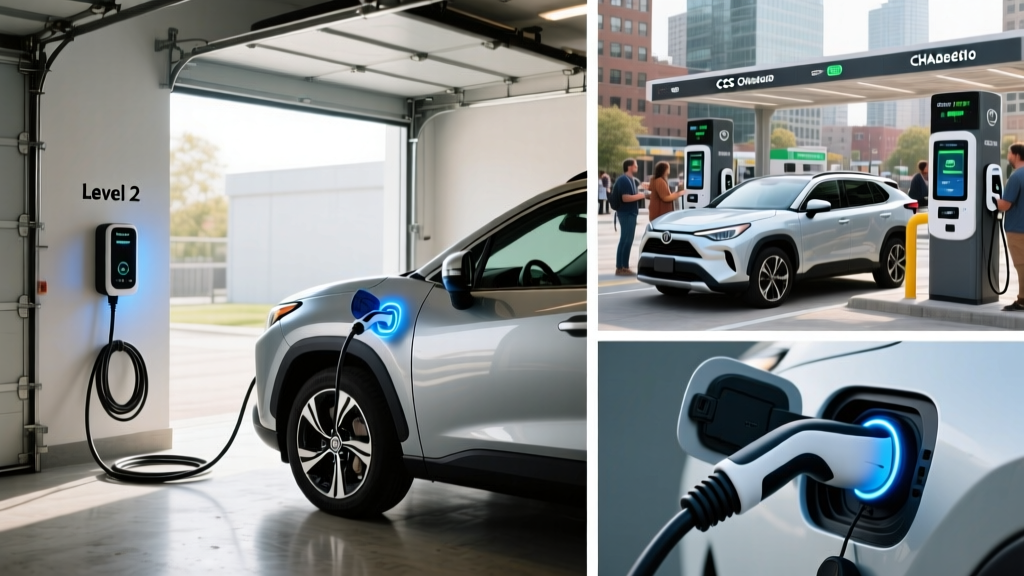
Home charging falls into two categories: Level 1 (standard 120V outlet) and Level 2 (240V dedicated circuit). DC Fast Charging is the public-road-trip option. Here's how each compares:
| Level | Voltage | Max Power (kW) | Miles of Range Added/Hour | Best For |
|---|---|---|---|---|
| Level 1 (120V) | 120V / 12A | ~1.4 kW | 3–5 mi/hr | Overnight top-up, PHEVs, low daily mileage |
| Level 2 (240V) | 240V / 40–48A | 9.6–11.5 kW | 30–44 mi/hr | Daily home charging, all BEVs |
| DC Fast Charge | 400–800V DC | 50–350 kW | 150–1,000+ mi/hr | Road trips, public stations |
For a Tesla Model Y with a ~75 kWh battery, Level 1 charging would take 50+ hours for a full charge—impractical for most owners. A Level 2 Tesla Wall Connector at 11.5 kW replenishes that same battery in roughly 6.5 hours, meaning an overnight session easily covers any daily driving. For reference, the U.S. Department of Energy recommends Level 2 as the minimum practical home charging solution for battery-electric vehicles.
Tesla Wall Connector Hardware: Specs, Pricing, and Options
Tesla's current-generation Wall Connector is a hardwired Level 2 unit rated for up to 48 amps (11.5 kW on a 60-amp dedicated circuit). It retails for approximately $475 directly from Tesla and includes:
- 24-foot cable length
- Integrated NACS (Tesla) connector—no adapter needed for Tesla vehicles
- Wi-Fi connectivity for firmware updates and energy monitoring via the Tesla app
- Indoor/outdoor rated (NEMA 3R enclosure)
- Load-sharing capability when multiple Wall Connectors are installed on one circuit
- Compatibility with all NACS-equipped EVs (which now includes Ford, GM, Rivian, and others using the North American Charging Standard)
If you drive a non-Tesla EV with a CCS1 port, you'll need a NACS-to-CCS adapter (available from Tesla for approximately $199) or you can opt for a third-party J1772/NACS universal charger. We cover adapter compatibility in the connector section below.
Alternative Level 2 Chargers for Tesla/NACS Owners
Power: 11.5 kW (48A)
Connector: NACS native
Cable: 24 ft
Smart features: Wi-Fi, app monitoring, load sharing
Price: ~$475
Power: Up to 12 kW (50A adjustable)
Connector: NACS (2025+ model) or J1772
Cable: 23 ft
Smart features: Wi-Fi, Alexa, scheduling, energy reports
Price: ~$599
Power: Up to 11.5 kW (48A)
Connector: NACS or J1772
Cable: 24 ft
Smart features: Wi-Fi, solar integration, energy dashboard
Price: ~$399
The Tesla Wall Connector remains the best value for Tesla owners specifically—native NACS, no adapter required, and seamless integration with the Tesla app. The ChargePoint Home Flex offers more granular scheduling and smart-home integration if you want cross-brand flexibility.
Installation Cost Breakdown: Equipment, Electrician, Permits, and Panel Upgrades
Here's where the "install Tesla home charger cost" question gets detailed. Your total depends heavily on three variables: the amperage of the circuit you need, the distance from your electrical panel to the charger location, and whether your panel can handle the additional load.
| Cost Component | Simple Install (Short Run, Adequate Panel) | Complex Install (Long Run or Panel Upgrade) |
|---|---|---|
| Tesla Wall Connector hardware | $475 | $475 |
| Electrician labor (licensed) | $300–$700 | $800–$2,000 |
| Electrical materials (conduit, wire, breaker) | $50–$150 | $200–$600 |
| Permit (local electrical) | $50–$150 | $50–$200 |
| Panel upgrade (100A → 200A, if needed) | N/A | $1,500–$3,000 |
| Total Estimated Cost | $875–$1,475 | $3,025–$6,275 |
What Drives the Cost Up?
Panel capacity: A 48-amp charger requires a 60-amp dedicated circuit (the National Electrical Code requires circuits to be rated at 125% of the continuous load). If your home has a 100-amp main panel that's already near capacity, you'll need a service upgrade to 200 amps. This is the single biggest cost variable and is common in homes built before 1990.
Wire run distance: If your panel is in the basement and the charger goes in an attached garage 10 feet away, labor and materials are minimal. If the panel is on one side of the house and the charger goes in a detached garage 80 feet away, you'll pay significantly more for wire (6 AWG copper or 4 AWG aluminum for a 60-amp circuit) and conduit.
Conduit and code requirements: Many jurisdictions now require GFCI protection on 240V EV circuits, which can add $50–$100 for a GFCI breaker. Outdoor installations may require specific weatherproof enclosures or mounting hardware.
Permits: Most municipalities require an electrical permit for a new 240V circuit. The permit ensures the work is inspected for safety. Skipping the permit to save $100 can void your homeowner's insurance if a fire occurs—never worth the risk.
Connector Compatibility: NACS, CCS1, and Adapters
The connector landscape has consolidated significantly since 2024, when Ford, GM, Rivian, and most major automakers adopted the North American Charging Standard (NACS) originally developed by Tesla. Here's where things stand:
| Connector | Vehicles Using It (2026) | Tesla Wall Connector Compatible? |
|---|---|---|
| NACS (Tesla) | All Tesla models, Ford F-150 Lightning/Mach-E, GM EVs (Blazer, Equinox, Silverado EV, Cadillac Lyriq), Rivian R1T/R1S, Hyundai Ioniq 5/6 (2025+), most new BEVs | Yes — native, no adapter |
| CCS1 | Older non-Tesla EVs (2022 and earlier VW ID.4, older Bolt EV, etc.) | No — requires NACS-to-CCS1 adapter (~$199) |
| CHAdeMO | Nissan Leaf (legacy), Mitsubishi Outlander PHEV | No — CHAdeMO adapter not available for Wall Connector; use J1772 charger with adapter |
| J1772 (Level 2) | All non-Tesla EVs for AC Level 2 charging | No — Tesla includes a J1772 adapter with vehicles, or use a J1772 home charger |
If you exclusively drive Tesla vehicles, the Wall Connector is a plug-and-play solution. If your household includes a non-Tesla EV with CCS1, consider either purchasing Tesla's NACS-to-CCS adapter or installing a second charger with a J1772/NACS universal connector.
Cost to Charge at Home vs. Gas: The Per-Mile Math
One of the most compelling reasons to install a home charger is the dramatic per-mile cost reduction compared to gasoline. Here's the math using 2026 national averages:
| Scenario | Rate | Cost Per Mile (EV at 3.5 mi/kWh) | Cost Per Mile (Gas at 28 MPG) |
|---|---|---|---|
| Home charging (national avg. residential) | $0.16/kWh | $0.046/mi | $0.125/mi (at $3.50/gal) |
| Home charging (off-peak TOU rate) | $0.08/kWh | $0.023/mi | $0.125/mi (at $3.50/gal) |
| Home charging (high-cost state, e.g., CA avg.) | $0.30/kWh | $0.086/mi | $0.157/mi (at $4.40/gal) |
| Public DC Fast Charging (avg.) | $0.35–$0.48/kWh | $0.10–$0.14/mi | Varies by state |
At a national average residential rate of $0.16/kWh and a typical EV efficiency of 3.5 miles per kWh (roughly what a Tesla Model Y achieves per fueleconomy.gov), home charging costs about 4.6 cents per mile. A comparable gasoline SUV at 28 MPG and $3.50/gallon costs 12.5 cents per mile—nearly three times more.
If your utility offers a time-of-use (TOU) plan with off-peak rates (typically overnight between 10 PM and 6 AM), you can cut your home charging cost to roughly 2–3 cents per mile. The Tesla app allows you to schedule charging to begin during these off-peak windows automatically.
For a driver covering 12,000 miles per year, the annual fuel savings of home charging vs. gasoline ranges from $600 to $1,200 depending on local electricity and gas prices. Over five years, that's $3,000–$6,000—enough to offset the charger installation cost many times over.
Charging Time Examples: What to Expect
Charge times depend on your battery size, the charger's power output, and the vehicle's onboard acceptance rate. Note that charging slows significantly above 80% State of Charge (SoC) to protect battery health—this is called the charge curve taper. Here are realistic 10–80% times for common scenarios:
- Tesla Model Y Long Range (~75 kWh usable) on Tesla Wall Connector (11.5 kW): ~4.5 hours for 10–80%
- Tesla Model 3 Standard Range (~57 kWh usable, LFP) on Wall Connector (11.5 kW): ~3.5 hours for 10–80%
- Tesla Model S (~100 kWh usable) on Wall Connector (11.5 kW): ~6 hours for 10–80%
- Any EV on Level 1 (1.4 kW): 10–80% takes 30–50 hours depending on battery size—only practical as a trickle-charge supplement
- Tesla Model Y on DC Fast Charge (250 kW peak): 10–80% in approximately 25–30 minutes at a Supercharger V3/V4 station
For daily use, most owners plug in each evening and wake up to a full charge. You'll rarely need to charge from 10% at home—the overnight window provides more than enough time to replenish even a heavily depleted battery on Level 2.
Safety, Electrical Code, and Best Practices
A Level 2 charger draws significant current for extended periods—this is classified as a continuous load under the National Electrical Code (NEC). Here's what your installation must include:
- Dedicated circuit: Your charger must be on its own breaker, not shared with other appliances. A 48-amp charger requires a 60-amp breaker; a 40-amp charger requires a 50-amp breaker.
- GFCI protection: The 2020 NEC (adopted by most jurisdictions by 2026) requires GFCI protection for all EV charging outlets. For hardwired installations like the Tesla Wall Connector, a GFCI breaker is typically required. This adds $50–$100 but protects against ground faults.
- Wire gauge: A 60-amp circuit requires minimum 6 AWG copper wire (or 4 AWG aluminum). Your electrician will size this based on the run length—longer runs may need thicker wire to prevent voltage drop.
- Outdoor rating: If installing outdoors, ensure the Wall Connector's NEMA 3R rating is adequate for your climate. The unit is rated for rain and sleet but should be mounted under an overhang in areas with heavy snow accumulation.
- Permit and inspection: Always pull a permit. The inspection ensures your installation meets code and protects your home insurance coverage. The National Fire Protection Association maintains the NEC standards that local inspectors enforce.
If your home has a 100-amp electrical service and you're already running central A/C, an electric oven, and a dryer, adding a 60-amp EV circuit will likely exceed your panel's capacity. Signs you may need an upgrade: frequent breaker trips, a panel with no open slots, or a home built before 1985. A licensed electrician can perform a load calculation to determine if your panel can handle the additional circuit. Budget $1,500–$3,000 for a 200-amp service upgrade if needed.
Federal Tax Credit for Home Charger Installation
The federal Alternative Fuel Vehicle Refueling Property Credit (IRS Form 8911) covers 30% of the cost of home EV charger equipment and installation, up to a maximum of $1,000. Key eligibility rules for 2026:
- The charger must be installed at your primary residence
- The property must be located in an eligible census tract (typically non-urban or lower-income areas—check the IRS census tract locator)
- The credit covers both equipment and installation labor
- Maximum credit is $1,000 (30% of up to $3,333 in qualifying expenses)
- This is a non-refundable credit—you must have sufficient tax liability to claim it
If your installation costs $1,500 total ($475 hardware + $1,025 labor/permit), you'd qualify for $450 back as a federal tax credit (30% of $1,500), assuming you meet the census tract requirement and have sufficient tax liability. Consult a tax professional to confirm your eligibility, as rules and eligible census tracts are subject to change.
Frequently Asked Questions
How much does it cost to install a Tesla home charger?
For a straightforward installation with an adequate electrical panel and a short wire run, expect $875–$1,475 total (hardware, labor, materials, and permit). If you need a panel upgrade or a long conduit run, costs range from $3,025–$6,275. The Tesla Wall Connector itself costs ~$475.
Can I install the Tesla Wall Connector myself?
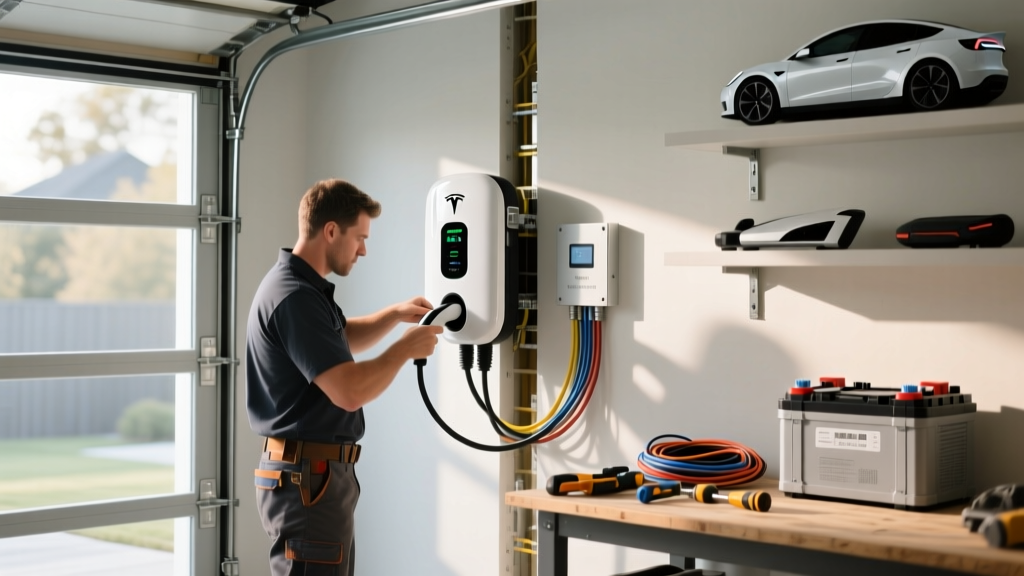
Tesla strongly recommends—and most local codes require—a licensed electrician for hardwired 240V installations. DIY electrical work at 60 amps carries serious fire and shock risk and will likely void your homeowner's insurance if unpermitted. The Wall Connector is hardwired (not a plug-in unit), so there is no shortcut around professional installation.
Do I need a panel upgrade for a Tesla charger?
Not always. If you have a 200-amp service with available capacity, a new 60-amp breaker is straightforward. If you have a 100-amp service that's already heavily loaded, a panel upgrade to 200 amps will be necessary. Your electrician will perform a load calculation per NEC Article 220 to determine this.
Will the Tesla Wall Connector work with non-Tesla EVs?
Yes. Since 2024, most new EVs from Ford, GM, Rivian, Hyundai, and others ship with NACS ports. The Tesla Wall Connector uses the NACS connector natively, so it works with any NACS-equipped vehicle without an adapter. For older CCS1 vehicles, a NACS-to-CCS adapter is required.
How fast does a Tesla Wall Connector charge compared to a regular outlet?
A standard 120V outlet (Level 1) adds roughly 3–5 miles of range per hour. The Tesla Wall Connector at 48 amps (11.5 kW) adds approximately 44 miles of range per hour—roughly 10 times faster. An overnight 8-hour session on Level 2 adds about 350 miles, more than enough for any daily driving.
Is there a monthly fee or subscription for the Tesla Wall Connector?
No. The Wall Connector has no subscription or monthly fee. Wi-Fi connectivity and app-based energy monitoring are included. You pay only for the electricity you consume, billed through your regular utility account.