Buying a Tesla—or any EV with a NACS port—is only half the equation. The other half is figuring out how to charge it efficiently at home, and more importantly, what that installation will actually cost. If you've searched for the install Tesla charger at home cost and found vague answers ranging from "$500 to $5,000," you're not alone. The truth is more nuanced, and this guide gives you the exact numbers you need to budget properly in 2026.
We'll walk through the three charging levels, electrical requirements, real installation cost breakdowns, connector compatibility, ongoing charging costs, and equipment picks. No fluff, just data.
Understanding EV Charging Levels: Speeds in kW and Miles Per Hour
Before calculating installation costs, you need to understand what you're installing. EV charging happens at three levels, each with different power requirements and speeds. The critical distinction: kW (kilowatts) measures power—how fast energy flows into your car—while kWh (kilowatt-hours) measures energy—the total capacity of your battery. Think of kW as the diameter of a hose and kWh as the size of the bucket.
| Level | Voltage | Power (kW) | Miles Added Per Hour | Typical Use Case |
|---|---|---|---|---|
| Level 1 | 120V AC | 1.0–1.4 kW | 3–5 mi/hr | Overnight trickle; emergency |
| Level 2 | 240V AC | 7.2–19.2 kW | 25–70 mi/hr | Home daily charging; workplace |
| DC Fast | 400–800V DC | 50–350 kW | 180–1,000+ mi/hr | Road trips; public stations |
For home use, Level 2 is the standard. A Level 1 plug into a regular 120V outlet adds roughly 4 miles of range per hour—adequate only if you drive under 30 miles daily and can leave the car plugged in for 10+ hours. Level 2 at 240V is what makes EV ownership practical for the vast majority of drivers.
DC fast charging is a public-infrastructure technology. You won't install a 150 kW Supercharger in your garage—the electrical service required (often 480V three-phase) is commercial-grade and prohibitively expensive for residential use.
How Much Does It Cost to Install a Tesla Charger at Home?
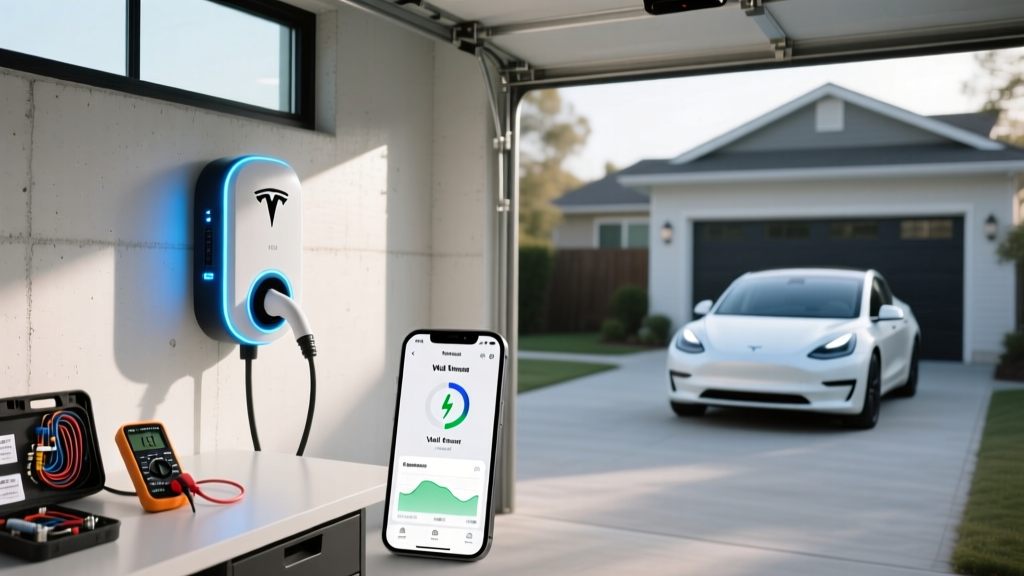
The total cost to install a Tesla Wall Connector at home typically ranges from $1,000 to $3,500 for a straightforward installation, but can climb to $4,000–$8,000+ if your electrical panel needs an upgrade. Here's a realistic breakdown:
| Cost Component | Simple Install | Moderate Install | Complex Install (Panel Upgrade) |
|---|---|---|---|
| Tesla Wall Connector (equipment) | $420 | $420 | $420 |
| Electrician labor (2–6 hrs @ $100–$150/hr) | $300–$500 | $500–$900 | $800–$1,500 |
| Materials (conduit, wire, breaker) | $100–$200 | $200–$500 | $300–$600 |
| Permit fee | $50–$150 | $50–$200 | $100–$300 |
| Electrical panel upgrade (if needed) | $0 | $0 | $1,500–$4,000 |
| Total Estimated Range | $870–$1,270 | $1,170–$2,020 | $3,120–$6,820 |
What drives the cost variation?
- Distance from panel to charger location: A Wall Connector mounted 10 feet from your breaker box costs far less in wire and conduit than one mounted 60 feet away in a detached garage.
- Wire gauge and conduit: A 60A circuit requires 6 AWG copper wire (or 4 AWG aluminum), which costs $3–$6 per foot. Longer runs add up quickly.
- Wall type: Running wire through finished drywall requires cutting, fishing, and patching—more labor than exposed basement or garage walls.
- Local permit requirements: Most jurisdictions require a permit for new 240V circuits. Fees vary from $50 to $300 depending on your municipality.
The panel-upgrade wildcard
Here's the cost factor most online guides gloss over: your home's electrical panel capacity. A Tesla Wall Connector on a 60A circuit draws 48 continuous amps (EV chargers are considered continuous loads under the National Electrical Code, meaning the circuit must be rated 125% above the continuous draw).
If your home has a 100A main panel—a common setup in houses built before the 1990s—you likely don't have enough spare capacity for a 60A EV circuit. Upgrading to a 200A panel typically costs $1,500 to $4,000, depending on your utility's requirements, local labor rates, and whether the service mast and meter base also need replacement.
Pro tip: Before hiring an electrician, check your panel's main breaker rating (the large switch at the top) and add up your existing major loads (HVAC, electric oven, dryer, water heater). If you're already near 80% of your panel's capacity with existing loads, a panel upgrade or a lower-amperage circuit is inevitable.
Electrical Requirements: What Your Home Needs for a Tesla Wall Connector
The Tesla Wall Connector is configurable across multiple amperage settings, which gives you flexibility if your panel can't support the maximum draw:
| Circuit Breaker | Continuous Output | Power at 240V | Miles Per Hour (Model Y) |
|---|---|---|---|
| 60A | 48A | 11.5 kW | ~44 mi/hr |
| 50A | 40A | 9.6 kW | ~37 mi/hr |
| 40A | 32A | 7.7 kW | ~30 mi/hr |
| 30A | 24A | 5.8 kW | ~22 mi/hr |
| 20A | 16A | 3.8 kW | ~15 mi/hr |
For most Tesla owners, a 60A circuit / 48A continuous setup is ideal. It delivers up to 11.5 kW, which fully replenishes a Model Y Long Range's ~75 kWh usable battery in roughly 7 hours—perfect for overnight charging.
Safety and code requirements
Your installation must comply with NEC Article 625 (Electric Vehicle Charging System Equipment) and local amendments. Key requirements:
- Dedicated circuit: The Wall Connector must be on its own breaker—no sharing with other outlets or appliances.
- GFCI protection: The 2023 NEC (adopted by most states by 2026) requires GFCI protection for all EV charging outlets. Tesla Wall Connectors have built-in ground-fault protection, but hardwired installations may need a GFCI breaker depending on your local inspector's interpretation.
- Outdoor rating: If mounting outdoors, the Wall Connector's NEMA 4 rating handles rain and dust. However, the conduit and junction boxes must also be rated for wet locations.
- Wire sizing: Undersized wire creates fire risk. Your electrician will calculate the correct gauge based on circuit amperage, run length, and voltage-drop considerations (runs over 50 feet typically require upsizing).
Connector Compatibility: Will the Tesla Wall Connector Work With Non-Tesla EVs?
This is where the connector landscape matters. The Tesla Wall Connector uses the NACS (North American Charging Standard) connector—formerly proprietary to Tesla but now adopted by nearly every major automaker for 2025 and newer models.
| Connector | Brands Using It (2026) | Tesla Wall Connector Compatible? |
|---|---|---|
| NACS (Tesla) | Tesla, Ford, GM, Rivian, Hyundai, Kia, BMW, Mercedes, Volvo, Polestar, Nissan (new models) | Yes — native fit |
| CCS1 | Older-model VW ID.4, Audi e-tron (pre-2025), some Stellantis EVs | Requires NACS-to-CCS adapter (~$200–$300) |
| CHAdeMO | Nissan Leaf (legacy), Mitsubishi Outlander PHEV | Not compatible — no adapter available |
If you drive a non-Tesla EV that still uses CCS1, you can use a NACS-to-CCS adapter (such as the Tesla NACS adapter or third-party equivalents) to charge on a Wall Connector. However, verify your vehicle's onboard charger acceptance rate—plugging into a 48A Wall Connector won't charge a car with a 7.2 kW onboard charger any faster than 7.2 kW.
For households with mixed EV fleets (one Tesla, one CCS vehicle), a dual-connector home charger like the Lectron V-Box Pro or a Wall Connector plus a CCS adapter is the practical solution.
Charging Time Examples: How Long to Charge Common EV Batteries at Home
Here's what Level 2 home charging looks like in real time for popular 2026 EVs, assuming a 60A circuit / 48A (11.5 kW) Tesla Wall Connector. Note that charging slows significantly above 80% state of charge to protect battery health—this is the charge-curve taper effect.
| Vehicle | Usable Battery | 10–80% Time | 0–100% Time | EPA Range |
|---|---|---|---|---|
| Tesla Model Y Long Range AWD | ~75 kWh (NMC) | ~5.0 hrs | ~7.5 hrs | 330 mi |
| Tesla Model 3 Long Range | ~75 kWh (NMC) | ~5.0 hrs | ~7.5 hrs | 363 mi |
| Ford F-150 Lightning Extended Range | ~131 kWh (NMC) | ~8.5 hrs | ~12.5 hrs | 320 mi |
| Hyundai Ioniq 5 (NACS, 2026) | ~77.4 kWh (NMC) | ~5.5 hrs | ~7.8 hrs | 318 mi |
| Chevrolet Equinox EV 3RS | ~85 kWh (NMC) | ~6.0 hrs | ~8.5 hrs | 319 mi |
Cost to Charge: Home Electricity vs. Gas Per Mile
One of the strongest arguments for home Level 2 charging is cost. Let's compare real charging costs against gasoline:
| Scenario | Rate | Vehicle Efficiency | Cost Per Mile |
|---|---|---|---|
| Home charging (national avg. $0.16/kWh) | $0.16/kWh | 3.5 mi/kWh (Model Y) | $0.046 |
| Home off-peak / TOU rate ($0.08/kWh) | $0.08/kWh | 3.5 mi/kWh | $0.023 |
| Public Level 2 (avg. $0.30/kWh) | $0.30/kWh | 3.5 mi/kWh | $0.086 |
| DC fast charging (avg. $0.48/kWh) | $0.48/kWh | 3.5 mi/kWh | $0.137 |
| Gas car (25 MPG combined, $3.40/gal) | $3.40/gal | 25 mi/gal | $0.136 |
| Gas car (30 MPG combined, $3.40/gal) | $3.40/gal | 30 mi/gal | $0.113 |
At the national average residential electricity rate of roughly $0.16/kWh (per EIA data), a Tesla Model Y costs about 4.6 cents per mile to fuel at home. Switch to a time-of-use plan with off-peak rates around $0.08/kWh, and that drops to 2.3 cents—roughly one-fifth the cost of a 30 MPG gas car.
The economics shift if you rely entirely on DC fast charging at public rates ($0.40–$0.55/kWh at networks like Electrify America or Tesla Superchargers). At those rates, per-mile costs match or exceed a fuel-efficient gas car. This is why home charging is the financial linchpin of EV ownership.
Equipment Recommendations: Which Home Charger Should You Buy?
The Tesla Wall Connector isn't your only option, even if you drive a Tesla. Here's a comparison of the top Level 2 home chargers available in 2026 with NACS connectors:
Tesla Wall Connector (3rd Gen)
- Power: Up to 11.5 kW (48A)
- Connector: NACS native
- Cable: 24 ft
- Smart features: Wi-Fi, OTA updates, load sharing (pair two units on one circuit), Tesla app integration
- Price: ~$420
- Best for: Tesla owners wanting seamless ecosystem integration
ChargePoint Home Flex (NACS)
- Power: Up to 12 kW (50A) — configurable down to 16A
- Connector: NACS (2025+ models)
- Cable: 23 ft
- Smart features: Wi-Fi, Alexa, scheduling, detailed ChargePoint app with energy tracking
- Price: ~$550
- Best for: Multi-EV households, detailed energy monitoring
Emporia Vue Smart EV Charger
- Power: Up to 11.5 kW (48A)
- Connector: NACS or J1772 options
- Cable: 24 ft
- Smart features: Integrates with Emporia home energy monitor, solar-aware charging, scheduling
- Price: ~$400
- Best for: Solar-panel owners, budget-conscious buyers
Grizzl-E Smart (NACS)
- Power: Up to 10 kW (40A)
- Connector: NACS
- Cable: 24 ft
- Smart features: Wi-Fi, OCPP-compatible, adjustable amperage, extreme cold-rated (-40°F)
- Price: ~$500
- Best for: Cold-climate owners, outdoor installations
For most Tesla owners, the Tesla Wall Connector is the default pick—$420, native NACS, 24-foot cable, and load-sharing capability for two-car garages. If you have solar panels and want to charge only on excess solar production, the Emporia Vue is a compelling alternative at a similar price.
Federal Tax Credits and Incentives for Home Charger Installation
The federal Alternative Fuel Vehicle Refueling Property Credit (IRS Form 8911) can offset up to 30% of home EV charger equipment and installation costs, capped at $1,000. However, there's a significant geographic restriction: as of 2023 and continuing through 2026, the credit is only available if your home is located in an eligible census tract—generally rural or low-income communities as defined by the IRS.
- Credit amount: 30% of equipment + installation, max $1,000
- Eligibility: Must be in a qualifying census tract (check the IRS eligibility tool)
- Claim: File Form 8911 with your federal tax return
- Stacking: May combine with state/utility rebates—check your local programs
Many utilities also offer rebates of $200–$500 for installing a smart Level 2 charger, and some provide free or discounted time-of-use rate plans that dramatically lower your per-kWh cost. Check with your local utility before purchasing equipment—some require pre-approval to qualify.
Frequently Asked Questions
Can I install a Tesla Wall Connector myself?
Technically, a skilled homeowner with electrical experience could wire a 240V circuit, but we strongly advise against it. A 60A circuit carries enough current to cause serious arc-flash injury or fire if wired incorrectly. Most jurisdictions require a licensed electrician and a permit for new EV circuits, and your homeowner's insurance may deny claims related to unpermitted electrical work. Budget for professional installation.
Do I need a Tesla to use the Tesla Wall Connector?
No. Since Tesla opened the NACS standard, any EV with a NACS charge port (Ford, GM, Rivian, Hyundai, Kia, and others for 2025+ models) can use the Wall Connector natively. Older CCS1 EVs can use a NACS-to-CCS adapter. CHAdeMO vehicles (Nissan Leaf) are not compatible.
What if my electrical panel is maxed out?
You have several options: (1) Upgrade to a 200A panel ($1,500–$4,000). (2) Install the Wall Connector on a lower-amperage circuit (e.g., 30A/24A) that your existing panel can support—charging will be slower but still practical for overnight use. (3) Use a smart panel-load management device like the Emporia VUE or Span smart panel, which dynamically throttles EV charging when other household loads spike. (4) Install a 240V outlet (NEMA 14-50) instead of hardwiring, which allows you to take the Mobile Connector with you if you move.
Is a NEMA 14-50 outlet better than hardwiring?
A NEMA 14-50 outlet gives you portability—you can unplug the Tesla Mobile Connector and take it when you move. However, the Mobile Connector maxes out at 32A (7.7 kW) on a 14-50, compared to the Wall Connector's 48A (11.5 kW). Hardwired installations also avoid the NEC requirement for a GFCI breaker on receptacles, saving $100–$200 on the breaker alone. For most owners planning to stay in their home, hardwiring the Wall Connector is the better choice.
How fast will my Tesla charge overnight on Level 2?
On a 60A circuit at 11.5 kW, a Tesla Model Y adds roughly 44 miles of range per hour. In a typical 10-hour overnight window (say, 10 PM to 8 AM), you'd add about 440 miles of range—more than enough to fully replenish the battery from any realistic daily driving. Even on a 30A circuit at 5.8 kW, you'd add ~220 miles overnight, covering most daily commutes with margin.
Does the Tesla Wall Connector work with solar panels?
The Wall Connector itself doesn't have built-in solar-aware charging, but you can use the Tesla app's scheduled charging feature to charge during peak solar production hours (typically 10 AM–3 PM). For true solar-excess-only charging, pair it with a Tesla Powerwall or use a third-party charger like the Emporia Vue, which integrates directly with solar inverters to charge only on surplus production.