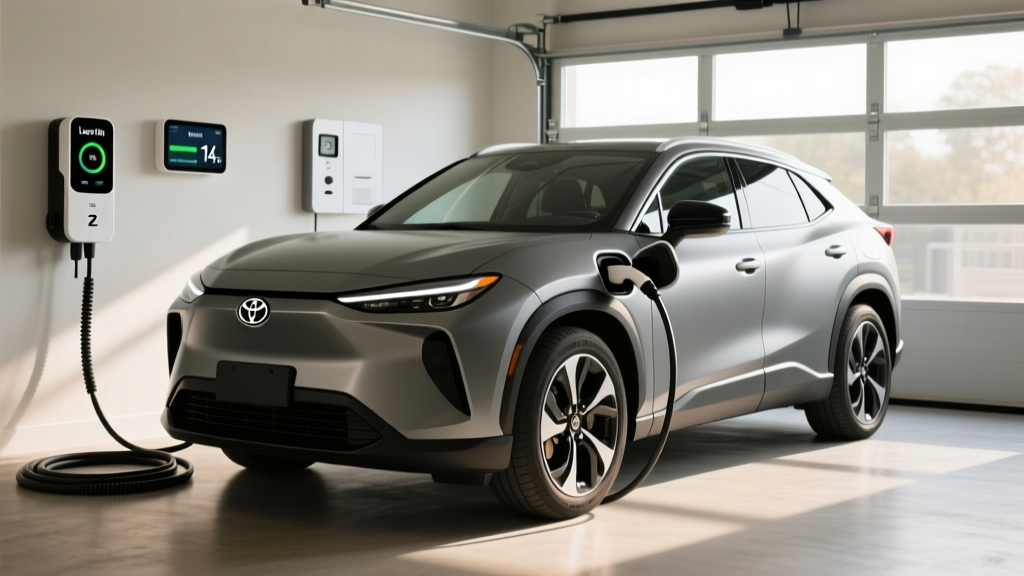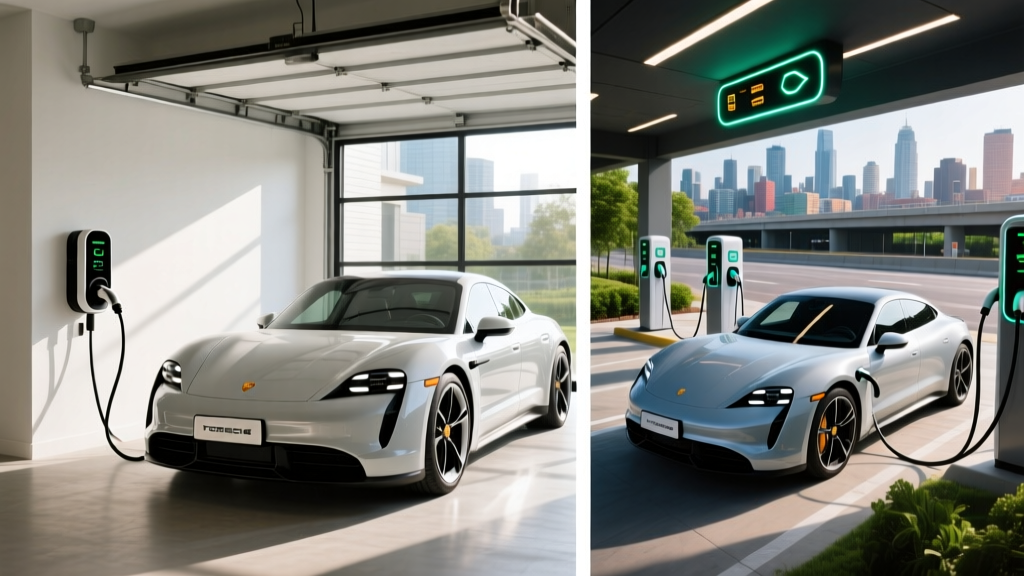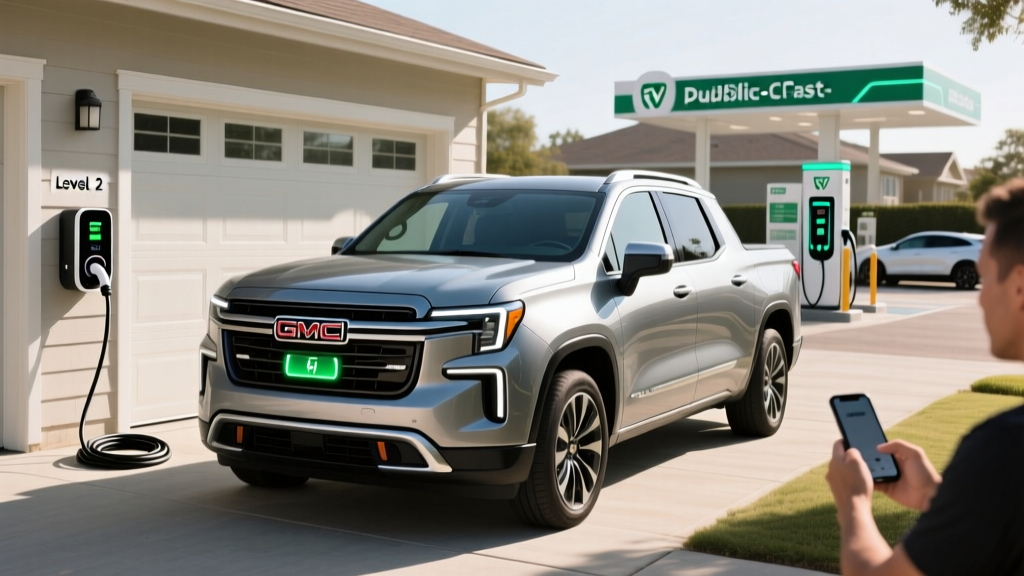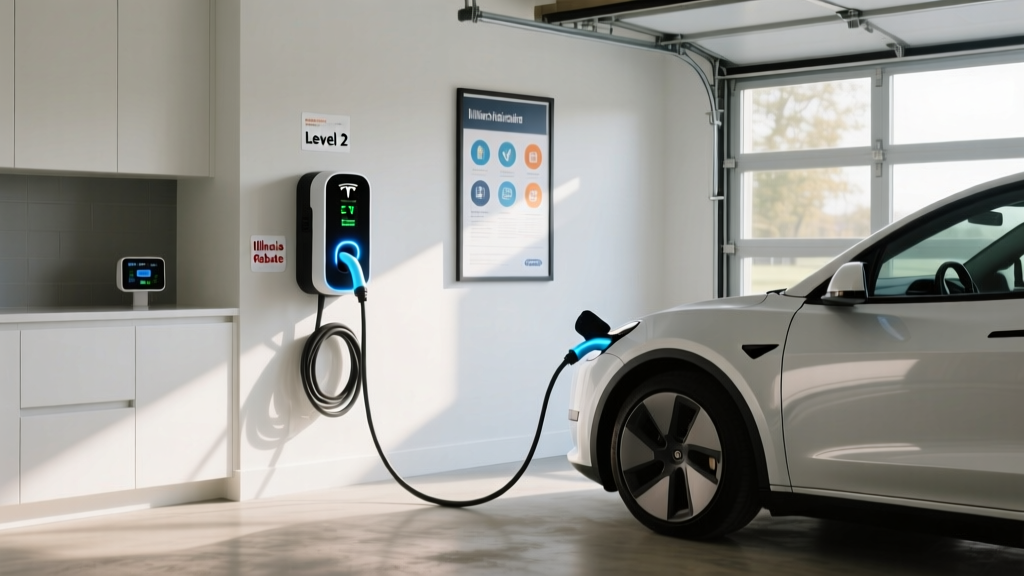
If you own or plan to buy an electric vehicle in Illinois, a home Level 2 charger is the single highest-impact upgrade you can make. Overnight charging at 240 volts eliminates range anxiety, cuts fuel costs to a fraction of gasoline, and lets you wake up to a full battery every morning. The upfront cost of equipment and electrical work can sting, but the Illinois EV charger rebate — combined with utility incentives and federal provisions — can offset a meaningful share of your total spend.
This guide breaks down exactly what Illinois rebates cover, what your home electrical system needs, which chargers we recommend in 2026, and what you'll actually pay per mile versus gas.
Understanding EV Charging Levels: kW, kWh, and Miles Per Hour
Before evaluating rebates or buying equipment, you need clarity on the three charging levels. The most common EV mistake is confusing kW (kilowatts — the rate of power delivery) with kWh (kilowatt-hours — the total energy stored in your battery). Think of kW as the width of the pipe and kWh as the size of the tank.
| Level | Voltage | Power (kW) | Miles of Range Per Hour | Best For |
|---|---|---|---|---|
| Level 1 | 120V (standard outlet) | 1.4–1.9 kW | 3–5 mi/hr | PHEVs, overnight trickle, emergency backup |
| Level 2 | 240V (dryer-style outlet or hardwired) | 7.2–19.2 kW | 20–60 mi/hr | Daily home charging for all BEVs and PHEVs |
| DC Fast Charge | 400–800V DC (public stations) | 50–350 kW | 150–300+ mi/hr (peak) | Road trips, quick top-ups on the go |
How Much Does It Cost to Install a Home EV Charger in Illinois?
Installation cost depends on three variables: the charger hardware, the complexity of the electrical work, and whether your panel needs upgrading. Here's a realistic breakdown for a typical Illinois home in 2026:
| Component | Typical Range | Notes |
|---|---|---|
| Level 2 charger (equipment) | $350–$750 | 32A–48A smart chargers; Wi-Fi enabled |
| Electrician labor (standard install) | $500–$1,500 | Run 240V circuit from panel to garage/carport |
| Electrical panel upgrade (if needed) | $1,500–$3,500 | Upgrading from 100A to 200A service |
| Permit and inspection | $50–$200 | Varies by Illinois municipality |
| Total (no panel upgrade) | $900–$2,450 | Most homes with 200A panels |
| Total (with panel upgrade) | $2,400–$5,950 | Older homes with 100A service |
Illinois EV Charger Rebate Programs
Illinois offers several layers of incentive to reduce your out-of-pocket cost:
- Illinois EV Rebate Program (state): The state has periodically offered rebates for Level 2 charging equipment, often covering up to $1,000 or a percentage of hardware cost. Program funding and availability cycle with state budgets — check the Illinois EPA or state energy office for current application windows.
- Utility rebates (ComEd, Ameren Illinois): ComEd has historically offered up to $1,000 for residential Level 2 charger installation, and Ameren Illinois has run similar programs. Both utilities also offer time-of-use (TOU) rate plans that slash your overnight charging cost. Check your utility's EV program page for 2026 availability.
- Federal Alternative Fuel Infrastructure Tax Credit (30C): If you live in a qualifying census tract, you may be eligible for a federal tax credit covering up to 30% of charger equipment and installation costs (capped at $1,000 for residential). This is separate from the §30D vehicle credit and requires filing IRS Form 8911. Consult a tax professional to confirm eligibility.
- Charger installed at your primary residence
- Located in an eligible census tract (check IRS guidance)
- Equipment must be new and meet safety certifications (UL-listed)
- Credit is 30% of combined hardware + install cost, up to $1,000 max
- Filed with your federal tax return using Form 8911
What Electrical Upgrades Might Your Home Need?
A Level 2 charger requires a dedicated 240-volt circuit — the same type of outlet your electric dryer or oven uses. Here's what determines your installation complexity:
Panel capacity: Most modern Illinois homes have 200-amp electrical service, which comfortably supports a 40A or 50A EV circuit alongside normal household loads. If your home has a 100-amp panel (common in pre-1990 construction), you'll likely need a service upgrade to 200A before adding a high-amperage charger.
Circuit sizing: The National Electrical Code (NEC) requires EV chargers to be on a dedicated circuit rated at 125% of the charger's continuous draw. A 40A charger (9.6 kW) requires a 50A circuit and breaker. A 48A charger (11.5 kW) requires a 60A circuit. This is non-negotiable for safety and code compliance.
Outlet vs. hardwired: You have two options:
- NEMA 14-50 outlet: A 240V/50A receptacle that lets you plug in a portable or wall-mount charger. Advantage: you can unplug and take the charger if you move. Requires a GFCI breaker under current NEC rules.
- Hardwired: The charger is wired directly into a junction box. Advantage: supports higher amperage (up to 48A or 80A on some units), no GFCI breaker required (the charger has internal ground-fault protection), and cleaner installation. This is the preferred approach for 48A+ chargers.
Permit and inspection: Illinois municipalities require an electrical permit for new 240V circuits. Your licensed electrician will pull the permit, and a local inspector will verify the work meets NEC and local code. Budget $50–$200 for the permit fee, and factor in 1–3 weeks for inspection scheduling.
How Fast Will Each Charging Level Add Range?
Charging speed depends on both the charger's kW output and your EV's onboard charger capacity. Here are real-world 10–80% charging times for common battery sizes on a Level 2 home charger:
| Charger Output | Battery Size (kWh) | Example Vehicles | 10–80% Time | Miles Added/Hour |
|---|---|---|---|---|
| 7.7 kW (32A) | 60–65 kWh | Chevy Equinox EV, base Tesla Model 3 RWD | ~5.5–6 hours | ~22–25 mi/hr |
| 9.6 kW (40A) | 75–82 kWh | Tesla Model Y LR, Hyundai Ioniq 5, BMW i4 | ~5.5–6.5 hours | ~28–32 mi/hr |
| 11.5 kW (48A) | 75–100 kWh | Ford F-150 Lightning, Rivian R1S, Lucid Air | ~5–7 hours | ~32–38 mi/hr |
| 19.2 kW (80A) | 100+ kWh | Hummer EV, Silverado EV (with dual onboard chargers) | ~4–5 hours | ~50–60 mi/hr |
Key insight: Your EV's onboard charger is the bottleneck for Level 2 speed. Most 2025–2026 EVs accept 11.5 kW (48A) maximum on AC power. If your car's onboard charger maxes out at 7.7 kW, a 48A charger won't charge it any faster — but it's still a reasonable investment for future-proofing your next EV.
Which Connector and Charger Is Compatible with Your EV?
The North American EV market has largely converged on the NACS (North American Charging Standard) connector — originally Tesla's proprietary plug, now adopted by Ford, GM, Hyundai, Kia, Rivian, BMW, and most major automakers for 2025–2026 models. However, millions of CCS1-equipped EVs are still on the road, and adapters are readily available.
| Connector | Brands Using It (2025–2026) | Home Charger Availability | Adapter Needed? |
|---|---|---|---|
| NACS (Tesla-style) | Tesla, Ford, GM, Hyundai/Kia (2025+), Rivian, BMW, Volvo, Polestar | Tesla Wall Connector, Lectron, Emporia, and others now offer NACS | No for NACS vehicles; CCS-to-NACS adapters available (~$200) |
| CCS1 | VW ID.4 (older), some legacy models, pre-2025 Hyundai/Kia | ChargePoint Home Flex, Emporia Vue, EnelX JuiceBox | No for CCS vehicles; NACS-to-CCS adapters available |
| CHAdeMO | Nissan Leaf (legacy only — discontinued) | Very limited new home chargers | Not practical for new installs |
Our recommendation for 2026: If you're buying a new EV this year, it almost certainly uses NACS. Buy a NACS-connector home charger or a universal unit with a swappable connector. If you own a pre-2025 CCS vehicle, buy a CCS charger or use a NACS-to-CCS adapter with a NACS charger to future-proof your install.
Recommended Home EV Chargers for 2026
These are our top picks based on power output, reliability, smart features, cable length, and value. All are UL-listed for safety.
Tesla Wall Connector (NACS) — Best Overall
- Power: Up to 11.5 kW (48A) hardwired
- Connector: NACS native
- Cable: 24 feet
- Smart features: Wi-Fi, OTA updates, Power Sharing (link multiple units on one circuit), access control
- Price: ~$475
- Why we like it: Excellent build quality, sleek design, and the best value for a 48A smart charger. Works with all NACS vehicles, not just Teslas.
ChargePoint Home Flex (CCS1 or NACS) — Best for CCS Owners
- Power: Up to 12 kW (50A) on a 60A circuit
- Connector: Available in CCS1 or NACS
- Cable: 23 feet
- Smart features: Wi-Fi, ChargePoint app scheduling, Alexa integration, detailed energy tracking
- Price: ~$550–$650
- Why we like it: Flexible amperage settings (16A–50A) let you match your circuit without oversizing. Strong app and scheduling for TOU rate optimization.
Emporia Level 2 Charger — Best Budget Smart Charger
- Power: Up to 11.5 kW (48A)
- Connector: NACS or J1772 (with adapter)
- Cable: 24 feet
- Smart features: Wi-Fi, Emporia app, solar integration, energy monitoring, load management
- Price: ~$350–$400
- Why we like it: Lowest price for a full-featured 48A smart charger. Excellent energy tracking pairs well with Emporia's whole-home energy monitor.
How Much Does Charging Cost Per Mile vs. Gasoline?
One of the strongest arguments for home EV charging is the per-mile fuel cost. Here's how Illinois electricity rates compare to gasoline, based on a midsize EV averaging 3.0 miles per kWh and a gas car averaging 28 MPG combined:
| Scenario | Cost per kWh | EV Cost per Mile | Gas Cost per Mile ($3.40/gal, 28 MPG) | Annual Savings (12,000 mi) |
|---|---|---|---|---|
| Home — off-peak TOU rate (overnight) | $0.07–$0.09/kWh | $0.023–$0.030 | $0.121 | $1,092–$1,176 |
| Home — standard residential rate | $0.12–$0.15/kWh | $0.040–$0.050 | $0.121 | $852–$972 |
| Public Level 2 (ChargePoint, etc.) | $0.20–$0.35/kWh | $0.067–$0.117 | $0.121 | $48–$648 |
| DC Fast Charging (Electrify America, etc.) | $0.35–$0.55/kWh | $0.117–$0.183 | $0.121 | -$744 to $48 (more expensive than gas) |
The takeaway: Home charging on an off-peak TOU plan is where EVs deliver maximum savings — roughly a quarter of the per-mile cost of gasoline. Relying exclusively on DC fast charging, however, can actually exceed gas costs. This is why a home Level 2 install is essential for EV economics to work in your favor.
Illinois TOU tip: ComEd and Ameren both offer time-of-use plans where overnight electricity (typically 10 PM–6 AM) costs significantly less than daytime rates. Schedule your charger to start after 10 PM via the charger's app to lock in the lowest rate.
Safety and Electrical Code Considerations
EV charging draws sustained high current for hours — this is fundamentally different from short-burst appliances like a microwave. Safety and code compliance are not optional:
- Dedicated circuit: Your charger must be on its own dedicated breaker. No sharing with other outlets or appliances.
- GFCI protection: NEC 2020 and later require GFCI protection for NEMA 14-50 receptacles used for EV charging. Hardwired chargers have internal ground-fault protection and don't require a GFCI breaker. Note: some EV owners report nuisance GFCI trips with certain breaker brands — if you're installing an outlet, discuss breaker selection with your electrician.
- Outdoor rating: If your charger is mounted outdoors (driveway or carport), ensure the unit carries a NEMA 4 or IP65 weather rating. All our recommended chargers above are rated for outdoor use.
- Cable management: A 24-foot cable on the ground is a trip hazard and can degrade from weather exposure. Install a cable holster or retractable hook to keep the cord organized and protected.
- Wire gauge: Your electrician will size wire to the circuit — typically 6 AWG copper for a 50A circuit and 4 AWG for a 60A circuit. Undersized wire is a fire risk; never cut corners here.
Frequently Asked Questions
How do I apply for the Illinois EV charger rebate?
Illinois state rebate programs are administered through the Illinois EPA or designated energy agencies, and application windows open and close based on funding availability. Utility rebates from ComEd or Ameren Illinois are applied for directly through each utility's EV program page, often requiring proof of charger purchase and electrician invoice. Check current availability before purchasing — some programs require pre-approval before installation begins.
Can I install a Level 2 charger myself?
No. A 240V circuit requires a licensed electrician to ensure code compliance, proper wire sizing, breaker selection, and permit/inspection. DIY electrical work at these amperages carries serious fire and electrocution risk, and will void your homeowner's insurance coverage if an unpermitted install causes damage.
What if my garage is far from the electrical panel?
Long wire runs increase cost. Expect to add $3–$8 per linear foot for conduit and wire on runs over 50 feet. A 100-foot run from a basement panel to a detached garage could add $400–$800 to the install. In some cases, installing a sub-panel closer to the garage is more cost-effective.
Will a Level 2 charger work with a standard 100A electrical panel?
It depends on your existing load. A 40A charger on a 100A panel leaves only 60A for all other household loads — which may be insufficient if you have electric heat, an electric dryer, and an electric range. An electrician will perform a load calculation to determine if your panel can handle the charger or if an upgrade to 200A is required.
Do I need a smart charger, or is a basic unit fine?
A basic (non-smart) charger will charge your car just fine. But a smart charger with Wi-Fi and app control lets you schedule charging during off-peak hours (critical for TOU rate savings), monitor energy usage, receive firmware updates, and in some cases participate in utility demand-response programs that earn you bill credits. For $50–$150 more than a dumb charger, the smart features pay for themselves quickly.
Does the Illinois EV charger rebate cover the electrical work or just the hardware?
It varies by program. The state rebate has historically focused on equipment costs, while some utility programs (like ComEd's past offerings) have covered combined equipment and installation. The federal 30C credit covers both hardware and labor. Always read the current program rules before assuming coverage.
Sources: fueleconomy.gov for vehicle efficiency data; IRS.gov for federal tax credit rules; ComEd and Ameren Illinois utility EV program pages for current rebate and TOU rate information.