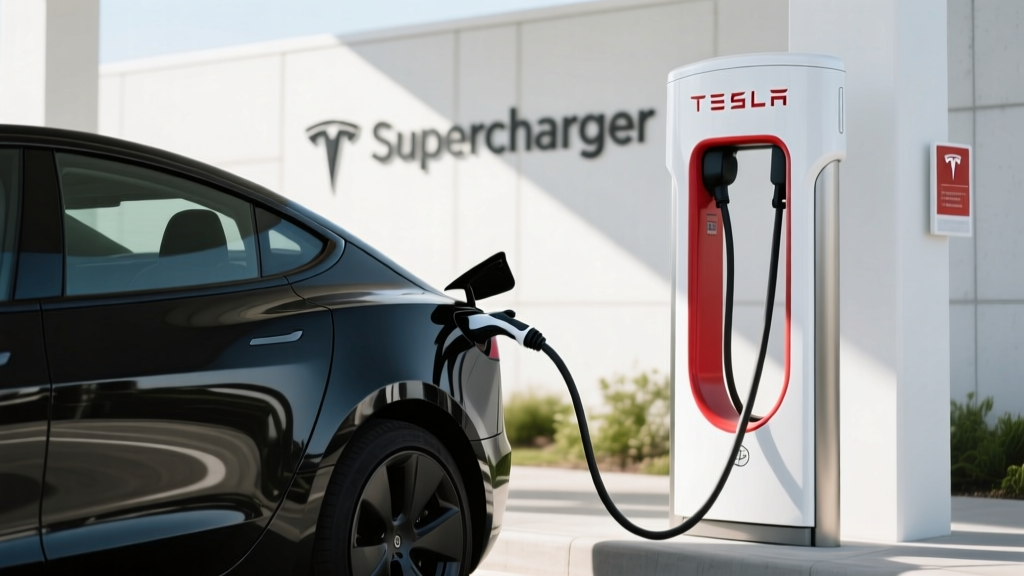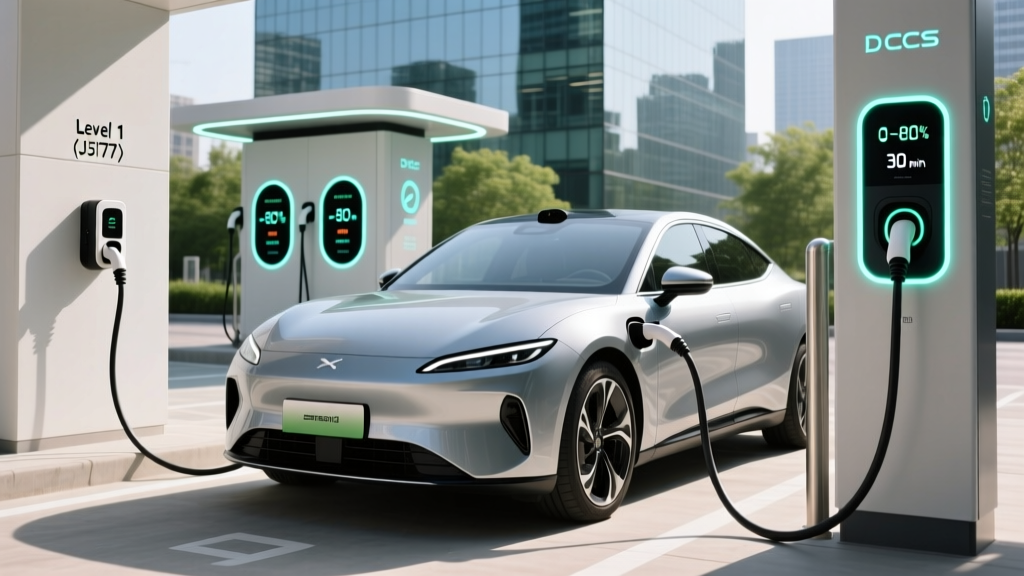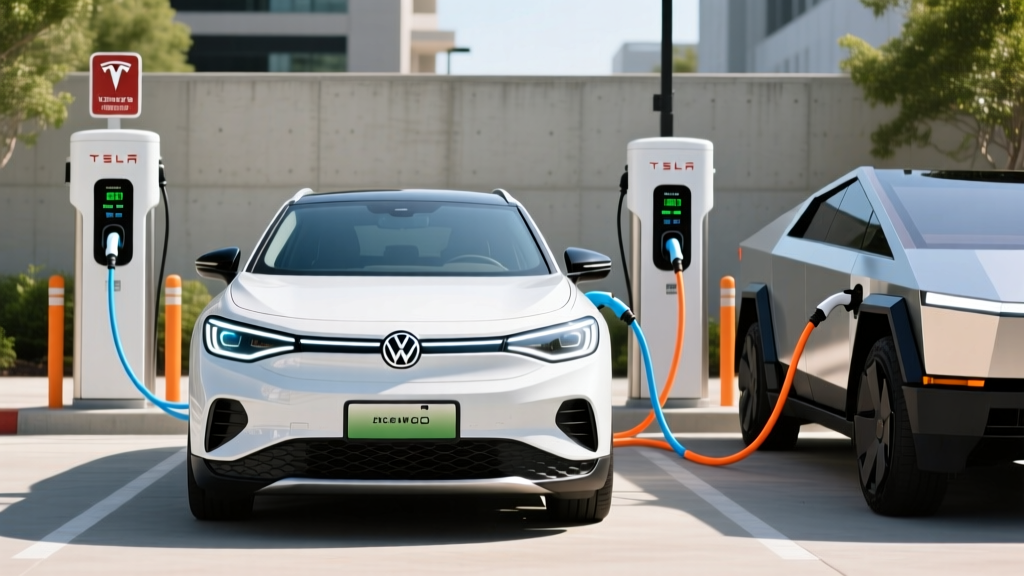
If you own or are shopping for a Volkswagen ID.4, one question dominates your charging research: can the VW ID.4 use Tesla Superchargers? The short answer for 2026 is yes — with the right adapter and a compatible Supercharger location. But Supercharger access is just one piece of a broader charging strategy that includes home Level 2 installation, public DC fast charging networks, and understanding exactly what you'll pay per mile.
This guide breaks down every charging scenario an ID.4 owner will face, from the electrical panel in your garage to the fastest highway chargers available, with exact numbers for power (kW), energy (kWh), time, and cost.
VW ID.4 Charging Speeds: Level 1, Level 2, and DC Fast Charging
Before we get to Tesla Superchargers, let's establish the three charging levels and what they mean for the ID.4's 82 kWh usable battery (NMC chemistry). Understanding the difference between kW (power, or how fast energy flows) and kWh (energy, or how much the battery holds) is essential — confusing them is the most common EV literacy mistake.
| Level | Power Source | Max Power (kW) | Miles of Range Added per Hour | Use Case |
|---|---|---|---|---|
| Level 1 | 120V household outlet | 1.2–1.4 kW | ~3–4 miles | Emergency/top-up only |
| Level 2 | 240V dedicated circuit | 7.2–11.5 kW | ~22–36 miles | Daily home charging |
| DC Fast | 480V+ public station | Up to 175 kW (ID.4 peak) | ~170–220 miles (peak rate) | Road trips, rapid top-ups |
The ID.4's onboard charger accepts up to 11.5 kW on Level 2 (48A), meaning a full charge from 10% to 100% takes roughly 7–8 hours at home. On DC fast charging, the ID.4 peaks at approximately 175 kW, though this rate is not sustained — like all EVs, charging speed tapers significantly above 80% State of Charge (SoC) to protect the battery. Expect a 10–80% charge in about 28–30 minutes at a compatible 175 kW+ station under ideal thermal conditions.
ID.4 Tesla Supercharger Access: NACS Adapter and Network Compatibility
Starting in 2025, Volkswagen joined the NACS (North American Charging Standard) coalition, enabling ID.4 owners to access Tesla's Supercharger network — the largest and most reliable DC fast charging infrastructure in North America, with over 25,000 stalls as of early 2026.
How ID.4 Supercharger Access Works
The VW ID.4 ships with a CCS1 (Combined Charging System) port. To use a Tesla Supercharger, you need one of the following:
- Tesla-approved NACS adapter: Tesla sells a CCS-to-NACS adapter (approximately $199–$249) that has been validated for use with non-Tesla vehicles on the Supercharger network. Volkswagen has also begun offering a compatible OEM adapter through dealerships.
- Built-in NACS port (future models): Starting with the 2026 model year refresh, some VW EVs are expected to ship with a native NACS port, eliminating the adapter requirement. As of this writing, the ID.4 still uses CCS1 — confirm your specific model year with your dealer.
Not every Supercharger stall is open to non-Tesla vehicles. Tesla designates specific locations as "Open to Non-Tesla EVs" through the Tesla app. Before planning a road trip, filter for compatible stations in the app or on Tesla's website. As of early 2026, roughly 60–70% of Supercharger locations in the U.S. support non-Tesla vehicles, with coverage expanding monthly.
| Connector Standard | Native Port on ID.4? | Network Access | Adapter Needed? |
|---|---|---|---|
| CCS1 | Yes (standard) | Electrify America, EVgo, ChargePoint, Ionity (EU) | No |
| NACS (Tesla) | No (2024–2025 models) | Tesla Supercharger (designated stalls) | Yes — CCS-to-NACS adapter |
| CHAdeMO | No | Largely legacy/discontinued | Not available |
Home Level 2 Charger Installation: Requirements, Costs, and Equipment
Home Level 2 charging is where most ID.4 owners will do 85–90% of their charging. A properly installed 240V Level 2 charger will fully replenish the ID.4's 82 kWh battery overnight, giving you a "full tank" every morning.
Electrical Requirements
The ID.4's onboard charger can accept up to 11.5 kW (48 amps). To deliver this, you need a dedicated 60-amp circuit on a 240V line (the National Electrical Code requires circuits to be rated at 125% of continuous load, so a 48A charger requires a 60A breaker). If you opt for a 40A charger, a 50A circuit suffices.
Key considerations for your electrical panel:
- Panel capacity: Most modern homes with 200A service can accommodate a 60A EV circuit without issue. Older homes with 100A service may require a panel upgrade ($1,500–$3,500) before adding an EV charger.
- Dedicated circuit: The EV charger must have its own dedicated breaker — it cannot share a circuit with other major appliances.
- GFCI protection: The 2023 NEC update requires GFCI protection for EV charging circuits in many jurisdictions. Confirm with your local electrical inspector.
- Outdoor rating: If your charger is installed outdoors (garage-less homes, driveway parking), ensure both the charger and the receptacle are rated for outdoor/wet locations (NEMA 4 or NEMA 4X enclosure rating).
- Permit requirements: Most municipalities require an electrical permit for EV charger installation. Your electrician typically handles this, and the cost is usually $50–$200 depending on your jurisdiction.
How Much Does It Cost to Install a Home EV Charger?
Installation costs vary widely based on your home's existing electrical infrastructure, the distance from your panel to the charging location, and local labor rates. Here's a realistic breakdown for 2026:
| Component | Cost Range | Notes |
|---|---|---|
| Level 2 Charger (Equipment) | $350–$700 | 40A–48A Wi-Fi-enabled units |
| Electrician Labor | $500–$1,800 | Varies by run length, conduit, and local rates |
| Electrical Permit | $50–$200 | Municipality-dependent |
| Panel Upgrade (if needed) | $1,500–$3,500 | Required for 100A service homes |
| Total (no panel upgrade) | $900–$2,700 | Most homes with 200A service |
| Total (with panel upgrade) | $2,400–$6,200 | Older homes with 100A service |
The federal Residential Clean Energy Credit (IRS §25D) covers 30% of the cost of EV charging equipment and installation, up to $1,000. This credit is available through 2032. Some states and utilities offer additional rebates — check with your local provider, as these vary significantly by jurisdiction.
Recommended Level 2 Chargers for the VW ID.4
ChargePoint Home Flex
- Power Output: Up to 12 kW (50A) / configurable down to 16A
- Connector: CCS1 (J1772 + CCS combo)
- Cable Length: 23 feet
- Smart Features: Wi-Fi, app scheduling, Alexa integration, energy reporting
- Price: ~$549 (equipment only)
- Best For: Flexibility across circuit sizes; robust app
Emporia Level 2 EV Charger
- Power Output: Up to 11.5 kW (48A)
- Connector: CCS1 (J1772 + CCS combo)
- Cable Length: 24 feet
- Smart Features: Wi-Fi, solar integration, real-time energy monitoring, load management
- Price: ~$399 (equipment only)
- Best For: Budget-conscious buyers; solar-home integration
Tesla Wall Connector (with adapter)
- Power Output: Up to 11.5 kW (48A)
- Connector: NACS native — requires CCS-to-J1772 adapter for ID.4
- Cable Length: 24 feet
- Smart Features: Wi-Fi, firmware updates, power sharing between units
- Price: ~$420 (equipment only)
- Best For: Multi-EV households with Tesla + VW
For most ID.4 owners with a single EV, the ChargePoint Home Flex offers the best combination of configurability, app quality, and direct CCS1 compatibility without needing an adapter at home.
Charging Costs: Home vs. Public DC Fast Charging vs. Gas
One of the strongest economic arguments for the ID.4 is the cost-per-mile advantage over gasoline vehicles — but only if you charge strategically. Here's how costs break down across scenarios.
| Charging Scenario | Rate ($/kWh) | Full Charge Cost (10–80%, ~57 kWh) | Cost per Mile (est.) |
|---|---|---|---|
| Home — Off-Peak Utility Rate | $0.08–$0.12 | $4.56–$6.84 | $0.02–$0.03 |
| Home — Standard Rate | $0.13–$0.18 | $7.41–$10.26 | $0.03–$0.04 |
| Public Level 2 (ChargePoint, etc.) | $0.20–$0.35 | $11.40–$19.95 | $0.05–$0.08 |
| DC Fast — Electrify America | $0.35–$0.52 | $19.95–$29.64 | $0.08–$0.12 |
| DC Fast — Tesla Supercharger (non-Tesla pricing) | $0.30–$0.48 | $17.10–$27.36 | $0.07–$0.11 |
| Gas Equivalent (25 MPG, $3.40/gal) | — | $7.75 (per 57 gallons-equivalent distance) | $0.14 |
At home off-peak rates, the ID.4 costs roughly $0.02–$0.03 per mile to fuel — about one-fifth the cost of a comparable gas SUV at $0.14 per mile. Even at public DC fast charging rates, the ID.4 remains cheaper per mile than gasoline, though the gap narrows to roughly 30–50% savings.
The key takeaway: home charging is where the economics of EV ownership truly shine. If you rely exclusively on public DC fast charging, your per-mile cost can approach that of a fuel-efficient hybrid. Time-of-use utility plans (charging overnight at reduced rates) maximize savings.
DC Fast Charging on the Road: ID.4 Charge Curve and 10–80% Times
The ID.4's 175 kW peak DC fast charging capability is competitive for its class, but understanding the charge curve is essential for realistic road-trip planning.
Here's what a typical DC fast charging session looks like for the ID.4 at a 175 kW+ station:
- 10–20% SoC: Ramp-up phase — approximately 80–120 kW
- 20–55% SoC: Peak charging window — sustains approximately 150–175 kW
- 55–80% SoC: Progressive taper — drops from ~150 kW down to ~60 kW
- 80–100% SoC: Slow trickle — drops below 30 kW (avoid charging above 80% on road trips unless necessary)
Under ideal conditions (battery preconditioned, ambient temperature 60–80°F), a 10–80% session takes approximately 28–32 minutes. In cold weather (below 40°F), expect 35–45 minutes due to reduced charge acceptance until the battery warms. The ID.4 does not have a dedicated battery preconditioning feature for non-Tesla chargers, so arriving at a DC fast charger after highway driving (which warms the battery) yields better results than charging from a cold start.
On a 300-mile road trip (e.g., Chicago to Indianapolis), the ID.4 with its ~240-mile real-world highway range requires one charging stop. Plan for 25–35 minutes at a Supercharger or Electrify America station, and you'll arrive at your destination with minimal time penalty compared to a gas-car rest stop.
VW ID.4 Charging FAQ
Can the VW ID.4 charge at any Tesla Supercharger?
Not every Supercharger stall is open to non-Tesla vehicles. You must use the Tesla app to identify designated "Open to Non-Tesla EVs" locations, and you'll need a Tesla-approved CCS-to-NACS adapter. Approximately 60–70% of U.S. Supercharger locations support non-Tesla EVs as of early 2026, and the number is growing.
How fast will the ID.4 charge on a Tesla Supercharger?
The ID.4's peak DC charge rate is 175 kW, regardless of which network you use. At a V3 Supercharger (250 kW capable), the ID.4 will still peak at its own 175 kW limit. Expect 10–80% in approximately 28–32 minutes under ideal conditions.
What electrical upgrades might I need for a home charger?
If your home has a 200-amp electrical panel with available capacity, you likely need only a dedicated 50A or 60A breaker and a wiring run to your garage or parking spot. Homes with 100A service — common in houses built before the 1990s — will likely require a panel upgrade ($1,500–$3,500) to safely support an EV charger alongside existing loads like HVAC, electric ovens, and dryers.
Is it cheaper to charge the ID.4 at home or at a Supercharger?
Home charging is significantly cheaper. At a national average residential rate of ~$0.15/kWh, a 10–80% home charge costs about $8.50. At a Tesla Supercharger with non-Tesla pricing (~$0.38/kWh average), the same session costs approximately $21.66. Over a year of 12,000 miles, home charging saves roughly $900–$1,200 compared to exclusive public fast charging.
Does using a CCS-to-NACS adapter affect charging speed or warranty?
A properly certified adapter does not reduce charging speed — the ID.4's onboard systems limit charge rate to 175 kW regardless of the adapter. Using a Tesla-approved or VW-OEM adapter will not void your battery warranty. Avoid uncertified third-party adapters, as they may lack proper safety protocols and could cause charge-port damage not covered under warranty.
How does the ID.4's charging speed compare to competitors?
The ID.4's 175 kW peak is mid-pack for 2026. The Hyundai Ioniq 5 charges at up to 240 kW (10–80% in ~18 minutes), and the Kia EV6 peaks at 239 kW. The Ford Mustang Mach-E charges at up to 150 kW. The ID.4's charging speed is adequate for road trips but not class-leading — if rapid DC charging is a top priority, the Ioniq 5's 800V architecture is meaningfully faster.
Do I qualify for any tax credits for home charger installation?
The federal Residential Clean Energy Credit (IRS §25D) covers 30% of home EV charger equipment and installation costs, up to $1,000, through 2032. Eligibility requires that the equipment be installed at your primary U.S. residence. State and utility incentives vary by location — consult a tax professional for your specific situation, as income limits and sourcing rules may apply.