Hyundai's shift to the North American Charging Standard (NACS) for its 2025 and newer EVs opened the door to Tesla Supercharger access — but if you own a 2022–2024 Hyundai Ioniq 5, Ioniq 6, or Kona Electric, your car still has a CCS1 port. That's where a Hyundai Tesla charger adapter comes in. This guide covers exactly which adapters work, how fast you can charge, what home installation actually costs, and whether your electrical panel can handle it.
Why Hyundai Owners Need a Tesla Charger Adapter
Starting with the 2025 model year, Hyundai equips new EVs with native NACS ports, granting direct access to Tesla's Supercharger network — over 25,000 stalls in North America. But the roughly 350,000+ Hyundai EVs sold in the US between 2019 and 2024 (Ioniq 5, Ioniq 6, Kona Electric) use the CCS1 connector. To charge those vehicles at a Tesla Supercharger, you need a CCS-to-NACS adapter.
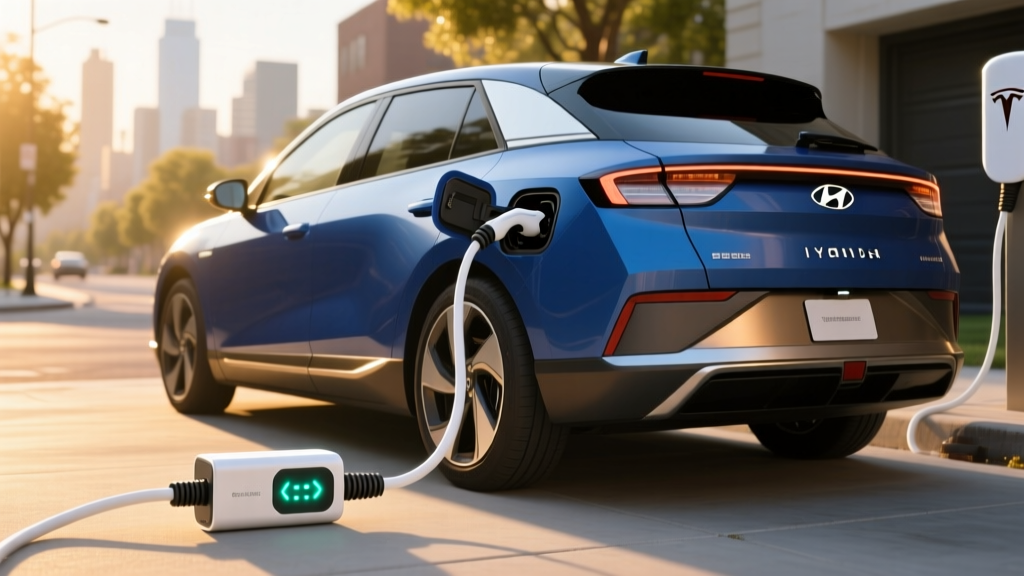
Hyundai began shipping an official CCS1-to-NACS adapter to eligible Ioniq 5 and Ioniq 6 owners in late 2024. Third-party adapters from brands like Lectron and A2Z also entered the market. The adapter bridges the physical connector difference — but charging speed depends on your car's onboard charger and the stall's output, not just the plug shape.
Charging Levels Explained: Speeds in kW and Miles Per Hour
Before choosing an adapter or home charger, understand the three charging levels. Power is measured in kW (kilowatts) — the rate of energy flow. Energy stored in your battery is measured in kWh (kilowatt-hours) — the total capacity. Think of kW as how fast water flows through a hose and kWh as the size of the bucket.
| Level | Voltage / Phase | Max Power (kW) | Miles of Range Added Per Hour | Typical Use Case |
|---|---|---|---|---|
| Level 1 | 120V / Single | 1.4–1.9 kW | 3–5 mi/hr | Overnight trickle; PHEVs |
| Level 2 | 240V / Single | 7.2–19.2 kW | 20–60 mi/hr | Home daily charging; workplace |
| DC Fast Charge | 200–800V DC | 50–350 kW | 150–1,000+ mi/hr (peak) | Road trips; rapid top-ups |
For a Hyundai Ioniq 5 with its 77.4 kWh usable battery, Level 2 at 11 kW (48A) adds roughly 35 miles of range per hour. A full 10–80% charge at home takes about 5.5 hours. On a 350 kW DC fast charger, the Ioniq 5's 800V architecture enables a peak of ~240 kW, reaching 10–80% in approximately 18 minutes under ideal conditions — though real-world charging curves taper significantly above 80% SoC.
Connector Compatibility: NACS, CCS1, and Adapter Options
North America's EV connector landscape has consolidated rapidly since Tesla opened its Supercharger network. Here's what Hyundai owners need to know:
| Hyundai Model / Year | Native Port | Supercharger Access | Adapter Needed |
|---|---|---|---|
| 2022–2024 Ioniq 5 | CCS1 | Via adapter | CCS1-to-NACS adapter |
| 2023–2024 Ioniq 6 | CCS1 | Via adapter | CCS1-to-NACS adapter |
| 2023–2024 Kona Electric | CCS1 | Via adapter | CCS1-to-NACS adapter |
| 2025+ Ioniq 5 (refresh) | NACS | Native | None |
| 2025+ Ioniq 9 | NACS | Native | None |
Adapter Options for Hyundai CCS1 EVs
Hyundai Official CCS1-to-NACS Adapter: Hyundai's OEM adapter, distributed to qualifying owners, supports DC fast charging up to the vehicle's maximum rate (240 kW on Ioniq 5/6). It weighs about 2.5 lbs and is UL-listed. Hyundai's electrified vehicle page details eligibility and ordering.
Third-Party Adapters (Lectron, A2Z EV): These CCS1-to-NACS adapters typically cost $150–$250 and support DC fast charging up to 150–250 kW depending on the model. Verify UL certification before purchasing — uncertified adapters risk overheating at high power levels.
For home Level 2 charging: If you install a NACS-connector wall charger (like the Tesla Wall Connector), you'll need a NACS-to-CCS1 adapter to plug into your older Hyundai. Alternatively, buy a Level 2 charger with a J1772 connector (the AC standard) and use the J1772 adapter that came with your Hyundai. This avoids a second adapter purchase.
Home Charger Installation: Electrical Requirements and Costs
A Level 2 home charger is the single best upgrade for daily EV ownership. But installation costs vary dramatically based on your home's electrical panel, distance from the panel to the charging location, and local permit fees.
Electrical Requirements
Most Level 2 chargers run on a 240V dedicated circuit. The circuit amperage must exceed the charger's draw by 25% per the National Electrical Code (NEC) — so a 48A charger requires a 60A breaker. Common setups:
- 40A circuit / 32A charger: 7.7 kW output — sufficient for overnight charging most EVs
- 50A circuit / 40A charger: 9.6 kW output — good for larger batteries
- 60A circuit / 48A charger: 11.5 kW output — fastest residential Level 2
Panel Upgrade Considerations
Many homes built before 2000 have 100A or 150A main service panels. Adding a 60A EV circuit to a 100A panel that's already near capacity may require a panel upgrade to 200A — a significant added cost. Signs you may need an upgrade:
- Your panel is 100A with electric range, dryer, and central AC already on it
- Breakers are double-tapped or the panel has a Federal Pacific/Zinsco brand (known safety issues)
- Your electrician's load calculation exceeds 80% of panel capacity with the EV circuit added
| Cost Component | Standard Install (200A panel, short run) | Complex Install (panel upgrade, long conduit run) |
|---|---|---|
| Level 2 Charger (equipment) | $400–$700 | $400–$700 |
| Electrician labor | $500–$1,200 | $1,500–$3,500 |
| Electrical permit | $50–$200 | $50–$300 |
| Panel upgrade (if needed) | $0 | $1,500–$4,000 |
| Conduit/wiring materials | $100–$300 | $300–$800 |
| Total | $1,050–$2,400 | $3,750–$9,300 |
Always hire a licensed electrician and pull a permit. Unpermitted EV charger installs can void homeowner's insurance claims and create fire hazards. The NEC requires a GFCI-protected circuit for outdoor installations, and outdoor-rated (NEMA 4) chargers for exposed locations.
Charging Cost Per Mile: Home vs. Public vs. Gas
One of the strongest economic arguments for EV ownership is lower fueling cost — but the savings depend heavily on where and when you charge.
| Charging Scenario | Rate ($/kWh) | Cost to Add 200 Miles (Ioniq 5 at 3.5 mi/kWh) | Cost Per Mile |
|---|---|---|---|
| Home (off-peak utility rate) | $0.08–$0.14 | $4.57–$8.00 | $0.023–$0.040 |
| Home (standard residential avg) | $0.16 | $9.14 | $0.046 |
| Public Level 2 (ChargePoint, etc.) | $0.25–$0.49 | $14.29–$28.00 | $0.071–$0.140 |
| DC Fast Charge (Electrify America) | $0.35–$0.56 | $20.00–$32.00 | $0.100–$0.160 |
| Tesla Supercharger (avg 2026) | $0.30–$0.45 | $17.14–$25.71 | $0.086–$0.129 |
| Gasoline vehicle (28 MPG avg, $3.40/gal) | — | $24.29 | $0.121 |
At home off-peak rates, a Hyundai Ioniq 5 costs roughly $0.03–$0.04 per mile to fuel — about one-third the cost of a 28 MPG gasoline car at $3.40/gallon. Even public DC fast charging at $0.45/kWh is competitive with gas. The savings are most dramatic for drivers with access to cheap overnight home electricity. Check your utility's EV time-of-use (TOU) rate plans — many offer $0.06–$0.10/kWh between midnight and 6 AM.
Recommended Chargers and Adapter Equipment
Here are specific charger and adapter picks for Hyundai EV owners, based on power output, build quality, smart features, and price as of 2026:
Home Level 2 Chargers
Tesla Wall Connector (Gen 4): 48A / 11.5 kW output, NACS connector, 24-foot cable, Wi-Fi connected, $420. Excellent build quality. For CCS1 Hyundais, pair with a NACS-to-CCS1 adapter (~$100–$180). Best for households with both Tesla and Hyundai EVs.
ChargePoint Home Flex: Up to 50A / 12 kW output (configurable), J1772 connector, 23-foot cable, app-based scheduling and TOU optimization, $549. Works natively with all Hyundai EVs via the included J1772 inlet adapter. UL-listed, NEMA 4 outdoor-rated.
Emporia Vue Level 2 Charger: 48A / 11.5 kW, J1772 connector, 24-foot cable, integrates with Emporia's home energy monitoring, $399. Budget-friendly option with robust app features and load management to avoid panel upgrades.
Grizzl-E Smart: 40A / 9.6 kW, J1772 connector, 24-foot cable, OCPP-compatible, built in Canada with extreme cold-weather durability, $499. Ideal for garages or outdoor installations in northern climates.
Adapters
Hyundai OEM CCS1-to-NACS Adapter: Supports up to 240 kW DC fast charging. Distributed directly by Hyundai to eligible owners — check your MyHyundai account or dealer for availability.
Lectron CCS1-to-NACS Adapter: Rated for up to 250 kW DC, ~$180–$220, UL-listed. Compact form factor, good for keeping in the frunk for Supercharger access.
Tesla J1772 Mobile Connector + NACS adapter: For emergency Level 1/2 use at non-Tesla locations. Not recommended as a primary home solution due to lower power (12A/1.4 kW on 120V).
DC Fast Charging Times for Hyundai EVs
When using an adapter at a Tesla Supercharger or any DC fast charger, real-world charging times depend on battery size, state of charge, ambient temperature, and the charger's power output. Here are typical 10–80% times for popular Hyundai models:
- 2022–2024 Ioniq 5 (77.4 kWh, 800V): ~18 minutes on a 350 kW charger; ~25 minutes on a 150 kW Supercharger V3. The 800V architecture sustains high charge rates longer than 400V competitors, but above 80% SoC the curve tapers sharply — 80–100% can add another 20+ minutes.
- 2023–2024 Ioniq 6 (77.4 kWh, 800V): ~18 minutes on 350 kW; ~24 minutes on 150 kW. Slightly faster than Ioniq 5 due to lower drag coefficient (0.21 Cd).
- 2023–2024 Kona Electric (64.8 kWh, 400V): ~43 minutes on a 100 kW charger; peaks at ~77 kW. Significantly slower than the Ioniq platform — plan longer stops on road trips.
In cold weather (below 32°F), expect 10–80% times to increase by 20–40% unless you precondition the battery via the Hyundai app before arriving at the charger. The Ioniq 5 and 6's heat pump and battery preconditioning system significantly mitigate cold-weather charging slowdowns when navigation is set to a charging station.
Safety, Code Compliance, and Installation Best Practices
EV charging draws sustained high current for hours — unlike a dryer or oven that cycles on and off. This makes proper installation non-negotiable:
- Dedicated circuit: Your EV charger must be on its own dedicated breaker — never shared with other appliances.
- GFCI protection: NEC 2023 and later requires GFCI protection for all outdoor receptacles used for EV charging. Hardwired chargers (recommended) may have built-in GFCI.
- Wire gauge: 6 AWG copper for 48A–50A circuits; 4 AWG for 60A. Your electrician will calculate based on run length and voltage drop.
- NEMA 4 rating: Any outdoor charger must be rated for weather exposure. All chargers listed above carry NEMA 4 or equivalent ratings.
- Smart load management: If your panel is tight on capacity, chargers like the Emporia Vue and ChargePoint Home Flex offer load-sharing features that dynamically reduce charge rate to prevent tripping the main breaker — potentially avoiding a $2,000+ panel upgrade.
According to the National Highway Traffic Safety Administration, EV fires are statistically rarer than ICE vehicle fires, but electrical faults from improper charging installations are a preventable risk. Always verify your electrician pulls a permit and that the installation passes inspection.
Frequently Asked Questions
How much does it cost to install a home EV charger?
A standard Level 2 installation on an existing 200A panel with a short wiring run costs $1,050–$2,400 including equipment, labor, and permits. If your home needs a panel upgrade from 100A to 200A, expect $3,750–$9,300 total. Get at least two quotes from licensed electricians and confirm they include permit costs.
How fast will each charging level add range to my Hyundai?
Level 1 (120V) adds 3–5 miles per hour — adequate only for PHEVs or very low daily mileage. Level 2 (240V, 48A) adds roughly 35 miles per hour to an Ioniq 5, enough for a full overnight charge. DC fast charging adds 150+ miles in 10 minutes under ideal conditions at a 350 kW station.
Which connector and charger is compatible with my Hyundai EV?
2022–2024 Hyundai EVs use CCS1. For home Level 2 charging, any J1772-connector charger works natively. For Tesla Supercharger access, you need a CCS1-to-NACS adapter. 2025+ Hyundai EVs have NACS ports and require no adapter for Superchargers. For EPA range and efficiency data on specific models, check fueleconomy.gov.
How much does charging cost per mile compared to gas?
Home charging at $0.12/kWh costs about $0.034/mile in an Ioniq 5 (3.5 mi/kWh). A comparable 28 MPG gas car at $3.40/gallon costs $0.121/mile. Even public DC fast charging at $0.45/kWh ($0.129/mile) is roughly cost-competitive with gasoline. The biggest savings come from home charging on off-peak utility rates.
What electrical upgrades might I need for a home charger?
If your home has a 100A main panel with existing high-draw appliances (electric range, dryer, HVAC), adding a 60A EV circuit will likely require a panel upgrade to 200A — costing $1,500–$4,000. Older panels (Federal Pacific, Zinsco, certain Challenger models) should be replaced regardless for safety. Smart chargers with load management can sometimes avoid an upgrade by dynamically adjusting charge rate based on real-time panel load.
Can I use a Tesla Wall Connector to charge my Hyundai at home?
Yes, but you'll need a NACS-to-CCS1 adapter if your Hyundai has a CCS1 port (2022–2024 models). The Tesla Wall Connector Gen 4 outputs up to 48A/11.5 kW, which the Ioniq 5's 10.9 kW onboard charger can nearly fully utilize. For a simpler setup without adapters, choose a J1772-connector charger like the ChargePoint Home Flex.