If you own a Hyundai Ioniq 5, Ioniq 6, or are eyeing the upcoming Ioniq 9, you've likely seen headlines about Tesla Supercharger access. The big question for current and prospective Hyundai EV buyers: is the Hyundai NACS adapter free? The short answer is yes — but with important caveats about eligibility, timing, and what you actually need to charge at home versus on the road.
This guide covers everything Hyundai EV owners need to know about the NACS adapter program, plus a complete breakdown of home charging installation costs, public charging economics, and the equipment that makes the most sense for your garage in 2026.
Hyundai's Free NACS Adapter Program: What You Get
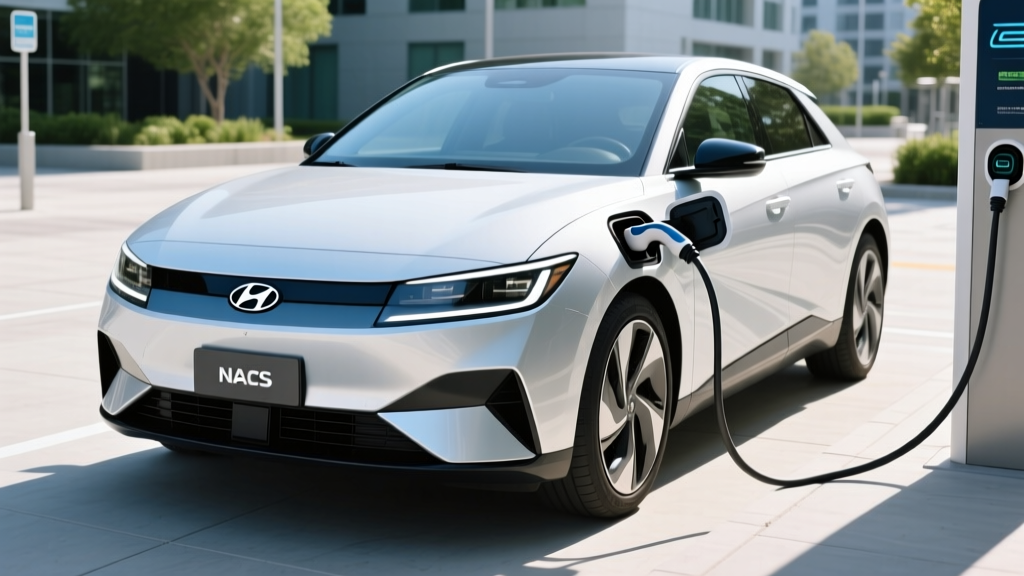
Hyundai began offering a complimentary NACS (North American Charging Standard) adapter to eligible Ioniq 5 and Ioniq 6 owners starting in early 2025, with the program continuing into 2026. The adapter converts your Hyundai's native CCS1 charge port to Tesla's NACS connector, unlocking access to over 20,000 Tesla Supercharger stalls across North America.
- Eligible models: 2022–2026 Hyundai Ioniq 5, 2023–2026 Ioniq 6, and select Kona Electric trims with CCS1 ports
- How to claim: Register through the Hyundai Bluelink app or your local dealer; adapter ships to your address or is installed at the dealership
- Cost: $0 for eligible original owners and subsequent registered owners while supplies last
- Limitation: One adapter per VIN; replacement adapters may carry a fee (~$150–$200 based on third-party NACS adapter pricing)
The adapter supports DC fast charging at up to the vehicle's maximum charge rate. For the Ioniq 5 (84 kWh usable battery, 800V architecture), that means peak charging at approximately 240 kW on a compatible Supercharger V4 stall. Expect a 10–80% charge in roughly 18 minutes under ideal conditions — though real-world charging curves taper significantly above 80% State of Charge (SoC), so plan your stops accordingly.
Charging Levels Explained: Speed, Power, and Range Added
Before we get into equipment and costs, let's clarify the three charging levels available to Hyundai EV owners. The critical distinction: kW (kilowatts) measures power — how fast energy flows into your battery. kWh (kilowatt-hours) measures energy — the total capacity of your battery, like gallons in a fuel tank. A 77 kWh battery charged at 7.7 kW takes roughly 10 hours from empty to full.
| Level | Voltage | Max Power (kW) | Miles of Range Added per Hour | Best For |
|---|---|---|---|---|
| Level 1 (120V household) | 120V | 1.4–1.9 kW | 3–5 miles | Overnight trickle; PHEV top-ups |
| Level 2 (240V home/public) | 240V | 7.2–11.5 kW | 20–40 miles | Daily home charging; workplace |
| DC Fast Charging | 400–800V DC | 150–350 kW | 180–600+ miles (equivalent) | Road trips; rapid top-ups |
For context, the Ioniq 5 Long Range AWD has an EPA-estimated range of 290 miles (fueleconomy.gov). In real-world highway driving at 70+ mph, expect roughly 240–260 miles; in cold weather (below 30°F), that can drop to 200–220 miles. The Ioniq 6 SEL with its more aerodynamic profile achieves an EPA 361 miles and holds up slightly better at highway speeds.
Home Charger Installation: Costs, Electrical Requirements, and Gotchas
Most Hyundai EV owners will want a Level 2 home charger — it's the sweet spot for overnight charging that restores your daily driving range while you sleep. Here's what's involved.
Electrical Requirements
A typical Level 2 home charger requires a 240V dedicated circuit, similar to what an electric dryer or oven uses. The most common setup is a 40-amp or 50-amp circuit on a NEMA 14-50 outlet, or a hardwired connection (which many electricians prefer for safety and code compliance on circuits above 40A).
- 40A circuit / 32A continuous charge: Delivers ~7.7 kW — sufficient for overnight charging of any Hyundai EV
- 50A circuit / 40A continuous charge: Delivers ~9.6 kW — faster, future-proof for larger batteries
- 60A circuit / 48A continuous charge: Delivers ~11.5 kW — maximum Level 2 speed; requires substantial panel capacity
Installation Cost Breakdown
| Component | Low Estimate | High Estimate | Notes |
|---|---|---|---|
| Level 2 charger (hardware) | $350 | $700 | Smart Wi-Fi chargers; basic models less |
| Electrician labor | $500 | $1,500 | Varies by run length, wall type, conduit |
| Electrical permit | $50 | $200 | Required in most jurisdictions |
| Panel upgrade (if needed) | $1,500 | $4,000 | Older 100A panels may need 200A service |
| Total (no panel upgrade) | $900 | $2,400 | |
| Total (with panel upgrade) | $2,400 | $6,400 |
The panel upgrade is the wildcard. Homes built before the 1990s often have 100-amp electrical service, which may not support a dedicated 40–50A EV circuit alongside existing loads (HVAC, electric range, dryer). A licensed electrician will perform a load calculation per NEC Article 220 to determine if your panel can handle it. Don't skip this step — overloading a panel is a fire risk.
Some Hyundai models qualify for the federal §30D tax credit, and certain states or utilities offer rebates for home charger installation. Check IRS.gov for current vehicle credit rules, and contact your local utility for charger-specific rebates (many offer $250–$500 back).
Connector Compatibility: NACS, CCS1, and What You Need
Hyundai's transition to NACS is underway but not yet complete across the lineup. Here's where things stand for 2026 model-year vehicles:
| Model | Native Port | NACS Adapter Needed? | Tesla Supercharger Access |
|---|---|---|---|
| 2022–2025 Ioniq 5 | CCS1 | Yes (free program) | With adapter |
| 2026 Ioniq 5 (refreshed) | CCS1 / NACS (TBD by market) | Check build sheet | Native or with adapter |
| 2023–2026 Ioniq 6 | CCS1 | Yes (free program) | With adapter |
| 2024–2026 Kona Electric | CCS1 | Yes (free program) | With adapter |
| Ioniq 9 (announced) | NACS (expected) | No | Native |
CHAdeMO note: Hyundai has not used the CHAdeMO connector on any US-market vehicle. If you encounter a CHAdeMO-only public charger, it will not be compatible with your Hyundai EV — these stations are increasingly rare and primarily serve older Nissan Leaf and Mitsubishi models.
For home charging, the NACS adapter is irrelevant. Your home Level 2 charger will have a J1772 connector (the North American standard for AC Level 2), which plugs directly into your Hyundai's CCS1 port (the top portion of the CCS1 inlet accepts J1772). If you buy a NACS-wall-connector-style home charger (like the Tesla Wall Connector), you'll need the reverse adapter or a J1772-to-NACS adapter for your CCS-equipped Hyundai.
Charging Cost per Mile: EV vs. Gas in 2026
One of the strongest arguments for going electric is fuel cost savings — but the actual number depends heavily on how and where you charge.
| Scenario | Cost per kWh / Gallon | Cost per Mile | Annual Cost (12,000 mi) |
|---|---|---|---|
| Home charging (national avg. electricity) | $0.16/kWh | $0.048 | $576 |
| Home charging (off-peak utility rate) | $0.09/kWh | $0.027 | $324 |
| Public Level 2 (ChargePoint, EVgo) | $0.30/kWh | $0.090 | $1,080 |
| DC Fast Charging (Electrify America / Supercharger) | $0.38/kWh | $0.114 | $1,368 |
| Gas SUV (25 MPG combined, $3.40/gal) | $3.40/gal | $0.136 | $1,632 |
The Ioniq 5 AWD consumes roughly 34 kWh per 100 miles (about 3.4 miles per kWh) based on EPA data. At home on an off-peak rate, you're paying under 3 cents per mile — roughly one-fifth the cost of a comparable gas SUV. Even exclusive DC fast charging still undercuts gasoline on a per-mile basis, though the margin narrows.
The takeaway: home charging is where the economics shine. If you can install a Level 2 charger and access off-peak utility rates, your annual "fuel" cost drops to $300–$600. Relying entirely on public DC fast charging pushes costs closer to gas parity, which is why home installation is the priority investment.
Recommended Home Chargers for Hyundai EVs
Here are three chargers well-suited to Hyundai's EV lineup, selected for reliability, power output, and smart features:
ChargePoint Home Flex
- Power: Up to 11.5 kW (48A) on a 60A circuit; configurable down to 16A
- Connector: J1772 (plugs directly into Hyundai CCS1 port)
- Cable length: 23 feet
- Smart features: Wi-Fi, scheduling, Alexa, energy tracking
- Price: ~$550
Best for: Flexibility across circuit sizes; excellent app.
Emporia Level 2 EV Charger
- Power: Up to 11.5 kW (48A)
- Connector: J1772
- Cable length: 24 feet
- Smart features: Wi-Fi, solar integration, real-time energy monitoring
- Price: ~$400
Best for: Budget-conscious buyers with solar panels; best value per kW.
Tesla Wall Connector (J1772 version)
- Power: Up to 11.5 kW (48A)
- Connector: J1772 (2024+ version for non-Tesla EVs)
- Cable length: 24 feet
- Smart features: Wi-Fi, OTA updates, power sharing between two units
- Price: ~$550
Best for: Households with both a Tesla and a Hyundai; power-sharing feature.
Any of these chargers will fully replenish an Ioniq 5's 84 kWh battery overnight (approximately 8–10 hours at 7.7–11.5 kW). For daily driving of 30–50 miles, a 3–4 hour charge window is more than enough.
Safety, Electrical Code, and Permitting
Home EV charger installation isn't a DIY project. The National Electrical Code (NEC) and most local jurisdictions require:
- Dedicated circuit: Your EV charger must have its own breaker — no sharing with other appliances
- GFCI protection: Required for all outdoor receptacles and increasingly for indoor EV circuits per NEC 2023/2026 updates
- Outdoor rating: If your charger is mounted outside (garage exterior, carport, driveway), both the outlet and charger must carry a NEMA 4 or NEMA 4X weather-resistance rating
- Permit and inspection: Most municipalities require an electrical permit and a post-installation inspection. Your electrician typically handles the permit application. Skipping this can void home insurance coverage for electrical fires
- Wire gauge: A 50A circuit typically requires 6 AWG copper wire; a 60A circuit requires 4 AWG. Undersized wire is a serious fire hazard
Always hire a licensed electrician — preferably one with EV charger installation experience. Ask for a load calculation before committing to a circuit size, and get at least two quotes. Prices vary dramatically by region and by how far the new circuit must run from your panel.
Frequently Asked Questions
Is the Hyundai NACS adapter really free?
Yes, for eligible Hyundai Ioniq 5, Ioniq 6, and Kona Electric owners through Hyundai's adapter program. You claim it via the Bluelink app or your dealer. The program is subject to availability and covers one adapter per VIN. If you lose or damage it, a replacement will likely cost $150–$200.
How fast will each charging level add range to my Ioniq 5?
Level 1 (120V): approximately 3–5 miles per hour. Level 2 (240V, 40A): approximately 25–30 miles per hour. DC fast charging at peak 240 kW: roughly 180+ miles in 18 minutes (10–80% SoC). These figures assume the Ioniq 5 AWD at ~3.4 mi/kWh efficiency.
Can I use a Tesla Supercharger without the adapter?
No. If your Hyundai has a CCS1 port (all current models except the announced Ioniq 9), you must use the NACS adapter to physically connect to a Tesla Supercharger. The adapter handles the communication handshake between the car and the charger.
How much does charging cost per mile compared to gas?
Home charging on an average electricity rate (~$0.16/kWh) costs about $0.05 per mile for the Ioniq 5 — roughly one-third to one-quarter the cost of a 25 MPG gas SUV at $3.40/gallon ($0.14/mile). Off-peak home rates can push EV fuel cost below $0.03 per mile.
What electrical upgrades might I need for a home charger?
If your home has a 200-amp electrical panel with available capacity, you likely just need a new dedicated circuit ($500–$1,500 for electrician labor). If you have an older 100-amp panel or your load calculation shows insufficient headroom, a panel upgrade to 200A may be required ($1,500–$4,000). A licensed electrician must perform the load calculation per NEC Article 220.
Does the NACS adapter affect charging speed?
No meaningful impact. The adapter is a passive physical connector conversion. Your Ioniq 5's 800V architecture still negotiates up to ~240 kW on a compatible V4 Supercharger. Charging speed is limited by the vehicle's onboard charge acceptance, not the adapter.