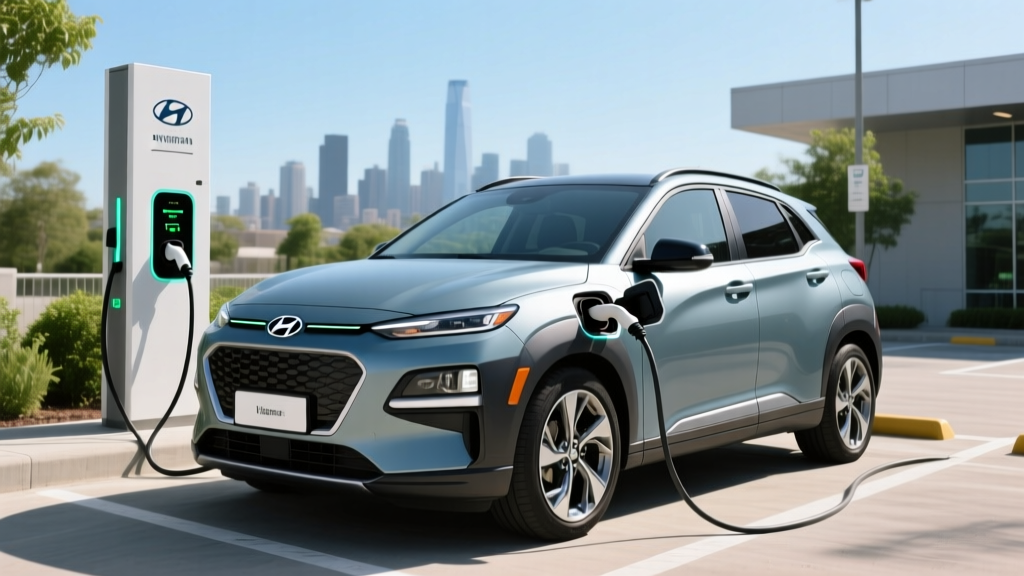
The Hyundai Kona Electric remains one of the most accessible compact EVs on the market, and understanding its real-world range and charging behavior is the key to owning one without surprises. The 2025/2026 Kona Electric carries an EPA-estimated range of up to 261 miles on its SEL and Limited trims (the larger 64.8 kWh battery), while the SE trim with the smaller 48.6 kWh battery delivers an EPA-estimated 200 miles. But EPA stickers are laboratory averages — your actual range depends heavily on how you charge, where you drive, and how you set up your home charging infrastructure.
This guide breaks down exactly how to charge the Kona Electric at home and on the road, what electrical upgrades your house might need, which connectors and adapters apply, and how the per-mile cost stacks up against a comparable gas vehicle. Whether you're a prospective buyer or a new owner optimizing your setup, these are the numbers that matter.
Kona Electric Range: EPA vs. Real-World Expectations
| Trim | Battery (usable) | EPA Range | Real-World Highway (~70 mph) | Cold Weather (below 30°F) |
|---|---|---|---|---|
| SE (48.6 kWh) | 48.6 kWh (NMC) | 200 mi | ~165–180 mi | ~140–160 mi |
| SEL / Limited (64.8 kWh) | 64.8 kWh (NMC) | 261 mi | ~215–235 mi | ~180–200 mi |
Real-world figures based on mixed highway driving at moderate temperatures. Cold-weather estimates assume no preconditioning and cabin heating active. Source: EPA fueleconomy.gov
The Kona Electric's efficiency is rated at approximately 118 MPGe combined (SEL/Limited), which translates to roughly 28–30 kWh per 100 miles driven. That's competitive with the Chevrolet Bolt EV and Nissan Ariya in the compact crossover segment. Highway driving at sustained speeds above 65 mph reduces efficiency by 10–15%, and cold weather can cut range by 20–30% due to battery thermal management demands and cabin heating loads.
One critical ownership insight: the Kona Electric does not come standard with a heat pump on all trims in the U.S. market. If you live in a climate with regular sub-freezing winters, the lack of a heat pump means resistive cabin heating draws directly from the traction battery, accelerating range loss. Preconditioning the battery while plugged in (using the Hyundai app) mitigates some of this, but it's a real factor in daily winter range.
Charging Levels Explained: How Fast Will Each Level Add Range?
Before we get into specific times, let's clarify the most important distinction in EV charging: kW (kilowatts) measures power — the rate at which energy flows into the battery. kWh (kilowatt-hours) measures energy — the total capacity of the battery. Think of kW as the width of a pipe and kWh as the size of the tank. A wider pipe (higher kW) fills the tank faster.
| Level | Power Source | Max kW | Miles of Range Added per Hour | Best For |
|---|---|---|---|---|
| Level 1 | 120V household outlet | ~1.4 kW | ~4–5 mi/hr | Overnight top-ups, low-mileage drivers |
| Level 2 | 240V (NEMA 14-50 or hardwired) | ~10.9 kW (vehicle-limited) | ~35–40 mi/hr | Daily home charging |
| DC Fast Charge | Public DC station (CCS1) | ~100 kW peak | ~200–250 mi/hr (at peak) | Road trips, quick top-ups |
The Kona Electric's onboard charger is rated at 10.9 kW for Level 2 AC charging. This means even if you install an 11.5 kW or 19.2 kW home charger, the car will only accept 10.9 kW. Plan your equipment purchase accordingly — there's no benefit to oversizing the charger beyond what the vehicle can accept, unless you're future-proofing for a second EV.
Charging Time Examples: 10–80% and Full Charges
| Battery Size | Level 1 (120V) | Level 2 (240V, 48A circuit) | DC Fast (10–80%) |
|---|---|---|---|
| 48.6 kWh (SE) | ~34 hours (0–100%) | ~5 hours (0–100%) | ~43 minutes |
| 64.8 kWh (SEL/Limited) | ~46 hours (0–100%) | ~6.5 hours (0–100%) | ~47 minutes |
A note on DC fast charging curves: the Kona Electric peaks at approximately 100 kW but only sustains that rate between roughly 10–40% State of Charge (SoC). Above 60%, the charge rate tapers significantly — often dropping below 40 kW. This is why manufacturers quote 10–80% times rather than 0–100%. Charging from 80–100% on DC fast charge can take nearly as long as the 10–80% portion. For battery longevity, daily charging to 80% is recommended for NMC chemistry batteries like the Kona's.
Home Charger Installation: Requirements, Costs, and Gotchas
Installing a Level 2 home charger is the single most impactful upgrade for EV ownership. For the Kona Electric, a properly installed Level 2 station means waking up every morning with a full charge — eliminating routine visits to public chargers entirely for most drivers.
Electrical Requirements
To deliver the Kona Electric's maximum 10.9 kW AC charge rate, you need a 240V circuit rated at 48 amps or higher. Per the National Electrical Code (NEC), continuous loads (like EV charging) can only use 80% of a circuit's rated capacity. That means:
- 48A charging requires a 60-amp dedicated circuit (48 ÷ 0.8 = 60)
- 40A charging requires a 50-amp dedicated circuit (common for NEMA 14-50 outlets)
- 32A charging requires a 40-amp dedicated circuit
A NEMA 14-50 outlet on a 50A circuit delivers up to 40A (9.6 kW) to the vehicle — slightly below the Kona's 10.9 kW maximum, but the practical difference is roughly 30–40 minutes on a full charge. Most owners find this negligible for overnight charging.
Installation Cost Breakdown
| Component | Low End | High End | Notes |
|---|---|---|---|
| Level 2 charger (hardware) | $350 | $700 | Quality Wi-Fi-enabled 40–48A unit |
| Electrician labor | $500 | $1,500 | Varies by run length, wall type, conduit |
| Electrical permit | $50 | $200 | Required in most jurisdictions |
| Panel upgrade (if needed) | $1,500 | $4,000+ | 100A→200A service upgrade for older homes |
| Total (no panel upgrade) | $900 | $2,400 | Most homes with 200A service |
| Total (with panel upgrade) | $2,400 | $6,400+ | Homes with 100A or maxed-out panels |
Panel upgrade reality check: Homes built before the 1990s often have 100-amp electrical service. Adding a 50A or 60A dedicated EV circuit to an already-loaded 100A panel may require a service upgrade to 200A. This is the single biggest cost variable in home charging installation. Before purchasing a charger, have a licensed electrician perform a load calculation on your panel. The National Electrical Contractors Association (NECA) can help you find qualified professionals.
Some utilities offer rebates of $200–$500 for Level 2 charger installation, and the federal Residential Clean Energy Credit (as of current IRS rules) may cover 30% of charging equipment and installation costs up to $1,000. Check with your utility and a tax professional for eligibility.
Which Connector and Charger Is Compatible with the Kona Electric?
The Hyundai Kona Electric sold in North America uses the CCS1 (Combined Charging System) connector for both Level 2 AC charging and DC fast charging. This is the standard shared by most non-Tesla EVs sold in the U.S. through 2025.
| Connector Type | Charging Level | Compatible with Kona Electric? | Adapter Needed? |
|---|---|---|---|
| J1772 | Level 1 & Level 2 (AC) | Yes — native | No |
| CCS1 | DC Fast Charge | Yes — native | No |
| NACS (Tesla) | Level 2 & DC Fast | With adapter | Yes — CCS-to-NACS adapter (~$200–$250) |
| CHAdeMO | DC Fast Charge | No | Not available / not practical |
The NACS adapter question: As Tesla's North American Charging Standard (NACS) becomes the dominant connector for new EVs starting in 2025–2026, many CCS1-equipped vehicles — including the Kona Electric — can access Tesla Supercharger networks using a CCS-to-NACS adapter. Hyundai has indicated compatibility with approved adapters, but always verify with the adapter manufacturer and confirm that the specific Supercharger station supports non-Tesla vehicles via the Tesla app before relying on this for a road trip.
Cost to Charge: Per-Mile Cost vs. Gasoline
One of the strongest ownership arguments for the Kona Electric is fuel cost. Here's how the numbers break down across common charging scenarios:
| Charging Scenario | Typical $/kWh | Cost per Mile | Annual Cost (12,000 mi) |
|---|---|---|---|
| Home (off-peak utility rate) | $0.08–$0.12 | $0.024–$0.036 | $288–$432 |
| Home (standard residential rate) | $0.14–$0.18 | $0.042–$0.054 | $504–$648 |
| Public Level 2 (network pricing) | $0.25–$0.40 | $0.075–$0.120 | $900–$1,440 |
| DC Fast Charge (public) | $0.35–$0.55 | $0.105–$0.165 | $1,260–$1,980 |
| Gasoline equivalent (30 MPG, $3.40/gal) | — | $0.113 | $1,360 |
At home off-peak rates, the Kona Electric costs roughly 3 cents per mile to fuel — about one-quarter the cost of a 30 MPG gas car at $3.40/gallon. Even at standard residential rates, you're paying roughly 4–5 cents per mile. The savings erode if you rely primarily on DC fast charging at public stations, where costs can match or exceed gasoline per mile.
The takeaway is straightforward: home charging is where the economics win. If your daily driving is under 40 miles and you charge at home overnight, you may only visit a public charger a handful of times per year on road trips.
Recommended Home Chargers for the Kona Electric
Since the Kona Electric's onboard charger maxes out at 10.9 kW, you want a Level 2 station that delivers at least 48 amps (11.5 kW) to ensure you're not leaving charging speed on the table. Here are three proven options:
ChargePoint Home Flex
- Power output: Up to 12 kW (50A) — configurable down to 16A
- Connector: J1772 (CCS1-compatible for AC)
- Cable length: 23 feet
- Smart features: Wi-Fi, app scheduling, utility demand-response integration, Alexa
- Price: ~$550–$650
- Best for: Flexible amperage settings, strong app ecosystem
Emporia Vue Level 2 Charger
- Power output: Up to 11.5 kW (48A)
- Connector: J1772
- Cable length: 24 feet
- Smart features: Wi-Fi, energy monitoring, solar integration, app control
- Price: ~$350–$400
- Best for: Budget-conscious buyers who want smart features
Grizzl-E Smart
- Power output: Up to 10 kW (40A)
- Connector: J1772
- Cable length: 24 feet
- Smart features: Wi-Fi, OCPP-compatible, adjustable amperage
- Price: ~$450–$550
- Best for: Cold-climate durability (rated to -40°F), rugged build
Why not a 19.2 kW charger? Higher-output chargers like the ChargePoint Home Flex at 80A or certain 19.2 kW units exist, but the Kona Electric cannot accept more than 10.9 kW. Spending extra on a higher-output charger only makes sense if you plan to own a future EV with a larger onboard charger (e.g., some trucks and luxury EVs accept 19.2 kW). For Kona-only households, a 48A unit is the sweet spot.
Safety, Code, and Installation Best Practices
EV charging involves sustained high-current draw — often 8+ hours continuously. This places demands on your electrical system that typical household circuits never experience. Here's what code and safety require:
- Dedicated circuit: Your Level 2 charger must be on its own dedicated circuit — it cannot share with other appliances. This is a NEC requirement, not a recommendation.
- GFCI protection: The 2020 NEC and later require GFCI (Ground Fault Circuit Interrupter) protection for EV charging outlets. Hardwired installations may have different GFCI requirements depending on jurisdiction. Your electrician will determine compliance.
- Outdoor rating: If your charger is installed outdoors (garage-adjacent or driveway), the unit must carry a NEMA 4 or NEMA 4X weather rating. All three chargers recommended above meet this standard.
- Wire gauge: A 60A circuit typically requires 6 AWG copper wire; a 50A circuit requires 6 AWG or 8 AWG depending on wire type and run length. Your electrician will size this correctly.
- Permit and inspection: Most municipalities require an electrical permit and post-installation inspection for EV charger circuits. Skipping this can void home insurance coverage in the event of an electrical fire.
Never use an extension cord for EV charging. Never plug a Level 2 charger into an outlet shared with a dryer, welder, or other high-draw appliance using a splitter. These are fire hazards and code violations.
Kona Electric Battery Health and Charging Habits
The Kona Electric uses NMC (nickel manganese cobalt) battery chemistry, which offers high energy density but is more sensitive to sustained high or low State of Charge than LFP (lithium iron phosphate) chemistry. To maximize long-term battery health:
- Daily charging limit: Set your charge limit to 80% for routine daily driving. The Hyundai infotainment system and app allow you to configure this.
- Avoid DC fast charging as a daily habit: Occasional DC fast charging is fine, but frequent high-rate charging accelerates degradation. Reserve it for road trips.
- Don't store at 100% or below 10%: If you're leaving the car parked for more than a few days, aim for 50–70% SoC.
- Precondition while plugged in: Use the Hyundai app to warm or cool the battery and cabin while connected to grid power. This preserves range and reduces battery stress.
Hyundai's battery warranty covers the Kona Electric's traction battery for 10 years or 100,000 miles (whichever comes first) against capacity loss below 70% of original capacity. This is one of the strongest battery warranties in the segment and provides meaningful long-term ownership confidence.
Frequently Asked Questions
How much does it cost to install a home EV charger for the Kona Electric?
Expect $900–$2,400 for a standard installation (charger hardware, electrician labor, and permit) if your electrical panel has sufficient capacity. If your home needs a panel upgrade from 100A to 200A service, total costs can reach $2,400–$6,400+. Always get a load calculation from a licensed electrician before purchasing equipment.
How fast will each charging level add range to the Kona Electric?
Level 1 (120V) adds approximately 4–5 miles of range per hour. Level 2 (240V, 48A) adds approximately 35–40 miles per hour. DC fast charging at peak rate (~100 kW) can add roughly 200+ miles per hour, but only for a portion of the session before the charge curve tapers above 60% SoC.
Which connector is compatible with the Hyundai Kona Electric?
The Kona Electric uses CCS1 natively for both AC Level 2 and DC fast charging. The AC portion uses the J1772 connector (the top portion of CCS1). To access Tesla Superchargers, you'll need a CCS-to-NACS adapter. CHAdeMO is not compatible.
How much does charging the Kona Electric cost per mile vs. gas?
At home off-peak rates ($0.08–$0.12/kWh), the Kona Electric costs roughly $0.024–$0.036 per mile — about one-quarter the cost of a 30 MPG gas car at $3.40/gallon ($0.113/mile). Public DC fast charging at $0.35–$0.55/kWh costs $0.105–$0.165 per mile, which can exceed gasoline costs.
What electrical upgrades might I need for a Level 2 charger?
You need a dedicated 240V circuit (50A or 60A) with appropriate wire gauge and a GFCI-protected outlet or hardwired connection. The most common major upgrade is a panel service increase from 100A to 200A, required when your existing panel lacks spare capacity. A licensed electrician's load calculation determines this.
Does the Kona Electric qualify for the federal EV tax credit?
Federal tax credit eligibility under IRS §30D depends on MSRP caps, buyer income limits, battery component sourcing, and critical mineral requirements — all of which are subject to change. The Kona Electric's eligibility has varied by model year. Check the latest information on irs.gov and consult a tax professional before relying on the credit in your purchase decision. Point-of-sale transfer is available if eligible.
Can I use a Tesla Supercharger with my Kona Electric?
Yes, but only with a CCS-to-NACS adapter and only at Supercharger stations that Tesla has opened to non-Tesla vehicles (check the Tesla app for station compatibility). Charging speed will be limited by the Kona's ~100 kW peak DC acceptance rate, which is below the Supercharger network's maximum capability.
Quick-Reference Spec Summary
| Spec | SE (48.6 kWh) | SEL / Limited (64.8 kWh) |
|---|---|---|
| EPA Range | 200 miles | 261 miles |
| Battery Chemistry | NMC | NMC |
| Usable Battery Capacity | 48.6 kWh | 64.8 kWh |
| MPGe (combined) | ~121 MPGe | ~118 MPGe |
| Max AC Charge Rate (Level 2) | 10.9 kW | 10.9 kW |
| Max DC Fast Charge Rate | ~100 kW | ~100 kW |
| DC Fast Charge 10–80% | ~43 min | ~47 min |
| Horsepower | 201 hp | 201 hp |
| 0–60 mph | ~7.4 sec | ~7.4 sec |
| Connector | CCS1 (J1772 AC) | CCS1 (J1772 AC) |
| Base MSRP (approx.) | ~$33,000 | ~$37,000–$41,000 |
| Battery Warranty | 10 yr / 100,000 mi | 10 yr / 100,000 mi |
Source: EPA fueleconomy.gov, Hyundai Motor America. Pricing and specifications are approximate and subject to change by model year. Verify current specs with your dealer.