The Hyundai Ioniq 9 is one of the most anticipated three-row electric SUVs on the market, and its headline number — an estimated EPA range of up to 335 miles on the Long Range RWD model with its 110.3 kWh (usable) battery pack — is a major selling point for families considering the jump to electric. But that sticker range is only half the equation. How you charge the Ioniq 9 at home, how quickly you can replenish on road trips, and what connector ecosystem you're buying into will determine whether that 335-mile figure translates into real daily convenience or frustrating compromise.
This guide breaks down exactly what it takes to charge the Hyundai Ioniq 9 efficiently, from Level 1 trickle charging through DC fast charging, home installation costs, connector compatibility in the rapidly shifting NACS/CCS landscape, and the real cost-per-mile compared to gasoline. We'll also recommend specific Level 2 chargers matched to the Ioniq 9's onboard charger capacity.
| Battery (usable) | 110.3 kWh (NMC chemistry) |
| Est. EPA Range (Long Range RWD) | ~335 miles |
| Est. EPA Range (AWD) | ~300 miles |
| Max DC Fast Charge Rate | ~350 kW peak (800V architecture) |
| 10–80% DC Fast Charge | ~18–24 minutes (conditions dependent) |
| Level 2 Onboard Charger | 10.9 kW (48A) |
| Charging Port | CCS1 (NACS adapter available/planned) |
| Battery/Powertrain Warranty | 10 years / 100,000 miles |
Sources: Hyundai Newsroom, preliminary specifications. Final EPA figures subject to official certification.
Understanding Charging Levels: How Fast Will Each Add Range to the Ioniq 9?
Before we talk hardware, let's clarify the single most important distinction in EV charging: kW (kilowatts) measures the rate of energy flow — think of it as how fast water pours from a hose. kWh (kilowatt-hours) measures the total energy stored — the size of the bucket. The Ioniq 9's battery holds roughly 110.3 kWh of usable energy. Your charger's kW output determines how quickly that bucket fills.
| Charging Level | Voltage / Amperage | Max Power (kW) | Miles of Range Added per Hour | Full Charge Time (0–100%) |
|---|---|---|---|---|
| Level 1 (120V household outlet) | 120V / 12A | ~1.4 kW | ~3–4 mi/hr | ~80+ hours |
| Level 2 (240V home/public) | 240V / 48A | 10.9 kW (Ioniq 9 onboard limit) | ~30–35 mi/hr | ~10–12 hours |
| DC Fast Charging (public stations) | 400–800V DC | Up to 350 kW peak | ~200–600+ mi/hr (varies by SoC) | 10–80% in ~18–24 min |
Home Charger Installation: Electrical Requirements, Costs, and Panel Upgrades
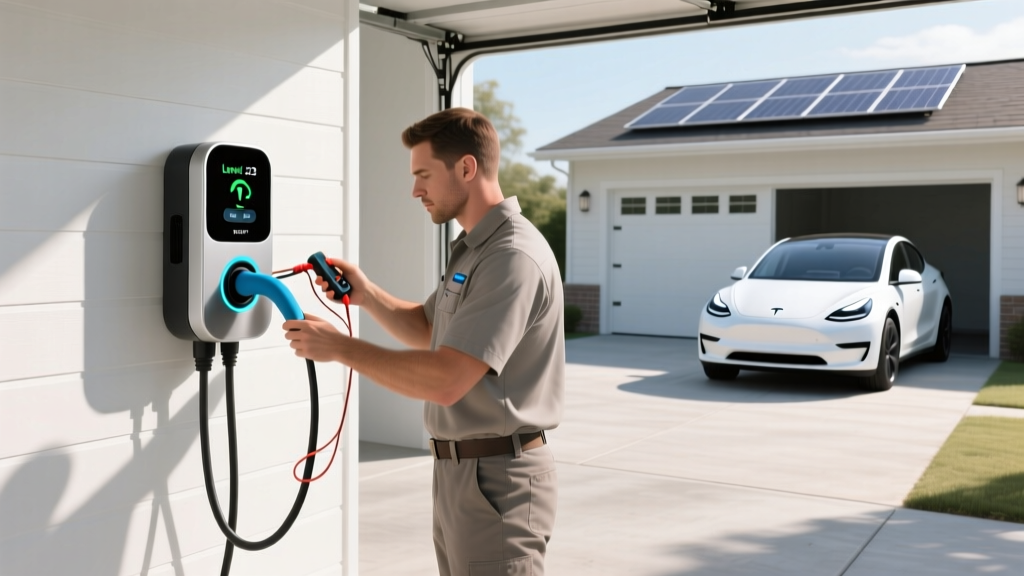
To unlock the Ioniq 9's full 10.9 kW Level 2 charging capability at home, you need a 240-volt circuit rated for at least 60 amps (which supports a continuous 48A draw — electrical code requires circuits to be rated 125% above the continuous load). Here's what that actually means for your home and your wallet.
Electrical Requirements for a 48A Level 2 Charger
- Circuit: Dedicated 60-amp, 240-volt breaker
- Wire: 6 AWG copper (or 4 AWG aluminum) run from panel to charger location
- Panel capacity: Your main electrical panel must have sufficient spare amperage — most modern 200A panels can accommodate this; older 100A panels often cannot
- Permit: Required in virtually all US jurisdictions for new 240V circuits
- GFCI: NEC 2020/2023 requires GFCI protection for EV receptacles; hardwired chargers may not require a separate GFCI breaker (the unit provides internal protection)
Installation Cost Breakdown
| Component | Typical Cost Range | Notes |
|---|---|---|
| Level 2 Charger (hardware) | $400 – $750 | 48A smart chargers; see recommendations below |
| Electrician labor (standard install) | $500 – $1,500 | Depends on wire run distance from panel (10–50 ft typical) |
| Permit & inspection | $50 – $250 | Varies by municipality |
| Panel upgrade (if needed) | $1,500 – $4,000+ | 100A → 200A service upgrade; common in pre-1990 homes |
| Total (no panel upgrade) | $950 – $2,500 | Most homeowners fall in this range |
| Total (with panel upgrade) | $2,450 – $6,500+ | Older homes; get 2–3 electrician quotes |
Panel upgrade reality check: If your home has a 100-amp main panel — common in houses built before the 1990s — adding a 60A EV circuit may exceed safe capacity. An electrician will perform a load calculation per NEC Article 220. If you're over the limit, you'll need a service upgrade to 200A (or consider a lower-amperage 32A charger on a 40A circuit, which still delivers ~7.7 kW — enough for overnight replenishment of the Ioniq 9's battery). Always get a licensed electrician to assess this; it's not a DIY decision.
The federal Alternative Fuel Vehicle Refueling Property Credit (IRS Form 8911) may cover up to 30% of home charger hardware and installation costs (max $1,000), subject to income and census-tract eligibility. Check current-year rules with a tax professional.
Connector Compatibility: NACS, CCS1, and the Adapter Landscape
The Ioniq 9 ships with a CCS1 (Combined Charging System) port, which has been the North American standard for non-Tesla EVs. However, the industry is rapidly migrating to Tesla's NACS (North American Charging Standard), and Hyundai has confirmed that future model-year Ioniq vehicles will adopt NACS natively. For 2025–2026 Ioniq 9 buyers, this means navigating a transitional period.
| Connector Type | Network Access | Ioniq 9 Compatibility |
|---|---|---|
| CCS1 | Electrify America, EVgo, ChargePoint, most non-Tesla networks | Native — built-in port |
| NACS (Tesla) | Tesla Supercharger network (17,000+ stalls in North America) | Via CCS-to-NACS adapter (provided or available from Hyundai; aftermarket adapters from Lectron, A2Z) |
| CHAdeMO | Legacy network; largely deprecated in North America | Not compatible; not relevant for Ioniq 9 |
| J1772 (Level 2 AC) | All public Level 2 stations, home chargers | Native — used for all AC Level 2 charging |
Practical advice: If you plan to road-trip frequently, a CCS-to-NACS adapter is essential. Tesla's Supercharger network remains the most reliable and geographically complete DC fast-charging infrastructure in the US. Hyundai has indicated that Ioniq 9 owners will receive an adapter or have one available at purchase — confirm with your dealer. Adapters from reputable manufacturers like Lectron and A2Z EV typically cost $150–$250 and are rated for up to 250 kW DC (note: adapter limitations may cap your peak charge rate below the Ioniq 9's 350 kW maximum on Superchargers).
DC Fast Charging the Ioniq 9: Charge Curves, Speeds, and 10–80% Times
The Ioniq 9 uses Hyundai Motor Group's E-GMP 800-volt architecture, the same platform underpinning the Ioniq 5 and Ioniq 6. This is significant: 800V systems can accept higher charge power with lower current, reducing heat and enabling faster sustained charging. On a 350 kW-capable DC fast charger (like Electrify America's latest stalls), the Ioniq 9 can peak near 350 kW under ideal conditions.
However — and this is where real-world honesty matters — peak kW is not sustained kW. Like all lithium-ion batteries, the Ioniq 9's charge rate tapers as the state of charge (SoC) rises. Here's a realistic charge curve estimate based on the E-GMP platform's behavior:
- 10–40% SoC: Sustains near peak power (~300–350 kW) — fastest portion of the curve
- 40–60% SoC: Steps down to ~200–250 kW
- 60–80% SoC: Further taper to ~120–180 kW
- 80–100% SoC: Dramatic taper to ~50 kW and below (this is why 10–80% is the standard metric)
Estimated 10–80% charge time on a 350 kW station: ~20–24 minutes (battery preconditioned to optimal temperature). On a 150 kW station, expect ~30–38 minutes. Cold batteries will charge significantly slower unless preconditioned — the Ioniq 9's thermal management system can warm the pack when navigation is set to a charging station, a feature you should always use in winter.
Cost to Charge: Home vs. Public vs. Gasoline
One of the strongest ownership arguments for the Ioniq 9 is fuel cost savings, but the magnitude depends entirely on where you charge. Let's run the numbers using the Ioniq 9's estimated efficiency of ~2.8–3.0 miles per kWh (roughly 112–107 MPGe combined, based on E-GMP platform benchmarks).
| Scenario | Cost per kWh | Cost per Mile | Cost for 335-Mile "Fill-Up" |
|---|---|---|---|
| Home (off-peak utility rate) | $0.09 – $0.13 | $0.03 – $0.04 | $10.05 – $13.40 |
| Home (average US rate) | $0.16 | $0.05 – $0.06 | $17.85 – $20.10 |
| Public Level 2 (ChargePoint, etc.) | $0.25 – $0.49 | $0.08 – $0.17 | $26.80 – $56.95 |
| DC Fast Charging (Electrify America) | $0.40 – $0.56 | $0.13 – $0.20 | $43.55 – $67.00 |
| Gasoline equivalent (25 MPG, $3.40/gal) | — | $0.14 | $46.90 |
The takeaway: Charging at home on off-peak rates makes the Ioniq 9 dramatically cheaper to "fuel" than any comparable gas SUV — roughly $11–13 for a full 335-mile equivalent, versus $47 for a gas vehicle getting 25 MPG. But exclusive reliance on DC fast charging can erase that advantage, sometimes costing more than gasoline. Home charging access is the economic linchpin of EV ownership.
Recommended Level 2 Home Chargers for the Hyundai Ioniq 9
Since the Ioniq 9's onboard charger accepts up to 10.9 kW (48A), you'll want a charger that can deliver at least that. Here are three proven options matched to the Ioniq 9's capabilities:
ChargePoint Home Flex
- Power: Up to 12 kW (50A), adjustable down to 16A
- Connector: J1772 (NACS version now available)
- Cable length: 23 ft
- Smart features: Wi-Fi, app scheduling, energy tracking, Alexa
- Price: ~$550–$650
- Best for: Flexibility — adjustable amperage works with any panel capacity
Emporia Level 2 EV Charger
- Power: Up to 11.5 kW (48A)
- Connector: J1772
- Cable length: 24 ft
- Smart features: Wi-Fi, app, solar integration, energy monitoring
- Price: ~$400–$500
- Best for: Budget-conscious buyers who want smart features and energy tracking
Wallbox Pulsar Plus (48A)
- Power: Up to 11.5 kW (48A)
- Connector: J1772
- Cable length: 25 ft
- Smart features: Wi-Fi + Bluetooth, app scheduling, power sharing
- Price: ~$550–$650
- Best for: Compact design, outdoor-rated (NEMA 4), power-sharing for two chargers on one circuit
Hardwired vs. plug-in: For 48A charging, a hardwired installation is preferred (and often required by code for circuits above 40A). A NEMA 14-50 receptacle is rated for 50A but only supports 40A continuous draw, which limits you to ~9.6 kW — still adequate for overnight Ioniq 9 charging, but you'll leave ~1.3 kW on the table. Hardwiring also eliminates the need for a GFCI breaker (saving ~$100–$150 on the electrical bill).
Safety, Code, and Installation Best Practices
EV charging involves sustained high-current draw for hours — this is fundamentally different from briefly running a dryer or oven. Cutting corners on installation creates fire risk. Here are the non-negotiable requirements:
- Dedicated circuit: Your Level 2 charger must be on its own dedicated breaker — never shared with other appliances
- Correct wire gauge: 6 AWG copper minimum for a 60A circuit; undersized wire causes overheating
- Outdoor rating: If your charger is installed outdoors or in an unenclosed carport, it must be rated NEMA 3R or NEMA 4 (weather-resistant)
- GFCI protection: Required by NEC 2020+ for receptacle-based EV charging; hardwired units have built-in ground-fault protection
- Permit and inspection: Required in virtually all jurisdictions — unpermitted work can void homeowner's insurance in the event of an electrical fire
- Use a licensed electrician: This is not a DIY project. Hire an electrician experienced with EV charger installations; ask for references and verify licensing
Frequently Asked Questions
How much does it cost to install a home EV charger for the Hyundai Ioniq 9?
For a standard installation without a panel upgrade, expect $950–$2,500 total (charger hardware + electrician labor + permit). If your home needs a 200A panel upgrade, add $1,500–$4,000+, bringing the total to $2,450–$6,500+. Always get multiple quotes from licensed electricians.
How fast will each charging level add range to the Ioniq 9?
Level 1 (120V) adds roughly 3–4 miles per hour — impractical for a 110.3 kWh battery. Level 2 (240V, 48A) adds approximately 30–35 miles per hour, fully replenishing the battery overnight in ~10–12 hours. DC fast charging at 350 kW can add 10–80% in roughly 20–24 minutes under ideal conditions.
Which connector and charger is compatible with the Hyundai Ioniq 9?
The Ioniq 9 uses a CCS1 port natively for DC fast charging and a J1772 inlet for Level 2 AC charging. To access Tesla Superchargers, you'll need a CCS-to-NACS adapter (confirm availability with your Hyundai dealer). For home charging, any J1772 Level 2 charger rated at 48A or higher will match the Ioniq 9's 10.9 kW onboard charger capacity.
How much does charging the Ioniq 9 cost per mile vs. a gas SUV?
Charging at home on average US electricity rates ($0.16/kWh), the Ioniq 9 costs approximately $0.05–$0.06 per mile. A comparable gas SUV getting 25 MPG at $3.40/gallon costs about $0.14 per mile. Home charging saves roughly 60–65% on fuel costs. Exclusive DC fast charging at $0.48–$0.56/kWh can cost $0.15–$0.20 per mile — roughly equivalent to or slightly above gasoline.
What electrical upgrades might I need for a home charger?
The most common upgrade is a panel capacity increase from 100A to 200A service, needed in older homes that lack spare amperage for a 60A EV circuit. Your electrician will perform an NEC Article 220 load calculation. Other potential upgrades include adding a sub-panel (if the main panel is full), upgrading the service drop from the utility, or replacing outdated wiring. Budget $1,500–$4,000+ for a panel upgrade if required.
Will the Hyundai Ioniq 9 qualify for the federal EV tax credit?
Federal tax credit eligibility under IRS §30D depends on MSRP caps (SUVs: $80,000), buyer income limits (AGI ≤ $300,000 joint / $150,000 single), battery component sourcing, and critical mineral requirements — all of which are subject to change. The credit can now be transferred to the dealer at point of sale as an upfront discount. Confirm current-year eligibility with your dealer and a tax professional before purchasing.
Sources consulted: Hyundai Motor America Newsroom, fueleconomy.gov (EPA), IRS Clean Vehicle Credits. Specifications are based on preliminary/announced data for the 2025–2026 Hyundai Ioniq 9; final EPA certification figures may differ.