The Hyundai Ioniq 6 SE Standard Range is one of the most aerodynamic and efficient sedans in the EV market, but its 58.0 kWh battery and 270-mile EPA range rating mean charging strategy matters more than it does on long-range trims. Whether you're plugging in at home overnight or relying on DC fast chargers for road trips, understanding the exact power levels, connector requirements, and real-world costs will save you time and money.
This guide breaks down every charging scenario for the Ioniq 6 SE Standard Range — from a 120V trickle charge to 350 kW DC fast charging — plus what it takes to install a Level 2 charger at home, what equipment to buy, and how the per-mile cost compares to a gas car.
Ioniq 6 SE Standard Range: Key Charging Specs at a Glance
| Specification | Value |
|---|---|
| Battery Capacity (Usable) | ~54.0 kWh (58.0 kWh gross) |
| Battery Chemistry | NMC (Nickel Manganese Cobalt) |
| EPA Range | 270 miles (RWD) |
| Real-World Highway Range | ~220–240 miles (70+ mph, moderate climate) |
| EPA Efficiency | 140 MPGe / 24 kWh per 100 miles |
| Max DC Fast Charge Rate | ~175 kW peak |
| 10–80% DC Fast Charge Time | ~18 minutes (ideal conditions, preconditioned) |
| Level 2 Onboard Charger | 10.9 kW (48A at 240V) |
| Connector | CCS1 (NACS adapter available) |
| 0–60 mph | 7.2 seconds |
| Horsepower | 168 hp (RWD) |
| Base MSRP (2025 SE Standard Range) | $37,500 |
| Battery/Powertrain Warranty | 10 years / 100,000 miles |
Charging Levels Explained: Speeds and Range Added Per Hour
There are three levels of EV charging, each with different power delivery and use cases. Understanding the difference between kW (power, or how fast energy flows) and kWh (energy, or the battery's total capacity) is essential. Think of kW as the size of a hose and kWh as the size of the bucket.
| Level | Voltage | Max Power (kW) | Miles of Range Added Per Hour | Best Use Case |
|---|---|---|---|---|
| Level 1 (120V) | 120V AC | 1.4–1.9 kW | ~4–6 miles/hr | Overnight trickle; emergency backup |
| Level 2 (240V) | 240V AC | Up to 10.9 kW (Ioniq 6 onboard limit) | ~30–38 miles/hr | Daily home charging; workplace |
| DC Fast Charging | 400V+ DC | Up to ~175 kW (Ioniq 6 peak) | ~400–600+ miles/hr (at peak) | Road trips; rapid top-ups |
Level 1: The Emergency Backup
Every Ioniq 6 ships with a portable charging cable that plugs into a standard 120V household outlet. At roughly 1.4 kW continuous draw, you'll add about 4–6 miles of range per hour. A full 10–80% charge (roughly 38 kWh) would take about 27 hours. This is impractical for daily use but sufficient if you drive fewer than 30 miles per day and can plug in for 10–12 hours overnight.
Level 2: The Daily Workhorse
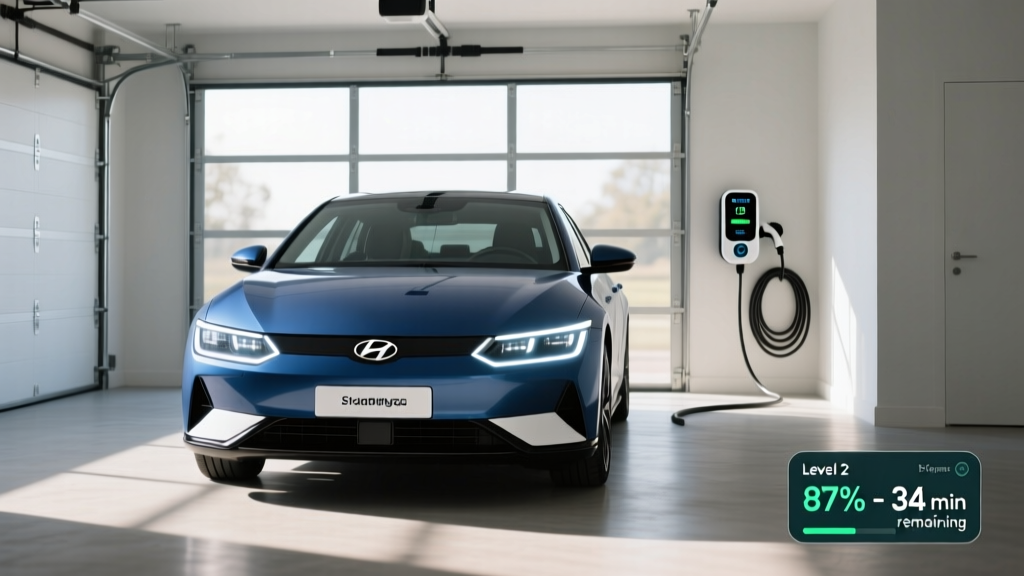
A 240V Level 2 home charger is the standard for EV ownership. The Ioniq 6's onboard charger accepts up to 10.9 kW, meaning a 48A circuit (on a 60A breaker) will deliver maximum charging speed. At 10.9 kW, you add roughly 35–38 miles of range per hour, and a full 10–80% charge takes approximately 3.5–4 hours. This is the sweet spot for overnight charging — plug in when you get home, wake up to a full battery every morning.
DC Fast Charging: Road Trip Ready
The Ioniq 6 SE Standard Range supports DC fast charging at up to ~175 kW peak on a 350 kW charger. Under ideal conditions (battery preconditioned, moderate temperature, low state of charge), a 10–80% charge takes roughly 18 minutes. However, the charge curve tapers significantly above 80%, and real-world sessions at Electrify America or similar networks may average 100–130 kW sustained. Expect 25–30 minutes for a typical highway stop.
Home Charger Installation: Electrical Requirements and Costs
Installing a Level 2 charger at home is the single best investment for EV ownership, but costs vary significantly based on your home's electrical panel, the distance from panel to charger location, and local permit requirements.
Electrical Requirements for the Ioniq 6
- Circuit: Dedicated 60-amp breaker (for a 48A continuous charger load)
- Voltage: 240V (same as a dryer or oven circuit)
- Wire gauge: 6 AWG copper (or 4 AWG aluminum) for runs up to 50 feet; thicker wire for longer runs
- Outlet vs. hardwired: A NEMA 14-50 outlet offers flexibility (portable charger use, RV compatibility); hardwired is slightly cheaper and avoids GFCI nuisance trips
Panel Upgrade: The Hidden Cost
Many older homes have 100-amp or 150-amp electrical panels. If your panel is already near capacity (common with electric heating, A/C, and a dryer), adding a 60-amp EV circuit may require a panel upgrade to 200 amps. A panel upgrade typically costs $1,500–$3,500 on top of the charger installation. Have an electrician perform a load calculation before committing to a circuit size.
If a panel upgrade isn't feasible, you can install a lower-amperage circuit — a 30-amp breaker with a 24A charger still delivers ~5.8 kW, adding roughly 20 miles of range per hour. That's sufficient for most daily driving needs.
| Cost Component | Simple Install (panel nearby, no upgrade) | Complex Install (long run, panel upgrade) |
|---|---|---|
| Level 2 Charger (Equipment) | $400–$700 | $400–$700 |
| Electrician Labor | $500–$1,200 | $1,500–$3,000 |
| Electrical Permit | $50–$200 | $50–$200 |
| Panel Upgrade (if needed) | — | $1,500–$3,500 |
| Conduit, Wire, Misc. | $100–$300 | $300–$800 |
| Total Estimated Cost | $1,050–$2,400 | $3,750–$8,200 |
The IRS Residential Clean Energy Credit covers 30% of home EV charger equipment and installation costs, up to $1,000, through 2032. Check irs.gov for current eligibility and Form 8911 requirements. Some utilities also offer rebates of $200–$500 for Level 2 installations.
Connector Compatibility: CCS1, NACS, and Adapters
The Hyundai Ioniq 6 SE Standard Range comes equipped with a CCS1 (Combined Charging System) connector port. This is the legacy standard used by most non-Tesla EVs through 2024–2025. However, the charging landscape has shifted significantly: most major automakers, including Hyundai, have adopted or are transitioning to the NACS (North American Charging Standard, originally Tesla's connector).
| Connector | Used By | Ioniq 6 SE Standard Range Compatible? | Notes |
|---|---|---|---|
| CCS1 | Hyundai, Kia, VW, BMW, Ford (pre-2025), most non-Tesla | Yes — native port | Works at Electrify America, EVgo, ChargePoint DC stations |
| NACS (Tesla) | Tesla (native); Ford, GM, Rivian, Hyundai (2025+ models) | Yes — with Hyundai-approved NACS adapter | Enables Tesla Supercharger access; confirm adapter availability with dealer |
| CHAdeMO | Nissan Leaf (legacy), Mitsubishi | No | Being phased out; avoid relying on CHAdeMO stations |
| J1772 (Level 1/2 AC) | All EVs (standard AC plug) | Yes — native port (upper portion of CCS) | Used for Level 1 and Level 2 public AC charging |
Adapter recommendation: If you plan to use Tesla Superchargers on road trips, obtain Hyundai's official NACS-to-CCS adapter (availability varies by model year — check with your dealer). Third-party adapters exist but may not be covered under warranty. For home Level 2 charging, all chargers use the J1772 connector, which plugs directly into the Ioniq 6's port.
Cost to Charge: Per-Mile Comparison vs. Gasoline
One of the strongest arguments for the Ioniq 6 SE Standard Range is its exceptional efficiency — rated at 24 kWh per 100 miles (140 MPGe). That low consumption directly translates into lower charging costs.
| Charging Scenario | Cost per kWh | Cost per 100 Miles | Cost per Mile | Equivalent Gas Price (at 30 MPG) |
|---|---|---|---|---|
| Home (off-peak utility rate) | $0.08–$0.12 | $1.92–$2.88 | $0.02–$0.03 | $0.60–$0.90/gal |
| Home (average US rate) | $0.16 | $3.84 | $0.04 | $1.20/gal |
| Public Level 2 (ChargePoint, etc.) | $0.25–$0.40 | $6.00–$9.60 | $0.06–$0.10 | $1.80–$3.00/gal |
| DC Fast Charging (Electrify America) | $0.40–$0.56 | $9.60–$13.44 | $0.10–$0.13 | $3.00–$3.90/gal |
| Gas Car (30 MPG, $3.50/gal) | — | $11.67 | $0.12 | $3.50/gal |
At home on an average electricity rate, the Ioniq 6 SE Standard Range costs roughly 3–4 cents per mile to fuel — about one-third the cost of a comparable 30 MPG gas sedan at $3.50/gallon. Even on the most expensive DC fast chargers, the cost per mile roughly matches gasoline. The savings compound quickly: at 12,000 miles per year, home charging saves approximately $950–$1,100 annually compared to gas.
Tip: Many utilities offer time-of-use (TOU) rates with off-peak pricing as low as $0.06–$0.08/kWh overnight. Set your Ioniq 6's scheduled charging feature (via the infotainment system or Bluelink app) to charge between 10 PM and 6 AM for the lowest cost.
Recommended Home Level 2 Chargers for the Ioniq 6
The Ioniq 6's 10.9 kW onboard charger means you'll want a Level 2 unit that can deliver at least 48 amps to achieve maximum charging speed. Here are three proven options across different budgets:
Emporia Vue Level 2 (Best Value)
- Power Output: 48A / 11.5 kW max (adjustable down)
- Connector: J1772 (NACS version also available)
- Cable Length: 24 feet
- Smart Features: Wi-Fi, app scheduling, energy monitoring, load management
- Price: ~$399
- Why it works: Delivers full 10.9 kW to the Ioniq 6; excellent energy tracking pairs well with solar or TOU rates
ChargePoint Home Flex (Most Popular)
- Power Output: Up to 50A / 12 kW (dip-switch adjustable to match circuit)
- Connector: J1772
- Cable Length: 23 feet
- Smart Features: Wi-Fi, app scheduling, Alexa integration, detailed session history
- Price: ~$599
- Why it works: Flexible amperage lets you match any circuit from 20A to 60A; UL-listed and widely utility-rebated
Grizzl-E Smart (Rugged / Outdoor)
- Power Output: 40A / 9.6 kW
- Connector: J1772
- Cable Length: 24 feet
- Smart Features: Bluetooth + Wi-Fi, OCPP-compatible, extreme weather rated (-40°F to 122°F)
- Price: ~$449
- Why it works: Built for outdoor/garage installations in harsh climates; slightly lower power (9.6 kW) still adds ~32 miles/hr to the Ioniq 6
For a 48A charger (Emporia, ChargePoint at 48A), you'll need a dedicated 60-amp breaker. For the 40A Grizzl-E, a 50-amp breaker suffices. Always have a licensed electrician confirm your panel capacity and install to NEC Article 625 requirements.
Safety, Code, and Installation Best Practices
- Dedicated circuit: Your Level 2 charger must be on its own dedicated circuit — never share with other appliances. EV charging is a continuous load (3+ hours), so NEC code requires the circuit breaker to be rated at 125% of the charger's maximum draw (48A charger → 60A breaker).
- GFCI protection: The 2020 NEC requires GFCI protection for outlet-installed EV chargers. Hardwired installations may be exempt in some jurisdictions and avoid nuisance tripping common with NEMA 14-50 outlets.
- Outdoor rating: If mounting outside, choose a charger rated NEMA 4 (weatherproof). Most quality units (Grizzl-E, ChargePoint Home Flex) carry this rating. Ensure the connector holster keeps the plug off the ground.
- Permit and inspection: Most municipalities require an electrical permit for a new 240V circuit ($50–$200). The inspection ensures code compliance and is often required to claim utility rebates or the federal 30% charger tax credit.
- Cable management: A 24-foot cable is sufficient for most garages. Ensure the cable doesn't stretch across walkways — use a cable organizer or retractable reel for safety.
Frequently Asked Questions
How much does it cost to install a home EV charger for the Ioniq 6?
A straightforward Level 2 installation (panel nearby, no upgrade needed) typically costs $1,050–$2,400 total, including the charger, electrician labor, permit, and materials. If your home needs a 200-amp panel upgrade or the charger is far from the panel, costs can reach $3,750–$8,200. The federal Residential Clean Energy Credit covers 30% of costs up to $1,000.
How fast will each charging level add range to the Ioniq 6 SE Standard Range?
Level 1 (120V): approximately 4–6 miles per hour. Level 2 (240V, 48A): approximately 35–38 miles per hour. DC fast charging (at peak ~175 kW): up to 400–600+ miles per hour of equivalent charging, though the charge curve tapers significantly above 80% state of charge.
Which connector and charger is compatible with my Ioniq 6?
The Ioniq 6 SE Standard Range uses a CCS1 connector natively. For home Level 2 charging, any J1772 charger works (this is the universal AC standard). For Tesla Supercharger access, you'll need a Hyundai-approved NACS adapter. CHAdeMO is not compatible.
How much does charging the Ioniq 6 cost per mile compared to gas?
At the US average home electricity rate ($0.16/kWh), the Ioniq 6 SE Standard Range costs about $0.04 per mile — roughly one-third the $0.12/mile cost of a 30 MPG gas car at $3.50/gallon. On off-peak rates, home charging drops to $0.02–$0.03 per mile. Even at the most expensive DC fast chargers, per-mile costs roughly match gasoline.
What electrical upgrades might I need for a Level 2 charger?
If your home has a 200-amp panel with available capacity, a new 60-amp breaker and 240V circuit is all that's needed. Older homes with 100-amp or 150-amp panels may require a panel upgrade ($1,500–$3,500). Alternatively, you can install a lower-amperage circuit (30A breaker / 24A charger) for ~5.8 kW charging, which still adds about 20 miles per hour — adequate for most daily needs.
Does the Ioniq 6 SE Standard Range support 800V ultra-fast charging?
No. The Ioniq 6 SE Standard Range uses a 400V architecture, unlike the SE Long Range and SEL trims which use Hyundai's E-GMP 800V system capable of 350 kW peak charging. The Standard Range tops out at approximately 175 kW on DC fast chargers — still fast (10–80% in ~18 minutes), but not the 12-minute ultra-fast speeds available on higher trims.
Sources: EPA efficiency and range data from fueleconomy.gov; Hyundai Ioniq 6 specifications from Hyundai USA; federal tax credit rules from IRS.gov.