Hyundai Ioniq 6 Charging Speed: The 800-Volt Advantage Explained
The Hyundai Ioniq 6 shares the E-GMP platform with the Ioniq 5 and Kia EV6, which means it inherits one of the most capable charging architectures on the market: an 800-volt electrical system. While most competitors operate at 400V and peak around 150 kW on DC fast chargers, the Ioniq 6 can accept up to 238 kW peak at a 350 kW-capable station. That translates to a 10–80% charge in approximately 18 minutes under ideal conditions — one of the fastest production EVs you can buy.
But peak kW is only part of the story. Real-world charging speed depends on the station's output, battery temperature, state of charge (SoC), and whether you're using Level 2 at home or DC fast charging on the road. Below, we break down exactly what Ioniq 6 owners should expect at every charging level, what home installation actually costs, and which equipment we recommend.
| Spec | Standard Range (SE/SEL) | Long Range (SE/SEL/Limited) |
|---|---|---|
| Battery Capacity (usable) | 54.0 kWh | 77.4 kWh |
| Battery Chemistry | NMC (Nickel Manganese Cobalt) | NMC |
| EPA Range | 240 mi (est.) | 305–361 mi |
| Peak DC Fast Charge Rate | ~180 kW | ~238 kW |
| 10–80% DC Fast Charge Time | ~20 min (350 kW station) | ~18 min (350 kW station) |
| Level 2 Onboard Charger | 10.9 kW | 10.9 kW |
| Connector (North America) | CCS1 (NACS adapter available) | CCS1 (NACS adapter available) |
| Electrical Architecture | 800V | 800V |
Real-world caveat: Hyundai's 18-minute claim requires a 350 kW CCS charger with active battery preconditioning. On a 150 kW station — still the most common DC fast charger type in the U.S. — expect 10–80% in roughly 28–32 minutes. In cold weather (below 35°F), without preconditioning, that time can stretch to 45+ minutes as the battery management system limits charge rate to protect the cells.
Charging Levels: How Fast Will Each Add Range?
EV charging breaks into three tiers. Here's how each applies to the Ioniq 6 Long Range (77.4 kWh battery, ~3.5 mi/kWh efficiency):
| Level | Voltage / Amperage | Max Power (kW) | Miles Added per Hour | 0–100% Time (77.4 kWh) | Best For |
|---|---|---|---|---|---|
| Level 1 (120V) | 120V / 12A | ~1.4 kW | ~5 mi/hr | ~55 hours | Emergency top-ups, PHEVs |
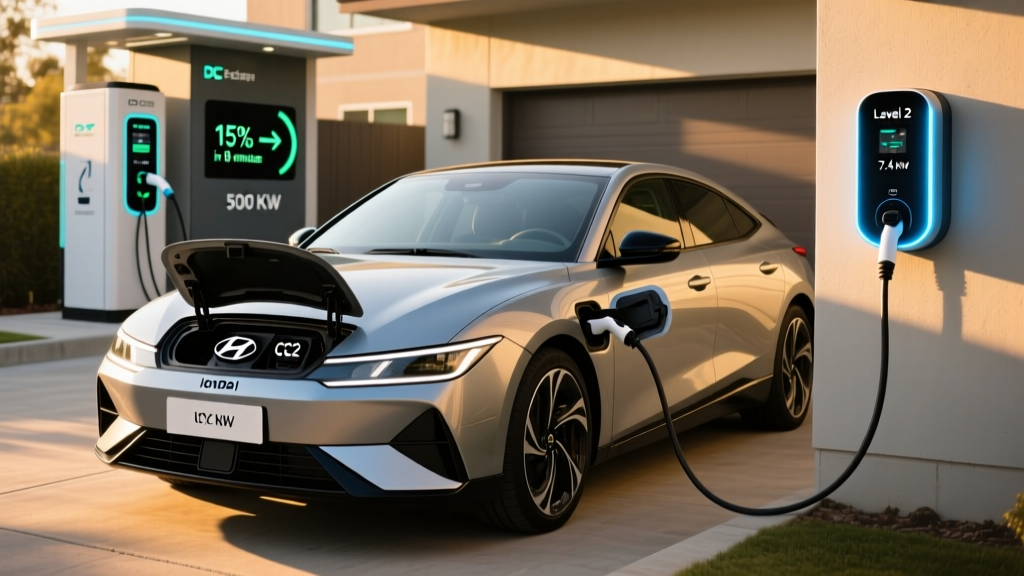
| Level 2 (240V) | 240V / 48A | 10.9 kW (onboard limit) | ~38 mi/hr | ~7.5 hours | Daily home charging |
| DC Fast (CCS) | 400–800V DC | 238 kW peak | N/A (measured in minutes) | ~18 min (10–80%) | Road trips, rapid top-ups |
kW vs. kWh — the critical distinction: kW (kilowatts) measures the rate of energy delivery — like water pressure from a hose. kWh (kilowatt-hours) measures total energy stored — like the size of the bucket. The Ioniq 6 Long Range has a 77.4 kWh battery (bucket) and can accept up to 238 kW of charge rate (pressure). The onboard Level 2 charger caps at 10.9 kW regardless of how powerful your home charger is.
Home Level 2 Installation: Electrical Requirements and Costs
Most Ioniq 6 owners will do 80–90% of their charging at home on Level 2. To unlock the car's full 10.9 kW onboard charger, you need a 240V circuit rated for at least 60 amps (EV chargers are considered continuous loads under NEC Article 625, so the circuit must be rated 125% above the charger's max draw — a 48A charger requires a 60A breaker).
What Your Electrician Will Assess
- Panel capacity: A 200-amp main panel is standard in modern homes. Adding a 60A EV circuit consumes roughly 30% of available headroom. Homes with 100A service or heavy existing loads (electric range, dryer, HVAC) may need a panel upgrade or a smart load-management device.
- Run distance: Longer wire runs from panel to garage increase copper cost. Runs over 50 feet may require thicker-gauge wire (6 AWG vs. 8 AWG for shorter runs).
- Permit requirements: Most jurisdictions require an electrical permit for a new 240V circuit. Inspections ensure code compliance — skipping this can void homeowner's insurance coverage for electrical fires.
- Panel upgrade: Upgrading from 100A to 200A service typically costs $1,500–$3,000. In rare cases with underground service or utility transformer upgrades, costs can exceed $5,000.
| Component | Low End | High End | Notes |
|---|---|---|---|
| Level 2 Charger (hardware) | $350 | $700 | 40A–48A hardwired units |
| Electrician labor | $400 | $1,200 | Depends on run distance and complexity |
| Electrical permit | $50 | $200 | Varies by municipality |
| Wire & conduit materials | $100 | $400 | Longer runs = more copper |
| Panel upgrade (if needed) | $1,500 | $3,000 | 100A → 200A service |
| Total (no panel upgrade) | $900 | $2,500 | Most common scenario |
| Total (with panel upgrade) | $2,400 | $5,500 | Older homes with 100A service |
Federal incentive: The IRS Residential Clean Energy Credit (Section 25C) covers 30% of home EV charger hardware and installation costs, up to $1,000, for equipment placed in service through 2032. Eligibility depends on your tax liability and whether you live in a qualifying census tract. Consult a tax professional for your specific situation.
Connector Compatibility: CCS1, NACS, and Adapter Reality
The Ioniq 6 ships with a CCS1 (Combined Charging System) port in North America. Hyundai has announced NACS (Tesla-style) adoption for future model years, but current Ioniq 6 vehicles require an adapter to access Tesla Superchargers.
| Connector Type | Native Support? | Network Access | Adapter Needed? |
|---|---|---|---|
| CCS1 | Yes (built-in) | Electrify America, EVgo, ChargePoint, Ionity (EU) | No |
| NACS (Tesla) | No (future model years) | Tesla Supercharger network (17,000+ stalls) | Yes — Hyundai-approved CCS-to-NACS adapter (~$200–$300) |
| CHAdeMO | No | Largely deprecated in North America | Not available / not recommended |
| J1772 (Level 2 AC) | Yes (upper portion of CCS port) | All public Level 2 stations | No |
Adapter warning: Only use adapters approved by Hyundai or certified by a recognized testing lab (UL, TÜV). Cheap third-party CCS-to-NACS adapters from unverified sellers can lack proper thermal management and communication protocols, potentially damaging your vehicle's charge port or voiding warranty coverage. Hyundai has indicated an official adapter will be available — check with your dealer.
DC Fast Charging in Practice: The Charge Curve Reality
Hyundai's 18-minute 10–80% claim is accurate — but only within that SoC window. Here's what the actual charge curve looks like on the Ioniq 6 Long Range at a 350 kW Electrify America station with a preconditioned battery:
- 10–40% SoC: Peak rate of ~230–238 kW. This is where the 800V architecture shines, adding roughly 2.5 miles per second.
- 40–60% SoC: Sustained rate of ~180–200 kW. Still exceptionally fast compared to 400V competitors.
- 60–80% SoC: Tapers to ~120–150 kW as the BMS reduces current to protect cell health.
- 80–100% SoC: Sharp taper to under 50 kW. Charging from 80–100% can take as long as 10–80%. Avoid DC fast charging past 80% on road trips — it's faster to stop again later.
Battery preconditioning matters. Navigate to a DC fast charger using the Ioniq 6's built-in navigation, and the thermal management system will warm or cool the battery to the optimal temperature window before you arrive. Without preconditioning — especially in winter — peak charge rates can be cut by 40–60%. Always use the nav-based preconditioning feature.
Cost to Charge: Home vs. Public vs. Gas
One of the strongest ownership arguments for the Ioniq 6 is fuel cost savings, but the math depends heavily on where you charge.
| Scenario | Price per kWh | Cost per 100 Miles | Cost per Mile |
|---|---|---|---|
| Home (national avg. residential) | $0.17 | $4.86 | $0.049 |
| Home (off-peak utility rate) | $0.09 | $2.57 | $0.026 |
| Public Level 2 (ChargePoint, etc.) | $0.30 | $8.57 | $0.086 |
| DC Fast (Electrify America) | $0.48 | $13.71 | $0.137 |
| Gas car (28 MPG combined, $3.40/gal) | — | $12.14 | $0.121 |
At home on off-peak rates, the Ioniq 6 costs roughly 4–5 cents per mile — a quarter of what a comparable gas sedan costs. Even at DC fast-charger prices, it's roughly break-even with gas. The key insight: if you can charge at home, the Ioniq 6 pays for its price premium within 3–4 years of average driving through fuel savings alone, before accounting for reduced maintenance (no oil changes, fewer brake replacements due to regenerative braking).
Source: National average electricity rates from EIA; EPA efficiency data from fueleconomy.gov.
Recommended Home Chargers for the Ioniq 6
Since the Ioniq 6's onboard charger caps at 10.9 kW (~48A at 240V), you want a Level 2 unit that delivers at least 48A to maximize overnight charging speed. Here are three units we recommend based on reliability, smart features, and value:
Emporia Vue Level 2 Charger
- Max Output: 48A (11.5 kW)
- Connector: J1772 (CCS-compatible)
- Cable Length: 24 ft
- Smart Features: Wi-Fi, app scheduling, energy monitoring, solar integration
- Installation: Hardwired (no plug — requires electrician)
- Price: ~$400
- Why: Best value for a full-48A hardwired unit. Energy monitoring pairs well with time-of-use utility plans.
ChargePoint Home Flex
- Max Output: 50A (12 kW) — adjustable down via DIP switch
- Connector: J1772
- Cable Length: 23 ft
- Smart Features: Wi-Fi, app scheduling, Alexa integration, NEMA 14-50 plug option
- Installation: Hardwired or NEMA 14-50 plug (plug allows portability)
- Price: ~$550
- Why: UL-listed, well-established brand, plug-in option means you can take it when you move.
Wallbox Pulsar Plus
- Max Output: 48A (11.5 kW)
- Connector: J1772
- Cable Length: 25 ft
- Smart Features: Wi-Fi + Bluetooth, app control, Power Sharing (dual-charger setups)
- Installation: Hardwired
- Price: ~$500
- Why: Compact form factor, excellent for tight garages. Power Sharing lets two chargers share one 60A circuit — useful for two-EV households.
Pro tip: If your electrical panel is tight on capacity, consider a 40A charger on a 50A circuit instead. You'll charge at ~9.6 kW (still adds ~34 mi/hr) — more than enough to fully replenish the Long Range battery overnight — and avoid a costly panel upgrade.
Safety and Code Considerations
EV charging is a high-draw, continuous electrical load. Cutting corners on installation is both dangerous and illegal in most jurisdictions. Key requirements per the National Electrical Code (NEC) Article 625:
- Dedicated circuit: Your EV charger must be on its own dedicated breaker — no sharing with other appliances.
- GFCI protection: NEC 2020 and later require GFCI protection for all receptacles used for EV charging (outdoor installations always, indoor increasingly required by local amendments).
- Outdoor rating: If your charger is installed outdoors (driveway, exterior wall), both the unit and the receptacle must carry a NEMA 3R or 4 weather-resistance rating.
- Wire gauge: 6 AWG copper for 60A circuits; 8 AWG for 50A circuits. Aluminum wire is cheaper but requires larger gauge and is not recommended for EV circuits due to thermal expansion concerns at termination points.
- Permit and inspection: Required in virtually all jurisdictions. Your electrician should pull the permit — if they suggest skipping it, find another electrician.
Frequently Asked Questions
How much does it cost to install a home EV charger for the Ioniq 6?
Expect $900–$2,500 for a standard installation (48A hardwired charger, 60A circuit, no panel upgrade). If your home has a 100A electrical panel that needs upgrading to 200A, total costs can reach $2,400–$5,500. The IRS 25C credit can offset up to $1,000 (30% of costs) if you qualify.
How fast will each charging level add range to the Ioniq 6?
Level 1 (120V): ~5 miles per hour. Level 2 (240V, 48A): ~38 miles per hour — a full Long Range charge in about 7.5 hours. DC fast charging (350 kW station): 10–80% in ~18 minutes with battery preconditioning.
Which connector and charger are compatible with the Ioniq 6?
The Ioniq 6 uses CCS1 for DC fast charging and J1772 for Level 2 AC charging (the J1772 connector is the upper portion of the CCS1 port). To access Tesla Superchargers, you'll need a Hyundai-approved CCS-to-NACS adapter. Any J1772 Level 2 home charger will work.
How much does charging the Ioniq 6 cost per mile compared to gas?
At the national average residential electricity rate ($0.17/kWh), the Ioniq 6 costs about $0.05 per mile. A comparable gas sedan at 28 MPG and $3.40/gallon costs about $0.12 per mile. Home charging with off-peak rates drops the Ioniq 6 to under $0.03 per mile. Even DC fast charging at $0.48/kWh ($0.14/mi) is roughly comparable to gas.
What electrical upgrades might I need for a home charger?
If your home has a 200A panel with available capacity, you likely need only a new 60A breaker and a wire run — no panel work. Homes with 100A service, heavy existing electrical loads (electric heat, range, dryer), or subpanels may need a service upgrade to 200A ($1,500–$3,000). A load-management device like the Emporia Smart Load Center can sometimes avoid a panel upgrade by dynamically reducing charger draw when other appliances cycle on.
Does the Ioniq 6 come with a portable charger?
Hyundai includes a portable 120V Level 1 charging cord (ICC) with the Ioniq 6. It delivers ~1.4 kW and adds about 5 miles per hour — sufficient for overnight trickle charging or emergencies, but not practical as a primary charging solution for daily driving. Budget for a Level 2 home installation.