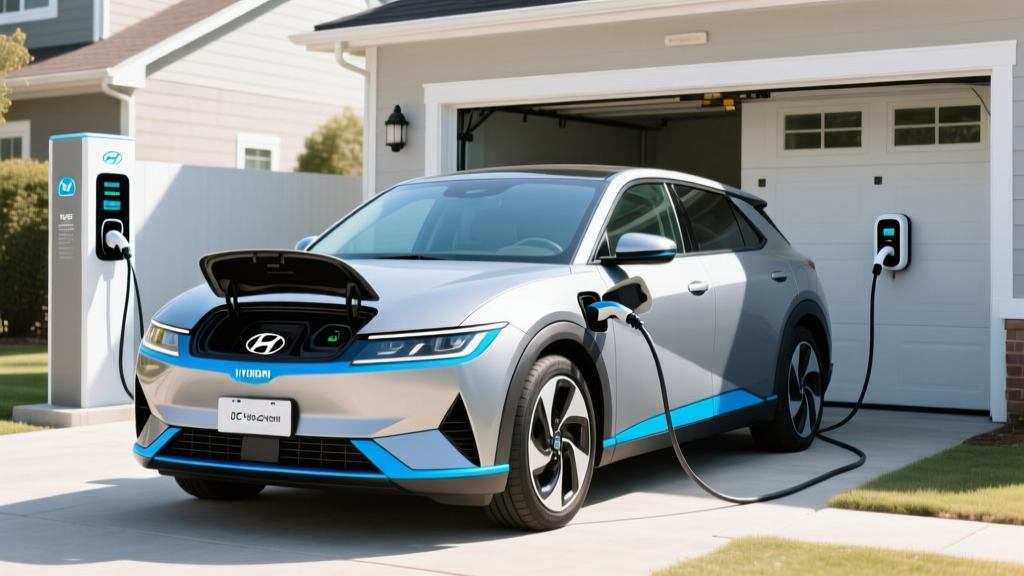
If you own or are shopping for a Hyundai Ioniq 5, one of the first practical questions you'll face is straightforward but surprisingly layered: what Hyundai Ioniq 5 charger type do you actually need? The answer depends on your model year, where you charge, and how fast you want electrons flowing into the Ioniq 5's 84 kWh (usable) battery pack. This guide breaks down every charging scenario — from a standard wall outlet to a 350 kW DC fast charger — with the exact numbers, costs, and equipment you need to make smart decisions.
Which Connector Does the Hyundai Ioniq 5 Use?
The Hyundai Ioniq 5's charge port has undergone a significant transition. Here's where things stand for the 2026 model year:
- 2022–2024 Ioniq 5: Equipped with a CCS1 (Combined Charging System) port natively. This is the J1772 connector for AC charging combined with two DC pins below it.
- 2025+ Ioniq 5 (refreshed): Hyundai switched to the NACS (North American Charging Standard) port — the same connector Tesla uses. This means native access to Tesla Superchargers without an adapter.
This matters enormously for public charging access. If you own an earlier CCS1-equipped Ioniq 5, you'll need a CCS-to-NACS adapter to use Tesla Superchargers that have opened to non-Tesla vehicles. Hyundai has offered a complimentary adapter program for qualifying owners — check with your dealer for current availability.
| Connector | 2022–2024 Ioniq 5 | 2025+ Ioniq 5 | Adapter Needed? |
|---|---|---|---|
| CCS1 | Native | Adapter required | Yes (NACS-to-CCS1) for 2025+ |
| NACS (Tesla) | Adapter required | Native | Yes (CCS-to-NACS) for 2022–2024 |
| J1772 (AC Level 2 public) | Native (upper port) | Adapter required | Yes (NACS-to-J1772) for 2025+ |
| CHAdeMO | Not compatible | Not compatible | No adapter exists |
Key takeaway: The Ioniq 5 has never used CHAdeMO. If you're buying a used 2022–2024 model, budget $150–$250 for a quality CCS-to-NACS adapter (such as the Lectron or A2Z adapter) to unlock Tesla Supercharger access. For the 2025+ models with native NACS, you'll want a NACS-to-J1772 adapter (~$100–$170) if you frequent older Level 2 public chargers at malls or workplaces.
Charging Levels Explained: Speed, Power, and Range Added
Before we get into specific equipment, let's clarify a critical distinction: kW (kilowatts) measures power — the rate at which energy flows. kWh (kilowatt-hours) measures energy — the total amount stored in the battery. Think of kW as the width of a hose and kWh as the size of the bucket. The Ioniq 5's "bucket" is 84 kWh usable. How fast you fill it depends on the kW rate.
| Level | Voltage | Max Power (kW) | Miles of Range Added per Hour | Typical Use Case |
|---|---|---|---|---|
| Level 1 (120V) | 120V AC | ~1.4 kW | ~3–5 mi/hr | Emergency / overnight trickle |
| Level 2 (240V) | 240V AC | Up to 10.9 kW (onboard limit) | ~32–40 mi/hr | Home daily charging, workplace |
| DC Fast Charging | 400V–800V DC | Up to 240 kW peak (800V architecture) | ~200+ mi in 18 min (10–80%) | Road trips, highway corridors |
The Ioniq 5's onboard AC charger is rated at 10.9 kW. This means even if you connect a 48-amp Level 2 wall charger capable of delivering 11.5 kW, the car will only accept 10.9 kW. There's no benefit to buying a charger that exceeds this onboard limit — a 40-amp circuit (delivering ~9.6 kW) or a 48-amp circuit (delivering ~10.9 kW at the car's limit) are both excellent choices.
DC Fast Charging: The Ioniq 5's 800V Advantage
The Hyundai Ioniq 5 uses an 800-volt electrical architecture — one of the few vehicles in its price class to do so (alongside the Kia EV6, Porsche Taycan, and Lucid Air). This enables exceptionally fast DC charging when paired with a high-power charger.
Here's what to expect at various DC fast-charger power levels:
- At a 350 kW charger (Electrify America, Ionity): The Ioniq 5 peaks around 230–240 kW, charging from 10–80% in approximately 18 minutes. The 800V system sustains high power longer than 400V competitors, which typically taper sharply after 50% SoC.
- At a 150 kW charger (common EA, EVgo stations): Expect 10–80% in roughly 25–28 minutes. The car will pull its maximum available rate up to the charger's cap.
- At a 50 kW charger (older CCS stations): Expect 10–80% in about 60–70 minutes. Functional but painfully slow for an 84 kWh battery — avoid these on road trips when possible.
Real-world charging curve note: Like all EVs, the Ioniq 5 does not sustain peak kW for the entire session. Power tapers significantly above 80% State of Charge (SoC) to protect the battery. Charging from 80–100% on DC can take nearly as long as the 10–80% portion. For road trips, plan to charge to 80% and drive on — this is dramatically faster.
Cold-weather caveat: In temperatures below 32°F (0°C), expect DC charging speeds to decrease by 20–40% unless you precondition the battery. Use the Ioniq 5's navigation-based preconditioning feature: set a DC charger as your destination, and the car will warm the battery en route for optimal charging speed.
How Much Does It Cost to Install a Home EV Charger?
Home Level 2 charging is where most Ioniq 5 owners will do 80–90% of their charging. Installation cost varies enormously depending on your home's electrical panel, the distance from panel to garage or driveway, and local permit requirements.
| Component | Cost Range | Notes |
|---|---|---|
| Level 2 Charger (Equipment) | $300 – $700 | Quality smart chargers; see recommendations below |
| Electrician Labor (standard install) | $500 – $1,500 | Panel to garage, <30 ft run, 240V/50A circuit |
| Permit & Inspection | $50 – $300 | Varies by municipality; some areas waive for EV |
| Electrical Panel Upgrade (if needed) | $1,500 – $4,000 | Required if panel is 100A or has no spare slots |
| Total (no panel upgrade) | $850 – $2,500 | Most homes with 200A service |
| Total (with panel upgrade) | $2,350 – $6,500 | Older homes with 100A or 150A service |
What Electrical Upgrades Might I Need?
Before hiring an electrician, check your main electrical panel:
- 200-amp service with open breaker slots: You're likely good to go. A 50-amp breaker (for a 40-amp continuous charger) or 60-amp breaker (for a 48-amp charger) will be added.
- 200-amp service but no open slots: You may need a tandem breaker or a sub-panel (~$300–$600 additional).
- 100-amp or 150-amp service: A panel upgrade to 200A is often required, especially if you already have high-draw appliances (electric range, dryer, HVAC). This is the single biggest cost variable and can add $1,500–$4,000.
NEC code requirement: The National Electrical Code requires EV chargers to be on a dedicated circuit rated at 125% of the charger's continuous draw. A 40-amp charger needs a 50-amp breaker; a 48-amp charger needs a 60-amp breaker. Your electrician will handle this, but it's worth understanding so you can evaluate quotes intelligently.
For outdoor installations, ensure your charger is rated NEMA 4 (weatherproof) and that the circuit includes GFCI protection as required by NEC 2020 and later for outdoor receptacles. Hardwired installations (no plug) are generally preferred for outdoor setups — they avoid the code requirement for GFCI breakers on 240V receptacles, which can cause nuisance tripping with some EV chargers.
Best Level 2 Chargers for the Hyundai Ioniq 5
Since the Ioniq 5 caps AC charging at 10.9 kW, you want a Level 2 charger that can deliver at least 40 amps (9.6 kW) to get close to that ceiling. Here are top picks for 2026, selected for reliability, cable length, and smart features:
ChargePoint Home Flex (NACS or J1772)
- Power Output: Up to 50 amps (12 kW) — adjustable via app
- Connector: Available in NACS (native for 2025+ Ioniq 5) or J1772
- Cable Length: 23 feet
- Smart Features: Wi-Fi, scheduling, energy tracking, Alexa integration
- Price: ~$550–$650
- Verdict: Excellent all-rounder. The adjustable amperage lets you match your circuit capacity without buying a different unit.
Emporia Level 2 EV Charger
- Power Output: Up to 48 amps (11.5 kW)
- Connector: J1772 (NACS adapter included in newer bundles)
- Cable Length: 24 feet
- Smart Features: Wi-Fi, solar integration, real-time energy monitoring via Emporia app
- Price: ~$350–$400
- Verdict: Best value pick. Pairs well with Emporia's whole-home energy monitor for solar owners.
WallConnector (Tesla, with NACS)
- Power Output: Up to 48 amps (11.5 kW)
- Connector: NACS native
- Cable Length: 24 feet
- Smart Features: Wi-Fi, over-the-air updates, power sharing with second unit
- Price: ~$420–$475
- Verdict: Best choice for 2025+ NACS-equipped Ioniq 5 owners. Sleek, reliable, and future-proof if you add a Tesla to the household.
Grizzl-E Smart (United Chargers)
- Power Output: Up to 40 amps (9.6 kW)
- Connector: J1772 (NACS version available)
- Cable Length: 24 feet
- Smart Features: Wi-Fi, OCPP compatibility, adjustable amperage via dip switches
- Price: ~$400–$500
- Verdict: Built like a tank. Best for extreme cold climates — rated to -40°F. Made in Canada.
Important: For the 2022–2024 Ioniq 5 with CCS1/J1772, buy a J1772 charger (or a NACS charger with a J1772 adapter). For the 2025+ NACS-equipped model, buy a NACS-native charger for the cleanest setup.
Charging Cost: Home vs. Public vs. Gas
The Ioniq 5 Long Range AWD achieves an EPA-rated 106 MPGe combined (per fueleconomy.gov), consuming roughly 32 kWh per 100 miles. Let's translate that into real costs.
| Charging/Fuel Scenario | Cost per kWh or Gallon | Cost per 100 Miles | Cost per Mile |
|---|---|---|---|
| Home (off-peak utility rate) | $0.12/kWh | $3.84 | $0.038 |
| Home (average US rate) | $0.17/kWh | $5.44 | $0.054 |
| Public Level 2 (ChargePoint, EVgo) | $0.30/kWh | $9.60 | $0.096 |
| DC Fast (Electrify America) | $0.48/kWh | $15.36 | $0.154 |
| Gas SUV (25 MPG combined, $3.50/gal) | $3.50/gallon | $14.00 | $0.140 |
At home off-peak rates, the Ioniq 5 costs roughly 3.8 cents per mile — about a quarter of what a comparable 25 MPG gas SUV costs. Even at DC fast-charging rates, the Ioniq 5 is competitive with gas on a per-mile basis, though this erodes the ownership savings significantly if you rely exclusively on public DC charging.
Full charge cost at home: Charging the 84 kWh battery from 10% to 100% (roughly 76 kWh needed) costs about $9.12 at $0.12/kWh or $12.92 at $0.17/kWh. That buys you roughly 266 miles of real-world range (EPA sticker is 290 miles for the Long Range RWD; expect ~250–270 miles on mixed highway driving, less in cold weather).
How Fast Will Each Charging Level Add Range to the Ioniq 5?
Here's a practical timeline for common scenarios with the 84 kWh battery:
- Level 1 (120V, 12A): Adds ~4 miles of range per hour. An overnight charge (10 hours) yields ~40 miles — adequate only for short-commute PHEV-like usage or emergency trickle charging. A full 0–100% charge would take roughly 60+ hours.
- Level 2 (240V, 48A, 10.9 kW to the car): Adds ~36 miles per hour. A 10–80% charge (roughly 59 kWh) takes approximately 5.5–6 hours — perfect for overnight charging. You'll wake up to a full battery every morning.
- DC Fast (240 kW peak at 350 kW station): Adds ~13 miles per minute at peak rate. 10–80% in ~18 minutes. This is the Ioniq 5's party trick — the 800V architecture makes it one of the fastest-charging mainstream EVs available.
For context, the EPA rates the 2026 Ioniq 5 Long Range RWD at 303 miles of range and the AWD at 270 miles. In real-world highway driving at 70 mph, expect approximately 250–270 miles (RWD) and 230–250 miles (AWD). In sub-freezing temperatures, reduce those figures by 15–25% due to cabin heating demand and battery chemistry limitations.
Safety, Code, and Installation Best Practices
A Level 2 charger draws significant continuous current — often for 6–10 hours at a stretch. Proper installation isn't optional; it's a fire-safety necessity.
- Dedicated circuit: NEC requires a dedicated breaker for your EV charger. Never share a circuit with other high-draw appliances.
- Wire gauge: A 50-amp circuit requires 6 AWG copper wire; a 60-amp circuit requires 4 AWG. Your electrician will size this correctly, but verify it on the invoice.
- GFCI protection: Required for outdoor 240V receptacles under NEC 2020+. Hardwired installations bypass this requirement and are generally more reliable for outdoor setups.
- NEMA rating: If mounting outdoors, the charger must be rated NEMA 4 (enclosed against rain and ice). All chargers recommended above meet this standard.
- Permit and inspection: Most jurisdictions require an electrical permit for a new 240V circuit. The inspection ensures the work meets code — don't skip this step, as unpermitted work can void home insurance coverage.
For detailed code requirements, the U.S. Department of Energy's Alternative Fuels Data Center provides state-by-state guidance on EV charging infrastructure installation.
Federal Tax Credit for Home Charger Installation
The IRS §30C Alternative Fuel Vehicle Refueling Property Credit can offset up to 30% of home EV charger equipment and installation costs, capped at $1,000. However, eligibility depends on several factors:
- The charger must be installed at your primary residence in the United States.
- The property must be located in an eligible census tract (generally non-urban or low-income communities — check the IRS eligibility tool).
- The credit is non-refundable — it can reduce your tax liability to zero but won't generate a refund beyond that.
For a $2,000 total installation, the credit could reduce your cost by $600, bringing your net investment to $1,400. Always consult a tax professional for your specific situation, as IRS rules and eligible census tracts are updated periodically.
Frequently Asked Questions
Can I charge the Hyundai Ioniq 5 on a regular 120V outlet?
Yes, but it's slow. Level 1 charging at 120V/12A delivers roughly 1.4 kW, adding about 3–5 miles of range per hour. A full charge would take over 60 hours. Level 1 is suitable only for emergencies or very low-mileage daily driving (under 30 miles). For practical daily use, a 240V Level 2 charger is strongly recommended.
Does the Ioniq 5 come with a charger?
Hyundai includes a portable Level 1 charging cable (120V) with every new Ioniq 5. Some model years included a dual-level portable charger capable of both 120V and 240V (with the appropriate plug adapter). A dedicated wall-mounted Level 2 charger is not included and must be purchased separately.
Can I use a Tesla Supercharger with my Hyundai Ioniq 5?
If you have a 2025+ Ioniq 5 with a native NACS port, yes — you can plug directly into any Tesla Supercharger. For 2022–2024 models with CCS1, you'll need a CCS-to-NACS adapter. Hyundai has offered these adapters through its dealer network; third-party adapters from Lectron and A2Z are also available for $150–$250.
How much does it cost to install a home EV charger?
For most homes with 200-amp electrical service and an open breaker slot, expect to pay $850–$2,500 total (equipment + electrician + permit). If your home needs a panel upgrade from 100A to 200A, costs can rise to $2,350–$6,500. Get at least two quotes from licensed electricians and verify they include permit and inspection costs.
Is it better to hardwire or use a NEMA 14-50 outlet for my charger?
Hardwiring is generally preferred for outdoor installations and avoids NEC GFCI breaker requirements that can cause nuisance tripping. A NEMA 14-50 outlet offers portability — you can unplug and take the charger if you move. Both are code-compliant when installed correctly. For indoor garage installations, either approach works well.
How long does the Ioniq 5 battery last?
Hyundai warranties the Ioniq 5's high-voltage battery for 10 years or 100,000 miles (whichever comes first) against defects and excessive capacity loss (typically defined as dropping below 70% State of Health). The battery uses NMC (nickel manganese cobalt) chemistry. Real-world degradation data from 2022–2024 models suggests approximately 5–8% capacity loss over the first 100,000 miles under normal use patterns — well within warranty coverage.