If you bought a new Hyundai Ioniq 5, Ioniq 6, or Kona Electric, you may be eligible for the Hyundai free charger program — a perk that provides a complimentary Level 2 home charging unit to qualifying buyers. But "free" only covers the hardware. Installation, electrical upgrades, and permitting are on you, and those costs vary wildly depending on your home's electrical panel. This guide breaks down exactly what the program offers, what you'll actually pay out of pocket, and how to maximize your home charging setup for Hyundai's current EV lineup.
What Is the Hyundai Free Charger Program?
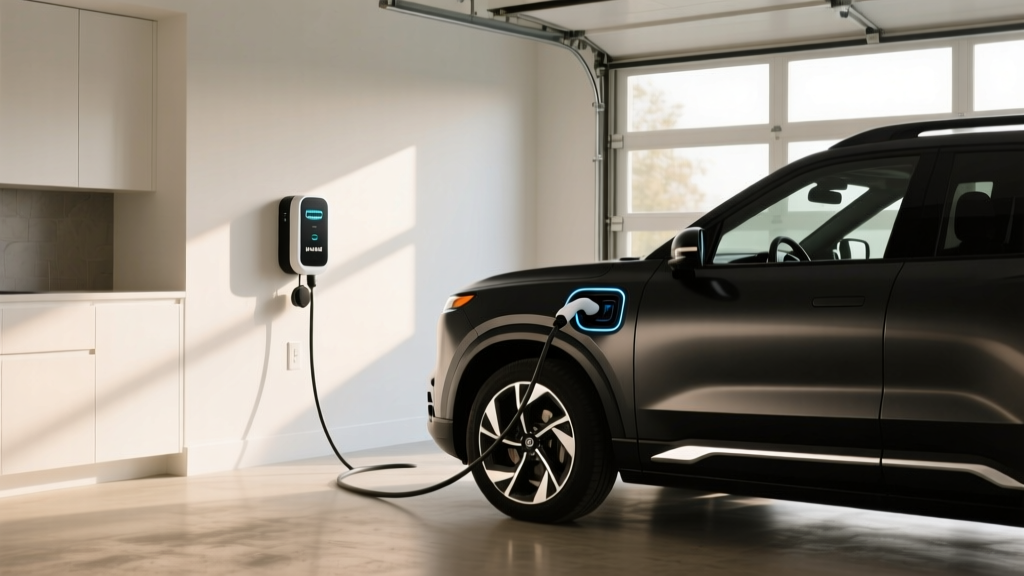
Hyundai has periodically offered a complimentary Level 2 home charger to purchasers and lessees of new all-electric models, typically through partnerships with charging hardware companies. The program has evolved over the years — earlier iterations partnered with ChargePoint, while more recent offers have included hardware from other manufacturers. As of the 2025–2026 model years, the program generally provides:
- A Level 2 home charging station (typically 32A to 48A output, or 7.7 kW to 11.5 kW on a 240V circuit)
- Wi-Fi-enabled smart features — scheduling, energy monitoring, and remote start via app
- A NACS or CCS1 connector depending on your vehicle's model year and port type
The charger itself is valued between $400 and $700 depending on the specific unit offered. However, Hyundai does not cover installation labor, electrical materials, or permitting — and for many homeowners, those costs exceed the value of the free hardware.
Charging Levels Explained: How Fast Will Each Level Add Range?
Hyundai EVs support three charging levels. Understanding the speed difference is critical to planning your daily routine and road trips.
| Level | Voltage | Max Power (kW) | Miles of Range Per Hour | Typical Use Case |
|---|---|---|---|---|
| Level 1 | 120V (standard outlet) | 1.2–1.9 kW | 3–5 mi/hr | Overnight trickle for PHEVs or low-mileage days |
| Level 2 | 240V (dryer-style outlet or hardwired) | 7.7–11.5 kW | 25–44 mi/hr | Primary home and workplace charging |
| DC Fast Charging | 400V–800V DC | 50–350 kW | 150–600+ mi/hr (peak) | Road trips and public charging stations |
Real Charging Times for Hyundai EVs (Level 2 at Home)
Here's what to expect when charging common Hyundai EV batteries on a Level 2 home charger:
- Ioniq 5 (77.4 kWh battery, 303 mi EPA): A full 10–80% charge takes approximately 7–8 hours on a 32A (7.7 kW) charger, or roughly 5–6 hours on a 48A (11.5 kW) unit.
- Ioniq 6 (77.4 kWh battery, 361 mi EPA Long Range): Similar to the Ioniq 5 — about 7–8 hours at 7.7 kW, or 5–6 hours at 11.5 kW for a 10–80% session.
- Kona Electric (64.8 kWh battery, 261 mi EPA): 10–80% in roughly 5.5–6.5 hours on 7.7 kW, or 4–5 hours on 11.5 kW.
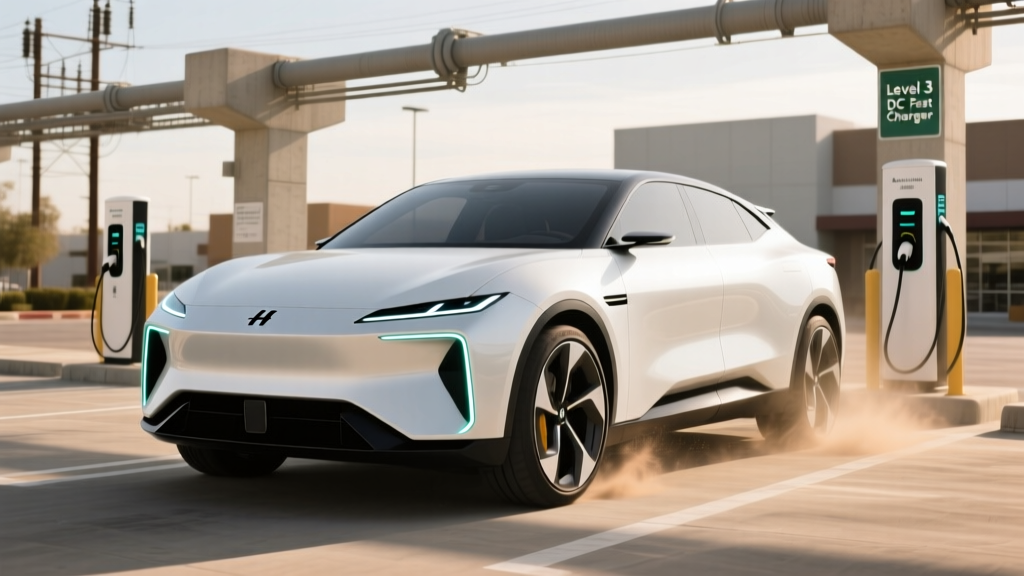
For DC fast charging, the Ioniq 5 and Ioniq 6 feature 800V architecture, enabling peak charge rates up to 240 kW on compatible 350 kW chargers. In real-world testing, a 10–80% DC fast charge takes approximately 18 minutes under ideal conditions. Note that charge speed tapers significantly above 80% SoC — this is normal battery protection behavior, not a malfunction.
Home Charger Installation: Electrical Requirements and Costs
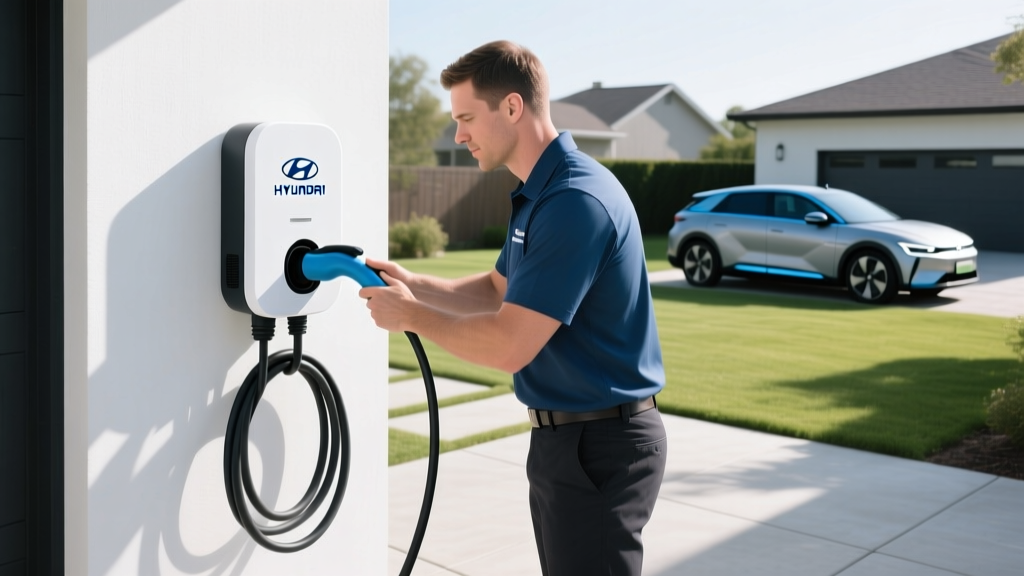
The Hyundai free charger covers the hardware, but professional installation is mandatory for safety and code compliance. Here's what the process involves and what you'll pay.
Electrical Requirements for a Level 2 Charger
- Circuit: A dedicated 240V circuit — typically 40A (for a 32A charger) or 60A (for a 48A charger). National Electrical Code requires the circuit breaker to be rated 125% above the continuous load.
- Wiring: 8-gauge copper wire for 40A circuits; 6-gauge for 50–60A circuits. Wire gauge and run length affect material cost significantly.
- Outlet vs. hardwired: A NEMA 14-50 outlet offers portability (you can unplug and take the charger when you move). Hardwired connections are slightly cheaper to install and avoid the requirement for a GFCI breaker in many jurisdictions.
- Panel capacity: Your main electrical panel must have enough spare amperage to support the new circuit. Most modern 200A panels can accommodate a 40–60A EV circuit. Older 100A panels often cannot.
Installation Cost Breakdown
| Component | Simple Install (panel nearby) | Complex Install (long run or panel upgrade) |
|---|---|---|
| Charging unit (covered by Hyundai program) | $0 (program value: $400–$700) | $0 |
| Electrician labor (2–4 hrs typical) | $300–$600 | $800–$1,500 |
| Electrical materials (wire, conduit, breaker) | $100–$300 | $400–$800 |
| Permit and inspection | $50–$150 | $100–$250 |
| Panel upgrade (100A → 200A, if needed) | N/A | $1,500–$3,500 |
| Total estimated cost | $450–$1,050 | $2,800–$6,050 |
Safety and Code Considerations
Per the National Electrical Code (NEC), your installation must meet these requirements:
- Dedicated circuit: The EV charger must have its own breaker — no sharing with other appliances.
- GFCI protection: If using a receptacle (NEMA 14-50), NEC 2017 and later requires GFCI protection for outlets in garages. Hardwired installations may be exempt in some jurisdictions.
- Outdoor rating: If your charger is installed outside, the unit must carry a NEMA 4 or IP65 weatherproof rating. The Hyundai-provided chargers typically meet outdoor standards, but confirm before scheduling installation.
- Permit and inspection: Most municipalities require an electrical permit and post-installation inspection. Skipping this step can void homeowner's insurance coverage for electrical fires.
Connector Compatibility: Which Plug Fits Your Hyundai EV?
Hyundai's EV lineup is in a transitional period regarding charging connectors. Here's what fits what.
| Model / Year | Built-in Port | DC Fast Charging Network Access | Adapter Needed? |
|---|---|---|---|
| Ioniq 5 (2025–2026) | NACS (native Tesla-style) | Tesla Superchargers + CCS networks | CCS adapter for Electrify America, EVgo (included or available) |
| Ioniq 6 (2025–2026) | NACS (native Tesla-style) | Tesla Superchargers + CCS networks | CCS adapter for non-Tesla DC networks |
| Ioniq 5 (2022–2024) | CCS1 | Electrify America, EVgo, ChargePoint | NACS adapter for Tesla Supercharger access (available from Hyundai) |
| Kona Electric (2024–2026) | CCS1 | Electrify America, EVgo, ChargePoint | NACS adapter for Tesla Supercharger access |
When claiming your Hyundai free charger, confirm which connector version ships with your unit. If you drive a 2025+ Ioniq 5 or Ioniq 6 with a native NACS port, you'll want the charger with a NACS plug. For older CCS1-equipped models, the charger should have a CCS1 (J1772 combo) connector. Adapters are available from Hyundai dealers and third-party manufacturers (such as the Lectron or A2Z NACS-to-CCS adapter, typically $150–$250) for cross-network compatibility.
How Much Does Charging Cost Per Mile vs. Gas?
One of the strongest ownership arguments for a Hyundai EV is the per-mile fuel savings — but only if you charge smartly. Here's the math using real utility and public-charging rates.
| Charging Scenario | Rate | Cost Per Mile (Ioniq 5, ~3.5 mi/kWh) | Annual Cost (12,000 mi) |
|---|---|---|---|
| Home off-peak (utility time-of-use) | $0.08–$0.12/kWh | $0.025–$0.034 | $300–$410 |
| Home standard rate | $0.14–$0.18/kWh | $0.040–$0.051 | $480–$620 |
| Public Level 2 (ChargePoint, etc.) | $0.25–$0.49/kWh | $0.071–$0.140 | $850–$1,680 |
| DC Fast Charging (Electrify America, EVgo) | $0.35–$0.55/kWh | $0.100–$0.157 | $1,200–$1,880 |
| Gasoline (28 MPG avg, $3.40/gal) | $3.40/gal | $0.121 | $1,455 |
The takeaway: home charging on off-peak rates delivers fuel costs roughly 75–80% below gasoline. Even at standard residential rates, you'll save 50–65%. However, exclusive reliance on DC fast charging can push your per-mile cost to near-gasoline levels. This is why the Hyundai free charger program's real value is enabling consistent, cheap home charging — not just saving you $500 on hardware.
For detailed efficiency ratings by trim, consult the EPA's Fuel Economy website, which lists MPGe and kWh/100mi figures for every Hyundai EV variant.
Equipment Recommendations: If the Free Charger Doesn't Fit Your Needs
The Hyundai free charger is a solid unit, but depending on your installation setup or desired features, you may want to consider alternatives. Here are proven Level 2 chargers compatible with Hyundai EVs:
ChargePoint Home Flex
- Power: Up to 11.5 kW (48A) on a 60A circuit, configurable down to 16A
- Connector: J1772 (CCS1-compatible); NACS version available
- Cable length: 23 feet
- Smart features: Wi-Fi, app scheduling, energy reporting, Alexa integration
- Price: ~$550–$700
Emporia Vue Level 2 Charger
- Power: Up to 11.5 kW (48A)
- Connector: J1772 (CCS1-compatible)
- Cable length: 24 feet
- Smart features: Wi-Fi, app control, solar integration, load management
- Price: ~$350–$450
Tesla Wall Connector (for NACS Hyundai EVs)
- Power: Up to 11.5 kW (48A)
- Connector: NACS (native fit for 2025+ Ioniq 5/6)
- Cable length: 24 feet
- Smart features: Wi-Fi, firmware updates, power sharing between units
- Price: ~$425–$475
Grizzl-E Smart
- Power: Up to 10 kW (40A)
- Connector: J1772 (CCS1-compatible)
- Cable length: 24 feet
- Smart features: OCPP-compatible, app control, adjustable amperage
- Price: ~$450–$550
If your Hyundai-provided charger meets your power needs (typically 32A/7.7 kW) and has the correct connector, there's no reason not to use it. But if you want 48A/11.5 kW to cut charge times by 25–30%, or need a longer cable for your garage layout, upgrading is straightforward — just ensure your electrician sizes the circuit to match.
Federal Tax Credit for Home Charger Installation (§30C)
Beyond the Hyundai free charger hardware, you may qualify for a federal tax credit that offsets installation costs. The Alternative Fuel Vehicle Refueling Property Credit (IRS §30C) covers 30% of home EV charging equipment and installation costs, up to $1,000 per tax year. Key eligibility rules for 2025–2026:
- The charger must be installed at your primary residence in the United States.
- The property must be located in an eligible census tract (generally non-urban or low-income communities — check the IRS eligibility tool).
- The credit applies to both the equipment cost and installation labor.
- Income caps do not apply to §30C (unlike the §30D vehicle credit).
Example: If your total installation cost (electrician + permit + materials) is $1,200, and you're in an eligible census tract, the credit would be $360 (30% × $1,200). Consult a tax professional to confirm eligibility for your specific address and filing situation.
Frequently Asked Questions
How much does it cost to install a home EV charger?
With the Hyundai free charger covering the hardware, expect to pay $450–$1,050 for a straightforward installation (short wire run from a 200A panel to a nearby garage). If your home needs a panel upgrade or has a long conduit run, costs can reach $2,800–$6,050. Always get a quote from a licensed electrician before committing.
How fast will each charging level add range?
Level 1 (120V) adds 3–5 miles per hour — adequate only for plug-in hybrids or very low daily mileage. Level 2 (240V) adds 25–44 miles per hour depending on amperage — sufficient to fully replenish any Hyundai EV overnight. DC fast charging adds 150–600+ miles per hour at peak rates, with the Ioniq 5 and Ioniq 6 achieving 10–80% in approximately 18 minutes on a 350 kW charger.
Which connector/charger is compatible with my EV?
2025–2026 Ioniq 5 and Ioniq 6 models use the native NACS connector. The Kona Electric and older (2022–2024) Ioniq 5 models use CCS1 (J1772 combo). Adapters are available from Hyundai and third-party manufacturers to access both Tesla Superchargers and CCS-based networks like Electrify America. Confirm your vehicle's port type before ordering or claiming a charger.
How much does charging cost per mile vs. gas?
Home charging on off-peak rates costs $0.025–$0.034 per mile in an Ioniq 5 — roughly 75% less than a 28 MPG gasoline car at $3.40/gallon ($0.121/mile). Standard residential rates bring the EV cost to $0.04–$0.05/mile. Public DC fast charging at $0.35–$0.55/kWh narrows the gap to $0.10–$0.16/mile, approaching gasoline parity.
What electrical upgrades might I need?
The most common upgrade is a panel replacement from 100A to 200A service, costing $1,500–$3,500. Other potential needs include: replacing a Federal Pacific or Zinsco panel (known safety hazards, $2,000–$4,000), upgrading service wire from the utility, or adding a sub-panel if your main panel is full. A licensed electrician's load calculation will determine your specific requirements.
Is the Hyundai free charger worth claiming?
Yes — if you're buying a qualifying new Hyundai EV and plan to charge at home. The $400–$700 hardware value is genuine, and the units are generally reliable, Wi-Fi-enabled Level 2 chargers. The only scenario where you might skip it: if you need a 48A/11.5 kW charger for faster overnight charging and the free unit is a 32A model. In that case, you can still claim the free charger as a backup or for a second location and purchase a higher-output unit separately.
For the most current program terms, eligible models, and claim instructions, check with your Hyundai dealer at the time of purchase or visit Hyundai's official electrified vehicle page. Program details, charger models, and partnerships can change between model years.