Why Hyundai Owners Are Searching for a Charger Adapter in 2026
If you own a Hyundai Ioniq 5, Ioniq 6, or Kona Electric, you've likely noticed the charging landscape shifting beneath your feet. Starting with the 2025 model year, Hyundai began equipping new EVs sold in North America with the North American Charging Standard (NACS) port — the same connector Tesla pioneered. But hundreds of thousands of 2022–2024 Hyundai EVs still on the road use the CCS1 (Combined Charging System) port. That mismatch means many owners now need a Hyundai charger adapter to access Tesla Superchargers, while newer NACS-equipped owners may need the reverse adapter to use legacy CCS stations.
This guide breaks down exactly which adapter you need, how fast each charging level works, what a home Level 2 installation actually costs, and how per-mile charging expenses compare to gasoline — with real numbers, not marketing fluff.
Charging Levels Explained: Speeds, Power, and Range Added
Before discussing adapters, let's nail down the three charging levels. Power is measured in kW (kilowatts) — that's the rate of energy delivery. Energy stored in your battery is measured in kWh (kilowatt-hours) — that's the total capacity. Think of kW as how fast water flows from a hose, and kWh as the size of the bucket. Confusing the two is the single most common EV mistake.
| Level | Voltage | Power (kW) | Miles of Range Added per Hour | Typical Use Case |
|---|---|---|---|---|
| Level 1 | 120V AC | 1.0–1.4 kW | 3–5 mi/hr | Overnight top-up, emergency |
| Level 2 | 240V AC | 3.3–19.2 kW | 12–75 mi/hr | Home daily charging, workplace |
| DC Fast Charge | 400–800V DC | 50–350 kW | 150–300+ mi in 20–30 min | Road trips, highway corridors |
Hyundai Charger Adapter Compatibility: NACS, CCS1, and What Fits What
The connector on your Hyundai EV determines which public chargers you can use natively — and which require an adapter. Here's the compatibility matrix as of the 2026 model year:
| Hyundai Model & Year | Native Port | Tesla Supercharger Access | CCS Public Network Access | Adapter Needed? |
|---|---|---|---|---|
| Ioniq 5 (2025–2026) | NACS | Native — no adapter | Requires NACS-to-CCS adapter | NACS→CCS for Electrify America, etc. |
| Ioniq 5 (2022–2024) | CCS1 | Requires CCS-to-NACS adapter | Native — no adapter | CCS→NACS for Tesla Superchargers |
| Ioniq 6 (2025–2026) | NACS | Native — no adapter | Requires NACS-to-CCS adapter | NACS→CCS for non-Tesla DC networks |
| Ioniq 6 (2023–2024) | CCS1 | Requires CCS-to-NACS adapter | Native — no adapter | CCS→NACS for Tesla Superchargers |
| Kona Electric (2024–2026) | CCS1 / NACS (varies by build date) | Check port; adapter may be needed | Check port | Varies |
Adapter Options for Hyundai EV Owners
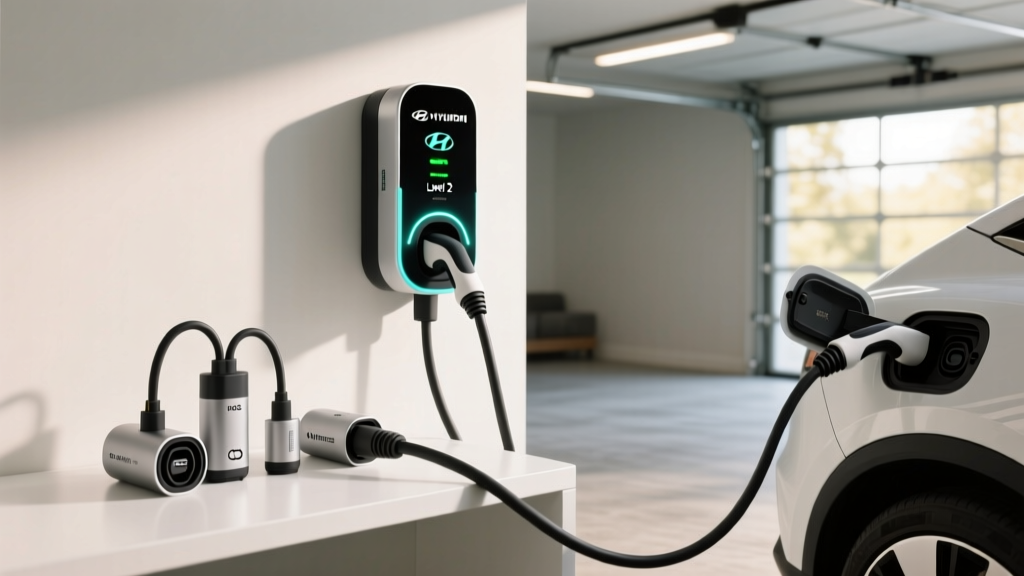
Hyundai has offered a complimentary CCS-to-NACS adapter to owners of qualifying 2022–2024 Ioniq 5 and Ioniq 6 models through a dealer program, enabling access to Tesla's Supercharger network (now open to non-Tesla vehicles via the NACS standard). If you didn't receive one, aftermarket adapters from brands like Lectron and A2Z EV are available for roughly $150–$250.
Important: Adapters only change the physical connector shape. They do not change the charging protocol or power delivery. A CCS1-to-NACS adapter on a 2023 Ioniq 5 will still charge at the vehicle's maximum DC rate (~240 kW peak) on a V3 or V4 Tesla Supercharger, provided the stall can deliver sufficient power.
Level 2 (AC) Adapter Note
For home and public Level 2 AC charging, the J1772 connector remains the standard for non-Tesla Level 2 stations. Newer NACS-equipped Hyundais can use a NACS-to-J1772 adapter (or vice versa) to plug into any Level 2 wall connector. Most new NACS-port Hyundais ship with this adapter in the box.
Home Level 2 Charger Installation: Costs, Electrical Requirements, and Gotchas
Installing a dedicated 240V Level 2 charger at home is the single biggest quality-of-life upgrade for any EV owner. Here's what it actually involves and costs.
Electrical Requirements
- Circuit: A dedicated 240V circuit, typically 40-amp or 50-amp (breaker rated at 125% of continuous load, so a 40A charger needs a 50A breaker).
- Wire: 6 AWG copper for 50A circuits; 8 AWG for 40A (varies by run length and local code).
- Outlet vs. hardwired: A NEMA 14-50 outlet offers portability; hardwired units are cleaner, support higher amperage, and don't require GFCI breakers (which can nuisance-trip with some EV chargers).
- Panel capacity: Your main electrical panel must have enough spare amperage. A 200A panel with significant existing load may need a panel upgrade to 300A–400A or a load-management device.
Installation Cost Breakdown
| Item | Typical Cost Range | Notes |
|---|---|---|
| Level 2 charger unit | $350 – $750 | Varies by brand, power, smart features |
| Electrician labor (standard install) | $500 – $1,500 | Short run from panel to garage; longer runs cost more |
| Permit & inspection | $50 – $300 | Required in most jurisdictions; varies by municipality |
| Panel upgrade (if needed) | $1,500 – $4,000+ | 200A→400A upgrade; older homes most at risk |
| Total (no panel upgrade) | $900 – $2,550 | Most homes with 200A+ panels fall here |
| Total (with panel upgrade) | $2,400 – $6,550+ | Older homes, high-load panels |
Safety and Code Considerations
- Dedicated circuit: NEC Article 625 requires EV charging equipment to be on its own dedicated branch circuit. No sharing with dryers or HVAC.
- GFCI: Hardwired chargers typically don't require GFCI breakers (the charger has built-in ground-fault protection). NEMA 14-50 receptacles in garages may require GFCI per 2020 NEC in some jurisdictions — consult your local inspector.
- Outdoor rating: If your charger is mounted outside, ensure it carries a NEMA 4 or IP65 rating for weather resistance.
- UL listing: Only purchase UL-listed (or ETL-listed) chargers. Non-listed units from overseas marketplaces may lack critical safety protections and can void homeowner insurance in case of fire.
Recommended Level 2 Chargers for Hyundai EVs
Below are three proven Level 2 chargers that pair well with Hyundai's EV lineup, whether your car has a CCS or NACS port.
ChargePoint Home Flex
- Power output: Up to 12 kW (50A) on a 240V/60A circuit; configurable down to 16A for lower-capacity panels
- Connector: J1772 (use adapter for NACS-port Hyundais) or NACS (newer SKU)
- Cable length: 23 feet
- Smart features: Wi-Fi, app scheduling, energy tracking, Alexa integration, charge sharing between two units
- Price: ~$550–$650
- Best for: Owners who want flexible amperage tuning and robust app control
Wallbox Pulsar Plus
- Power output: Up to 11.5 kW (48A) on a 240V/60A circuit
- Connector: J1772 or NACS (select at purchase)
- Cable length: 25 feet
- Smart features: Wi-Fi + Bluetooth, load balancing, Power Sharing for multi-charger setups, compact form factor
- Price: ~$450–$550
- Best for: Tight garage spaces and budget-conscious buyers who still want smart scheduling
Emporia Level 2 EV Charger
- Power output: Up to 11.5 kW (48A) on a 240V/60A circuit
- Connector: J1772 (NACS adapter available)
- Cable length: 24 feet
- Smart features: Wi-Fi, app control, integrates with Emporia Vue whole-home energy monitor for solar-aware charging
- Price: ~$350–$400
- Best for: Solar panel owners who want to charge exclusively on excess solar production
Charging Cost Per Mile: EV vs. Gasoline
The financial case for home charging is overwhelming — but public DC fast charging narrows the gap significantly. Here's a realistic breakdown using a 2026 Hyundai Ioniq 5 SEL (84 kWh battery, EPA 303 mi, ~3.6 mi/kWh efficiency) versus a comparable gas crossover getting 28 MPG combined.
| Charging/Fueling Scenario | Rate | Cost per Full "Tank" | Cost per Mile |
|---|---|---|---|
| Home Level 2 (off-peak utility rate) | $0.09/kWh | $7.56 (84 kWh) | $0.025/mi |
| Home Level 2 (national avg residential) | $0.17/kWh | $14.28 | $0.047/mi |
| Public Level 2 (network like ChargePoint) | $0.25–$0.35/kWh | $21–$29.40 | $0.07–$0.10/mi |
| DC Fast Charging (Electrify America, EVgo) | $0.35–$0.55/kWh | $29.40–$46.20 | $0.10–$0.15/mi |
| Tesla Supercharger (NACS, avg) | $0.28–$0.36/kWh | $23.52–$30.24 | $0.08–$0.10/mi |
| Gasoline (28 MPG, $3.40/gal) | $3.40/gal | ~$51 (15-gal tank) | $0.12/mi |
The bottom line: Home off-peak charging costs roughly one-fifth what gasoline does per mile. Even at national average residential electricity rates, you're saving 60% per mile. But if you rely exclusively on DC fast charging at $0.48/kWh, your per-mile cost rivals or exceeds gasoline — a critical factor for apartment dwellers without home charging access.
DC Fast Charging Times: What to Expect at the Plug
Hyundai's E-GMP platform (used in the Ioniq 5 and Ioniq 6) supports 800V DC fast charging, which is among the fastest in the industry. But peak kW numbers don't tell the full story — the charging curve matters more. Here are real-world time estimates:
| Vehicle | Battery (kWh usable) | Peak DC Rate | 10–80% Time (ideal) | 10–80% Time (real-world) |
|---|---|---|---|---|
| Ioniq 5 Long Range AWD | 84 kWh | ~240 kW | 18 min | 22–26 min (cold/thermal) |
| Ioniq 6 SE Long Range | 77.4 kWh | ~235 kW | 18 min | 22–25 min |
| Kona Electric (2024+) | 64.8 kWh | ~100 kW | 43 min | 47–55 min |
Preconditioning Matters
If you navigate to a DC fast charger using your Hyundai's built-in navigation (or the Bluelink app), the vehicle will precondition the battery — warming or cooling it to the optimal temperature for maximum charge acceptance. In cold weather (below 40°F), arriving at a charger without preconditioning can add 5–10 minutes to your 10–80% session and reduce peak kW by 30–50%. Always use the nav-based preconditioning when possible.
Frequently Asked Questions
How much does it cost to install a home EV charger for my Hyundai?
For a typical home with a 200A electrical panel and a short wire run from the panel to the garage, expect $900–$2,550 total (charger unit + electrician + permit). If your home needs a panel upgrade (common in pre-1990 construction), add $1,500–$4,000+. Always get a licensed electrician's assessment before purchasing equipment.
How fast will each charging level add range to my Hyundai EV?
Level 1 (120V standard outlet): 3–5 miles per hour — suitable only for overnight trickle charging or PHEVs. Level 2 (240V home charger, 48A): approximately 40–44 miles per hour for an Ioniq 5. DC Fast Charging (350 kW station): roughly 150–200 miles in 18–25 minutes depending on battery state and temperature.
Which Hyundai charger adapter do I need for Tesla Superchargers?
If your Hyundai has a CCS1 port (2022–2024 Ioniq 5, 2023–2024 Ioniq 6), you need a CCS-to-NACS adapter to plug into Tesla Superchargers. Hyundai offered these free to qualifying owners; aftermarket options cost $150–$250. If your Hyundai already has a NACS port (2025+ models), you can plug into Superchargers natively — but you'll need a NACS-to-CCS adapter to use Electrify America and other CCS-only DC networks.
How much does charging a Hyundai EV cost per mile vs. gas?
At the national average residential electricity rate of ~$0.17/kWh, an Ioniq 5 costs about $0.047 per mile to charge at home. A comparable 28 MPG gas crossover at $3.40/gallon costs $0.12 per mile. Home charging saves roughly 60% per mile. However, DC fast charging at $0.48/kWh pushes cost per mile to ~$0.13–$0.15, which can exceed gasoline.
What electrical upgrades might I need for a home charger?
The most common upgrade is a panel capacity increase — if your 200A panel is already near capacity (electric range, dryer, HVAC, water heater), adding a 50A EV circuit requires either a panel upgrade to 300–400A or a smart load-management device that throttles the charger when other loads spike. Other potential needs: upgrading from aluminum to copper wiring, adding a sub-panel in a detached garage, or installing a NEC-compliant disconnect switch for outdoor units.
Is the federal tax credit available for home charger installation?
The Alternative Fuel Vehicle Refueling Property Credit (IRS Form 8911) offers up to $1,000 (30% of cost, capped) for home charger equipment and installation. However, eligibility depends on whether your census tract qualifies as a low-income or non-urban area per the Inflation Reduction Act rules. Check the IRS guidance and consult a tax professional to confirm eligibility for your specific address.
Quick Reference: Hyundai EV Charging Spec Summary
| Spec | 2026 Ioniq 5 SEL AWD | 2026 Ioniq 6 SEL | 2026 Kona Electric SEL |
|---|---|---|---|
| EPA Range | 290 mi (real-world hwy ~245–260 mi) | 320 mi (real-world hwy ~270–290 mi) | 261 mi (real-world hwy ~220–240 mi) |
| Battery (usable) | 84 kWh, NMC | 77.4 kWh, NMC | 64.8 kWh, NMC |
| Native Port | NACS | NACS | CCS1 |
| Max DC Fast Charge | ~240 kW | ~235 kW | ~100 kW |
| 10–80% DC Time | ~18 min (ideal) | ~18 min (ideal) | ~43 min |
| Level 2 Max Acceptance | 10.9 kW | 10.9 kW | 11 kW |
| Battery Warranty | 10 yr / 100,000 mi | 10 yr / 100,000 mi | 10 yr / 100,000 mi |
| Base MSRP | ~$47,850 | ~$43,600 | ~$34,975 |
Sources: EPA range and efficiency data from fueleconomy.gov. Hyundai specifications from Hyundai Motor America Newsroom. Federal tax credit rules from IRS.gov. All prices and specs reflect 2026 model year at time of publication; verify with your dealer.