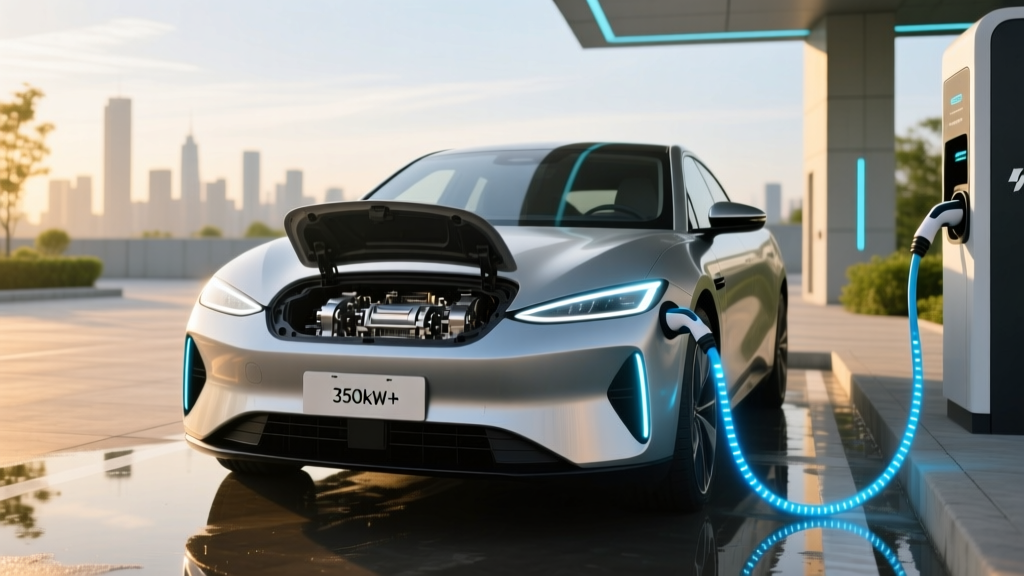
Public charging infrastructure has moved well beyond the 50 kW CHAdeMO stations of the early 2010s. Today, a new generation of hyperfast chargers — DC fast-charging stations delivering 250 kW, 350 kW, and even 500 kW of peak power — can add hundreds of miles of range in under 15 minutes. But raw peak power tells only part of the story. Your EV's battery architecture, state of charge, ambient temperature, and charging curve all determine how much of that headroom you actually use.
This guide explains what hyperfast charging actually delivers in practice, which vehicles can take full advantage, what you'll pay per session, and how public DC fast charging fits alongside the Level 2 home charger that should still do the heavy lifting for daily driving.
Charging Levels Explained: From Level 1 to Hyperfast DC
Before dissecting 350 kW+ stations, it's worth grounding the full spectrum of EV charging. Power is measured in kW (kilowatts) — the rate at which energy flows. Energy is measured in kWh (kilowatt-hours) — the total amount stored in your battery. A hyperfast charger's 350 kW rating describes its maximum power output, not the energy it delivers in a session.
| Level | Voltage | Power (kW) | Miles of Range Added per Hour | Typical Use |
|---|---|---|---|---|
| Level 1 | 120V AC | 1.0–1.4 kW | 3–5 mi/hr | Overnight trickle; PHEVs; emergency |
| Level 2 | 240V AC | 3.3–19.2 kW | 12–75 mi/hr | Home daily charging; workplace; destinations |
| DC Fast (standard) | 200–500V DC | 50–150 kW | 120–350 mi/hr | Road trips; quick top-ups |
| Hyperfast DC | 200–1,000V DC | 150–500 kW | 300–1,200+ mi/hr (peak) | Highway corridor charging; fleet turnaround |
The "miles per hour" figures assume roughly 3–4 miles per kWh of vehicle efficiency (typical for a midsize crossover EV). A heavy truck or a performance sedan with wider tires will see fewer miles per kWh, and therefore fewer miles added per hour of charging.
What Makes a Hyperfast Charger Different?
The term "hyperfast" isn't an official SAE classification — it's an industry shorthand for DC fast chargers that exceed roughly 150–175 kW and push into the 250–500 kW range. Key providers include Electrify America (350 kW stalls), Tesla Supercharger V4 (up to 350 kW for non-Tesla vehicles via Magic Dock), Ionity (350 kW in Europe, expanding in the US), and IONNA (the new joint venture between seven automakers targeting 350 kW+ stations along US highways).
Several technical factors separate these stations from older 50–150 kW DC fast chargers:
- Liquid-cooled cables: At 350 kW and above, cables carry enormous current. Liquid cooling keeps cable diameter manageable and prevents overheating.
- 800V vehicle architectures: Vehicles like the Hyundai Ioniq 5, Kia EV6, Porsche Taycan, and Lucid Air use 800V (or higher) battery systems. Higher voltage means the same power can be delivered at lower current, reducing heat and cable mass. A 350 kW charger delivering to a 400V vehicle may be limited to ~150–175 kW by the vehicle's current ceiling, while an 800V vehicle can accept the full rate.
- Power electronics: Modern hyperfast stations use modular silicon-carbide (SiC) power cabinets that can dynamically split power across multiple stalls based on each vehicle's demand.
- Plug-and-charge authentication: Many hyperfast stations support ISO 15118 plug-and-charge — you plug in and billing starts automatically, no app or RFID card required.
Real-World 10–80% Charging Times at Hyperfast Stations
Peak kW is a headline number. What matters is the charging curve — how power tapers as the battery fills. Lithium-ion batteries accept maximum power only at low states of charge (typically 10–30% SoC). Above 50–60%, the battery management system (BMS) progressively reduces the charge rate to protect cell health. This is why we measure 10–80% times rather than 0–100%.
| Vehicle | Battery (kWh usable) | Architecture | Peak DC Rate | 10–80% Time (est.) |
|---|---|---|---|---|
| Hyundai Ioniq 5 (2025) | 77.4 kWh (NMC) | 800V | 240 kW | ~18 min |
| Kia EV6 GT-Line (2025) | 77.4 kWh (NMC) | 800V | 240 kW | ~18 min |
| Porsche Taycan (2025) | 97.0 kWh (NMC) | 800V | 320 kW | ~18 min |
| Lucid Air Pure (2025) | 88 kWh (NMC) | 900V+ | 250+ kW | ~15–20 min |
| Tesla Model 3 Long Range (2025) | 75 kWh (NMC) | 400V | 250 kW | ~25–27 min |
| Ford F-150 Lightning (2025) | 131 kWh (NMC) | 400V | 150 kW | ~41 min |
| Chevrolet Equinox EV (2025) | 85 kWh (NMC) | 400V | 190 kW | ~30 min |
Which EVs Can Actually Use a Hyperfast Charger?
Not every EV can accept 350 kW. The vehicle's onboard charging hardware and battery voltage architecture set a hard ceiling. Here's how connector compatibility and power acceptance break down:
| Brand | Connector | Max DC Rate (typical) | Adapter Needed? |
|---|---|---|---|
| Tesla (all models) | NACS (native) | 250 kW | No (Tesla Superchargers); CCS adapter included for 3rd-party |
| Ford, Rivian, GM, Volvo, Polestar (2025+) | NACS (native) | 150–250 kW | No (for Tesla Superchargers); CCS adapter may be included |
| Hyundai, Kia, Genesis | CCS1 (2025); NACS (2026+) | 240–350 kW | NACS-to-CCS adapter for Tesla Superchargers (2025 models) |
| BMW, Mercedes, VW, Audi | CCS1 (transitioning to NACS) | 150–320 kW | Varies by model year; check manufacturer |
| Nissan Leaf (legacy) | CHAdeMO | 50–100 kW | No native CCS/NACS; limited adapter options |
The NACS transition: By 2026, nearly every major automaker selling in the US has adopted or is adopting the North American Charging Standard (NACS), originally developed by Tesla. If you're buying a 2025 model with CCS1, the manufacturer typically provides or sells a NACS-to-CCS adapter for Tesla Supercharger access. By 2026 model year, most new vehicles ship with NACS ports natively. Per SAE J3400, NACS has been standardized for both AC and DC charging across the industry.
How Much Does Hyperfast Public Charging Cost?
Hyperfast chargers carry a price premium over standard DC fast chargers and especially over home Level 2 charging. Pricing models vary by network, but most charge per kWh consumed, sometimes with an idle fee if you remain plugged in after reaching your charge target.
| Scenario | Rate ($/kWh) | Cost for 60 kWh Session | Cost per Mile (at 3.5 mi/kWh) |
|---|---|---|---|
| Home Level 2 (national avg. electricity) | $0.13–$0.17 | $7.80–$10.20 | $0.037–$0.049 |
| Home Level 2 (off-peak / time-of-use) | $0.07–$0.10 | $4.20–$6.00 | $0.020–$0.029 |
| Public Level 2 (ChargePoint, EVgo L2) | $0.20–$0.35 | $12.00–$21.00 | $0.057–$0.100 |
| Standard DC Fast (50–150 kW) | $0.30–$0.48 | $18.00–$28.80 | $0.086–$0.137 |
| Hyperfast DC (250–350 kW) | $0.40–$0.60 | $24.00–$36.00 | $0.114–$0.171 |
| Gasoline comparison: at $3.40/gal and 28 MPG combined, cost per mile = ~$0.121 | |||
Key takeaway: Hyperfast charging at $0.48–$0.60/kWh can cost more per mile than gasoline for efficient ICE vehicles. This is why hyperfast chargers are a road-trip tool, not a daily charging strategy. Home Level 2 charging on an off-peak rate remains the cheapest way to fuel an EV — typically 60–75% less per mile than gas.
Some networks offer subscription plans (e.g., Electrify America's Pass+ at $4/month for reduced per-kWh rates, EVgo's Plus plan) that can lower hyperfast session costs by 10–25% if you charge publicly more than twice a month.
Home Charging Setup: What You Actually Need
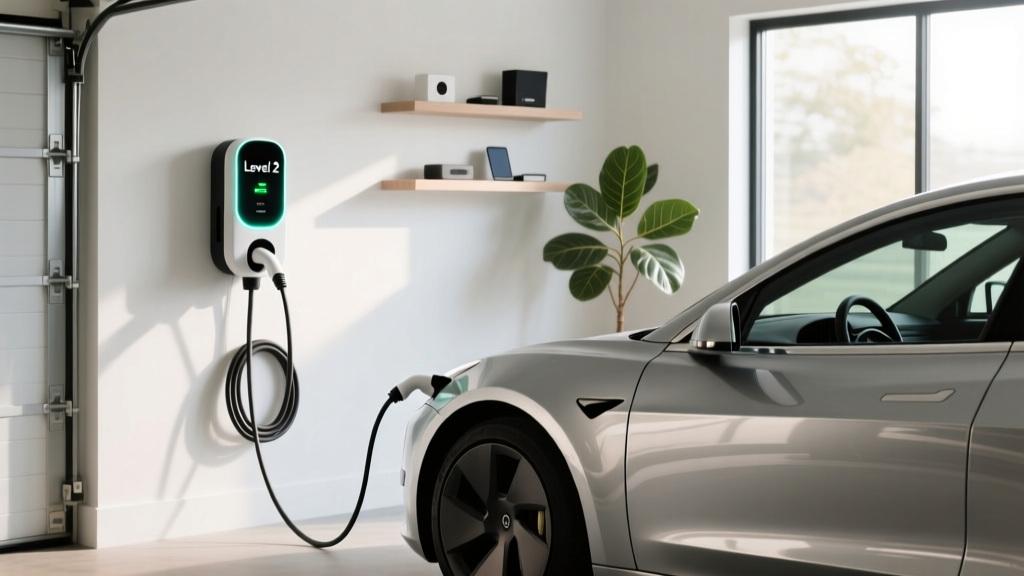
While hyperfast chargers handle road trips, 90%+ of EV charging happens at home on Level 2. Here's what a proper home installation requires.
Electrical Requirements
A Level 2 home charger requires a dedicated 240V circuit — the same voltage as your electric dryer or oven. Common configurations:
- 240V / 40A circuit → delivers up to 9.6 kW (most common residential setup; sufficient for overnight charging of any EV)
- 240V / 48A circuit → delivers up to 11.5 kW (faster; requires 60A breaker)
- 240V / 60A circuit → delivers up to 14.4 kW (maximum for some chargers; requires 75A breaker and heavier gauge wire)
- 240V / 80A circuit → delivers up to 19.2 kW (newer high-power home chargers; requires 100A breaker, heavy wire, and significant panel capacity)
National Electrical Code (NEC) requires that continuous loads (including EV charging, which runs for hours) use only 80% of a circuit's rated capacity. A 40A circuit therefore delivers a maximum continuous 32A, or 7.7 kW at 240V.
Panel Upgrade Considerations
This is the cost variable that catches many homeowners off guard. If your home has a 100A main electrical panel (common in homes built before 2000), adding a 40–60A dedicated EV circuit may exceed your panel's capacity, especially if you already have electric range, dryer, and HVAC loads. An upgrade to a 200A panel typically costs $1,500–$3,500 before the EV circuit is even installed. Homes with existing 200A panels usually have sufficient headroom.
Installation Cost Breakdown
| Component | Cost Range |
|---|---|
| Level 2 charger hardware (smart, Wi-Fi enabled) | $300–$750 |
| Electrician labor (standard install, short conduit run) | $500–$1,500 |
| Electrician labor (long run, conduit, drywall work) | $1,200–$3,000 |
| Electrical permit | $50–$250 |
| Panel upgrade (if needed — 100A to 200A) | $1,500–$3,500 |
| Total (no panel upgrade) | $850–$2,500 |
| Total (with panel upgrade) | $2,350–$6,000 |
Some utilities offer rebates of $250–$1,000 for smart Level 2 charger installations, particularly if you enroll in a time-of-use (TOU) rate plan. Check with your local utility before scheduling installation.
Safety and Code Requirements
- Dedicated circuit: Your EV charger must be on its own breaker — never shared with other appliances.
- GFCI protection: NEC 2020 and later requires Ground Fault Circuit Interrupter protection for EV charging outlets. Many smart chargers include built-in GFCI; hardwired installations may require a GFCI breaker.
- Outdoor rating: If your charger is installed outdoors (garage exterior, carport, driveway), it must carry a NEMA 4 or NEMA 4X rating for weather resistance.
- Hardwired vs. plug: Hardwired installations (no plug) eliminate the NEMA 14-50 receptacle and are often preferred for 48A+ chargers, as some 14-50 outlets have been associated with overheating when used for continuous high-amperage loads. Hardwired also avoids the NEC GFCI-breaker requirement for receptacles.
Recommended Home Level 2 Chargers (2025–2026)
These are the home chargers we recommend based on reliability, power output, connector options, smart features, and value. Note: none of these are hyperfast chargers — they are Level 2 units for daily home use.
ChargePoint Home Flex
- Power: Up to 12 kW (50A, adjustable down)
- Connector: NACS or J1772 (configurable)
- Cable length: 23 ft
- Smart features: Wi-Fi, app scheduling, TOU optimization, Alexa
- Price: ~$599
Tesla Wall Connector
- Power: Up to 11.5 kW (48A)
- Connector: NACS (native); J1772 adapter available
- Cable length: 24 ft
- Smart features: Wi-Fi, OTA updates, power sharing (multiple units)
- Price: ~$475
Emporia Vue Level 2 Charger
- Power: Up to 11.5 kW (48A)
- Connector: J1772 (NACS adapter available)
- Cable length: 24 ft
- Smart features: Energy monitoring, solar integration, app control
- Price: ~$399
Grizzl-E Smart
- Power: Up to 10 kW (40A)
- Connector: J1772 or NACS
- Cable length: 24 ft
- Smart features: OCPP-compatible, adjustable amperage, rugged build
- Price: ~$449
How Hyperfast Charging Affects Battery Longevity
A common concern is whether frequent use of 350 kW hyperfast chargers degrades the battery faster than slower charging. The data suggests the effect is real but manageable.
Lithium-ion cells experience the most stress from two factors: high charge rates at elevated temperatures and sustained high states of charge. Hyperfast charging generates significant heat, which is why modern EVs use active liquid cooling during DC fast sessions. Studies from NREL and real-world fleet data from Recurrent Auto indicate that vehicles that DC fast charge exclusively show approximately 5–10% more degradation over 100,000 miles compared to those that primarily use Level 2 — but this gap narrows significantly when battery preconditioning is used consistently.
Best practices for hyperfast charging longevity:
- Always navigate to the charger using the vehicle's built-in routing to trigger battery preconditioning.
- Charge to 80%, not 100%, unless you need the full range for that day's drive.
- Avoid DC fast charging when the battery is already above 80% SoC — the taper curve makes it extremely slow anyway.
- In hot weather, let the vehicle's thermal management system run for a few minutes before initiating maximum-rate charging.
- Reserve hyperfast charging for road trips; use Level 2 at home for daily needs.
Frequently Asked Questions
How much does it cost to install a home EV charger?
A standard Level 2 home charger installation costs between $850 and $2,500 if your electrical panel has sufficient capacity. If you need a panel upgrade from 100A to 200A, total costs can reach $2,350–$6,000. The charger hardware itself runs $300–$750, with electrician labor and permits making up the rest.
How fast will each charging level add range?
Level 1 (120V) adds 3–5 miles per hour. Level 2 (240V, 40A) adds roughly 30 miles per hour. A 150 kW DC fast charger adds roughly 300+ miles per hour at peak. A 350 kW hyperfast charger can theoretically add 700–1,000+ miles per hour at peak, though real-world charging curves mean you'll average roughly 400–600 mi/hr over a 10–80% session.
Which connector/charger is compatible with my EV?
For 2025–2026 models: Tesla uses NACS natively. Ford, GM, Rivian, Volvo, and Polestar have switched to NACS. Hyundai, Kia, and most legacy brands still use CCS1 but provide NACS adapters. Nissan Leaf uses CHAdeMO. Check your vehicle's charge port or owner's manual, and consult the EPA's fueleconomy.gov for model-specific charging specs.
How much does charging cost per mile vs gas?
Home Level 2 charging on a standard rate costs roughly $0.04–$0.05 per mile — about 60–70% less than gasoline at $3.40/gal and 28 MPG ($0.12/mile). However, hyperfast public charging at $0.48–$0.60/kWh can cost $0.11–$0.17 per mile, which is comparable to or slightly more than gas. The economic advantage of EV ownership depends heavily on having access to home or workplace Level 2 charging.
What electrical upgrades might I need?
The most common upgrade is a panel capacity increase from 100A to 200A, which costs $1,500–$3,500. You may also need a new dedicated circuit with appropriate wire gauge (6 AWG for 50A, 4 AWG for 60A+), a conduit run from the panel to the charger location, and a GFCI breaker if using a receptacle rather than hardwiring. A licensed electrician should perform a load calculation before quoting the job.
Is a hyperfast charger worth the premium over a standard DC fast charger?
Only if your vehicle supports it. A 400V vehicle like the Tesla Model Y or Ford F-150 Lightning physically cannot accept more than 150–250 kW regardless of the station's capability. You'd pay the hyperfast per-kWh premium without receiving faster charging. If you drive an 800V vehicle (Ioniq 5, EV6, Taycan, Lucid Air), a 350 kW station can meaningfully reduce your 10–80% time by 5–10 minutes versus a 150 kW station — which matters on a long road trip but is marginal for a quick top-up.