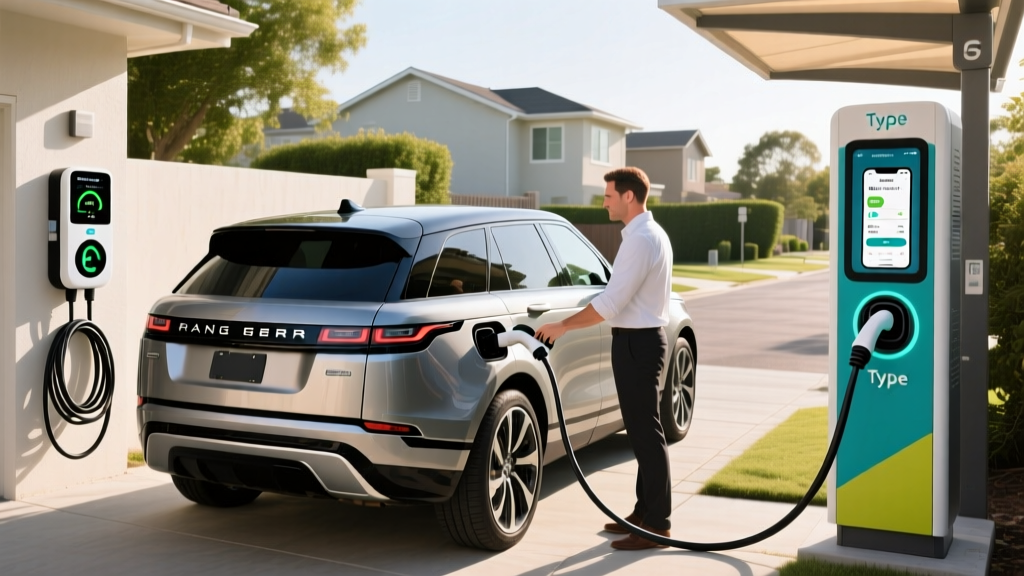
Land Rover's plug-in hybrid Range Rover lineup pairs a turbocharged inline-six with a substantial traction battery, delivering roughly 40–50 miles of electric-only range on models like the P550e. But that electric range is only useful if you can actually replenish it efficiently. Too many PHEV owners plug into a standard 120V outlet and wonder why their "full charge" takes overnight and barely covers a school run.
This guide covers exactly what it takes to charge a 2026 hybrid Range Rover at home and in public — from the electrical panel requirements and real installation costs to the connector standards, charging speeds at each level, and how much you'll actually save per mile versus pumping gas. Whether you own a Range Rover PHEV or are shopping for one, here's the data you need.
Range Rover PHEV Battery and Charging Hardware at a Glance
The current-generation Range Rover P550e plug-in hybrid uses a 31.8 kWh lithium-ion battery pack (approximately 28.9 kWh usable), paired with a 3.0-liter inline-six and electric motor producing a combined 542 horsepower. The onboard AC charger is rated at 7.2 kW, which caps how fast the vehicle can accept Level 2 power regardless of how large your home charger is. For DC fast charging, the P550e supports up to 50 kW via its CCS1 port.
| Specification | 2026 Range Rover P550e PHEV |
|---|---|
| Battery (usable) | ~28.9 kWh (Lithium-ion) |
| EPA Electric Range | 48 miles |
| Combined Output | 542 hp |
| Onboard AC Charger | 7.2 kW |
| DC Fast Charge Max | 50 kW (CCS1) |
| Charge Port | CCS1 (J1772 + DC pins) |
| EPA MPGe (electric+gas) | 42 MPGe |
| Gas-only Fuel Economy | ~20 MPG combined |
| Base MSRP | ~$111,000 |
| Battery Warranty | 8 years / 100,000 miles |
Charging Levels Explained: Speeds and Range Added Per Hour
Understanding the three charging levels is critical. The key distinction: kW (kilowatts) measures power — the rate at which electricity flows. kWh (kilowatt-hours) measures energy — the total amount stored in your battery. Think of kW as the flow rate of a hose and kWh as the size of the bucket.
| Level | Voltage | Power (kW) | Miles of Range Added/Hour | Best Use Case |
|---|---|---|---|---|
| Level 1 | 120V AC | 1.0–1.4 kW | 3–5 miles | Overnight trickle; emergency top-up |
| Level 2 | 240V AC | 3.3–19.2 kW | 12–60+ miles | Primary home and workplace charging |
| DC Fast Charge | 400–800V DC | 50–350 kW | 150–800+ miles | Road trips; rapid top-ups away from home |
For the Range Rover P550e specifically: On Level 1 (120V), you'll add roughly 4 miles of electric range per hour — meaning a full 0–100% charge takes about 12 hours. On Level 2 at the vehicle's 7.2 kW maximum, a full charge takes approximately 4 hours. At a 50 kW DC fast charger, you can go from 10–80% in roughly 30 minutes, though the charge curve tapers significantly above 80% to protect battery health.
Because the P550e's onboard charger caps at 7.2 kW, installing a 48-amp (11.5 kW) home charger won't charge the Range Rover any faster than a 32-amp (7.7 kW) unit. However, a higher-output charger provides future-proofing if you add a full BEV to your garage later.
Home Charger Installation: Electrical Requirements and Costs
A Level 2 home charger is the single best upgrade for any PHEV owner. For the Range Rover P550e, a 32-amp circuit delivering 7.7 kW matches the vehicle's onboard charger almost perfectly. Here's what's involved electrically.
Circuit requirements: A 32-amp charger requires a dedicated 40-amp breaker (NEC code mandates circuits be rated at 125% of continuous load). This means a 240V circuit with 8 AWG copper wire (6 AWG for longer runs over 100 feet). A 40-amp or 48-amp charger needs a 50-amp or 60-amp breaker respectively, with correspondingly thicker wire.
Electrical panel capacity: Most modern homes with 200-amp service can accommodate a 40–50 amp EV circuit without issue. Older homes with 100-amp panels or panels already near capacity (electric range, dryer, HVAC) may require a panel upgrade to 200 amps — a significant added cost.
| Component | Cost Range | Notes |
|---|---|---|
| Level 2 Charger (hardware) | $350–$750 | Smart Wi-Fi chargers from ChargePoint, Wallbox, Emporia |
| Electrician labor | $500–$2,000 | Depends on panel-to-garage distance, wall type, conduit run |
| Electrical permit | $50–$250 | Required in most jurisdictions; varies by city/county |
| Panel upgrade (if needed) | $1,500–$4,000 | Only if existing panel lacks capacity; 100A → 200A upgrade |
| Total (no panel upgrade) | $900–$3,000 | Typical scenario for homes with 200A service |
| Total (with panel upgrade) | $2,400–$7,000 | Older homes; budget for worst-case |
Safety and code considerations: Your installation must include a dedicated circuit (not shared with other appliances). Outdoor installations require a NEMA 4-rated (weatherproof) charger enclosure and a GFCI breaker per NEC 2023 Article 625. Hardwired chargers are generally preferred over NEMA 14-50 receptacles for reliability and to avoid the 2017+ NEC requirement for GFCI breakers on receptacles (which can cause nuisance tripping with some EVSEs). Always hire a licensed electrician — this is not a DIY project.
Connector Compatibility: NACS, CCS1, and Adapter Needs
The 2026 Range Rover P550e uses a CCS1 (Combined Charging System) port, which combines the J1772 AC connector with two additional DC fast-charge pins below it. This is the standard for most non-Tesla EVs and PHEVs sold in North America.
| Connector | Used By | Range Rover PHEV Compatible? |
|---|---|---|
| J1772 (AC Level 1/2) | All non-Tesla EVs/PHEVs | Yes — native |
| CCS1 (DC Fast) | Most non-Tesla (VW, BMW, Hyundai, Land Rover, etc.) | Yes — native |
| NACS (Tesla) | Tesla vehicles; Ford, GM, Rivian, Volvo (2025+) | No — adapter required for Tesla Superchargers |
| CHAdeMO (DC Fast) | Nissan LEAF, Mitsubishi (legacy) | Not applicable |
Adapter considerations: Tesla has opened its Supercharger network to non-Tesla vehicles, but only those with NACS ports or an approved CCS-to-NACS adapter. As of 2026, Land Rover has not announced a native NACS transition for the Range Rover PHEV. If you want access to Tesla Superchargers, you'll need a CCS-to-NACS adapter (approximately $200–$250 from approved suppliers). However, with the P550e's 50 kW DC fast-charge cap, Tesla's V3 Superchargers (250 kW) offer no speed advantage — any 50+ kW CCS charger from Electrify America, EVgo, or ChargePoint will deliver the same rate.
Cost to Charge: Home vs. Public vs. Gas
The economic case for plugging in your Range Rover PHEV depends heavily on where you charge. Here's a realistic breakdown using the P550e's ~28.9 kWh usable battery and 48-mile electric range.
| Charging Scenario | Rate ($/kWh) | Cost for Full Charge | Cost Per Mile (Electric) |
|---|---|---|---|
| Home (off-peak utility rate) | $0.08–$0.13 | $2.31–$3.76 | $0.05–$0.08 |
| Home (standard residential avg) | $0.16 | $4.62 | $0.10 |
| Public Level 2 (ChargePoint, etc.) | $0.25–$0.49 | $7.23–$14.16 | $0.15–$0.29 |
| DC Fast Charge (Electrify America) | $0.35–$0.55 | $10.12–$15.90 | $0.21–$0.33 |
| Gasoline (premium, $4.20/gal, 20 MPG) | — | — | $0.21 |
The takeaway: Charging at home on off-peak rates cuts your per-mile cost to roughly one-quarter to one-third of what you'd spend on premium gasoline. Even at standard residential rates, electric driving costs about half as much per mile. Public DC fast charging, however, can equal or exceed the cost of gas — it's a convenience for road trips, not a daily strategy.
For maximum savings, configure your charger's scheduling feature (most smart chargers support this) to charge during your utility's off-peak window, typically 10 PM – 6 AM. Some utilities offer dedicated EV time-of-use (TOU) rates as low as $0.06–$0.09/kWh — check with your provider.
Equipment Recommendations: Best Level 2 Chargers for the Range Rover PHEV
Since the Range Rover P550e caps at 7.2 kW, a 32-amp (7.7 kW) charger is the sweet spot. That said, 40-amp or 48-amp units are worth considering for future-proofing. Here are three chargers that perform well in real-world use.
ChargePoint Home Flex
- Power Output: Up to 12 kW (50 amp), configurable via DIP switches down to 16A/32A/40A/48A
- Connector: J1772 (CCS1 compatible for AC charging)
- Cable Length: 23 feet
- Smart Features: Wi-Fi, app scheduling, energy tracking, Alexa integration
- Price: ~$550–$650
- Best For: Flexibility — adjust amperage to match your circuit without buying a different unit
Wallbox Pulsar Plus
- Power Output: Up to 11.5 kW (48 amp)
- Connector: J1772
- Cable Length: 25 feet
- Smart Features: Wi-Fi + Bluetooth, app control, load balancing (Power Sharing for dual installs), solar integration
- Price: ~$450–$550
- Best For: Compact size, excellent app, load management if your panel is tight on capacity
Emporia Vue 2 EV Charger
- Power Output: Up to 11.5 kW (48 amp)
- Connector: J1772
- Cable Length: 24 feet
- Smart Features: Wi-Fi, whole-home energy monitoring integration, scheduling, solar-aware charging
- Price: ~$350–$400
- Best For: Budget-conscious buyers who want smart features and energy visibility
For the Range Rover P550e, any of these units will deliver a full charge in approximately 4 hours when configured at 32 amps. If your electrical panel has the headroom, installing a 48-amp circuit with one of these chargers gives you overhead for a future full-electric vehicle without rewiring.
Public Charging the Range Rover PHEV: What to Expect
The P550e's 50 kW DC fast-charge capability is modest by full-BEV standards (where 150–350 kW is common), but it's adequate for a PHEV with a ~29 kWh usable battery. At a 50 kW CCS1 station, you'll add roughly 25–30 miles of range in 15 minutes, and a 10–80% charge takes about 30 minutes.
Charge curve reality: Like all lithium-ion packs, the P550e charges fastest at low states of charge. Expect peak 50 kW draw from roughly 10–50% SoC, tapering to 25–30 kW between 50–70%, and dropping further to 10–15 kW above 80%. This is normal battery management — charging to 100% at a DC fast charger wastes time and accelerates degradation.
Network availability: Major CCS1 networks include Electrify America, EVgo, and ChargePoint (DC stations). According to fueleconomy.gov, PHEVs with DC fast-charge capability significantly reduce reliance on gasoline for drivers who take regular road trips. Use PlugShare or the networks' native apps to locate CCS1 stations along your route.
Tax Credits and Incentives for Home Charger Installation
The federal Alternative Fuel Vehicle Refueling Property Credit (IRS Form 8911) covers 30% of the cost of home EV charger equipment and installation, up to a maximum credit of $1,000 per tax year. However, this credit is subject to income limitations and geographic restrictions — it applies only in census tracts that are classified as low-income or non-urban. Consult a tax professional to determine your eligibility, as these rules are subject to change.
Many utilities also offer rebates for Level 2 charger installation — typically $250–$750 — and some provide free or discounted equipment. Check with your local utility before purchasing a charger, as the rebate may dictate which models qualify.
Frequently Asked Questions
How much does it cost to install a home EV charger for a Range Rover PHEV?
Expect $900–$3,000 for a typical installation (equipment + electrician + permit) if your home has a 200-amp electrical panel with available capacity. If a panel upgrade is required, costs can reach $2,400–$7,000. The Range Rover P550e's 7.2 kW onboard charger means a 32-amp circuit is sufficient, keeping wire and breaker costs on the lower end.
How fast will each charging level add range to my Range Rover?
Level 1 (120V): approximately 4 miles per hour. Level 2 (240V, 7.2 kW): approximately 25 miles per hour, reaching a full charge in about 4 hours. DC Fast (50 kW CCS1): approximately 60+ miles of range in 30 minutes (10–80% SoC).
Which connector is compatible with the hybrid Range Rover?
The Range Rover P550e uses a CCS1 port, which accepts J1772 connectors for AC Level 1 and Level 2 charging, and CCS1 connectors for DC fast charging. Tesla Supercharger access requires a CCS-to-NACS adapter, though the P550e's 50 kW DC cap means non-Tesla 50+ kW CCS chargers will deliver identical speeds.
How much does charging cost per mile versus gas in the Range Rover?
At home on off-peak rates ($0.10/kWh average), electric driving costs about $0.05–$0.08 per mile. On premium gasoline at $4.20/gallon and 20 MPG combined, gas costs about $0.21 per mile. Home charging saves roughly 60–75% per mile compared to gas. Public DC fast charging ($0.35–$0.55/kWh) costs roughly the same as or more than gasoline.
What electrical upgrades might I need for a Level 2 charger?
If your home has a 200-amp panel with at least 40–50 amps of spare capacity, no upgrade is needed — just a dedicated circuit with a new breaker. If you have a 100-amp panel, an older fuse box, or a panel already near its load limit, you may need a panel upgrade to 200 amps ($1,500–$4,000). A licensed electrician can perform a load calculation during an initial consultation to determine this before you commit.
Can I use the Range Rover PHEV's battery to power my home?
As of the 2026 model year, the Range Rover P550e does not support V2H (vehicle-to-home) or V2L (vehicle-to-load) bidirectional charging. If home backup power is a priority, vehicles like the Ford F-150 Lightning (with the Ford Charge Station Pro and Home Integration System) currently offer this capability.
Does frequent DC fast charging degrade the PHEV battery?
Occasional DC fast charging has minimal impact, but habitual daily use of DC fast charging can accelerate degradation over time. Land Rover warranties the P550e's battery for 8 years / 100,000 miles against capacity loss below a specified threshold (typically 70% state of health). For daily use, Level 2 home charging is gentler on the battery and significantly cheaper.