If you live along the Gulf Coast, the Eastern Seaboard, or anywhere that sees tropical storms and nor'easters, you've probably Googled "hurricane charger" at some point. What you're really looking for is a weatherproof, outdoor-rated Level 2 EV charger that can survive driving rain, salt spray, flying debris, and repeated power outages without corroding or shorting out. The good news: several NEMA 4 and NEMA 4X-rated chargers on the market in 2026 are built for exactly this environment. The less-good news: your electrical panel, circuit capacity, and utility grid reliability matter just as much as the charger itself when storms hit.
This guide walks through what "hurricane charger" actually means in EV terms, the charging levels you need to know, real installation costs (including the panel upgrade nobody warns you about), connector compatibility for every major EV brand, and equipment picks that won't quit when the weather turns ugly.
What Does "Hurricane Charger" Actually Mean?
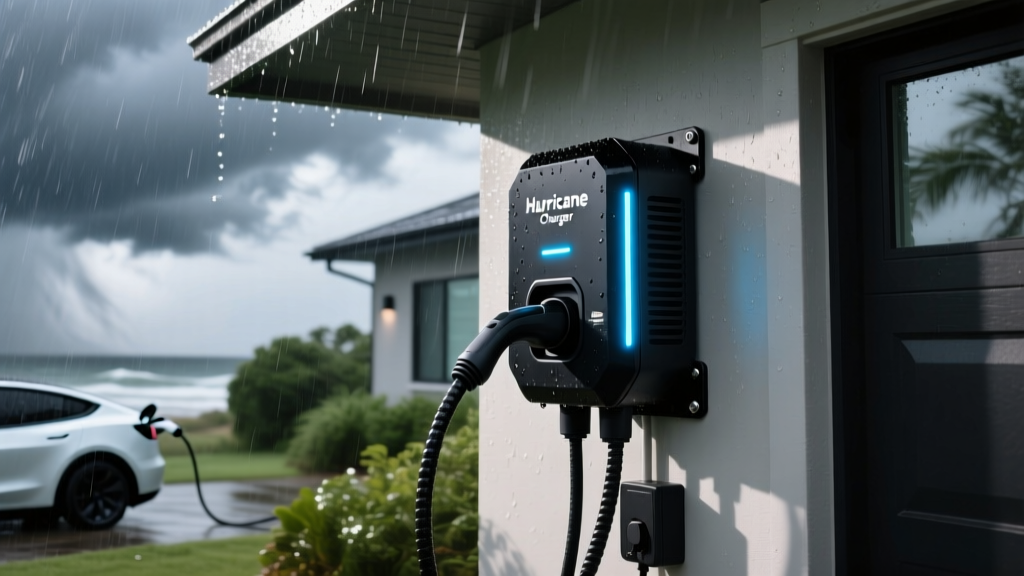
There is no official "hurricane charger" certification in the EV industry. When EV owners in storm-prone regions use the term, they're typically referring to a Level 2 home charger rated NEMA 4 or NEMA 4X — meaning it's sealed against windblown dust, splashing water, hose-directed water, and (for 4X) corrosion from salt air. Some buyers also mean a charger paired with a backup power system — a home battery like the Tesla Powerwall 3 or a generator with an automatic transfer switch — so they can still charge during the multi-day outages that follow major storms.
Here's the hierarchy of weatherproofing you'll encounter:
- NEMA 3R: Protects against falling rain and sleet. Common for basic outdoor chargers. Adequate for light coastal exposure.
- NEMA 4: Watertight. Resists windblown dust, rain, splashing water, and hose-directed water. The minimum I'd recommend for hurricane-zone installations.
- NEMA 4X: Same as NEMA 4 plus corrosion resistance. Essential if you're within 5 miles of the coast where salt spray is constant.
- IP65/IP66: The international equivalent. IP65 = dust-tight and protected against water jets. IP66 = protected against powerful water jets. Many European-designed chargers use this rating.
A charger rated NEMA 3R will survive a thunderstorm. It will not reliably survive a Category 3 hurricane's wind-driven rain and salt intrusion over a multi-year service life. If you're shopping for a "hurricane charger," insist on NEMA 4 or better.
Charging Levels Explained: Speeds in kW and Miles Per Hour
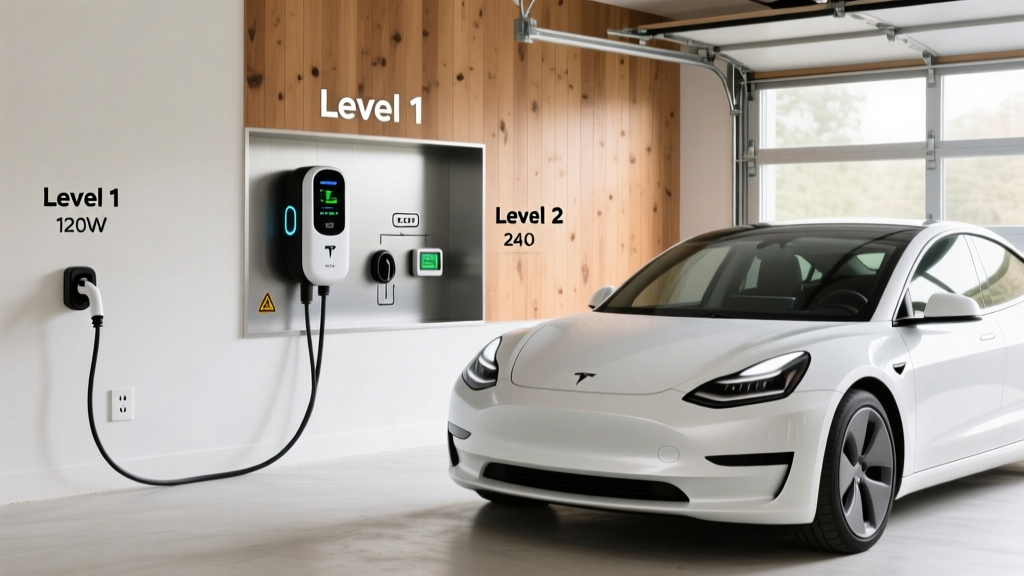
Before picking equipment, you need to understand the three EV charging levels. Power is measured in kW (kilowatts) — that's the rate at which energy flows. Energy stored in your battery is measured in kWh (kilowatt-hours) — that's the tank size. Confusing the two is the single most common EV mistake. A 48 kW charger delivering power for one hour adds 48 kWh of energy to your battery.
| Level | Voltage | Max Power (kW) | Miles of Range Added Per Hour | Typical Use |
|---|---|---|---|---|
| Level 1 | 120V | 1.3–1.9 kW | 3–5 mi/hr | Overnight trickle; PHEVs and low-mileage commuters |
| Level 2 | 240V | 3.3–19.2 kW | 12–75 mi/hr | Primary home and workplace charging |
| DC Fast Charging | 400–800V DC | 50–350 kW | 150–1,200+ mi/hr | Road trips; 10–80% in 15–45 minutes |
Real-world context: A 75 kWh battery (like the Tesla Model Y Long Range) charged on a 11.5 kW Level 2 circuit adds roughly 35 miles of range per hour — or a full 0–100% in about 7 hours. On a 350 kW DC fast charger, that same battery can go from 10% to 80% in roughly 22 minutes, though the charge curve tapers significantly above 80% to protect the cells. Peak kW is not sustained kW — a charger rated at 250 kW may only sustain that rate between 10–50% SoC before stepping down.
Home Installation: Electrical Requirements and Real Costs
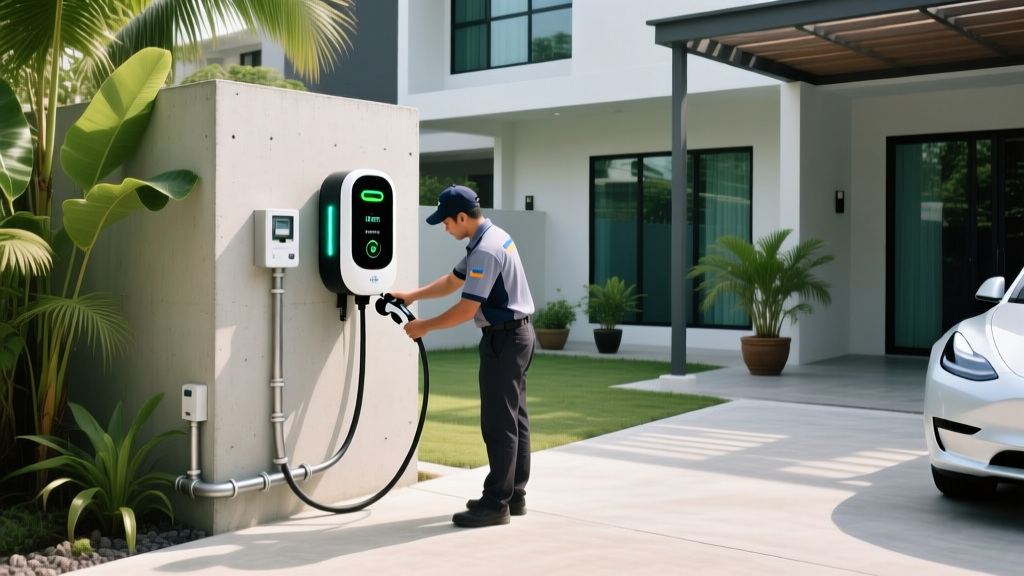
A Level 2 "hurricane charger" installation isn't plug-and-play. You're adding a high-amperage 240V circuit to your home, and in coastal areas, that circuit needs to be routed, grounded, and protected to code — especially when flooding and wind-driven moisture are real risks.
Electrical Requirements for a 48A Level 2 Charger
- Circuit: Dedicated 60A breaker (NEC requires circuits rated at 125% of continuous load, so a 48A charger needs a 60A circuit)
- Wire: 6 AWG copper (THHN in conduit) for runs up to 50 feet; 4 AWG for longer runs to prevent voltage drop
- Outlet vs. hardwired: NEMA 14-50 outlet offers portability; hardwired eliminates the GFCI breaker nuisance-trip issue that plagues many outdoor 14-50 installations
- GFCI protection: NEC 2020/2023 requires GFCI on 240V outlets — but many EV chargers have built-in ground-fault protection, making hardwired installations simpler and more reliable
- Outdoor rating: Charger must be NEMA 4/4X; conduit and junction boxes must be rated for wet locations
Panel Upgrade: The Cost Nobody Mentions
Most homes built before 2000 have 100A or 150A main panels. A 60A EV circuit can consume 30–40% of your panel's available capacity. If your panel is already loaded with HVAC, electric range, dryer, and water heater circuits, a licensed electrician may recommend a panel upgrade to 200A — or a load management device like the Emporia Smart Load Center that dynamically throttles the charger when other circuits draw heavily.
| Component | Low End | High End | Notes |
|---|---|---|---|
| Level 2 charger (NEMA 4 rated) | $400 | $750 | 40A–48A smart chargers |
| Electrician labor (standard install) | $500 | $1,500 | Depends on conduit run length and wall material |
| Permit and inspection | $50 | $250 | Varies by municipality; some coastal counties charge more |
| Panel upgrade (if needed) | $1,500 | $3,500 | 100A→200A; includes new panel, breaker, labor |
| Load management device (alternative) | $200 | $400 | Emporia, Span, or manufacturer-specific |
| Total (no panel upgrade) | $950 | $2,500 | Typical for homes with 200A panels |
| Total (with panel upgrade) | $2,450 | $6,000 | Older homes, longer conduit runs |
The IRS §30C tax credit covers up to 30% of home charging equipment and installation costs, capped at $1,000 per year. This applies to the charger and the electrician's work, though eligibility depends on your census tract meeting certain criteria. Check with a tax professional for your specific situation.
Connector Compatibility: NACS, CCS, and CHAdeMO in 2026
The connector landscape has consolidated significantly. Tesla's NACS (North American Charging Standard) is now the dominant plug in North America, with Ford, GM, Rivian, Volvo, Hyundai/Kia, and most other automakers adopting it for 2025–2026 models. CCS1 is still present on some legacy models, and CHAdeMO is effectively discontinued for new vehicles.
| Connector | Brands Using It | Home Charger Availability |
|---|---|---|
| NACS (J3400) | Tesla, Ford, GM, Rivian, Volvo, Polestar, Hyundai, Kia, Mercedes, BMW, Nissan (2026+) | Widely available — Tesla Wall Connector, ChargePoint, Emporia, EnelX |
| CCS1 | VW (ID.4 pre-2026), older BMW i4/iX, legacy Hyundai/Kia, legacy Ford | Available but shrinking — ChargePoint, JuiceBox, ClipperCreek |
| CHAdeMO | Nissan Leaf (pre-2026), Mitsubishi Outlander PHEV (older) | Limited — mostly ClipperCreek |
Adapter note: If you drive a CCS-equipped EV but want to use Tesla Superchargers or a NACS home charger, a CCS-to-NACS adapter (approximately $200–$300 from Lectron or A2Z) solves the problem. Tesla owners driving to CCS-only public chargers need the reverse. For home installations, I recommend buying a charger with the native connector your vehicle uses — adapters add a point of failure in wet conditions, which is exactly what you don't want during a storm.
Weatherproof Charger Picks: Equipment for Hurricane Zones
Here are four Level 2 chargers that meet NEMA 4 or 4X ratings and are practical for storm-prone regions. Each is evaluated on power output, cable length, smart features, and real-world durability.
ChargePoint Home Flex (NACS or CCS)
- Power: Up to 11.5 kW (48A on a 60A circuit); adjustable down to 16A for smaller panels
- Weatherproofing: NEMA 4 — rated for outdoor installation, windblown rain, and hose-directed water
- Cable: 23 feet — reaches most driveway parking positions
- Smart features: Wi-Fi, scheduling, energy tracking, Alexa integration
- Price: ~$599 (NACS version)
- Best for: Versatility — adjustable amperage means it works on 100A panels without upgrades
Tesla Wall Connector (NACS native)
- Power: Up to 11.5 kW (48A); supports power sharing between two units on one circuit
- Weatherproofing: NEMA 3R standard (adequate rain protection); NEMA 4X enclosure available as aftermarket accessory for coastal installations
- Cable: 24 feet
- Smart features: Wi-Fi, over-the-air updates, Tesla app integration, load sharing
- Price: ~$475
- Best for: Tesla owners who want seamless integration; pair with a NEMA 4X aftermarket enclosure in hurricane zones
Emporia Level 2 EV Charger (NACS)
- Power: Up to 11.5 kW (48A)
- Weatherproofing: NEMA 4 — fully sealed for outdoor and coastal use
- Cable: 24 feet
- Smart features: Real-time energy monitoring via Emporia Vue panel integration, solar-aware charging, time-of-use scheduling
- Price: ~$399
- Best for: Homes with solar panels or Emporia energy monitoring; best value in a NEMA 4-rated smart charger
EnelX JuiceBox 48 (NACS or CCS)
- Power: Up to 11.5 kW (48A)
- Weatherproofing: NEMA 4X — the only mainstream charger with full corrosion resistance, making it the strongest pick for salt-air coastal environments
- Cable: 25 feet — longest in this roundup
- Smart features: Wi-Fi, load balancing with EnelX smart home panel, scheduling
- Price: ~$649
- Best for: Coastal homes within 5 miles of the ocean where salt spray kills standard enclosures within 2–3 years
Cost to Charge: Per-Mile Economics vs. Gasoline
One reason EV owners in hurricane zones invest in home charging: when gas stations lose power (and they do, for days after major storms), an EV charged on your home solar or backup battery is still mobile. But even in normal conditions, the per-mile economics favor electric.
| Scenario | Cost per kWh | Cost per Mile (3.5 mi/kWh EV) | Equivalent Gas Cost at 28 MPG |
|---|---|---|---|
| Home charging (off-peak utility rate) | $0.09–$0.13 | $0.03–$0.04 | $0.89–$1.17 per gallon |
| Home charging (standard rate) | $0.14–$0.18 | $0.04–$0.05 | $1.17–$1.46 per gallon |
| Public Level 2 (ChargePoint, EVgo) | $0.25–$0.39 | $0.07–$0.11 | $2.04–$3.22 per gallon |
| DC Fast Charging (Electrify America, Tesla Supercharger) | $0.35–$0.56 | $0.10–$0.16 | $2.92–$4.69 per gallon |
| Gasoline (national average, mid-2026) | — | $0.11–$0.13 (at $3.15/gal, 28 MPG) | $3.15 per gallon |
Home off-peak charging is 3–4× cheaper per mile than gasoline. Even DC fast charging at the highest public rates is often comparable to or cheaper than gas — though if you're exclusively fast-charging, you're paying a premium and accelerating battery degradation. The data from fueleconomy.gov confirms that most EVs achieve 3.0–4.0 miles per kWh in combined driving, which is what these calculations are based on.
Storm-Ready Charging: Backup Power and Safety
A weatherproof charger is only useful if there's electricity flowing to it. After Hurricane Ian (2022) and Hurricane Helene (2024), many Florida and Carolina EV owners reported 5–10 day outages. Here's how to plan for that reality.
Backup Power Options
- Home battery (Tesla Powerwall 3, Enphase IQ 5P): 13.5–20 kWh of stored energy. A Powerwall 3 can deliver up to 11.5 kW continuous — enough to run a Level 2 charger at full speed during an outage. Expect 1–2 full EV charges per Powerwall depending on your battery size.
- Generator with transfer switch: A 10–22 kW standby generator (Generac, Kohler) can power a Level 2 charger, but you'll need a 240V/50A outlet wired through the transfer switch. Fuel supply (natural gas or propane) becomes the limiting factor.
- V2H (Vehicle-to-Home): The Ford F-150 Lightning with Ford Charge Station Pro and Hyundai Ioniq 5 (2025+) with V2H capability can power your home during an outage — not the other way around. This is a game-changer for storm prep: your EV becomes the backup battery.
- Solar + battery: The most resilient setup. Solar panels recharge your home battery during daylight, which then charges your EV. In a week-long outage, this is the only option that doesn't depend on fuel delivery.
Safety and Code Considerations
- Dedicated circuit: Your Level 2 charger must be on its own breaker — never shared with other appliances. NEC Article 625 is the governing code for EV charging.
- Surge protection: In lightning-prone hurricane zones, install a Type 2 surge protective device (SPD) at your panel. A $150 SPD can save your $600 charger and your car's onboard charger from voltage spikes during storms.
- Flood elevation: Mount the charger at least 24 inches above the base flood elevation (BFE) for your property. Check your FEMA flood map — many coastal installations place chargers at 4–6 feet above grade.
- Conduit sealing: In NEMA 4X installations, conduit entries must use sealing fittings to prevent water migration into the wall cavity or panel.
- Permit and inspection: Per the National Electrical Code (NEC), all EV charging installations require a permit and inspection. Don't skip this — unpermitted work can void your homeowner's insurance during a storm-related electrical fire.
Frequently Asked Questions
How much does it cost to install a weatherproof home EV charger?
Expect $950–$2,500 for a standard installation on an existing 200A panel, including a NEMA 4-rated charger ($400–$750), electrician labor ($500–$1,500), and permits ($50–$250). If your home needs a panel upgrade from 100A to 200A, add $1,500–$3,500. The IRS §30C credit can offset up to $1,000 of this cost if your census tract qualifies.
How fast will each charging level add range?
Level 1 (120V) adds 3–5 miles per hour. Level 2 (240V, 48A) adds roughly 35 miles per hour for most EVs. DC fast charging at 150–350 kW can add 150–1,200+ miles per hour, though real-world 10–80% sessions take 15–45 minutes depending on battery size and charge-curve taper.
Which connector is compatible with my EV?
If you bought a 2025 or 2026 model from Tesla, Ford, GM, Rivian, Volvo, Hyundai, Kia, BMW, or Mercedes, your vehicle uses NACS. Older VW ID.4 models and some pre-2025 EVs use CCS1. The Nissan Leaf (pre-2026) uses CHAdeMO. Check your owner's manual or the charging port itself — the physical shape is unmistakable.
How much does charging cost per mile vs. gas?
Home off-peak charging costs $0.03–$0.04 per mile — roughly equivalent to $0.90–$1.20 per gallon of gasoline. Standard-rate home charging is $0.04–$0.05 per mile. Gasoline at $3.15/gallon in a 28 MPG vehicle costs about $0.11 per mile — roughly 3× more than home charging.
What electrical upgrades might I need for a Level 2 charger?
Most homes with a 200A panel need only a new 60A breaker and a conduit run to the charger location. Homes with 100A or 150A panels — common in houses built before 2000 — may require a panel upgrade ($1,500–$3,500) or a load management device ($200–$400) to avoid overloading the service. Your electrician will perform a load calculation per NEC Article 220 to determine this.
Can I charge my EV during a hurricane if the power goes out?
Not without backup power. A weatherproof charger without electricity is just a box on a wall. Pair it with a home battery (Tesla Powerwall 3), a standby generator, or a solar-plus-storage system. If your EV supports V2H (Ford F-150 Lightning, Hyundai Ioniq 5 with V2H), the car itself can serve as the backup power source — just in reverse.
Is a NEMA 4X charger really necessary, or is NEMA 4 enough?
If you live more than 5 miles inland, NEMA 4 is sufficient. If you're on the coast or in a salt-spray zone, NEMA 4X's corrosion resistance will add years to the charger's lifespan. Standard NEMA 4 enclosures in salt-air environments often show corrosion on connector housings and mounting hardware within 2–3 years.