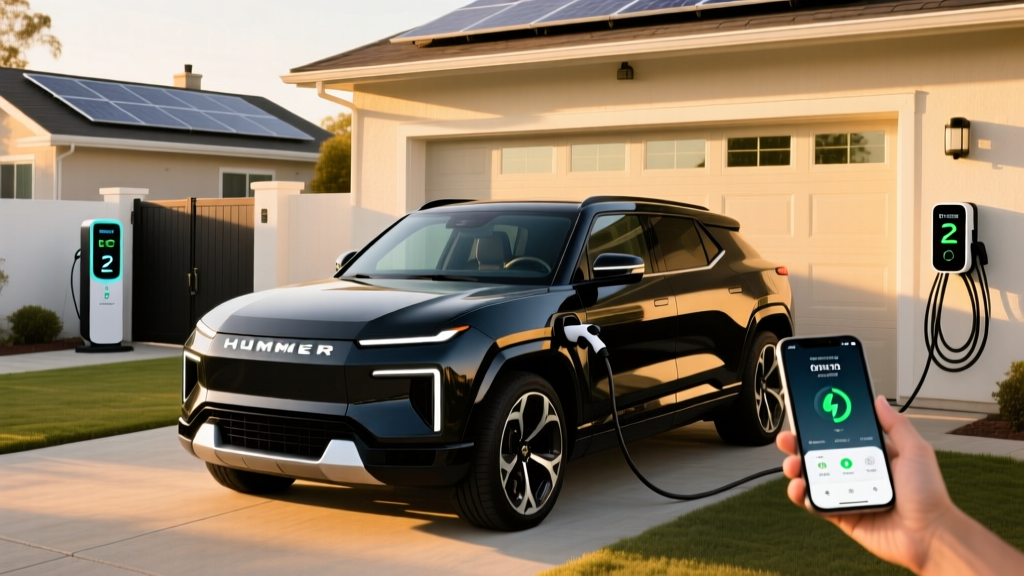
The GMC Hummer EV is one of the most power-hungry electric vehicles on the road. With a usable battery capacity exceeding 200 kWh in the Pickup 3X and SUV variants, understanding Hummer EV charging logistics isn't optional — it's the difference between a seamless ownership experience and a frustrating one. This guide breaks down exactly what you need to charge a Hummer EV at home, on the road, and what it all costs in 2026.
We'll cover the electrical infrastructure requirements, connector compatibility, real-world charging speeds, equipment recommendations, and the cost math versus a gas equivalent. Whether you've already reserved a Hummer EV or are evaluating whether your home can support it, this is the technical deep-dive you need.
Hummer EV Battery and Charging Specs at a Glance
Before we get into charging infrastructure, let's establish the numbers that define the Hummer EV's energy appetite. The GMC Hummer EV Pickup (3X trim) and the Hummer EV SUV share GM's Ultium platform with a massive battery pack.
| Specification | Hummer EV Pickup 3X | Hummer EV SUV 3X |
|---|---|---|
| Usable Battery Capacity | ~212.7 kWh (NMC) | ~212.7 kWh (NMC) |
| EPA Range | ~329 miles | ~314 miles |
| Max DC Fast Charge Rate | ~350 kW (peak) | ~350 kW (peak) |
| 10-80% DC Fast Charge Time | ~35-40 minutes (at 350 kW station) | ~35-40 minutes (at 350 kW station) |
| Level 2 AC Charge Acceptance | 11.5 kW (48A) | 11.5 kW (48A) |
| Connector | CCS1 (factory), NACS via adapter | CCS1 (factory), NACS via adapter |
| 0-60 mph (Watts to Freedom) | ~3.0 seconds | ~3.5 seconds |
| Horsepower | 830 hp | 830 hp |
| Battery/Powertrain Warranty | 8 years / 100,000 miles | 8 years / 100,000 miles |
| Starting MSRP (2025 3X) | ~$104,500 | ~$98,000 |
Real-World Range Reality: The EPA estimates ~329 miles for the Hummer EV Pickup, but expect 250-280 miles on sustained highway driving at 70+ mph. In cold weather (below 32°F), range can drop an additional 20-30%, putting realistic winter highway range closer to 200-230 miles. The Hummer EV's 9,000+ lb curb weight and brick-like aerodynamics demand significantly more energy per mile than a sedan or crossover.
Charging Levels Explained: What Speeds to Expect
Understanding the three charging levels is essential for any Hummer EV owner. Here's a critical distinction: kW (kilowatts) measures power — how fast energy flows into the battery. kWh (kilowatt-hours) measures energy — the total capacity of the battery. Think of kW as the width of a pipe and kWh as the size of the tank you're filling.
| Charging Level | Voltage / Amperage | Power (kW) | Miles of Range Per Hour | Full 0-100% Time (212 kWh) |
|---|---|---|---|---|
| Level 1 (Standard Outlet) | 120V / 12A | ~1.4 kW | ~2-3 miles | ~150+ hours (impractical) |
| Level 2 (Home/Public AC) | 240V / 48A | 11.5 kW | ~19-22 miles | ~18-20 hours |
| Level 2 (240V / 32A) | 240V / 32A | 7.7 kW | ~13-15 miles | ~27-30 hours |
| DC Fast Charge (150 kW) | 400-800V DC | 150 kW | ~250+ miles (in 30 min) | 10-80% in ~55-65 min |
| DC Fast Charge (350 kW) | 800V DC | 350 kW (peak) | ~500+ miles (in 30 min) | 10-80% in ~35-40 min |
Why 10-80%, not 0-100%? DC fast charging follows a charge curve. The battery accepts peak power (up to 350 kW on the Hummer EV) at low states of charge, then tapers significantly above 80% to protect battery health. Charging from 80% to 100% on DC fast charge can take as long as 10% to 80%. For road trips, plan to charge to 80% and move on — it's dramatically faster.
Home Charger Installation: Electrical Requirements and Costs
The Hummer EV's 212 kWh battery makes home charging infrastructure particularly important. Level 1 charging (120V) is completely impractical — adding only 2-3 miles per hour means it would take over six days to fully charge from empty. A Level 2 home charger is effectively mandatory.
Electrical Requirements for Hummer EV Home Charging
To achieve the Hummer EV's maximum 11.5 kW Level 2 acceptance rate, you'll need:
- Circuit: Dedicated 60-amp breaker (to support continuous 48A draw — NEC requires circuits rated 125% above continuous load)
- Voltage: 240V split-phase (standard US residential)
- Wire gauge: 6 AWG copper (or 4 AWG aluminum) for a 60A circuit
- Outlet option: NEMA 14-60 receptacle, or hardwired connection (hardwired is preferred for high-amperage EV chargers)
If you opt for a 40A charger (7.7 kW), a 50-amp breaker with 6 AWG wire will suffice. This is a common compromise that still delivers ~13-15 miles of range per hour — enough to fully recharge overnight for most daily driving.
Panel Upgrade Considerations
Here's where many Hummer EV buyers get surprised. The Hummer EV's massive battery means you'll want the fastest Level 2 charging you can get, which draws significant amperage. If your home has a 100-amp electrical panel (common in homes built before 1990), you will almost certainly need a panel upgrade to 200 amps. Even some 200-amp panels may lack capacity if you're already running electric ranges, dryers, HVAC, and other heavy loads.
A licensed electrician will perform a load calculation (per NEC Article 220) to determine if your existing panel can handle a 60A EV circuit. Don't skip this step.
| Item | Low Estimate | High Estimate | Notes |
|---|---|---|---|
| Level 2 EV Charger (Equipment) | $400 | $750 | 40A-48A smart charger, 25ft cable |
| Electrician Labor (Standard Install) | $500 | $1,500 | Panel to garage, <50ft run, conduit |
| Electrical Permit | $50 | $200 | Varies by municipality |
| Panel Upgrade (if needed) | $1,500 | $4,000 | 100A to 200A service upgrade |
| Trenching / Long Wire Runs | $500 | $3,000 | Detached garage, >50ft runs |
| Total (No Panel Upgrade) | $950 | $2,450 | Most straightforward installs |
| Total (With Panel Upgrade) | $2,450 | $6,450 | Older homes with 100A service |
Source: Installation cost ranges compiled from U.S. Department of Energy EV charging guidance and national electrician pricing data.
How Much Does It Cost to Install a Home EV Charger?
For a Hummer EV owner with a modern 200A panel and a garage within 50 feet of the panel, expect to pay $950-$2,450 total (equipment + electrician + permit) for a 48A Level 2 charger installation. If a panel upgrade is required, add $1,500-$4,000. Homes with detached garages or long wire runs may see additional costs for trenching and conduit.
Some utilities offer rebates of $250-$1,000 for Level 2 charger installations — check with your local provider. The federal Residential Clean Energy Credit (IRC §25C) may also cover up to 30% of charger equipment and installation costs (capped at $1,000) through 2032, though eligibility depends on location and census tract qualifications. Always consult a tax professional for your specific situation.
Connector Compatibility: CCS1, NACS, and Adapter Options
The GMC Hummer EV ships with a CCS1 (Combined Charging System) port. This is the standard connector used by most non-Tesla EVs sold in North America through 2024-2025. However, the connector landscape has shifted dramatically.
| Connector Type | Native Support? | Adapter Available? | Network Access |
|---|---|---|---|
| CCS1 | Yes (factory) | Not needed | Electrify America, EVgo, ChargePoint, Ionity (EU) |
| NACS (Tesla) | No (factory) | Yes — GM-approved NACS adapter | Tesla Supercharger network (15,000+ stalls in US) |
| CHAdeMO | No | Limited aftermarket | Largely deprecated in US (Nissan Leaf legacy) |
| J1772 (Level 2 AC) | Yes (CCS includes J1772) | Not needed | All public Level 2 stations |
The NACS Adapter Situation for Hummer EV Owners
General Motors began providing NACS adapters to existing Ultium-based EV owners (including Hummer EV) starting in 2024-2025. With this adapter, the Hummer EV can access Tesla Supercharger stalls, which significantly expands the DC fast charging network available to owners — particularly important for road trips through regions where Electrify America or EVgo coverage is sparse.
Important caveat: When using a NACS adapter at a Tesla V4 Supercharger (which supports CCS communication protocol), the Hummer EV can achieve high charge rates. However, older V2 and V3 Supercharger stalls may limit charge speeds or require specific adapter firmware. Always check the GMC Hummer EV owner resources for the latest adapter compatibility updates.
Public DC Fast Charging: Networks, Speeds, and Real-World Performance
The Hummer EV's ~350 kW peak DC fast charging capability puts it among the fastest-charging EVs available. But peak rate and sustained rate are very different things. Here's what to actually expect at public chargers.
Real-World Charge Curve for the Hummer EV
At a 350 kW-capable station (such as Electrify America's 350 kW stalls), the Hummer EV's charging curve typically looks like this:
- 10-30% SoC: Peaks near 300-350 kW — extremely fast energy delivery
- 30-50% SoC: Sustains ~200-280 kW — still very fast
- 50-80% SoC: Tapers to ~120-170 kW — moderate speed
- 80-100% SoC: Drops below 50 kW — very slow (avoid DC charging past 80% on trips)
This charge curve means a 10-80% session at a 350 kW station takes approximately 35-40 minutes. At a more common 150 kW station, expect 55-65 minutes for the same 10-80% session. The Hummer EV's massive battery means even at lower charge rates, you're adding meaningful range — but total session time is longer than smaller-battery EVs.
Which Public Networks Work Best for the Hummer EV?
- Electrify America: 350 kW stalls available at many locations; CCS1 native. Best for maximum charge speed.
- Tesla Supercharger (with NACS adapter): V4 stalls (newer) support CCS protocol; V3 stalls max at 250 kW. Largest network by far.
- EVgo: Mix of 50-350 kW CCS stalls; growing 350 kW footprint. Often co-located with shopping centers.
- ChargePoint: Primarily Level 2 public; some DC fast locations. Good for destination charging.
Cost to Charge: Home vs. Public vs. Gas Comparison
The Hummer EV's massive battery means charging costs add up faster than smaller EVs. Here's the real math for 2026 electricity and fuel prices.
| Charging Scenario | Cost per kWh | Cost to Fill 212 kWh (10-100%) | Cost Per Mile (~329 mi range) |
|---|---|---|---|
| Home (Off-Peak / Time-of-Use) | $0.08-$0.12 | $17-$25 | $0.05-$0.08 |
| Home (Standard Residential Avg) | $0.16 | $34 | $0.10 |
| Public Level 2 (ChargePoint, etc.) | $0.20-$0.35 | $42-$74 | $0.13-$0.22 |
| DC Fast Charge (EA / EVgo) | $0.35-$0.55 | $74-$117 | $0.22-$0.36 |
| Tesla Supercharger (avg 2026) | $0.28-$0.40 | $59-$85 | $0.18-$0.26 |
How Much Does Charging Cost Per Mile vs. Gas?
Compare the Hummer EV to a gas equivalent — say, a RAM 1500 TRX or Ford F-150 Raptor getting ~12 MPG combined on premium fuel at $4.00/gallon:
- Gas truck (12 MPG, $4.00/gal): $0.33 per mile
- Hummer EV (home off-peak): $0.05-$0.08 per mile — 75-85% cheaper
- Hummer EV (DC fast charge only): $0.22-$0.36 per mile — roughly comparable to gas
The economics are clear: if you charge primarily at home on off-peak rates, the Hummer EV costs a fraction per mile compared to a high-performance gas truck. But if you rely exclusively on public DC fast charging (apartment living, no home charging), the cost advantage narrows considerably — and in some regions, DC fast charging can actually exceed gas cost per mile.
The Hummer EV's energy consumption is approximately 65-70 kWh/100 miles combined (EPA), which translates to roughly 47-50 MPGe. This is low by EV standards but reflects the physics of moving a 9,000+ lb vehicle. Source: fueleconomy.gov.
Best Home Chargers for the Hummer EV: Equipment Recommendations
Given the Hummer EV's 11.5 kW maximum AC charge acceptance and 48A draw, you'll want a Level 2 charger that can deliver at least 48 amps to maximize charging speed. Here are our top equipment picks for 2026:
ChargePoint Home Flex
- Power Output: Up to 12 kW (50A), configurable down to 16A
- Connector: J1772 (CCS1 AC compatible)
- Cable Length: 25 feet
- Smart Features: Wi-Fi, app scheduling, energy tracking, Alexa integration
- Price: ~$550-$650
- Why for Hummer EV: Amperage-adjustable to match your circuit; robust app; UL-listed. Set to 48A on a 60A circuit to max out the Hummer EV's 11.5 kW acceptance.
Emporia Level 2 EV Charger
- Power Output: Up to 11.5 kW (48A)
- Connector: J1772 (CCS1 AC compatible)
- Cable Length: 24 feet
- Smart Features: Wi-Fi, real-time energy monitoring, solar integration, load management
- Price: ~$350-$450
- Why for Hummer EV: Best value for a 48A charger; excellent energy monitoring pairs well with solar panels; load management feature protects older panels.
Grizzl-E Smart (United Chargers)
- Power Output: Up to 10 kW (40A)
- Connector: J1772 (CCS1 AC compatible)
- Cable Length: 24 feet
- Smart Features: OCPP-compatible, app control, firmware updates, outdoor-rated (NEMA 4)
- Price: ~$450-$550
- Why for Hummer EV: Built like a tank; ideal for outdoor installation in harsh climates. 40A means ~13-15 miles/hour — slightly slower but sufficient for overnight charging on a 50A circuit.
Wallbox Pulsar Plus
- Power Output: Up to 11.5 kW (48A)
- Connector: J1772 (CCS1 AC compatible)
- Cable Length: 25 feet
- Smart Features: Wi-Fi + Bluetooth, app scheduling, Power Sharing (dual charger setups), compact form factor
- Price: ~$500-$650
- Why for Hummer EV: Compact, modern design; Power Sharing allows two chargers on one circuit if you have multiple EVs. Delivers full 48A for maximum Hummer EV Level 2 speed.
Safety, Electrical Code, and Installation Best Practices
Installing a 60A circuit for EV charging is serious electrical work. Here are the non-negotiable safety and code requirements:
- Dedicated circuit: The EV charger must be on its own dedicated breaker — never shared with other appliances. A 48A charger requires a 60A breaker per NEC 210.20 (125% rule for continuous loads).
- GFCI protection: NEC 2020 and later require GFCI protection for EV charging outlets (not required for hardwired installations in many jurisdictions). Hardwiring your charger can eliminate GFCI nuisance-tripping issues that some owners experience with high-amperage outlets.
- Outdoor rating: If your charger is installed outdoors or in an unenclosed carport, it must be rated NEMA 4 (weather-resistant) or better. All chargers listed above meet this standard except some ChargePoint Home Flex configurations — verify before ordering for outdoor use.
- Permit and inspection: Virtually all jurisdictions require an electrical permit for new 240V circuits. The inspection ensures wire gauge, breaker sizing, grounding, and bonding meet NEC standards. Do not skip this — it protects your home and is required for insurance claims related to electrical fires.
- Wire gauge matters: 6 AWG copper for 60A circuits. Undersized wire creates fire risk. Your electrician will handle this, but verify it's on the permit documentation.
Do not use extension cords or outlet adapters to "make do" with a lower-capacity circuit for your Hummer EV. A 212 kWh battery drawing 48A for 18+ hours generates sustained heat at every connection point. Use properly rated, code-compliant wiring and connectors only. The risk of fire or equipment damage from undersized infrastructure is not worth the shortcut.
Frequently Asked Questions: Hummer EV Charging
How fast will each charging level add range to the Hummer EV?
Level 1 (120V) adds roughly 2-3 miles per hour — essentially unusable for a 212 kWh battery. Level 2 at 48A (240V) adds approximately 19-22 miles per hour, fully recharging in 18-20 hours. DC fast charging at 350 kW can add 200+ miles in roughly 20 minutes during the peak portion of the charge curve (10-40% SoC).
Which connector and charger is compatible with the Hummer EV?
The Hummer EV uses a CCS1 connector natively for both AC Level 2 and DC fast charging. With the GM-approved NACS adapter (available from GMC), you can also use Tesla Supercharger stalls. For home Level 2 charging, any J1772 connector charger works (CCS1 includes the J1772 AC portion). CHAdeMO is not supported.
How much does charging cost per mile vs. gas for the Hummer EV?
Charging at home on off-peak electricity ($0.08-$0.12/kWh) costs approximately $0.05-$0.08 per mile. A comparable gas truck at 12 MPG on $4.00/gallon premium costs ~$0.33 per mile. However, exclusive reliance on DC fast charging ($0.35-$0.55/kWh) brings costs to $0.22-$0.36 per mile — comparable to or slightly above gas.
What electrical upgrades might I need for a Hummer EV charger?
You'll need a dedicated 60A, 240V circuit with 6 AWG copper wire for maximum 48A Level 2 charging. If your home has a 100A electrical panel, a panel upgrade to 200A ($1,500-$4,000) is likely required. Homes built after 2000 with 200A service usually have sufficient capacity. An electrician will perform a load calculation to confirm.
Can I charge the Hummer EV on a regular 120V outlet?
Technically yes, but practically no. At 1.4 kW (120V/12A), you'd add only 2-3 miles of range per hour. A full charge would take over 150 hours (6+ days). Level 1 is only useful as an emergency trickle charge — not as a primary charging strategy for a vehicle with a 212 kWh battery.
Does the Hummer EV qualify for the federal EV tax credit?
Federal tax credit eligibility under IRS §30D depends on multiple factors including MSRP caps (trucks: $80,000 — the Hummer EV exceeds this at ~$98,000-$104,500+), buyer income limits, and battery component/critical mineral sourcing requirements. As of 2026, the Hummer EV's MSRP likely disqualifies it from the new-vehicle credit. However, the used EV credit (up to $4,000) may apply if purchasing pre-owned and meeting income/price thresholds. Consult a tax professional and check current IRS guidance for your situation.
How long does it take to charge the Hummer EV from 10% to 80%?
At a 350 kW DC fast charger: approximately 35-40 minutes. At a 150 kW charger: approximately 55-65 minutes. At a 50 kW DC charger (older stations): approximately 2.5-3 hours. On Level 2 home charging (11.5 kW): approximately 13 hours for a 10-80% session.
Is preconditioning important for the Hummer EV?
Yes. The Hummer EV's battery thermal management system can precondition the battery when you navigate to a DC fast charging station via the infotainment system. Preconditioning warms the battery to optimal temperature, enabling faster charge acceptance — especially critical in cold weather. Without preconditioning, a cold battery may accept only a fraction of the available charge rate, adding significant time to your charging stop. Always use the built-in navigation to route to chargers when possible to trigger automatic preconditioning.