Understanding EV Charging Levels: Speed, Power, and What to Expect
Before plugging in anywhere, you need to understand the three charging levels available to EV owners. The single most important distinction in EV charging is between kW (kilowatts), which measures power or charge rate, and kWh (kilowatt-hours), which measures energy or battery capacity. Think of kW as how fast water flows from a hose, and kWh as the size of the bucket you're filling. Confusing the two is the most common mistake new EV owners make.
Your EV's battery is measured in kWh — for example, a 2025 Tesla Model Y Long Range has roughly 75 kWh of usable capacity. The charger's output is measured in kW. A 48-amp Level 2 home charger delivers up to 11.5 kW, meaning it can theoretically add 11.5 kWh of energy per hour to your battery.
| Level | Voltage | Max Power (kW) | Miles of Range Added/Hour | Best For |
|---|---|---|---|---|
| Level 1 (120V) | 120V / 12A | 1.4 kW | 3–5 mi/hr | Overnight top-offs, PHEVs, low-mileage drivers |
| Level 2 (240V) | 240V / 16–80A | 3.8–19.2 kW | 14–60 mi/hr | Daily home charging, workplace charging |
| DC Fast Charge | 400–800V DC | 50–350 kW | 150–1,200 mi/hr (peak) | Road trips, rapid top-ups away from home |
The "miles per hour" figures assume an average efficiency of 3–4 miles per kWh, which covers most EVs from a Chevrolet Equinox EV to a Ford F-150 Lightning. Less efficient vehicles like the GMC Hummer EV (roughly 1.5 mi/kWh) will see far fewer miles added per hour at every level.
How to Use a Public EV Charging Station Step by Step
Using a public charger for the first time can feel intimidating. Here's the practical sequence at a DC fast charging station — whether it's a Tesla Supercharger, Electrify America, or EVgo location:
- Pull up and check the connector. Verify the station's cable matches your vehicle's port. Most new EVs in 2026 use NACS (North American Charging Standard, the Tesla connector). Vehicles with CCS1 ports may need an adapter, which most automakers now provide.
- Authenticate. Open the network's app (or tap an RFID card) to activate the session. Tesla Superchargers authenticate automatically when you plug in with a Tesla or NACS-equipped vehicle. Non-Tesla networks typically require an account with a payment method on file.
- Plug in firmly. For NACS and CCS1, push the connector straight in until it clicks. You should hear the locking mechanism engage. The vehicle's charge port light typically turns green or blue when charging begins.
- Monitor the charge curve. Your vehicle will charge fastest at a low state of charge (SoC). A typical charge curve peaks early, then tapers significantly above 80% SoC. This is why 10–80% charge times are the standard metric — charging from 80–100% can take as long as 10–80%.
- Unplug when ready. Stop the session in the app or on the station screen, wait for the connector to unlock, then remove it. Return the cable to its holster.
At a Level 2 public charger — common at grocery stores, workplaces, and parking garages — the process is similar, but you may need your own J1772 adapter or NACS-to-J1772 adapter depending on the station's connector and your vehicle's port. Always check PlugShare or the network app for connector availability before you drive there.
Home EV Charger Installation: Costs, Electrical Requirements, and Permits
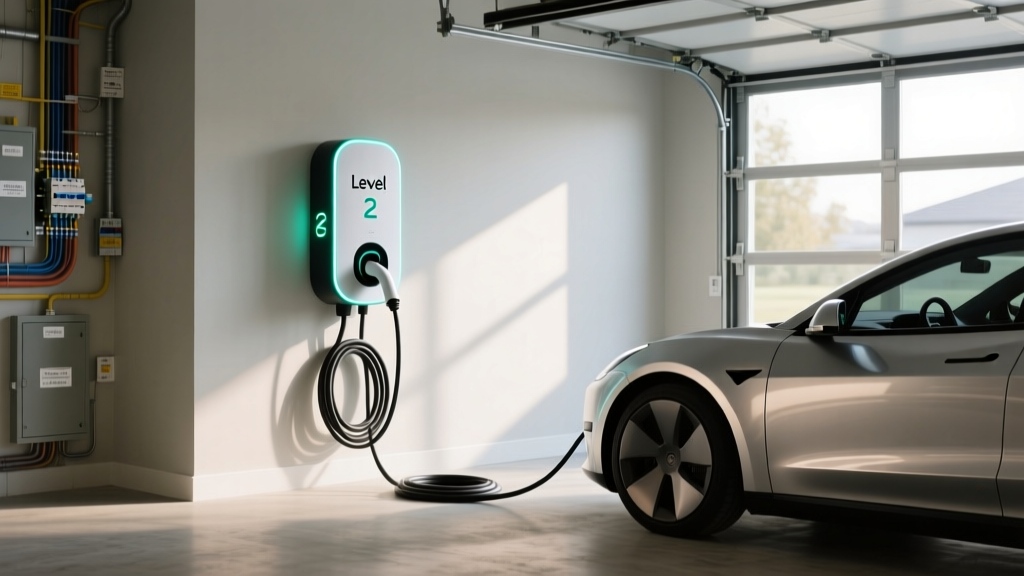
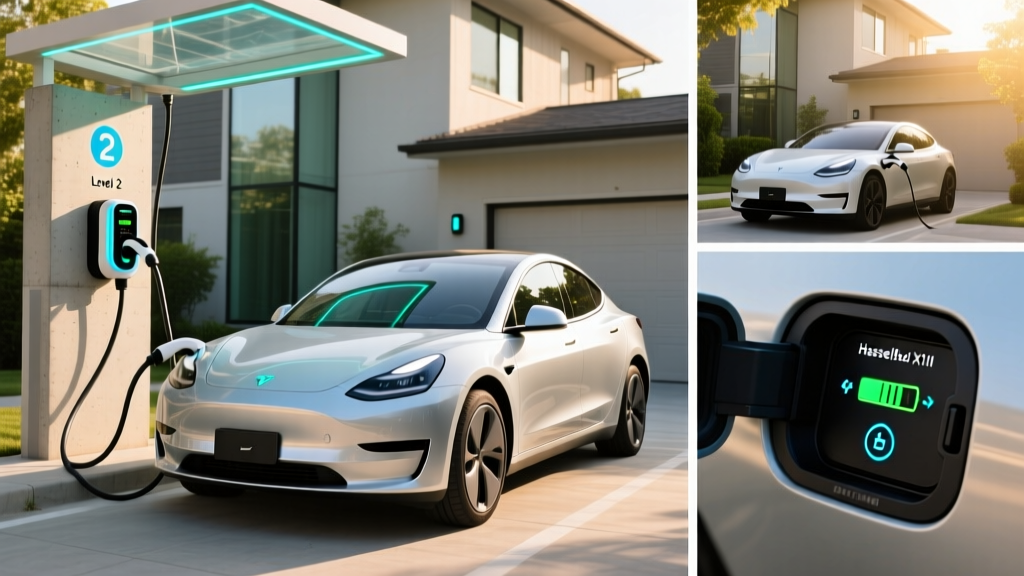
Installing a Level 2 home charger is the single best upgrade most EV owners can make. It means waking up to a full battery every morning, eliminating most public charging stops, and paying the lowest per-kWh rate available. But installation costs vary enormously depending on your home's electrical infrastructure.
A typical Level 2 home charger requires a dedicated 240-volt circuit, similar to what powers an electric dryer or oven. The most common setup is a 60-amp breaker feeding a 48-amp charger (electrical code requires the continuous load to be no more than 80% of the breaker rating). That 48-amp circuit delivers up to 11.5 kW of charging power.
What Electrical Upgrades Might You Need?
Many newer homes with 200-amp electrical panels can accommodate a 60-amp EV circuit without upgrades, especially if the panel has spare breaker slots and sufficient remaining capacity after a licensed electrician performs a load calculation. However, older homes — particularly those with 100-amp service or panels already near capacity — may require a panel upgrade to 200 amps. This is the single biggest cost variable in home charger installation.
Homes with aging Federal Pacific or Zinsco panels should plan for a full panel replacement regardless of EV charging, as these panels are known fire hazards that many insurers now flag.
| Cost Component | Simple Install (panel nearby, no upgrade) | Complex Install (long wire run or panel upgrade) |
|---|---|---|
| Level 2 Charger (Equipment) | $350–$700 | $350–$700 |
| Electrician Labor | $300–$800 | $800–$2,000 |
| Electrical Panel Upgrade (if needed) | $0 | $1,500–$3,000 |
| Permit & Inspection | $50–$200 | $50–$300 |
| Total Estimated Cost | $700–$1,700 | $2,700–$6,000 |
Some utilities offer rebates of $250–$500 for Level 2 charger installation, and the federal IRS §30D adjacent Alternative Fuel Vehicle Refueling Property Credit (§30C) can cover up to 30% of charger and installation costs (capped at $1,000) for installations in eligible census tracts. Check with your tax professional for current-year eligibility.
Which Connector and Charger Is Compatible With My EV?
The connector landscape has shifted dramatically since 2023, when Ford and GM announced adoption of NACS. By 2026, NACS is the dominant light-vehicle charging connector in North America. Here's what you need to know:
| Connector | Used By | Notes |
|---|---|---|
| NACS (Tesla) | Tesla (all years), Ford (2025+), GM (2025+), Rivian (2025+), Volvo/Polestar (2025+), most new 2026 EVs | Became the SAE J3400 standard. Smaller, lighter connector. Access to Tesla Supercharger network. |
| CCS1 | Hyundai/Kia (pre-2026 models), BMW, VW ID.4 (pre-2026), legacy non-Tesla EVs | Still widely available at Electrify America, EVgo. Adapters to NACS available from most automakers. |
| CHAdeMO | Nissan Leaf (all years), Mitsubishi Outlander PHEV | Declining infrastructure. Few new stations being built. Plan for adapter or CCS/NACS vehicle on your next purchase. |
If your EV has a CCS1 port but you want to access the Tesla Supercharger network — which has the highest reliability and coverage in North America — most automakers provide or sell a CCS-to-NACS adapter. Ford, GM, and Rivian owners received adapters with their vehicles or through dealer programs. Verify adapter compatibility with your specific model year before purchasing a third-party unit.
Charging Time Examples: How Long Does It Actually Take?
Charge times depend on your battery size, the charger's power output, and your vehicle's maximum charge acceptance rate. Here are real-world examples using common 2025–2026 EVs:
2025 Tesla Model Y Long Range (75 kWh battery, NACS, 250 kW peak DC):
- Level 1 (1.4 kW, 120V): ~54 hours from 10–100% — impractical except for trickle top-off
- Level 2 (11.5 kW, 48A/240V): ~5.5 hours from 10–100% — ideal overnight charge
- DC Fast (250 kW peak): 10–80% in approximately 20–25 minutes at a V3/V4 Supercharger
2025 Hyundai Ioniq 5 (77.4 kWh battery, 800V architecture, 350 kW peak DC):
- Level 2 (10.9 kW, 48A/240V): ~6 hours from 10–100%
- DC Fast (350 kW peak): 10–80% in approximately 18 minutes on a compatible 350 kW station
2025 Ford F-150 Lightning Extended Range (131 kWh battery, 150 kW peak DC):
- Level 2 (11.5 kW, 48A/240V): ~10+ hours from 10–100% — a large battery needs a long overnight session
- DC Fast (150 kW peak): 10–80% in approximately 41 minutes
Remember that peak charge rates are not sustained. A vehicle that peaks at 250 kW will typically hold that rate only between roughly 10–30% SoC, then taper. Average power over a 10–80% session is often 60–75% of the stated peak. Cold batteries also charge significantly slower until the thermal management system warms them — always use your vehicle's battery preconditioning feature when navigating to a DC fast charger.
How Much Does Charging Cost Per Mile vs. Gas?
One of the strongest arguments for EV ownership is lower fueling cost, but the savings depend heavily on where and when you charge. Electricity rates vary widely by state and utility, and public DC fast charging can approach the per-mile cost of a fuel-efficient gas car.
| Scenario | Rate ($/kWh) | Cost to Add 200 Miles* | Cost Per Mile |
|---|---|---|---|
| Home charging (off-peak utility rate) | $0.08–$0.12 | $4.80–$7.20 | $0.024–$0.036 |
| Home charging (standard residential rate) | $0.14–$0.18 | $8.40–$10.80 | $0.042–$0.054 |
| Public Level 2 (network charging) | $0.25–$0.40 | $15.00–$24.00 | $0.075–$0.120 |
| DC Fast Charge (Electrify America, EVgo) | $0.35–$0.55 | $21.00–$33.00 | $0.105–$0.165 |
| Gas car (28 MPG combined, $3.40/gal) | — | $24.29 | $0.121 |
*Based on an EV averaging 3.0 miles per kWh (EPA combined). Less efficient EVs like trucks will cost more per mile; more efficient sedans will cost less.
The takeaway: home charging at off-peak rates delivers fuel costs roughly 70–80% below a comparable gas vehicle. Exclusive reliance on DC fast charging narrows the gap substantially. If your lifestyle allows consistent overnight home charging, the annual fuel savings for a driver covering 12,000 miles can reach $800–$1,400 compared to a 28 MPG gas car. Data from fueleconomy.gov lets you compare specific models' kWh/100mi ratings against gas vehicles' MPG.
Recommended Home EV Chargers for 2026
Not all Level 2 chargers are equal. Key differentiators include amperage (which determines charge speed), cable length, smart features like scheduling and load management, connector type, and build quality. Here are top picks based on real-world ownership and testing:
ChargePoint Home Flex (NACS or J1772)
- Power Output: Up to 12 kW (50A, configurable down to 16A)
- Connector: Available in NACS or J1772
- Cable Length: 23 feet
- Smart Features: Wi-Fi, app scheduling, Alexa integration, energy tracking
- Price: ~$550–$650
- Best For: Flexibility across circuit sizes; works on 40A or 60A breakers
Tesla Wall Connector (NACS)
- Power Output: Up to 11.5 kW (48A on a 60A circuit)
- Connector: NACS (native Tesla, also charges NACS-equipped Ford/GM/Rivian)
- Cable Length: 24 feet
- Smart Features: Wi-Fi, over-the-air updates, power sharing between two units
- Price: ~$475
- Best For: Tesla owners and NACS-adopters wanting the most affordable high-quality unit
Emporia Vue + EV Charger (J1772 or NACS adapter)
- Power Output: Up to 11.5 kW (48A)
- Connector: J1772 (NACS adapter available separately)
- Cable Length: 24 feet
- Smart Features: Whole-home energy monitoring integration, solar-aware charging, load management
- Price: ~$400–$500 (charger only); ~$700+ with Emporia Vue panel monitor
- Best For: Homes with solar panels or those wanting detailed energy analytics
For any charger, ensure it is UL-listed (or ETL-listed) — this is a non-negotiable safety certification. Hardwired installations are generally preferred over plug-in (NEMA 14-50) units for reliability, as 14-50 receptacles under continuous high-amperage EV loads have been associated with overheating if not installed to exacting standards with commercial-grade outlets.
Safety, Electrical Code, and Installation Best Practices
EV charging places a sustained high-amperage load on your home's electrical system — unlike a dryer that cycles on and off, an EV charger may run at full draw for 6–10 hours straight. This makes proper installation critical.
- Dedicated circuit: Your EV charger must be on its own dedicated breaker. Never share a circuit with other appliances.
- GFCI protection: The 2023 NEC (National Electrical Code) requires GFCI protection for EV charging outlets in garages and all outdoor locations. Hardwired chargers may not require a GFCI breaker in all jurisdictions — confirm with your local inspector.
- Outdoor rating: If your charger is installed outside, ensure the unit carries a NEMA 4 or IP65 weather-resistance rating. All recommended chargers above meet this standard.
- Wire gauge: A 60-amp circuit typically requires 6 AWG copper wire (THHN in conduit) or 4 AWG NM-B (Romex). Your electrician will size wire based on run length and local code.
- Permit and inspection: Most jurisdictions require an electrical permit for a new 240V circuit. The inspection ensures the work meets code and protects your homeowner's insurance coverage. Do not skip this step — unpermitted electrical work can void insurance claims.
If you're considering a NEMA 14-50 receptacle instead of hardwiring, invest in a commercial-grade outlet (Hubbell or Bryant brand, typically $80–$120) rather than a residential-grade unit. The cheap $12 receptacles at hardware stores are not designed for the sustained 40A+ draw that EV charging demands, and failures have been documented in EV owner communities and by NFPA/NEC code officials.
Frequently Asked Questions
How much does it cost to install a home EV charger?
A straightforward Level 2 installation with a nearby electrical panel and no panel upgrade typically costs $700–$1,700 including equipment, labor, and permit. If your home needs a panel upgrade from 100A to 200A service, total costs can reach $2,700–$6,000. Get at least two quotes from licensed electricians, and confirm they include permit and inspection in the estimate.
How fast will each charging level add range?
Level 1 (120V) adds roughly 3–5 miles of range per hour. Level 2 (240V, 48A) adds 25–35 miles per hour for most EVs. DC fast charging can add 150–300+ miles in a 20–30 minute session, depending on the vehicle's peak charge rate and battery size. Exact rates depend on your vehicle's efficiency (miles per kWh).
Which connector/charger is compatible with my EV?
Check your vehicle's charge port. If you drive a 2025+ Ford, GM, Rivian, Volvo, or Polestar EV, or any Tesla, your vehicle uses NACS. Older non-Tesla EVs typically use CCS1. The Nissan Leaf uses CHAdeMO. For home Level 2 charging, most non-NACS vehicles use the J1772 connector. Adapters are widely available to bridge these standards.
How much does charging cost per mile vs. gas?
Home charging at typical residential rates ($0.12–$0.18/kWh) costs roughly $0.03–$0.05 per mile for an average-efficiency EV. A gas vehicle at 28 MPG with $3.40/gallon fuel costs about $0.12 per mile. Home-charged EVs save 60–75% on fuel costs. Exclusive use of public DC fast charging ($0.35–$0.55/kWh) narrows savings to 0–30%.
What electrical upgrades might I need?
If your home has a 200-amp panel with available breaker slots and capacity, you likely need only a new 60-amp breaker and a wire run to the charger location. Homes with 100-amp panels, full breaker boxes, or outdated panel brands (Federal Pacific, Zinsco, certain Challenger models) will likely need a panel upgrade costing $1,500–$3,000. A licensed electrician's load calculation is the definitive answer.
Can I use a regular 120V outlet to charge my EV?
Yes — this is Level 1 charging. It adds only 3–5 miles of range per hour, which is sufficient for PHEVs with small batteries or BEV owners who drive fewer than 30 miles per day and can charge for 10–12 hours overnight. For most BEV owners, Level 1 is a backup option, not a primary strategy. Ensure the outlet is on a dedicated 15A or 20A circuit and avoid extension cords, which can overheat under sustained EV charging loads.