The Real Cost of Fueling an EV: What You'll Actually Pay
If you're transitioning from a gas car to an electric vehicle, one of the first questions is practical and financial: how do you actually pay for EV charging, and what does it cost? The answer depends entirely on where and how you charge. Plug in at home on a utility off-peak rate, and you might spend the equivalent of $1.20 per gallon. Rely exclusively on DC fast chargers on road trips, and your per-mile cost can rival or exceed a fuel-efficient gas car.
This guide breaks down every charging scenario — home Level 1, home Level 2, and public DC fast charging — with exact costs per kWh, cost-per-mile comparisons, installation expenses, and the equipment you need. We'll also clarify the single most important distinction in EV literacy: kW (kilowatts) measures power — how fast energy flows into your car — while kWh (kilowatt-hours) measures energy — the total amount stored in your battery. Think of kW as the width of a hose and kWh as the size of the bucket.
Charging Levels Explained: Speed, Power, and Range Added
Every EV owner interacts with three charging tiers. Understanding the power output (kW) and the practical range each adds per hour is essential for planning both daily routines and road trips.
| Level | Voltage | Power (kW) | Miles of Range per Hour | Best For |
|---|---|---|---|---|
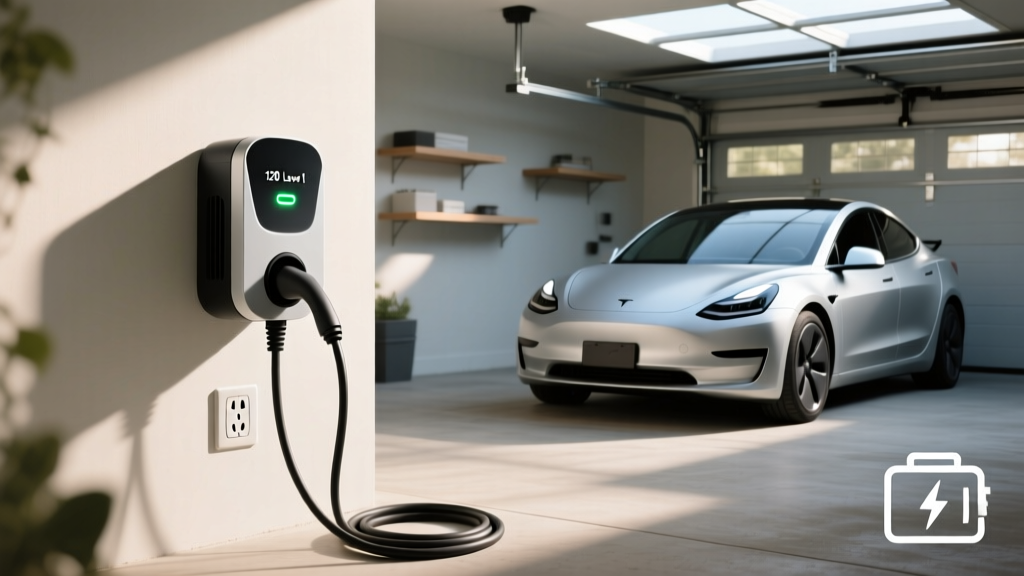
| Level 1 (120V) | 120V AC | 1.0–1.4 kW | 3–5 mi/hr | Overnight top-ups, low-mileage drivers, PHEVs |
| Level 2 (240V) | 240V AC | 3.3–19.2 kW | 12–75 mi/hr | Daily home charging, workplace, shopping centers |
| DC Fast Charging | 400–800V DC | 50–350 kW | 150–1,200+ mi/hr (peak) | Road trips, quick top-ups, commercial fleets |
A few real-world notes: Level 1 charging from a standard household outlet is viable for plug-in hybrids with 25–40 miles of electric range, or for BEV owners who drive under 30 miles daily and can leave the car plugged in for 10+ hours. For most BEV owners, Level 2 at home is the baseline expectation — it refills a typical 75 kWh battery overnight.
DC fast charging speeds vary enormously. A Hyundai Ioniq 5 on an 800V architecture can accept a peak 240 kW, adding roughly 200 miles of range in 18 minutes (10–80% State of Charge). A Chevrolet Equinox EV on a 400V system peaks around 150 kW, with a 10–80% session taking roughly 25–30 minutes. Critically, no EV sustains its peak charge rate for the entire session. Charging curves taper significantly above 80% SoC to protect battery health — which is why manufacturers quote 10–80% times rather than 0–100%.
Home Charger Installation: Costs, Electrical Requirements, and Panel Upgrades
Installing a Level 2 home charger is the single most impactful upgrade an EV owner can make. It's also where costs vary the most, depending on your home's electrical infrastructure.
Electrical Requirements for Level 2 Charging
A typical Level 2 home charger requires a 240-volt dedicated circuit, similar to what powers an electric dryer or oven. The most common residential setup is a 40-amp or 48-amp circuit, which supports chargers rated at 32A or 40A continuous draw (electrical code requires circuits rated at 125% of continuous load). Higher-output chargers like the 48A ChargePoint Home Flex require a 60-amp circuit.
Your home's electrical panel must have sufficient spare capacity. A 200-amp panel — standard in most homes built after the 1990s — usually has headroom for a 40A EV circuit. Older homes with 100-amp panels often require a panel upgrade to 200 amps, which is the single largest variable in installation cost.
| Component | Basic Install (Near Panel) | Standard Install (50–80 ft run) | Complex Install (Panel Upgrade) |
|---|---|---|---|
| Level 2 Charger (Equipment) | $350–$700 | $350–$700 | $350–$700 |
| Electrician Labor | $300–$600 | $600–$1,500 | $1,500–$3,000 |
| Electrical Permit | $50–$150 | $50–$200 | $100–$300 |
| Panel Upgrade (if needed) | — | — | $1,500–$4,000 |
| Conduit, Wiring, Misc. | $50–$150 | $200–$500 | $300–$800 |
| Total Estimated Cost | $750–$1,600 | $1,200–$2,900 | $3,750–$8,800 |
The wide range in the "complex" column reflects regional labor rates and whether your utility requires a service drop upgrade. Always get at least two quotes from licensed electricians, and confirm they have EV charger installation experience — improper wire gauge or missing GFCI protection creates a fire risk.
Permits, Safety, and Code Compliance
Most jurisdictions require an electrical permit for a new 240V circuit. The installation must comply with the National Electrical Code (NEC) Article 625, which governs EV charging equipment. Key requirements include:
- Dedicated circuit: The EV charger must have its own breaker — no sharing with other appliances.
- GFCI protection: Required for outdoor receptacles and increasingly for indoor installations depending on local code.
- Outdoor rating: If your charger is mounted outside, both the unit and the receptacle (if using a plug-in model) must carry a NEMA 3R or NEMA 4 weather-resistance rating.
- Wire gauge: A 40A circuit requires 8 AWG copper wire minimum; a 48A circuit requires 6 AWG. Undersized wire is a fire hazard.
Which Connector Does Your EV Use? Compatibility Guide
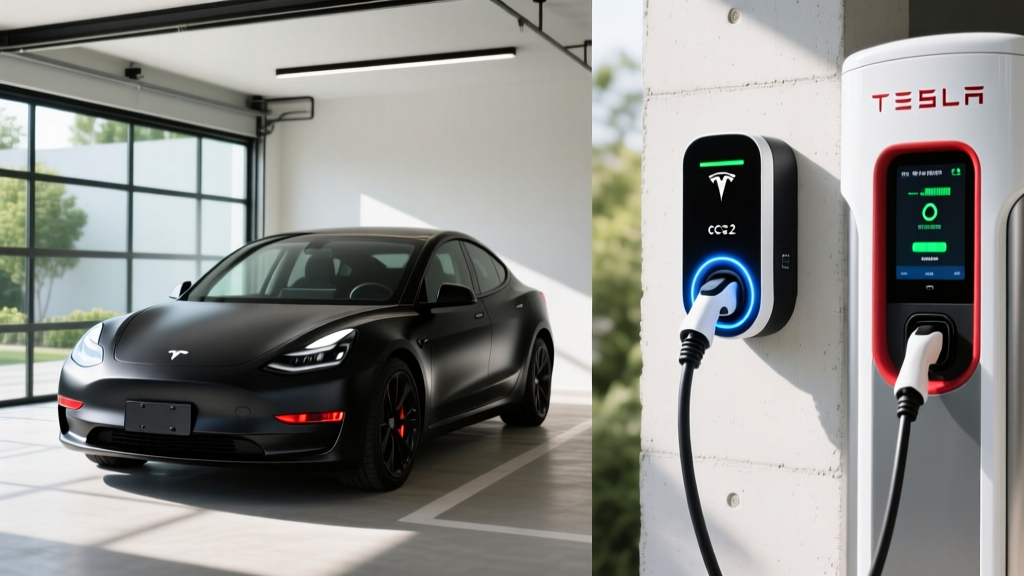
The connector landscape shifted dramatically between 2023 and 2026. Tesla's North American Charging Standard (NACS) has been adopted by nearly every major automaker, and as of 2026, most new EVs sold in the U.S. ship with a NACS charge port.
| Connector | Brands Using It (2026) | Notes |
|---|---|---|
| NACS (Tesla) | Tesla, Ford, GM, Rivian, Volvo, Polestar, Mercedes-Benz, Nissan, Honda, Hyundai/Kia (select), Fisker | Now the dominant standard; access to Tesla Supercharger network |
| CCS1 | Volkswagen, BMW, Stellantis (some), Hyundai/Kia (older models), legacy models | Still widely supported at Electrify America, EVgo stations |
| CHAdeMO | Nissan Leaf (2025 and earlier) | Effectively discontinued for new vehicles; station availability declining |
If you own a CCS-equipped EV (like a 2024 Hyundai Ioniq 5 or VW ID.4) and want to access Tesla Superchargers, you'll need a CCS-to-NACS adapter. Tesla sells an official adapter for approximately $250, and third-party options from Lectron and A2Z are available for $150–$200. Conversely, NACS-equipped vehicles can use CCS stations with a NACS-to-CCS adapter.
For home Level 2 charging, the connector matters less — nearly all home chargers use a J1772 connector, and NACS-equipped vehicles include a J1772 adapter in the trunk. Tesla Wall Connectors use NACS natively.
How Much Does EV Charging Cost Per Mile vs. Gas?
This is the comparison every prospective EV buyer wants. The answer hinges on your electricity rate, which varies enormously by location, time of day, and whether you're charging at home or in public.
| Scenario | Rate / Price | Vehicle Efficiency | Cost Per Mile |
|---|---|---|---|
| Home charging (off-peak utility rate) | $0.09–$0.13/kWh | 3.0 mi/kWh (100 MPGe avg) | $0.03–$0.043 |
| Home charging (standard residential rate) | $0.14–$0.18/kWh | 3.0 mi/kWh | $0.047–$0.06 |
| Public Level 2 (network pricing) | $0.25–$0.49/kWh | 3.0 mi/kWh | $0.083–$0.163 |
| DC fast charging (Electrify America, EVgo, etc.) | $0.35–$0.55/kWh | 3.0 mi/kWh | $0.117–$0.183 |
| Tesla Supercharger (typical) | $0.25–$0.36/kWh | 3.5 mi/kWh (Tesla efficiency) | $0.071–$0.103 |
| Gas car (28 MPG combined) | $3.20/gallon (2026 avg) | 28 MPG | $0.114 |
| Gas car (22 MPG combined, truck/SUV) | $3.20/gallon | 22 MPG | $0.145 |
The takeaway: home charging is dramatically cheaper than gas — typically one-third to one-quarter the cost per mile. Public DC fast charging narrows the gap considerably, and in high-cost markets like California or the Northeast, peak-rate DC fast charging can match or exceed the per-mile cost of a fuel-efficient gas car.
For a concrete example: a Tesla Model Y Long Range with an 81 kWh battery (75 kWh usable) charged at home at $0.12/kWh costs roughly $9.00 for a 10–80% session, yielding about 225 real-world miles — or $0.04 per mile. The same session at a $0.48/kWh Electrify America station costs $36, or $0.16 per mile, which exceeds a 28 MPG gas car at $3.20/gallon.
According to fueleconomy.gov, the average EV in 2026 achieves 97–132 MPGe combined, with the most efficient models (Lucid Air, Tesla Model 3) exceeding 4.0 mi/kWh. Your actual efficiency drops 15–30% in cold weather, at sustained highway speeds above 70 mph, and in hilly terrain — factor this into your cost calculations.
How to Pay: Apps, RFID Cards, Memberships, and Plug-and-Charge
The payment experience at public chargers has improved but remains fragmented compared to filling up with gas. Here's what you need to know about each payment method.
Network Apps and RFID Cards
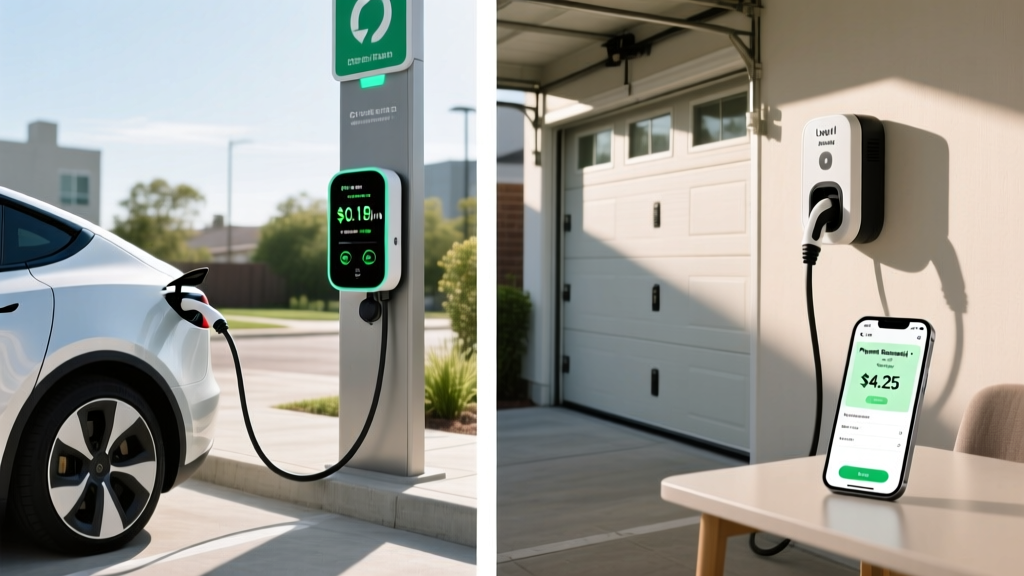
Most public charging networks — Electrify America, EVgo, ChargePoint, Blink — require their proprietary mobile app or an RFID card to initiate a session. You link a credit card in the app, plug in, and tap to start. Session pricing appears before you begin, and you receive a receipt by email.
Membership plans can reduce per-kWh costs. Electrify America's Pass+ plan ($4/month) lowers rates by roughly 15–25%. EVgo's membership offers similar discounts. If you charge publicly more than twice a month, a membership typically pays for itself.
Plug and Charge (ISO 15118)
The best public charging experience is Plug and Charge: you plug in, the charger identifies your vehicle automatically, and billing happens without opening an app. Tesla Superchargers have always worked this way. For non-Tesla networks, Plug and Charge is supported on select vehicles (Ford Mustang Mach-E, GM Ultium-based models, Mercedes EQS, Porsche Taycan) at compatible Electrify America and EVgo stations. Adoption is expanding through 2026 but isn't universal yet.
Home Charging Payment
Home charging is simply added to your monthly utility bill. Many utilities offer time-of-use (TOU) rates or dedicated EV charging rates that provide lower per-kWh pricing during overnight hours (typically 11 PM – 6 AM). If your utility offers a TOU plan, scheduling your charger to operate during off-peak windows can cut your home charging cost by 30–50%. Smart chargers with built-in scheduling (like the Emporia Vue or ChargePoint Home Flex) automate this.
Federal Tax Credit for Home Charging Equipment
Under IRS §30C Alternative Fuel Vehicle Refueling Property Credit, you may claim up to 30% of the cost of home EV charging equipment and installation, capped at $1,000. This credit is subject to eligibility requirements including placement in service in a qualifying census tract (low-income or non-urban areas). Check your eligibility at the IRS link above or consult a tax professional — rules and qualifying tracts are updated annually.
Equipment Recommendations: Best Home Chargers for 2026
The home charger market has matured considerably. Here are proven units we recommend based on reliability, power output, smart features, and value. All units below are hardwired or NEMA 14-50 plug-in compatible and carry UL certification.
ChargePoint Home Flex
- Power: Up to 12 kW (50A) on a 60A circuit; configurable down to 16A
- Connector: J1772 (works with all EVs; NACS vehicles use included adapter)
- Cable length: 23 feet
- Smart features: Wi-Fi, app scheduling, Alexa integration, energy tracking
- Price: ~$549
- Best for: Flexibility — adjustable amperage fits any panel capacity
Tesla Wall Connector
- Power: Up to 11.5 kW (48A) on a 60A circuit
- Connector: NACS native (J1772 adapter not included; non-Tesla EVs need adapter)
- Cable length: 24 feet
- Smart features: Wi-Fi, OTA updates, power sharing between multiple units, access control
- Price: ~$420
- Best for: Tesla and NACS-equipped vehicle owners seeking the cleanest integration
Emporia Level 2 EV Charger
- Power: Up to 11.5 kW (48A) on a 60A circuit
- Connector: J1772
- Cable length: 24 feet
- Smart features: Wi-Fi, solar integration, TOU scheduling, detailed energy monitoring
- Price: ~$399
- Best for: Budget-conscious buyers who want smart features and solar pairing
Grizzl-E Smart
- Power: Up to 10 kW (40A) on a 50A circuit
- Connector: J1772
- Cable length: 24 feet
- Smart features: Wi-Fi, OCPP compatibility, adjustable output
- Price: ~$499
- Best for: Cold-climate durability — rated to -40°F, built in Canada
Charging Time Examples: What to Expect With Common Battery Sizes
Charging time depends on three variables: your battery's usable capacity (kWh), the charger's power output (kW), and your vehicle's onboard charger limit for AC charging. Here are real-world estimates for popular 2026 EV models:
| Vehicle | Usable Battery (kWh) | Level 2 at 11.5 kW | DC Fast (Peak kW) | DC Fast 10–80% Time |
|---|---|---|---|---|
| Tesla Model 3 Long Range | 75 kWh | ~5.5 hours | 250 kW | ~25 min |
| Hyundai Ioniq 5 (Long Range) | 77.4 kWh | ~6 hours (10.9 kW onboard limit) | 240 kW (800V) | ~18 min |
| Ford Mustang Mach-E (Ext. Range) | 91 kWh | ~7 hours | 150 kW | ~34 min |
| Chevrolet Equinox EV (3RS) | 85 kWh | ~6.5 hours | 150 kW | ~30 min |
| BMW iX xDrive50 | 105.2 kWh | ~8 hours | 200 kW | ~34 min |
| Toyota bZ4X | 64 kWh | ~5 hours | 150 kW | ~30 min |
Two important caveats: First, DC fast charging times assume battery preconditioning — the vehicle has warmed the battery to optimal temperature before arrival. Without preconditioning (common when navigating to a charger without the car's built-in routing), actual charge times can increase 20–40% in cool weather. Second, charging slows dramatically above 80% SoC. If you need to charge past 80% on a road trip, budget an additional 20–40 minutes for that final 20%.
Frequently Asked Questions
How much does it cost to install a home EV charger?
A straightforward Level 2 installation near your electrical panel typically costs $750–$1,600 including equipment, electrician labor, and permit. A longer wire run (50–80 feet) pushes the total to $1,200–$2,900. If your home needs a panel upgrade from 100A to 200A, expect $3,750–$8,800 total. The federal §30C credit can offset up to $1,000 of this cost if you're in a qualifying census tract.
How fast will each charging level add range?
Level 1 (120V) adds 3–5 miles per hour. Level 2 (240V) adds 12–75 miles per hour depending on amperage — a 40A circuit adds roughly 30–35 miles per hour for most EVs. DC fast charging adds 150–1,200+ miles per hour at peak rate, though the rate tapers as the battery fills.
Which connector or charger is compatible with my EV?
Check your vehicle's charge port. For 2026 models: Tesla, Ford, GM, Rivian, Volvo, and most new models use NACS. Volkswagen, BMW, and some carry-over models use CCS1. The Nissan Leaf (older models) uses CHAdeMO. For home Level 2 charging, a J1772 charger works with all EVs (NACS vehicles include an adapter). For DC fast charging, match the station's connector to your vehicle's port or carry an adapter.
How much does charging cost per mile compared to gas?
Home charging at average residential rates ($0.14–$0.18/kWh) costs $0.047–$0.06 per mile for an average EV — roughly half the $0.114/mile cost of a 28 MPG gas car at $3.20/gallon. Public DC fast charging at $0.35–$0.55/kWh costs $0.12–$0.18 per mile, which narrows or eliminates the savings versus gas depending on the vehicle.
What electrical upgrades might I need for a home charger?
The most common upgrade is a new 240V dedicated circuit with a 40A–60A breaker, which most 200A panels can accommodate. If you have a 100A panel, an upgrade to 200A ($1,500–$4,000) may be necessary. Other potential costs include conduit runs for long wire distances, a GFCI breaker (required for outdoor installations), and in rare cases, a utility service drop upgrade. A licensed electrician can assess your panel during a site visit — many offer free estimates.