The EV Charger Tax Credit Explained: What §30C Covers
Before we get into the paperwork, let's be precise about what you're actually claiming. The Alternative Fuel Vehicle Refueling Property Credit (Internal Revenue Code §30C) is the federal incentive that reimburses a portion of what you spend on home EV charging equipment and its installation. It is separate from the §30D new-vehicle credit and the used-EV credit — you can claim all three in the same tax year if you qualify for each.
As of the 2026 tax year, here are the headline numbers:
- Credit rate: 30% of qualified equipment + installation costs
- Maximum credit: $1,000 per tax year for residential property
- Eligible property: Level 2 (240V) home charging equipment, wiring, conduit, panel upgrades directly tied to the charger circuit, and labor
- Nonrefundable: The credit can reduce your federal tax liability to zero but won't generate a refund beyond that
A common misconception: this is not a "rebate" mailed to you after purchase. It's a dollar-for-dollar reduction in your federal income tax owed, claimed on IRS Form 8911 when you file. If your total tax liability for the year is less than $1,000, you'll only benefit up to the amount you owe.
§30C Eligibility Checklist (2026)
- Charger installed at your primary or secondary US residence
- Equipment is new (not used or previously claimed)
- Installation performed in the current tax year
- Charger meets NEC and local electrical code
- You have sufficient federal tax liability to absorb the credit
- Property located in an eligible census tract (per IRA §30C geographic rules — verify at irs.gov)
How Fast Will Each Charging Level Add Range?
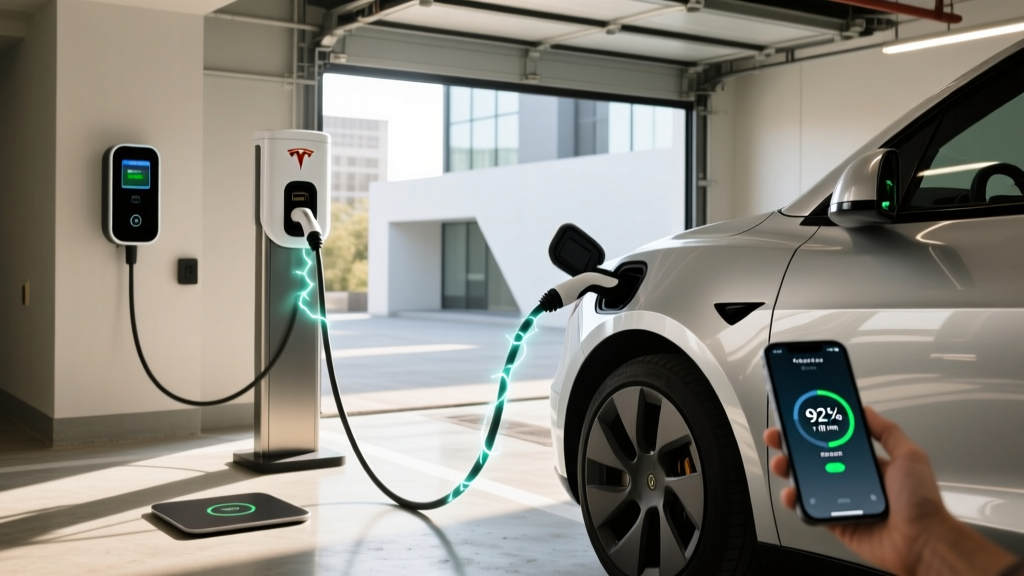
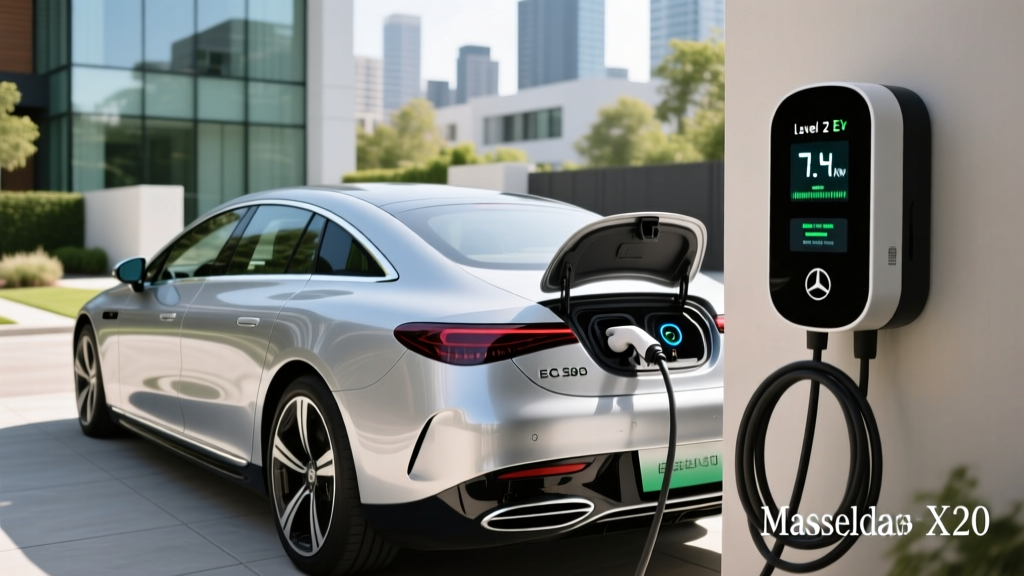
EV charging is measured in kW (kilowatts — the rate of power delivery) and kWh (kilowatt-hours — the total energy stored in your battery). Think of kW as the width of a hose and kWh as the size of the bucket. A wider hose fills the bucket faster.
Here's what each charging tier delivers in practice:
| Level | Voltage | Max Power (kW) | Miles of Range Added/Hour | Best For |
|---|---|---|---|---|
| Level 1 | 120V AC | 1.2–1.9 kW | 3–5 mi/hr | Overnight top-ups, PHEVs, low-mileage drivers |
| Level 2 (Home) | 240V AC | 7.2–11.5 kW | 20–44 mi/hr | Daily charging, most EV owners |
| Level 2 (Public) | 208–240V AC | 6.6–19.2 kW | 22–70 mi/hr | Workplace, shopping, apartment buildings |
| DC Fast | 400–800V DC | 50–350 kW | 150–1,000+ mi/hr (burst) | Road trips, highway corridors |
Real-world context: A 77 kWh battery (like the Ford Mustang Mach-E Extended Range) going from 10% to 80% on a 48-amp Level 2 home charger (11.5 kW) takes roughly 5 hours. That same 10–80% fill on a 150 kW DC fast charger takes about 30–35 minutes — but only while the battery is below ~60% SoC. Above 80%, the charge curve tapers sharply to protect battery chemistry, dropping to 30–50 kW. This is why manufacturers quote 10–80% times rather than 0–100%.
Home Charger Installation: Costs, Electrical Requirements, and Panel Upgrades
The tax credit is only valuable if you understand what it's actually covering. A Level 2 home charger requires a dedicated 240-volt circuit — the same type of outlet your electric dryer or oven uses. Here's what the electrical work entails.
Electrical Requirements
- Voltage: 240V (split-phase, standard US residential)
- Amperage: 40A circuit for a 32A charger, or 60A circuit for a 48A charger (NEC requires circuits rated at 125% of continuous load)
- Wire gauge: 6 AWG copper for 40A; 4 AWG for 60A (may vary by run length and local code)
- Dedicated circuit: The charger cannot share a breaker with other appliances
- GFCI protection: Required for outdoor installations per NEC 2023/2026; many jurisdictions now require it indoors as well
Do You Need a Panel Upgrade?
This is the single biggest cost variable. Most modern homes have 200-amp electrical service panels. If your panel has available breaker slots and sufficient remaining capacity (an electrician will run a load calculation per NEC Article 220), you can add a 40A or 60A breaker for $300–$600 in labor.
If your home has a 100-amp panel (common in pre-1980 construction) or your existing loads are near capacity, you'll need a service upgrade to 200A. This typically costs $1,500–$3,500 and may require utility coordination. The good news: panel-upgrade costs directly tied to the EV charger circuit do qualify under §30C, so 30% of that expense can count toward your $1,000 cap.
| Component | Typical Cost Range | Notes |
|---|---|---|
| Level 2 Charger (hardware) | $350–$750 | 40A–48A smart chargers; Wi-Fi enabled |
| Electrician labor (standard install) | $500–$1,500 | Assumes panel within 30 ft of garage; longer runs cost more |
| Permit & inspection | $50–$250 | Varies by municipality; some waive for EV chargers |
| Panel upgrade (if needed) | $1,500–$3,500 | 100A to 200A service upgrade |
| Total (no panel upgrade) | $900–$2,500 | 30% credit = up to $750 back |
| Total (with panel upgrade) | $2,400–$6,000 | 30% credit = max $1,000 back |
How to Actually Claim the Credit
- Keep every receipt: Charger purchase, electrician invoice (itemized by labor and materials), permit fees, and any panel-upgrade work tied to the charger circuit.
- File IRS Form 8911 (Alternative Fuel Vehicle Refueling Property Credit) with your federal return for the tax year in which installation was completed.
- Confirm census-tract eligibility: Under the Inflation Reduction Act, §30C residential credits are subject to geographic eligibility. Check the IRS-designated tract map at irs.gov or ask your tax professional.
- Coordinate with a tax professional: The credit is nonrefundable and interacts with other energy credits (§25C, §25D). A CPA can optimize your filing.
Connector Compatibility: NACS, CCS1, and CHAdeMO
The North American charging landscape has largely standardized around NACS (North American Charging Standard, originally Tesla's proprietary connector) as of the 2025–2026 model years. Nearly every major automaker — Ford, GM, Rivian, Hyundai, Kia, BMW, and others — has adopted NACS for new vehicles. CCS1 (Combined Charging System) is being phased out on new models but remains common on 2023 and older EVs. CHAdeMO is effectively legacy, found primarily on the Nissan Leaf.
| Connector | Brands Using It (2025–2026) | Home Charger Availability | Adapter Needed? |
|---|---|---|---|
| NACS (J3400) | Tesla, Ford, GM, Rivian, Hyundai, Kia, BMW, Volvo, Polestar, Mercedes, Toyota (bZ series 2026+) | Widely available (Tesla Wall Connector, ChargePoint, Emporia, Grizzl-E) | No for NACS vehicles; CCS-to-NACS adapters available for older chargers |
| CCS1 | VW ID.4 (2024 and older), Audi e-tron (2024 and older), legacy models | Still available; declining selection | NACS-to-CCS adapter (e.g., Lectron, A2Z) for use at Tesla Superchargers |
| CHAdeMO | Nissan Leaf (all years), Mitsubishi Outlander PHEV (older) | Limited; mostly legacy hardware | No adapter exists to NACS; CHAdeMO DC stations are declining |
Practical advice for home: If you're buying a new EV in 2026, it almost certainly uses NACS. Buy a NACS home charger. If you own a 2023–2024 CCS vehicle, you have two options: buy a CCS home charger (still available from ChargePoint, JuiceBox) or buy a NACS charger with a CCS adapter for occasional public use. For DC fast charging on the road, CCS vehicles can access Tesla Superchargers using a NACS-to-CCS adapter (~$150–$200).
Equipment Picks: 2026 Home Chargers Worth Buying
These are the chargers I recommend based on reliability, smart features, connector options, and value. All are hardwired or plug-in (NEMA 14-50) and Wi-Fi enabled for scheduling and utility demand-response programs.
Tesla Wall Connector (Gen 4, NACS)
- Power output: Up to 11.5 kW (48A on a 60A circuit)
- Connector: NACS native
- Cable length: 24 ft
- Smart features: Wi-Fi, OTA updates, Power Sharing (link multiple units), access control, integrates with Tesla app
- Price: ~$475
- Best for: Tesla owners and any NACS vehicle; best value-to-power ratio
ChargePoint Home Flex (NACS or CCS)
- Power output: Up to 12 kW (50A on a 60A circuit); adjustable down to 16A for lower-capacity panels
- Connector: Available in NACS or CCS1 configurations
- Cable length: 23 ft
- Smart features: Wi-Fi, Alexa integration, scheduling, utility demand-response, detailed energy reporting in app
- Price: ~$550–$650
- Best for: Non-Tesla EV owners wanting CCS or NACS flexibility; excellent app
Emporia Vue Level 2 Charger (NACS)
- Power output: Up to 11.5 kW (48A)
- Connector: NACS
- Cable length: 24 ft
- Smart features: Wi-Fi, integrates with Emporia whole-home energy monitor, solar-aware charging, TOU scheduling
- Price: ~$399
- Best for: Solar-panel owners and budget-conscious buyers; best price per kW
Grizzl-E Smart (NACS or J1772)
- Power output: Up to 10 kW (40A on a 50A circuit)
- Connector: NACS or J1772
- Cable length: 24 ft
- Smart features: Wi-Fi, OCPP-compatible, adjustable amperage, extreme-cold rated (-40°F)
- Price: ~$449
- Best for: Cold-climate owners; rugged outdoor installation; Canadian-built
Charging Cost Per Mile: EV vs. Gas in 2026
The economics of EV charging depend entirely on where and when you charge. Home charging on a time-of-use (TOU) plan is dramatically cheaper than public DC fast charging. Here's the breakdown using a mid-size EV averaging 3.0 miles per kWh (roughly 112 MPGe — typical for a Hyundai Ioniq 5 or Tesla Model Y).
| Charging Scenario | Cost per kWh | Cost per Mile | Equivalent Gas Price (at 28 MPG) |
|---|---|---|---|
| Home, off-peak TOU rate | $0.08–$0.12 | $0.03–$0.04 | $0.84–$1.12/gal |
| Home, standard flat rate | $0.14–$0.18 | $0.05–$0.06 | $1.40–$1.68/gal |
| Public Level 2 (workplace, mall) | $0.20–$0.35 | $0.07–$0.12 | $1.96–$3.36/gal |
| DC Fast (Electrify America, EVgo) | $0.35–$0.55 | $0.12–$0.18 | $3.36–$5.04/gal |
| Tesla Supercharger (avg 2026) | $0.28–$0.40 | $0.09–$0.13 | $2.52–$3.64/gal |
The bottom line: If you charge at home on off-peak rates (the most common scenario for EV owners with a Level 2 setup), your fuel cost is roughly $0.03–$0.04 per mile. A comparable gas car getting 28 MPG at $3.50/gal costs $0.125/mile — three to four times more. Over 15,000 miles/year, that's $450–$600 for home EV charging versus $1,875 for gas.
However, if you rely entirely on DC fast charging (apartment dwellers, frequent road-trippers), the cost advantage narrows significantly. At $0.48/kWh, you're paying the equivalent of ~$4.50/gallon gas. This is why home charging access is the single most important factor in whether an EV saves you money.
Safety, Code, and Installation Best Practices
A Level 2 charger draws continuous high current for hours. This is not a DIY project unless you are a licensed electrician. Here's what proper installation looks like:
- Dedicated circuit: Your charger must have its own breaker — no sharing with outlets, lights, or appliances.
- Hardwired vs. plug-in: Hardwired installations (directly connected to a junction box) are preferred for 48A+ chargers. NEMA 14-50 outlets are acceptable for 40A chargers but must be installed with a torque screwdriver to spec — loose 14-50 receptacles have caused fires.
- GFCI breaker: Required for outdoor installations in most jurisdictions. Some chargers have built-in GFCI, which may satisfy code — confirm with your inspector.
- Outdoor rating: If your charger is mounted outside or in an unenclosed carport, it must be rated NEMA 4 (weatherproof). All chargers listed above carry NEMA 4 ratings.
- Permit and inspection: Most US municipalities require an electrical permit for a new 240V circuit. The inspection ensures wire gauge, breaker sizing, and grounding meet NEC standards. Do not skip this — unpermitted work can void homeowner's insurance and creates a fire risk.
Frequently Asked Questions
How much does it cost to install a home EV charger?
A standard Level 2 installation (48A charger, 60A circuit, panel within 30 feet, no panel upgrade) typically runs $900–$2,500 including hardware, electrician labor, and permit. If your home needs a 200A panel upgrade, add $1,500–$3,500. The §30C tax credit returns 30% of these costs, up to $1,000.
How fast will each charging level add range?
Level 1 (120V) adds 3–5 miles per hour. Level 2 (240V, 48A) adds 30–44 miles per hour depending on the vehicle's onboard charger. DC fast charging adds 150–1,000+ miles per hour in short bursts but tapers significantly above 60–80% SoC. For daily driving, Level 2 at home is sufficient for nearly all use cases.
Which connector/charger is compatible with my EV?
For 2025–2026 model-year EVs, NACS is the dominant standard (Tesla, Ford, GM, Hyundai, Kia, Rivian, BMW, Volvo, and others). Older EVs (2023 and prior) may use CCS1 or CHAdeMO. Check your vehicle's charge port — if it's a compact single-port design, it's NACS. If it has a wider port with two additional DC pins below, it's CCS1. CHAdeMO is round with two large pins and is found almost exclusively on the Nissan Leaf.
How much does charging cost per mile vs. gas?
Home charging on off-peak rates costs roughly $0.03–$0.04 per mile — equivalent to $0.84–$1.12 per gallon of gas. Public DC fast charging costs $0.12–$0.18 per mile, comparable to $3.36–$5.04 per gallon. Most EV owners who charge at home save $1,000–$1,400 per year versus a 28 MPG gas car at $3.50/gallon over 15,000 miles.
What electrical upgrades might I need?
If your home has a 200A panel with available breaker slots and capacity, you likely need only a new 60A breaker and a wire run to the garage ($500–$1,500 in labor). If your panel is 100A (common in older homes), fully loaded, or lacks physical breaker space, a service upgrade to 200A will be required ($1,500–$3,500). A licensed electrician will perform a NEC Article 220 load calculation to determine this. Both the charger installation and the panel upgrade qualify toward the §30C credit.
Is the §30C charger credit refundable?
No. The §30C credit is nonrefundable, meaning it can reduce your federal tax liability to zero but will not result in a refund check for the difference. If your total tax owed for the year is $600, the maximum benefit you'll receive is $600 — even if 30% of your installation costs exceeds $1,000. Unused credit cannot be carried forward to future tax years.
Can I claim the charger credit if I rent my home?
Generally, no. The §30C residential credit is available to the property owner who installs qualifying equipment at their primary or secondary residence. Renters should check whether their landlord is willing to install a charger (the landlord could claim the credit). Some states and utilities offer separate renter-friendly incentives — check afdc.energy.gov for local programs.