Searches for "how reliable are dodge chargers" often stem from one of two intents: owners of the Dodge Charger Daytona EV wondering about its charging hardware, or shoppers conflating the muscle-car nameplate with the broader EV charging ecosystem. Either way, the question gets at the core anxiety of electrification — will the charger actually work when I need it?
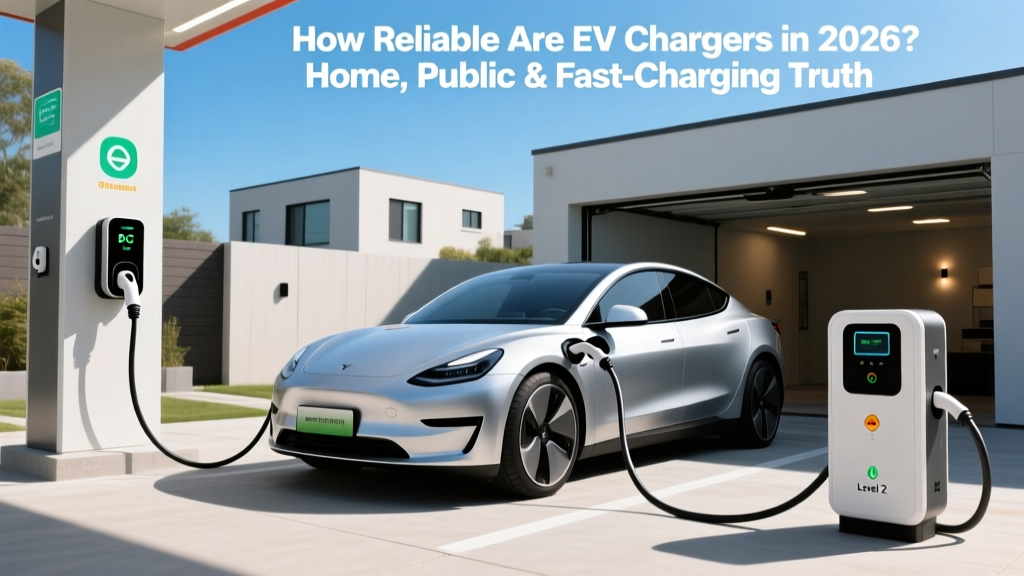
The short answer in 2026: home Level 2 charging is extremely reliable (95%+ uptime when properly installed), while public DC fast charging has improved dramatically but still trails at roughly 80-85% session success rates depending on the network. This guide breaks down the reliability data, charging speeds, installation costs, and connector compatibility you need to make an informed decision.
Charging Levels Explained: Speeds, Reliability, and Range Added Per Hour
Before comparing reliability, you need to understand what each charging level delivers. A critical distinction: kW (kilowatts) measures power — how fast energy flows into the battery. kWh (kilowatt-hours) measures energy — the battery's total capacity. Think of kW as the width of a hose and kWh as the size of the bucket.
| Level | Voltage | Power (kW) | Miles Added/Hour | Typical Use | Reliability |
|---|---|---|---|---|---|
| Level 1 | 120V AC | 1.0–1.4 kW | 3–5 mi/hr | Overnight, PHEVs | ~99% (simple hardware) |
| Level 2 | 240V AC | 3.3–19.2 kW | 12–75 mi/hr | Home daily charging | ~95–98% |
| DC Fast | 400–800V DC | 50–350 kW | 150–1,200 mi/hr | Road trips, quick stops | ~80–85% (varies by network) |
For a typical 75 kWh battery (like the one in the Dodge Charger Daytona R/T, rated at EPA estimates of roughly 274 miles of range), a Level 2 home charger at 11.5 kW adds approximately 35-40 miles of range per hour. A full 10-80% charge takes roughly 5.5 hours — perfectly suited to overnight charging.
How Much Does It Cost to Install a Home EV Charger?
Home Level 2 charging is where reliability meets economics. A properly installed 240V Level 2 charger is the single most impactful upgrade an EV owner can make — it's faster, cheaper per mile, and far more reliable than public charging.
Installation costs vary enormously based on your home's electrical panel capacity and the distance between the panel and your desired charger location. Here's a realistic breakdown:
| Component | Simple Install | Complex Install |
|---|---|---|
| Level 2 charger (hardware) | $350–$700 | $500–$750 |
| Electrician labor (240V/40-50A circuit) | $400–$800 | $1,200–$2,500 |
| Electrical permit | $50–$150 | $50–$200 |
| Panel upgrade (100A → 200A) if needed | $0 | $1,500–$3,500 |
| Conduit/wiring (long runs >50 ft) | $0–$200 | $400–$1,200 |
| Total | $800–$1,850 | $3,350–$8,150 |
When Will You Need a Panel Upgrade?
Homes built before 1990 often have 100-amp electrical panels. Adding a 40-amp dedicated EV circuit to an already-loaded 100A panel may exceed capacity, especially if you run electric heat, an electric dryer, and an electric oven. A licensed electrician will perform a load calculation to determine if an upgrade to 200A service is required.
Panel upgrades add $1,500-$3,500 to your project but are non-negotiable for safety and code compliance. Skipping this step risks tripped breakers, overheated wiring, or insurance claim denials.
Which Connector Is Compatible With Your EV?
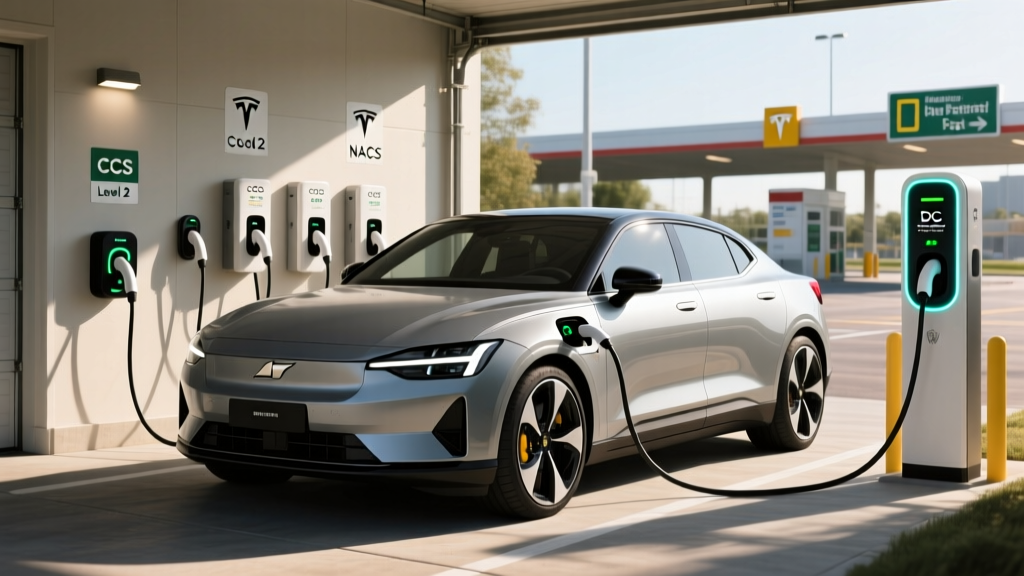
The connector landscape has consolidated significantly by 2026. The North American Charging Standard (NACS), originally developed by Tesla, is now the dominant connector for new vehicles. Most legacy CCS1 vehicles can access Tesla Superchargers via adapter.
| Connector | Brands Using It (2026) | Home Charging | Public DC Fast | Adapter Needed? |
|---|---|---|---|---|
| NACS (Tesla) | Tesla, Ford, GM, Rivian, Volvo, Polestar, Dodge Charger Daytona, Hyundai, Kia | NACS wall connector | Tesla Supercharger, most new networks | No (native on most 2025+ EVs) |
| CCS1 | Older VW ID.4, BMW iX (pre-2025), some legacy models | J1772 (Level 2) | Electrify America, EVgo | CCS-to-NACS adapter for Superchargers (~$200) |
| CHAdeMO | Nissan Leaf (discontinued 2025), Mitsubishi Outlander PHEV | J1772 (Level 2) | Limited, declining | No readily available adapter |
If you're buying a 2026 Dodge Charger Daytona EV, it ships with a NACS port natively — no adapter required for Tesla Superchargers or the growing number of NACS-equipped public stations.
How Much Does EV Charging Cost Per Mile vs. Gas?
Charging economics depend heavily on where and when you charge. Home charging on off-peak electricity rates is dramatically cheaper than gasoline. Public DC fast charging narrows the gap considerably.
| Scenario | Rate | Cost per kWh | Cost per Mile* | Annual (12,000 mi) |
|---|---|---|---|---|
| Home Level 2 (off-peak) | Utility TOU rate | $0.08–$0.14 | $0.025–$0.045 | $300–$540 |
| Home Level 2 (standard rate) | Average US residential | $0.16–$0.20 | $0.05–$0.065 | $600–$780 |
| Public Level 2 (workplace/mall) | Varies | $0.20–$0.35 | $0.065–$0.115 | $780–$1,380 |
| DC Fast Charging (public) | Network pricing | $0.35–$0.55 | $0.115–$0.18 | $1,380–$2,160 |
| Gasoline (25 MPG avg) | $3.40/gal (2026 avg) | — | $0.136 | $1,632 |
*Based on an EV efficiency of 3.0-3.2 miles per kWh (typical for midsize sedans like the Charger Daytona). Source: fueleconomy.gov
The takeaway: home-charged EVs cost 60-80% less per mile than a comparable gas vehicle. Even exclusive DC fast charging is roughly cost-competitive with gas — but nobody should rely solely on DC fast charging due to cost, battery health, and reliability concerns.
DC Fast Charging Times: What 10-80% Really Looks Like
DC fast charging is essential for road trips, but understanding the charge curve is critical. Peak kW ratings are only sustained for a portion of the session. As the battery approaches 80% state of charge (SoC), the charge rate tapers significantly to protect battery chemistry.
| Vehicle Example | Battery (kWh) | Peak DC kW | 10-80% Time | Notes |
|---|---|---|---|---|
| Dodge Charger Daytona R/T | ~92 kWh usable | ~175 kW | ~28-32 min | 400V architecture; taper above 70% |
| Hyundai Ioniq 6 (800V) | 77.4 kWh | 240 kW | ~18 min | 800V sustains peak longer |
| Tesla Model 3 LR | 79 kWh | 250 kW | ~22 min | V3 Supercharger curve |
| Chevrolet Equinox EV | 85 kWh | 150 kW | ~35 min | More gradual taper |
A common mistake: assuming a 175 kW peak means 175 kW sustained. In reality, the Dodge Charger Daytona may hold 175 kW from roughly 10-45% SoC, then step down to 120 kW, then 80 kW, then 40 kW above 80%. The average charge rate across the session is what matters — typically 60-70% of the peak rating.
Preconditioning Matters
Most modern EVs precondition the battery when you navigate to a DC fast charger — warming or cooling it to the optimal temperature for fast charging. If you arrive at a charger without preconditioning (especially in cold weather), expect 10-80% times to increase by 30-50%. Always use your EV's built-in navigation to route to chargers when possible.
Home Charger Equipment Recommendations (2026)
Not all Level 2 chargers are created equal. Here are three proven options across different price points, all hardwired for maximum reliability (plug-in NEMA 14-50 outlets introduce a failure point).
Budget Pick: Emporia Level 2 EV Charger
- Power output: 11.5 kW (48A on 60A circuit)
- Connector: J1772 (NACS adapter included)
- Cable length: 24 ft
- Smart features: Wi-Fi scheduling, energy monitoring, utility TOU integration
- Price: ~$399
- Best for: Budget-conscious owners who want app control
Best Overall: Tesla Universal Wall Connector
- Power output: 11.5 kW (48A on 60A circuit)
- Connector: NACS with integrated J1772 adapter
- Cable length: 24 ft
- Smart features: Wi-Fi, OTA updates, load sharing with 2nd unit, power sharing
- Price: ~$599
- Best for: NACS-native vehicles, multi-EV households
Premium Pick: ChargePoint Home Flex (Gen 2)
- Power output: Up to 19.2 kW (80A on 100A circuit) — configurable
- Connector: NACS or J1772 (select at purchase)
- Cable length: 23 ft
- Smart features: Alexa integration, detailed energy reports, flexible amperage
- Price: ~$699
- Best for: Homes with 100A+ spare capacity wanting maximum charge speed
Safety, Code Compliance, and Reliability Best Practices
A reliable home charger starts with a code-compliant installation. Here's what your licensed electrician must address:
- Dedicated circuit: Your Level 2 charger requires its own dedicated breaker — never shared with other appliances. A 48A charger needs a 60A breaker (NEC requires circuits rated at 125% of continuous load).
- GFCI protection: The 2023 NEC update (still enforced in 2026) requires GFCI protection for all EV charging outlets. Hardwired chargers bypass this requirement and are generally more reliable.
- Outdoor rating: If your charger is installed outside (garage exterior, carport, driveway), it must carry a NEMA 4 or IP65 weather rating. All three chargers above meet this standard.
- Permit and inspection: Most jurisdictions require an electrical permit for EV charger installation ($50-$200). The inspection ensures code compliance and protects your home insurance coverage.
- Wire gauge: A 60A circuit requires 6 AWG copper wire (or 4 AWG aluminum). Longer runs may require thicker gauge to prevent voltage drop.
Frequently Asked Questions
How reliable are public DC fast chargers in 2026?
Public DC fast charging has improved significantly. Tesla Superchargers consistently report 95%+ uptime. Non-Tesla networks like Electrify America and EVgo have improved to roughly 80-88% session success rates, up from 70-75% in 2023. The most common failures are payment-system errors, connector damage, and software glitches — not power delivery issues. The shift to NACS connectors and Plug & Charge (automatic payment authentication) has reduced friction considerably.
Is it safe to leave my EV plugged in overnight every night?
Yes. Modern EVs and Level 2 chargers communicate continuously. The vehicle's battery management system (BMS) stops drawing current once the target SoC is reached. Most manufacturers recommend setting a daily charge limit of 80% for NMC batteries to maximize longevity (or 100% for LFP chemistry, which tolerates full charges better). Leaving the car plugged in actually helps with battery thermal management in extreme temperatures.
Will fast charging degrade my EV battery faster?
Frequent DC fast charging does accelerate degradation slightly, but the effect is smaller than most owners fear. Studies from NREL and real-world fleet data show that vehicles fast-charged exclusively lose roughly 2-4% more capacity over 100,000 miles compared to Level 2-only charging. For most owners who charge at home 80% of the time and use DC fast charging for road trips, the impact is negligible within a typical ownership period.
Can I install a Level 2 charger myself?
Technically, a homeowner can perform their own electrical work in some jurisdictions. However, we strongly recommend using a licensed electrician for EV charger installations. The 240V/40-60A circuits involved carry significant fire risk if improperly installed, and most home insurance policies require permitted, inspected work for coverage. A botched DIY install could void your homeowner's insurance in the event of an electrical fire.
What federal tax credits or incentives apply to home charger installation?
The IRS §30D tax credit applies to the vehicle, not the charger. However, the Alternative Fuel Infrastructure Tax Credit (§134) was reinstated and covers 30% of home charging equipment and installation costs, up to $1,000, for qualifying census tracts. Check irs.gov for current eligibility rules, as income limits and geographic requirements apply. Many utilities also offer rebates of $200-$500 for Level 2 charger installations — check with your local provider.