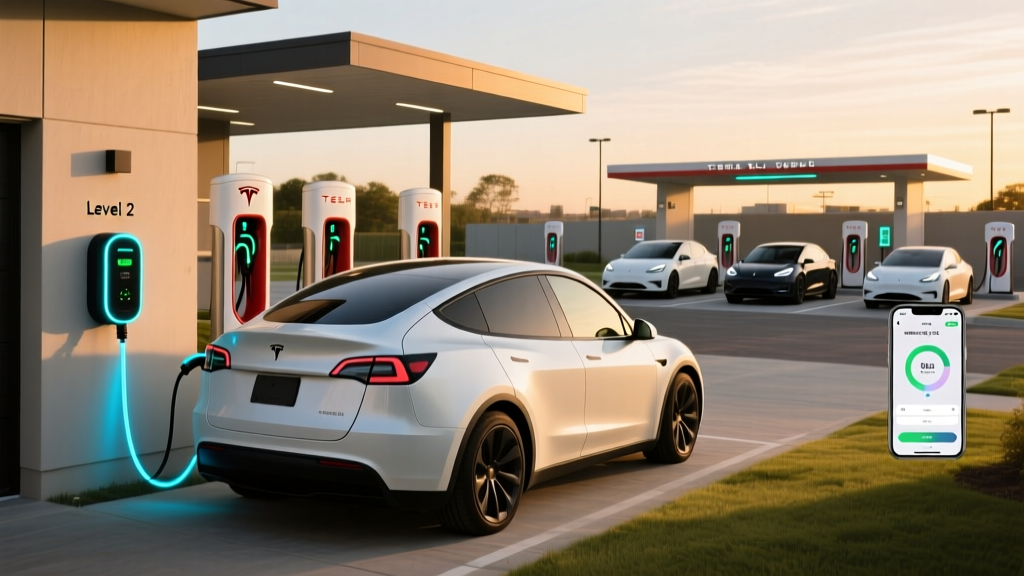
If you own a Tesla — or are about to buy one — the single most practical question after range is cost. How much is charging a Tesla, really, when you factor in home electricity rates, Supercharger pricing, destination charging, and the upfront cost of installing a Level 2 wall connector? The answer depends heavily on where and how you charge, and the spread is enormous: from under $0.04 per mile at home on off-peak utility rates to over $0.15 per mile at peak-rate DC fast chargers.
This guide breaks down every charging scenario a Tesla owner faces in 2026 — home Level 1 and Level 2, Tesla Superchargers, third-party DC fast networks, and destination/Level 2 public charging — with exact $/kWh figures, cost-per-mile math, and a comparison to gasoline. We'll also cover what it costs to install a home charger, what electrical upgrades you might need, and which equipment we recommend.
Charging Levels Explained: Speeds, Power, and Range Added Per Hour
Before calculating cost, you need to understand the three charging levels available to Tesla owners. The critical distinction: kW (kilowatts) measures power — how fast energy flows into the battery. kWh (kilowatt-hours) measures energy — how much the battery holds. A Tesla Model Y Long Range has roughly 75 kWh of usable battery capacity. Charging at 11.5 kW (Level 2) means you're adding 11.5 kWh of energy per hour.
| Level | Voltage | Max Power (kW) | Miles of Range Added Per Hour | Typical Use Case |
|---|---|---|---|---|
| Level 1 (120V) | 120V AC | 1.4–1.9 kW | 3–5 mi/hr | Overnight trickle, emergency top-up |
| Level 2 (240V) | 240V AC | 7.2–11.5 kW | 25–44 mi/hr | Home daily charging, workplace, destinations |
| DC Fast Charging | 400V+ DC | 150–250 kW (Supercharger V3/V4) | ~200 mi in 15 min (peak) | Road trips, rapid top-ups |
A few real-world notes: Level 1 charging via a standard 120V household outlet is functional but painfully slow — adding perhaps 40 miles overnight on a 10-hour session. It's adequate only for plug-in hybrids or EVs with very low daily mileage needs. For any Tesla with a 60–75 kWh battery, Level 1 means a full charge takes 40–50+ hours. Level 2 at 240V is the practical daily standard. DC fast charging peaks at high kW but tapers significantly above 80% State of Charge (SoC) to protect battery health — the advertised "200 miles in 15 minutes" applies to the 10–50% SoC window, not the full curve.
How Much Does Charging a Tesla Cost? By Scenario
Electricity pricing varies dramatically by location, utility, time of day, and charging network. Here's what Tesla owners actually pay across the most common scenarios in 2026, based on national averages and network-specific pricing.
Home Charging (Level 2, 240V)
The national average residential electricity rate is approximately $0.17/kWh as of early 2026 (U.S. EIA data). However, many utilities offer time-of-use (TOU) plans with off-peak rates between $0.08–$0.12/kWh for overnight charging (typically 10 PM – 6 AM).
- Off-peak home rate ($0.10/kWh): Fully charging a Model Y Long Range (~75 kWh usable) costs about $7.50 for ~310 EPA miles of range.
- Average home rate ($0.17/kWh): That same full charge costs about $12.75.
- Peak home rate ($0.28/kWh, some California utilities): A full charge can hit $21.00 — which is why TOU plans matter.
Tesla Supercharger Network (DC Fast)
Supercharger pricing is location-dependent and increasingly variable by time of day. In 2026, typical rates range from $0.25–$0.48/kWh, with urban and high-demand corridor chargers at the top end. Tesla has also expanded member pricing for non-Tesla EVs on the network, but Tesla owners generally pay the posted rate without a subscription surcharge.
- Low-cost Supercharger ($0.25/kWh): 10–80% charge on a Model Y (~52 kWh added) costs about $13.00.
- High-cost Supercharger ($0.45/kWh): The same session costs about $23.40.
Third-Party DC Fast Networks (Electrify America, EVgo, etc.)
With Tesla opening the Supercharger network to non-Tesla EVs via the NACS standard, and Tesla vehicles gaining access to some third-party networks with adapters, you may occasionally use Electrify America or EVgo. Rates typically run $0.30–$0.55/kWh, with idle fees if you remain plugged in after charging completes.
Cost Per Mile: Tesla Charging vs. Gasoline
The most useful comparison for buyers isn't $/kWh — it's cost per mile driven. Here's how a Tesla Model Y Long Range (2026, EPA 310 miles, ~28 kWh/100 mi efficiency) stacks up against a comparable gas crossover averaging 28 MPG combined on $3.40/gallon fuel.
| Charging/Fuel Scenario | Cost Per Mile | Annual Cost (12,000 mi) |
|---|---|---|
| Home off-peak ($0.10/kWh) | $0.028 | $336 |
| Home average ($0.17/kWh) | $0.048 | $576 |
| Supercharger average ($0.35/kWh) | $0.098 | $1,176 |
| Gas crossover (28 MPG, $3.40/gal) | $0.121 | $1,452 |
Even at the highest Supercharger rates, the Tesla undercuts gasoline on a per-mile basis. But the real savings come from home charging on off-peak rates — roughly $1,100 less per year than the gas equivalent for a typical driver covering 12,000 miles. Over five years, that's $5,500 in fuel savings alone, before accounting for reduced maintenance (no oil changes, fewer brake replacements due to regenerative braking).
Home Charger Installation: Electrical Requirements and Costs
Installing a Level 2 home charger is the single best investment a Tesla owner can make for convenience and cost savings. But installation costs vary widely based on your home's electrical panel, the distance from panel to charger location, and local permitting requirements.
Electrical Requirements for a Tesla Wall Connector
The Tesla Wall Connector (Gen 3, current as of 2026) supports up to 48 amps continuous draw, which requires a 60-amp dedicated circuit (NEC code requires circuits rated at 125% of continuous load). It connects to a 240V supply and delivers up to 11.5 kW of charging power. If your panel can't support a 60A circuit, the Wall Connector can be configured for lower amperage — for instance, 40A on a 50A circuit (9.6 kW) or 32A on a 40A circuit (7.7 kW).
Many older homes (pre-1990s) have 100-amp or 150-amp main service panels that may not have sufficient spare capacity for a 60A EV circuit, especially if you're also running electric HVAC, a dryer, and an electric oven. A licensed electrician will perform a load calculation to determine whether you need a panel upgrade (to 200A service) or can accommodate the charger on existing capacity.
| Component | Low Estimate | High Estimate | Notes |
|---|---|---|---|
| Tesla Wall Connector (equipment) | $400 | $475 | Gen 3, 24ft cable, Wi-Fi enabled |
| Electrician labor (standard install) | $600 | $1,500 | Varies by run length, conduit, wall type |
| Electrical permit | $50 | $200 | Required in most jurisdictions |
| Panel upgrade (if needed) | $1,500 | $4,000 | 100A → 200A service; not always required |
| Total (no panel upgrade) | $1,050 | $2,175 | Most common scenario |
| Total (with panel upgrade) | $2,550 | $6,175 | Older homes with limited panel capacity |
The federal Residential Clean Energy Credit (IRS §25D) covers 30% of the cost of EV charging equipment and installation, up to $1,000, for equipment placed in service through 2032. This can offset $300–$650 of a standard install. Some utilities also offer rebates of $200–$500 for Level 2 charger installation — check with your local provider.
Charging Times: 10–80% for Common Tesla Battery Sizes
EV batteries charge fastest between roughly 10% and 50% SoC, then taper to protect cell health. The "10–80% time" is the industry-standard benchmark because charging above 80% slows dramatically and most drivers don't need a full 100% for daily use.
| Model (Approx. Usable kWh) | Level 1 (1.4 kW) | Level 2 – 48A (11.5 kW) | Supercharger V3 (250 kW peak) | Supercharger V4 (est. 350 kW peak) |
|---|---|---|---|---|
| Model 3 RWD (~57 kWh) | ~30 hours | ~3.5 hours | ~25 min | ~18 min (est.) |
| Model Y Long Range (~75 kWh) | ~38 hours | ~4.5 hours | ~28 min | ~22 min (est.) |
| Model S Long Range (~95 kWh) | ~48 hours | ~5.8 hours | ~33 min | ~25 min (est.) |
| Cybertruck AWD (~123 kWh) | ~62 hours | ~7.5 hours | ~40 min | ~30 min (est.) |
Cold-weather caveat: Battery preconditioning is essential for fast charging in temperatures below 50°F. If you navigate to a Supercharger in the Tesla's built-in navigation, the car will automatically begin warming the battery en route. Arriving at a Supercharger without preconditioning in winter can add 10–15 minutes to your session and reduce peak kW substantially.
Connector Compatibility: NACS, CCS, and Adapter Needs
Tesla's proprietary connector is now the North American Charging Standard (NACS), adopted by Ford, GM, Rivian, Hyundai, and most major automakers starting in 2025. For Tesla owners, this is excellent news: the Supercharger network — the largest and most reliable DC fast-charging network in North America — was built for your car natively.
| Connector Type | Native on Tesla? | Adapter Available? | Where You'll Find It |
|---|---|---|---|
| NACS (Tesla) | Yes — all Tesla vehicles | N/A | Tesla Superchargers, Destination Chargers, many new public stations |
| CCS1 | No | Tesla CCS Adapter (~$175) | Electrify America, EVgo, ChargePoint DC stations |
| CHAdeMO | No | Aftermarket (limited, ~$300+) | Legacy Nissan Leaf infrastructure; phasing out |
| J1772 (Level 2 public) | No | Included with Tesla Mobile Connector | Public Level 2 stations, hotels, workplaces |
Every new Tesla ships with a Mobile Connector bundle that includes a NEMA 14-50 plug (for 240V/50A outlets) and a J1772 adapter for public Level 2 stations. The CCS adapter is a separate purchase but worth having for road trips through areas with limited Supercharger coverage. As of 2026, the Supercharger network exceeds 60,000 connectors globally, so most Tesla owners rarely need CCS.
Recommended Home Charging Equipment (2026)
Here are the Level 2 home chargers we recommend for Tesla owners, based on power output, build quality, smart features, and cable management.
Tesla Wall Connector (Gen 3) — Best Overall for Tesla Owners
- Power output: Up to 11.5 kW (48A on 60A circuit)
- Connector: NACS (native Tesla)
- Cable length: 24 feet
- Smart features: Wi-Fi enabled, OTA firmware updates, power sharing (link two units on one circuit), Tesla app integration
- Price: ~$400–$475
- Why we recommend it: Seamless Tesla integration, highest power output in its class, clean design, and power-sharing capability for two-car garages.
ChargePoint Home Flex — Best for Multi-EV Households
- Power output: Up to 12 kW (50A on 60A circuit) — configurable down to 16A
- Connector: J1772 (NACS adapter required for Tesla) or NACS version (new for 2025/2026)
- Cable length: 23 feet
- Smart features: Wi-Fi, ChargePoint app with scheduling and cost tracking, Alexa integration, flexible amperage dip-switch settings
- Price: ~$550–$650
- Why we recommend it: Excellent app, flexible amperage for older panels, and a NACS version is now available. Ideal if you have a Tesla and a non-Tesla EV in the same garage.
Emporia Level 2 EV Charger — Best Budget Smart Charger
- Power output: Up to 11.5 kW (48A)
- Connector: J1772 (NACS adapter needed for Tesla) or NACS version
- Cable length: 24 feet
- Smart features: Wi-Fi, Emporia app with real-time cost tracking, solar integration with Emporia energy monitor, scheduling
- Price: ~$350–$400
- Why we recommend it: Lowest-cost smart charger with full app features. The solar-integration capability is unique — pair it with rooftop solar to track exactly how much of your charging is sun-powered.
Safety, Code, and Installation Best Practices
EV charging draws sustained high current for hours — this is fundamentally different from intermittent loads like a microwave or dryer. Proper installation isn't optional; it's a fire-safety issue.
- Dedicated circuit: Your Level 2 charger must be on its own dedicated breaker. Never share a circuit with other appliances.
- GFCI protection: The 2023 NEC (National Electrical Code) requires GFCI protection for EV charging outlets. Hardwired installations (like the Tesla Wall Connector) may be exempt depending on local interpretation — your electrician will advise.
- Outdoor rating: If installing outdoors, the charger must carry a NEMA 4 or NEMA 4X rating for weather resistance. The Tesla Wall Connector is rated for indoor and outdoor use.
- Permit and inspection: Most jurisdictions require an electrical permit and post-installation inspection for EV charger circuits. Skipping this can void your homeowner's insurance coverage in the event of a fire.
- Wire gauge: A 60A circuit requires 6 AWG copper wire (or 4 AWG aluminum). Your electrician will size wire based on run length and local code — longer runs may need thicker wire to prevent voltage drop.
Frequently Asked Questions
How much does it cost to install a home EV charger for a Tesla?
Expect $1,050–$2,175 for a standard installation (equipment + electrician + permit) if your electrical panel has sufficient capacity. If a panel upgrade from 100A to 200A service is needed, total costs can reach $2,550–$6,175. The federal §25D credit covers 30% of equipment and installation, up to $1,000.
How fast will each charging level add range to my Tesla?
Level 1 (120V) adds 3–5 miles per hour. Level 2 (240V, 48A) adds 35–44 miles per hour depending on the model. DC fast charging at a V3 Supercharger (250 kW peak) can add approximately 200 miles in 15 minutes during the optimal 10–50% SoC window, tapering significantly above 80%.
Which connector and charger is compatible with my Tesla?
All Tesla vehicles use the NACS connector natively. This works at all Tesla Superchargers and Destination Chargers. For public Level 2 stations with J1772 connectors, use the J1772 adapter included with your Tesla Mobile Connector. For CCS1 DC fast chargers, Tesla sells a CCS adapter for approximately $175.
How much does charging a Tesla cost per mile vs. gas?
At home on off-peak electricity ($0.10/kWh), a Model Y costs about $0.028/mile — roughly $0.093/mile less than a 28 MPG gas crossover on $3.40/gallon fuel. Even at average Supercharger rates ($0.35/kWh), the Tesla costs $0.098/mile vs. $0.121/mile for gas. Annual savings for 12,000 miles of driving range from $276 (all Supercharger) to $1,116 (all home off-peak).
What electrical upgrades might I need for a home Tesla charger?
The most common upgrade is a panel capacity increase. Homes with 100A or 150A main service may need an upgrade to 200A to accommodate a 60A dedicated EV circuit alongside existing loads. Other potential upgrades include: running new conduit from panel to garage (if the panel is on the opposite side of the house), installing a sub-panel in the garage, or upgrading the meter socket. A licensed electrician's load calculation will determine exactly what's needed.
Is it cheaper to charge a Tesla at home or at a Supercharger?
Home charging is almost always cheaper. Off-peak home rates ($0.08–$0.12/kWh) are 2–4x less expensive than Supercharger rates ($0.25–$0.48/kWh). A full charge for a Model Y Long Range costs $7.50–$9.00 at home off-peak vs. $18.75–$36.00 at a Supercharger. The exception is if your utility charges very high peak rates and you cannot shift charging to off-peak hours — in that case, a mid-price Supercharger may occasionally be competitive.