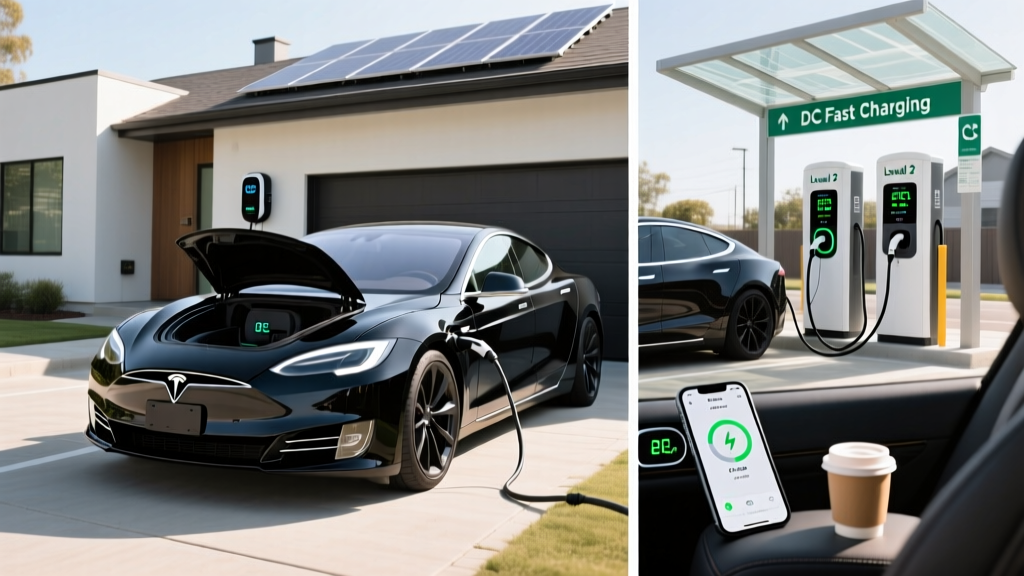
If you've typed "how much is a Supercharger" into a search bar, you're probably weighing two questions at once: what a Tesla Supercharger session costs per kilowatt-hour, and whether home or public charging makes more financial sense for your EV. The answer depends on where you live, when you plug in, and whether you're talking about the electricity itself or the hardware on your wall. This guide breaks down every layer — per-kWh rates at the pump, home installation costs, equipment picks, and the real cost-per-mile versus a gas car — using 2026 pricing and current EV battery sizes.
Charging Levels Explained: Speeds, Power, and Real-World Range Added
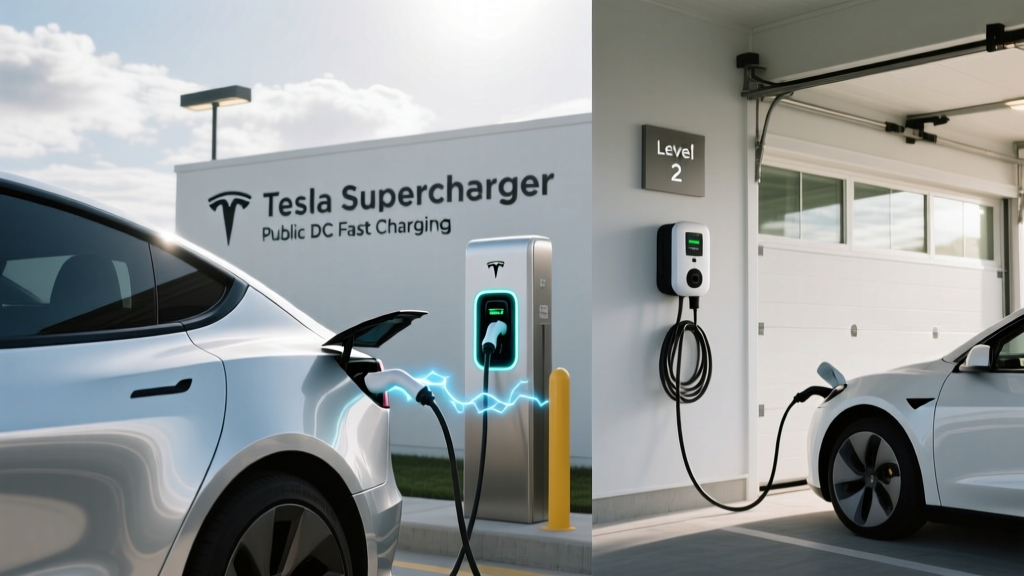
Before pricing anything, the three charging levels need clear definitions. EV drivers constantly mix up kW (power, or how fast energy flows) and kWh (energy, or how much the battery holds). Think of kW as the width of a hose and kWh as the size of the bucket. A 150 kW DC fast charger fills a 75 kWh battery far faster than a 7.2 kW Level 2 wallbox — but the battery is still 75 kWh either way.
| Level | Voltage | Typical Power (kW) | Miles of Range per Hour | Best For |
|---|---|---|---|---|
| Level 1 | 120V AC | 1.2 – 1.9 kW | 3 – 5 mi/hr | Overnight top-ups, PHEVs, emergency |
| Level 2 | 240V AC | 7.2 – 19.2 kW | 20 – 60 mi/hr | Daily home charging, workplace, hotels |
| DC Fast (incl. Supercharger) | 400–800V DC | 50 – 350 kW | 150 – 1,000+ mi/hr (peak) | Road trips, quick top-ups, fleet |
Those "miles per hour" numbers assume a relatively efficient EV around 3–4 mi/kWh (e.g., Tesla Model 3, Hyundai Ioniq 6). A heavier truck like the Ford F-150 Lightning or Rivian R1T will add fewer miles per hour at the same kW rate because it consumes more energy per mile.
How Much Does a Tesla Supercharger Session Actually Cost?
Tesla Supercharger pricing is not a single national number. Rates vary by station, time of day, and whether your vehicle is a Tesla or a non-Tesla EV using the network via the built-in Magic Dock or NACS adapter. As of early 2026, most U.S. Supercharger stations charge between $0.30 and $0.50 per kWh, with a national median around $0.38/kWh.
Here's what that looks like for a real charging session on common 2026 EVs:
- Tesla Model 3 Long Range (79 kWh usable, ~341 mi EPA): A 10–80% session adds roughly 55 kWh. At $0.38/kWh, that's about $20.90 for ~239 miles of range.
- Ford Mustang Mach-E Extended Range (91 kWh usable, ~320 mi EPA): A 10–80% session adds roughly 64 kWh. At $0.38/kWh, that's about $24.30.
- Hyundai Ioniq 5 (77.4 kWh usable, ~305 mi EPA): A 10–80% session adds roughly 54 kWh. At $0.38/kWh, that's about $20.50.
Tesla also enforces idle fees — typically $1.00/minute if your car remains plugged in after reaching its charge limit and the station is at high capacity. And some urban Superchargers cap power at 72 kW or 150 kW, which lengthens session time compared to the V3/V4 250–350 kW stalls found along highways.
Public DC Fast Charging Beyond Tesla: Electrify America, EVgo, and Others
If you drive a non-Tesla EV with a CCS1 port — or a newer NACS-equipped model from Ford, GM, or Rivian — you'll also use networks like Electrify America, EVgo, and ChargePoint. Pricing on these networks in 2026 typically ranges from $0.35 to $0.55/kWh, with some stations in California and the Northeast pushing toward $0.60/kWh during peak hours.
Subscription plans can lower per-kWh costs. EVgo's Plus membership, for example, offers a reduced rate (often $0.05–$0.10/kWh less) for a monthly fee of around $4.99–$9.99. Electrify America's Pass+ plan works similarly. If you DC fast charge more than twice a month, these plans usually pay for themselves.
One critical real-world factor: charge curve taper. A vehicle advertised at "250 kW peak" rarely sustains that rate. Most EVs hit peak power between 10–40% state of charge, then taper progressively. A Hyundai Ioniq 5 peaking at 240 kW might average only 130–150 kW across a full 10–80% session, taking roughly 18–22 minutes. Plan your road-trip stops around the curve, not the peak number.
Cost to Charge at Home vs. Public: Per-Mile Breakdown vs. Gas
Home charging is where EV ownership economics shine. The national average residential electricity rate in 2026 sits around $0.17/kWh, though this swings from roughly $0.12/kWh in parts of the Southeast and Pacific Northwest to over $0.30/kWh in California and the Northeast. Time-of-use (TOU) plans can drop off-peak overnight rates to $0.08–$0.12/kWh in many utility areas.
| Scenario | Rate ($/kWh) | Efficiency (mi/kWh) | Cost Per Mile | Equiv. Gas Price (at 28 MPG) |
|---|---|---|---|---|
| Home off-peak (TOU) | $0.10 | 3.5 | $0.029 | $0.81/gal |
| Home average rate | $0.17 | 3.5 | $0.049 | $1.37/gal |
| Tesla Supercharger (median) | $0.38 | 3.5 | $0.109 | $3.05/gal |
| Electrify America / EVgo | $0.48 | 3.5 | $0.137 | $3.84/gal |
| Gas car (28 MPG combined) | — | — | $0.118 | $3.30/gal actual |
The takeaway: home charging on an off-peak TOU plan is roughly 75% cheaper per mile than a gas car averaging 28 MPG at $3.30/gallon. Even at the national average residential rate, you're paying the equivalent of about $1.37/gallon. Public DC fast charging is the one scenario where EV fuel costs approach or slightly exceed gas — but most EV owners do 80–90% of their charging at home.
How Much Does It Cost to Install a Home EV Charger?
This is where "how much is a charger" gets more complex. The total cost of a Level 2 home charging setup includes the charger hardware, electrical labor, permits, and — in older homes — a potential panel upgrade.
| Component | Typical Range | Notes |
|---|---|---|
| Level 2 charger (hardware) | $350 – $750 | 32A–48A smart chargers; Tesla Wall Connector ~$420 |
| Electrician labor | $500 – $2,000 | Depends on run length, conduit, and local rates |
| Permit & inspection | $50 – $300 | Varies by municipality; some utilities bundle this |
| Electrical panel upgrade (if needed) | $1,500 – $4,000 | Required if your panel is 100A or maxed out; 200A is standard target |
| Total (no panel upgrade) | $900 – $3,050 | Most homes with 200A service fall in $1,200–$2,000 |
| Total (with panel upgrade) | $2,400 – $7,050 | Common in pre-1990 homes with 100A or 60A panels |
The electrical requirements for a typical 48-amp Level 2 charger are a dedicated 240V/60A circuit (NEC code requires circuits rated at 125% of continuous load, so a 48A charger needs a 60A breaker). A 32A charger requires a 40A circuit. Your electrician will run appropriate-gauge wire (typically 6 AWG copper for 60A) from the panel to the charger location, install a NEMA 14-50 outlet or hardwire the unit, and ensure GFCI protection where required by local code.
Panel upgrade gotcha: If your home has a 100-amp panel and you're already running central AC, an electric oven, and a dryer, adding a 60A EV circuit may push your calculated load beyond the panel's capacity. The solution is either a panel upgrade to 200A (costly but adds long-term home value) or an automated load-management device like the Emporia Smart Load Manager or Tesla's built-in load-sharing, which throttles the charger when other appliances draw heavy current. These devices cost $150–$300 and can avoid a full panel upgrade.
Which Connector Does My EV Use? NACS, CCS1, and CHAdeMO Compatibility
The North American charging connector landscape has consolidated significantly since Tesla opened its Supercharger network and the NACS (North American Charging Standard, SAE J3400) connector was adopted by nearly every major automaker starting in 2024–2025.
| Connector | Brands Using It (2026) | DC Fast Network Access | Adapter Needed? |
|---|---|---|---|
| NACS (J3400) | Tesla, Ford, GM, Rivian, Volvo, Polestar, Hyundai/Kia (2025+), BMW, Lucid, Mercedes | Tesla Supercharger natively; growing EA/EVgo NACS stalls | CCS-to-NACS adapter for older CCS stations (~$200–$250) |
| CCS1 | Older VW ID.4, some 2023–2024 Hyundai/Kia, legacy BMW i4/iX, Stellantis | Electrify America, EVgo, ChargePoint | NACS-to-CCS adapter for Tesla Superchargers (Ford/GM provide included adapters) |
| CHAdeMO | Nissan Leaf (legacy only — discontinued after 2025) | Declining; some EA and independent stations | No mainstream adapter; network access shrinking |
For 2026 model-year buyers, NACS is the default. If you purchase a new Ford, GM, Hyundai, Kia, or Rivian, your vehicle will have a native NACS port and can plug directly into any Tesla Supercharger without an adapter. If you own a 2023–2024 model with CCS1, Ford and GM have shipped complimentary CCS-to-NACS adapters to registered owners; aftermarket adapters from companies like Lectron and A2Z are available for $180–$250.
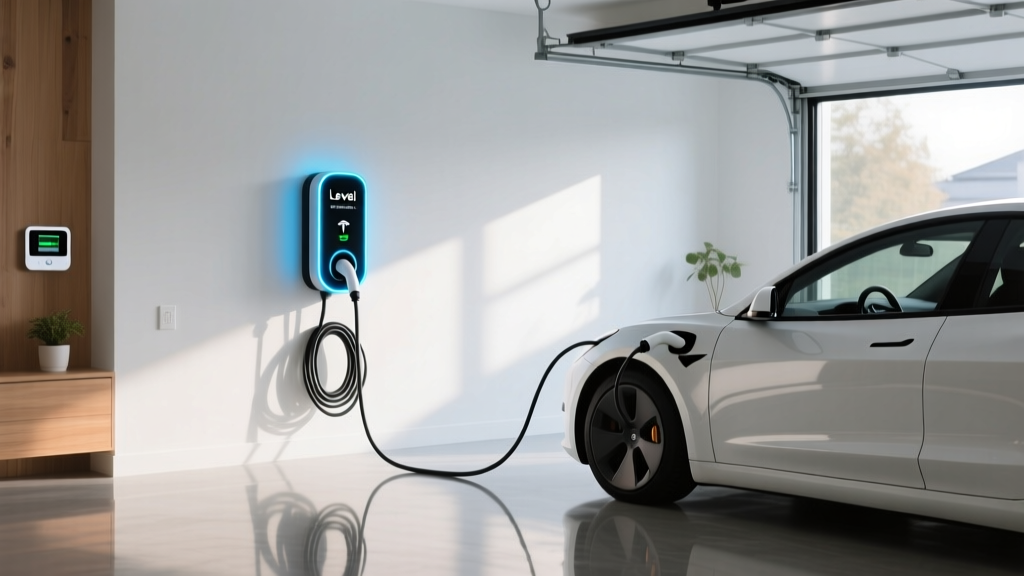
For home Level 2 charging, the connector situation is simpler: all Level 2 chargers sold in North America use a J1772 plug, and all EVs (including Teslas) accept J1772 — either natively or through the small J1772-to-Tesla adapter that ships with every Tesla. Starting in 2025, some Level 2 chargers (like the Tesla Wall Connector) offer a switchable J1772/NACS cable tip, eliminating the adapter step entirely.
Best Home Level 2 Chargers for 2026: Equipment Recommendations
Choosing a home charger comes down to amperage, cable length, smart features, and whether you want hardwired or plug-in (NEMA 14-50) installation. Here are top picks based on real-world reliability, feature sets, and value:
Tesla Wall Connector (Gen 4)
- Power: Up to 11.5 kW (48A on 60A circuit)
- Connector: Native NACS; includes J1772 adapter tip
- Cable: 24 ft
- Smart features: Wi-Fi, OTA updates, Power Sharing (link two units on one circuit), load management
- Price: ~$420
- Best for: Tesla owners, NACS-native EVs, multi-EV households
ChargePoint Home Flex (2nd Gen)
- Power: Up to 12 kW (50A, configurable from 16A–50A)
- Connector: J1772 (works with all EVs; Tesla via adapter)
- Cable: 23 ft
- Smart features: Wi-Fi, app scheduling, Alexa/Google integration, energy tracking
- Price: ~$550–$600
- Best for: Non-Tesla EVs, smart-home integration, flexible amperage
Emporia Vue Level 2 Charger
- Power: Up to 11.5 kW (48A)
- Connector: J1772 (NACS version available)
- Cable: 24 ft
- Smart features: Integrated with Emporia energy monitor, solar-aware scheduling, load management
- Price: ~$400
- Best for: Solar homes, budget-conscious buyers, energy monitoring enthusiasts
Grizzl-E Smart
- Power: Up to 10 kW (40A)
- Connector: J1772
- Cable: 24 ft
- Smart features: OCPP-compatible, adjustable amperage, extreme-cold rated (-40°F)
- Price: ~$450
- Best for: Cold climates, outdoor installs, Canadian/Northern U.S. owners
For most 2026 EV owners with a NACS port, the Tesla Wall Connector at $420 is the strongest value — native compatibility, excellent load-sharing for two-car garages, and reliable firmware updates. If you drive a J1772-equipped EV or want deeper energy analytics, the ChargePoint Home Flex or Emporia are strong alternatives.
Charging Time Examples: 10–80% for Common 2026 EVs
Charging times depend on the vehicle's onboard charger (for Level 2) and its DC fast-charge architecture. Here are real-world estimates for popular models:
| Vehicle | Battery (kWh usable) | Level 2 (11.5 kW) | DC Fast (peak kW) | DC Fast 10–80% (est.) |
|---|---|---|---|---|
| Tesla Model 3 Long Range | 79 kWh | ~5.5 hours | 250 kW | ~25 min |
| Tesla Model Y Long Range | 78 kWh | ~5.5 hours | 250 kW | ~27 min |
| Hyundai Ioniq 5 (Long Range) | 77.4 kWh | ~5.5 hours (at 10.9 kW onboard) | 240 kW (800V) | ~18 min |
| Ford Mustang Mach-E (ER) | 91 kWh | ~7 hours (at 10.5 kW) | 150 kW | ~40 min |
| Chevrolet Equinox EV (3RS) | 85 kWh | ~6.5 hours (at 11.5 kW) | 150 kW | ~35 min |
| Kia EV6 (Long Range) | 77.4 kWh | ~5.5 hours (at 10.9 kW) | 240 kW (800V) | ~18 min |
| Ford F-150 Lightning (ER) | 131 kWh | ~11 hours (at 11.5 kW) | 150 kW (est. peak) | ~55 min |
The 800-volt architectures in the Ioniq 5 and EV6 deliver a meaningful advantage: they sustain higher charge rates longer in the curve, making 10–80% sessions roughly 8–10 minutes shorter than 400V competitors. On road trips, that compounds quickly.
Also note: cold weather slows charging significantly. In sub-freezing temperatures, a battery that hasn't been preconditioned (warmed via the vehicle's thermal management system before arriving at the charger) may accept only 30–50% of its peak rate for the first several minutes. Always use your EV's built-in navigation to route to a DC fast charger — this triggers preconditioning automatically on most models.
Safety, Electrical Code, and Installation Best Practices
Level 2 EV charging is a continuous high-load operation — your charger will draw maximum current for hours at a time. This is fundamentally different from a dryer or oven that cycles on and off. Proper installation is non-negotiable:
- Dedicated circuit: Your EV charger must have its own dedicated breaker — never shared with other appliances.
- Breaker sizing: Per NEC Article 625, the circuit must be rated at 125% of the charger's maximum continuous draw. A 48A charger requires a 60A breaker; a 32A charger requires a 40A breaker.
- Hardwired vs. outlet: Hardwired installations are generally preferred for 48A+ chargers because NEMA 14-50 receptacles can overheat under sustained high load if not installed to exacting standards (some jurisdictions now require industrial-grade receptacles for EV use).
- GFCI protection: NEC 2020 and later require GFCI protection for outdoor receptacles used for EV charging. Hardwired units often have built-in ground-fault protection, which can simplify compliance.
- Outdoor rating: If your charger is mounted outside or in an open carport, ensure it carries a NEMA 4 or IP65 rating for weather resistance. All units listed above meet this standard.
- Permit and inspection: Most jurisdictions require an electrical permit for a new 240V circuit. Skipping this risks voiding homeowner's insurance coverage for any electrical fire. Your electrician should pull the permit; the utility may also require notification.
Always hire a licensed electrician familiar with EV charger installations. The Alternative Fuels Data Center maintains a directory of EV-trained contractors, and utilities like PG&E, ConEdison, and Xcel Energy offer installation referral programs and sometimes rebates of $250–$1,000 toward the installation cost.
Frequently Asked Questions
How much does a Tesla Supercharger cost per kWh in 2026?
Most U.S. Tesla Supercharger stations charge between $0.30 and $0.50/kWh, with a national median around $0.38/kWh. Some locations offer off-peak discounts, and a small number of older stations still have legacy free charging for vehicles purchased before 2017 — but those are increasingly rare. Non-Tesla EVs using Superchargers via the Magic Dock or adapter may see a slightly higher per-kWh rate at some stations.
Is it cheaper to charge at home or at a Supercharger?
Home charging is dramatically cheaper. At the national average residential rate of ~$0.17/kWh, you'll pay about $0.049/mile. At the Supercharger median of ~$0.38/kWh, that jumps to $0.109/mile — more than double. Over a year of 12,000 miles, the difference is roughly $720. Home charging is the economic case for EV ownership; Superchargers are a road-trip convenience.
Can I install a Level 2 charger myself?
If you're simply plugging a charger into an existing, properly rated NEMA 14-50 outlet, yes — plug-and-play. But if you need a new 240V circuit run from the panel, this is licensed electrician work. DIY 240V electrical work without a permit can void your homeowner's insurance and violate local code. The risk of fire from an improperly sized circuit or loose connection under continuous high load is real.
Do I need a panel upgrade for a home EV charger?
Maybe. If your home has a 200-amp panel with available capacity, you likely won't. If you have a 100-amp panel (common in homes built before 1990) or your existing loads are near capacity, a panel upgrade to 200A may be required. The alternative is an automated load-management device ($150–$300) that throttles charger power when other appliances are running, which can avoid the upgrade entirely. Ask your electrician to perform a load calculation before committing to a panel swap.
How fast does a Supercharger charge compared to home Level 2?
A Tesla V3 Supercharger at 250 kW can add roughly 200 miles of range in 15 minutes on a Model 3 Long Range. A home Level 2 charger at 11.5 kW adds about 35–40 miles per hour. For daily driving, overnight Level 2 charging easily replenishes a typical day's commute (30–50 miles) in 1–2 hours. DC fast charging is for road trips and situations where you need range quickly.
Are there any tax credits or rebates for home charger installation?
The federal Alternative Fuel Vehicle Refueling Property Credit (IRC §30C) covers 30% of the cost of home EV charger hardware and installation, up to $1,000. However, eligibility depends on your census tract meeting certain income or rural criteria as defined by the IRS. Many utilities also offer separate rebates of $250–$1,000 — check with your local provider. A tax professional can confirm your eligibility.