If you own a Tesla or are about to take delivery of a Model 3, Model Y, Model S, or Model X, one of the first ownership questions is practical: how much to install a Tesla charger at home? The answer depends on your home's electrical panel, the distance from that panel to your garage or driveway, local permit fees, and which wall connector you choose. In 2026, a straightforward Tesla Wall Connector installation typically runs between $500 and $2,200 all-in, but older homes needing panel upgrades can push that figure well past $3,000.
This guide walks through every cost component, explains charging levels and speeds in precise terms, and helps you decide whether a Tesla-specific charger or a universal NACS unit makes more sense for your setup.
Understanding Charging Levels: kW Power and Miles per Hour
Before pricing an installation, it is essential to understand what you are buying. EV charging is measured in kW (kilowatts), which represents the rate of power delivery. Your battery capacity is measured in kWh (kilowatt-hours), which represents stored energy. Think of kW as the width of a pipe and kWh as the size of the tank you are filling. Confusing the two is the most common mistake new EV owners make.
Here is how each level translates into real-world charging speed for a typical Tesla Model Y (75 kWh usable battery) or Model 3 (60 kWh usable, Rear-Wheel Drive):
| Level | Voltage | Power (kW) | Miles of Range per Hour | Typical Use Case |
|---|---|---|---|---|
| Level 1 | 120V | 1.2–1.9 kW | 3–5 mi/hr | Overnight top-up, low daily mileage |
| Level 2 | 240V | 7.2–19.2 kW | 25–70 mi/hr | Home wall connector, workplace |
| DC Fast | 400–800V DC | 50–250+ kW | 150–1,000+ mi/hr (peak) | Road trips, Superchargers |
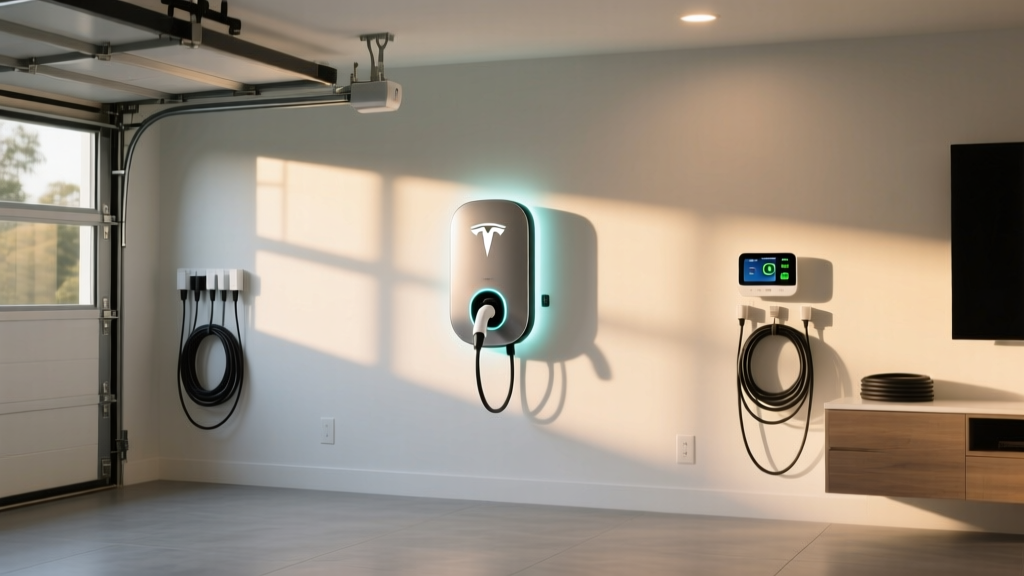
For most Tesla owners, a Level 2 home wall connector is the sweet spot. The Tesla Wall Connector delivers up to 11.5 kW (48 amps on a 60-amp dedicated circuit), which adds roughly 44 miles of range per hour of charging on a Model 3 Rear-Wheel Drive. A full overnight session easily replenishes any daily driving.
How Much Does It Cost to Install a Tesla Charger at Home?
The total cost to install a Tesla Wall Connector at home breaks down into three categories: the charger unit itself, electrician labor and materials, and local permit fees. Here is what to expect in 2026:
| Component | Low End | Typical | High End | Notes |
|---|---|---|---|---|
| Tesla Wall Connector (Gen 3) | $420 | $475 | $475 | 24-foot cable, Wi-Fi enabled, NACS connector |
| Universal Wall Connector | $550 | $600 | $600 | J1772 + NACS adapter included |
| Electrician labor (simple install) | $300 | $600 | $900 | Panel within 20 ft of install point |
| Electrician labor (complex install) | $800 | $1,200 | $2,000+ | Long conduit runs, trenching, drywall work |
| Electrical permit | $50 | $150 | $350 | Varies by municipality |
| Panel upgrade (if needed) | $1,500 | $2,500 | $4,000+ | 100A → 200A service upgrade |
| Total (no panel upgrade) | $770 | $1,225 | $3,725 | |
| Total (with panel upgrade) | $2,270 | $3,725 | $7,725+ |
What drives the cost range?
The single biggest variable is the distance from your electrical panel to the charger location. If your panel is in the garage right next to where you park, expect a straightforward 2–3 hour job. If the panel is in the basement and the charger goes on an exterior wall 60 feet away, your electrician will run conduit through walls, ceilings, or trench underground — each adding labor and material costs.
Electrical Requirements: Voltage, Amperage, and Panel Capacity
The Tesla Wall Connector (Gen 3) supports up to 48 amps of continuous draw, which requires a 60-amp dedicated circuit on a 240V line. Electrical code requires that continuous loads (defined as running for 3+ hours) only use 80% of a circuit breaker's rated capacity — hence 48A on a 60A breaker.
However, the Wall Connector is configurable. If your panel cannot spare 60 amps, your electrician can set the unit to draw less:
- 40-amp circuit: 32A continuous → ~7.7 kW → ~30 mi/hr of range
- 50-amp circuit: 40A continuous → ~9.6 kW → ~37 mi/hr of range
- 60-amp circuit: 48A continuous → ~11.5 kW → ~44 mi/hr of range
Do you need a panel upgrade?
Homes built before 1990 often have 100-amp service panels. If your panel is already near capacity — running electric range, dryer, HVAC, and water heater — adding a 60-amp EV circuit may exceed the panel's safe load. A licensed electrician will perform a load calculation to determine available capacity.
If you need an upgrade to 200-amp service, budget $1,500–$4,000 depending on your utility's requirements, local code, and whether a new meter base is needed. This is the single largest cost surprise for EV charger installations in older homes.
Connector Compatibility: NACS, CCS, and Adapters
As of 2026, the North American Charging Standard (NACS) — originally Tesla's proprietary connector — has become the dominant plug for new EVs sold in the United States. Ford, GM, Rivian, Hyundai, Kia, BMW, and most other major automakers now ship vehicles with native NACS ports. This simplifies the home charger decision significantly.
| Connector | Brands Using It (2026) | Adapter Needed for Tesla Charger? |
|---|---|---|
| NACS (Tesla) | Tesla, Ford, GM, Rivian, Hyundai, Kia, BMW, Volvo, Mercedes, Honda, Nissan (new) | No — native fit |
| CCS1 | Remaining Stellantis models, some legacy 2023–2024 EVs still on road | Yes — Tesla-to-CCS adapter (~$200–$250) or use Universal Wall Connector with J1772 |
| CHAdeMO | Nissan Leaf (legacy, discontinued for 2026) | Not compatible with Tesla Wall Connector |
If you own only Teslas, the standard Tesla Wall Connector with its built-in NACS plug is the obvious choice. If your household includes a non-Tesla EV that still uses CCS1, consider the Tesla Universal Wall Connector (introduced in 2024), which includes an integrated J1772 adapter tip that also fits CCS1 vehicles with a separate adapter. Alternatively, a third-party NACS charger like the Emporia Vue or ChargePoint Home Flex works across all NACS-equipped vehicles.
How Much Does Charging Cost per Mile vs. Gas?
One of the strongest financial arguments for home charging is the cost-per-mile advantage over gasoline. Here is a realistic comparison using 2026 energy and fuel prices:
| Scenario | Rate | Vehicle Efficiency | Cost per Mile |
|---|---|---|---|
| Home charging (national avg. residential) | $0.16/kWh | 3.5 mi/kWh (Model Y) | $0.046 |
| Home charging (off-peak TOU rate) | $0.09/kWh | 3.5 mi/kWh (Model Y) | $0.026 |
| Home charging (high-cost state, e.g. CA) | $0.30/kWh | 3.5 mi/kWh (Model Y) | $0.086 |
| Public Level 2 (avg.) | $0.30–$0.45/kWh | 3.5 mi/kWh (Model Y) | $0.086–$0.129 |
| Tesla Supercharger (avg.) | $0.30–$0.40/kWh | 3.5 mi/kWh (Model Y) | $0.086–$0.114 |
| Gasoline car (30 MPG combined) | $3.40/gallon | 30 mi/gal | $0.113 |
| Gasoline car (22 MPG combined, truck/SUV) | $3.40/gallon | 22 mi/gal | $0.155 |
At off-peak residential rates, home-charging a Tesla Model Y costs roughly $0.026 per mile — about one-quarter to one-sixth the cost of fueling a comparable gas vehicle. Even at California's higher residential rates, home charging undercuts gasoline on a per-mile basis. The savings compound quickly: driving 12,000 miles per year at off-peak home rates saves roughly $1,044 annually versus a 30-MPG gas car at $3.40/gallon.
Check whether your utility offers a time-of-use (TOU) plan. Many utilities offer rates 40–60% below standard pricing for charging between 10 PM and 6 AM. According to the U.S. Department of Energy, TOU plans are one of the most effective ways to reduce EV operating costs.
Charging Time Examples: What to Expect Overnight
Here is how long common Tesla models take to charge from 10% to 80% State of Charge on a Tesla Wall Connector at various amperage settings. Note that charging slows significantly above 80% to protect battery health — this is called the charge curve taper and is normal for all lithium-ion batteries.
| Model | Battery (usable kWh) | At 48A / 11.5 kW | At 32A / 7.7 kW | At 16A / 3.8 kW (Mobile Connector) |
|---|---|---|---|---|
| Model 3 RWD | 60 kWh | ~3.6 hours | ~5.5 hours | ~11 hours |
| Model 3 Long Range | 75 kWh | ~4.6 hours | ~6.8 hours | ~13.7 hours |
| Model Y Long Range | 75 kWh | ~4.6 hours | ~6.8 hours | ~13.7 hours |
| Model S Plaid | 95 kWh | ~5.8 hours | ~8.6 hours | ~17.4 hours |
| Cybertruck AWD | 123 kWh | ~7.5 hours | ~11.2 hours | ~22.5 hours |
For daily driving of 30–50 miles, even a 16A Mobile Connector on a standard 240V outlet (like a NEMA 14-50, commonly used for dryers) replenishes overnight. A full Wall Connector installation at 48A ensures you can recover from longer road-trip days without relying on public chargers.
Equipment Recommendations: Which Charger Should You Buy?
Here are the top home charging units for Tesla and NACS-equipped vehicles available in 2026:
Tesla Wall Connector (Gen 3)
- Power: Up to 11.5 kW (48A)
- Connector: NACS (native Tesla)
- Cable: 24 feet
- Smart features: Wi-Fi, OTA updates, power sharing (link multiple units on one circuit), access control
- Price: ~$475
- Best for: Tesla-only households
Tesla Universal Wall Connector
- Power: Up to 11.5 kW (48A)
- Connector: NACS + integrated J1772 adapter tip
- Cable: 24 feet
- Smart features: Wi-Fi, OTA, power sharing, built-in cable organizer
- Price: ~$600
- Best for: Multi-EV households (Tesla + non-Tesla)
ChargePoint Home Flex (NACS)
- Power: Up to 12 kW (50A, configurable down)
- Connector: NACS (2025+ models)
- Cable: 23 feet
- Smart features: Wi-Fi, app scheduling, Alexa integration, detailed energy reporting
- Price: ~$550–$650
- Best for: Non-Tesla NACS EVs, smart home integration
For the vast majority of Tesla owners, the standard Tesla Wall Connector at $475 is the best value. It is hardwired (no plug to accidentally disconnect), receives over-the-air firmware updates, and supports power sharing if you ever add a second charger on the same circuit.
Safety, Code, and Permit Considerations
A home EV charger installation is not a DIY project. The National Electrical Code (NEC) and most local jurisdictions require:
- Dedicated circuit: The charger must have its own breaker — it cannot share a circuit with other appliances.
- GFCI protection: NEC 2020 and later require ground-fault circuit interrupter protection for all 240V EV charging outlets. Hardwired units like the Tesla Wall Connector typically have built-in ground-fault protection.
- Outdoor rating: If installing outside, the unit must carry a NEMA 3R or NEMA 4 rating. The Tesla Wall Connector is rated for indoor and outdoor use (NEMA 3R).
- Permit and inspection: Nearly all jurisdictions require an electrical permit for a new 240V circuit. The inspection ensures the wiring gauge, breaker size, and conduit meet code. Skipping this step can void home insurance coverage in the event of an electrical fire.
- Wire gauge: A 60-amp circuit typically requires 6 AWG copper wire (or 4 AWG aluminum). Your electrician will size this based on the run length and local code amendments.
Always hire a licensed electrician. You can find Tesla-certified installers through Tesla's website, but any licensed electrician qualified in residential 240V circuits can install a Wall Connector. Get at least two quotes, and confirm the quote includes permit fees and a post-installation inspection.
Frequently Asked Questions
Can I install a Tesla charger myself?
Tesla sells a Mobile Connector that plugs into a standard 120V or 240V outlet, which requires no installation. However, a hardwired Wall Connector installation on a dedicated 60-amp circuit should be done by a licensed electrician to meet code and maintain your home insurance.
Is the Tesla Mobile Connector a viable alternative to a Wall Connector?
Yes, for lighter use. The Mobile Connector with a NEMA 14-50 adapter delivers up to 32 amps (7.7 kW) on a 240V outlet — adequate for most daily driving. However, it is less weather-resistant, easier to steal, and cannot power-share with a second unit. For daily reliability, a hardwired Wall Connector is superior.
Does installing a home charger qualify for a tax credit?
The federal Alternative Fuel Vehicle Refueling Property Credit (§30C) offers up to $1,000 for home EV charger installation through 2032, but it has specific requirements: the installation must be in a qualifying census tract (generally low-income or non-urban areas), and the credit covers 30% of combined equipment and installation costs up to the $1,000 cap. Check the IRS guidelines for eligibility and consult a tax professional.
Will a Tesla Wall Connector work with non-Tesla EVs?
Starting in 2026, most new EVs sold in the U.S. use the NACS connector, so a Tesla Wall Connector will physically plug into a Ford F-150 Lightning, GM Equinox EV, Hyundai Ioniq 5 (2025+), and others. For older CCS1-equipped EVs, you would need the Tesla Universal Wall Connector or a third-party adapter.
How fast will a Tesla Wall Connector charge a Model Y?
At its maximum 48-amp / 11.5 kW setting, the Tesla Wall Connector adds approximately 44 miles of range per hour to a Model Y Long Range. A 10–80% charge takes roughly 4.5 hours — easily completed overnight.
What if my electrical panel is full?
If your panel has no spare breaker slots or lacks the amperage headroom for a 60-amp circuit, you have three options: (1) install the Wall Connector at a lower amperage setting (e.g., 32A on a 40A breaker), (2) add a sub-panel, or (3) upgrade to 200-amp service. A load calculation by your electrician will determine the most cost-effective path.