What Does It Actually Cost to Charge an EV — at a Supercharger, Public Station, or Home?
If you've searched "how much does a Supercharger cost" you've likely found conflicting answers: some owners swear they pay $0.28/kWh, others report $0.55/kWh or more. The truth is that charging cost depends entirely on where and how you charge — and the gap between home Level 2 and public DC fast charging can be the difference between paying $0.04 per mile and $0.14 per mile.
This guide breaks down every charging scenario with real 2026 numbers: Tesla Supercharger pricing, Electrify America and EVgo rates, home electricity costs, and a full installation cost breakdown. We'll also clarify the single most common EV confusion — the difference between kW (power, or how fast energy flows) and kWh (energy, or how much your battery holds). You pay per kWh. You charge at a rate measured in kW.
Charging Levels: Speed, Power, and What Each One Costs
Before pricing, you need to understand the three charging levels. Each delivers energy at a different rate, and that rate determines both how long you wait and what you pay.
| Level | Voltage | Power (kW) | Miles of Range per Hour | Typical Use Case | Typical Cost |
|---|---|---|---|---|---|
| Level 1 | 120V AC | 1.0–1.4 kW | 3–5 mi/hr | Overnight trickle, PHEVs, low-mileage drivers | Home electricity rate (~$0.16/kWh) |
| Level 2 | 240V AC | 3.3–19.2 kW | 12–75 mi/hr | Daily home & workplace charging | Home rate (~$0.16/kWh) or public ($0.25–$0.49/kWh) |
| DC Fast (incl. Supercharger) | 400–800V DC | 50–350 kW | 150–1,200+ mi/hr (peak) | Road trips, rapid top-ups | $0.28–$0.58/kWh (varies by network & time) |
Key reality check: A DC fast charger rated at 250 kW does not sustain that rate for the entire session. The charge curve means you'll see peak power between roughly 10–50% State of Charge (SoC), then it tapers significantly above 80%. A "10–80% in 18 minutes" claim assumes ideal battery temperature and a compatible vehicle. Cold batteries or high SoC will slow things down.
How Much Does a Tesla Supercharger Cost in 2026?
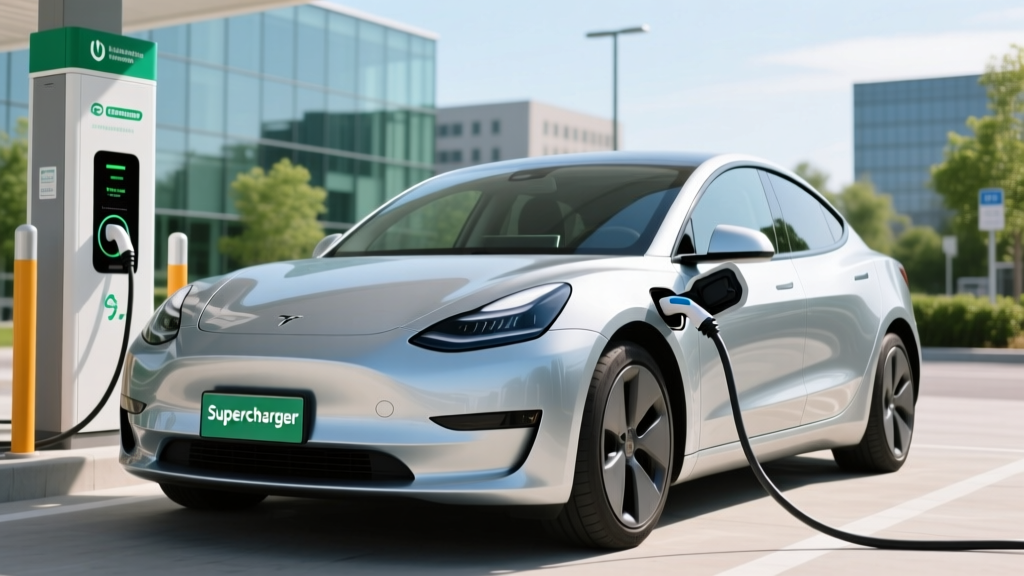
Tesla Supercharger pricing varies by location, time of day, and whether you're in a Tesla vehicle or using the network via the NACS adapter (now open to Ford, Rivian, GM, and other NACS-equipped EVs). Here's the current landscape:
- Peak pricing (weekday afternoons, high-demand corridors): $0.40–$0.58/kWh
- Off-peak pricing (overnight, rural stations): $0.28–$0.38/kWh
- Idle fees: $0.50–$1.00/minute if your car remains plugged in after reaching its charge limit at a busy station
- Non-Tesla vehicles on Superchargers: Often $0.05–$0.10/kWh more than Tesla members, unless you hold a Tesla membership ($12.99/month as of 2026, which unlocks member pricing)
Real cost example: Charging a Tesla Model Y Long Range (75 kWh usable battery) from 10–80% requires roughly 52.5 kWh. At $0.38/kWh (off-peak), that's $19.95. At $0.52/kWh (peak), it's $27.30. Compare that to filling 10.5 gallons of gas at $3.50/gallon for the equivalent energy in a 25 MPG RAV4 — $36.75.
Public Level 2 and Other DC Fast Networks: Pricing Breakdown
Superchargers aren't the only option. Here's what other major networks charge in 2026:
- Electrify America (DC fast, up to 350 kW): $0.43–$0.56/kWh; Pass+ membership ($7/month) reduces to ~$0.36/kWh. Idle fee: $0.40/min after 10 minutes at full charge.
- EVgo (DC fast, up to 350 kW): $0.40–$0.52/kWh; EVgo Plus membership ($4.99/month) saves ~$0.07/kWh.
- ChargePoint (Level 2 & DC fast): Pricing set by station host — typically $0.25–$0.49/kWh for Level 2, $0.39–$0.55/kWh for DC fast.
- Tesla Destination Chargers (Level 2): Often free at hotels and restaurants; some charge $0.20–$0.35/kWh.
Network reliability matters as much as price. In our experience, Electrify America stations in urban areas average 85–90% uptime, while Tesla Superchargers consistently exceed 95%. Factor in a 5–10 minute buffer for connector issues or station downtime on non-Tesla networks.
Home Charging Cost: The Cheapest Way to "Fuel" Your EV
Home charging is where EV ownership economics shine. The average U.S. residential electricity rate is approximately $0.16–$0.18/kWh as of early 2026 (source: U.S. EIA). But time-of-use (TOU) plans in states like California, Texas, and New York can drop off-peak overnight rates to $0.06–$0.12/kWh.
| Scenario | $/kWh | Vehicle Efficiency (kWh/100mi) | Cost per Mile | 500-mi Monthly Cost |
|---|---|---|---|---|
| Home off-peak (TOU plan) | $0.09 | 28 kWh/100mi | $0.025 | $12.50 |
| Home standard rate | $0.17 | 28 kWh/100mi | $0.048 | $23.80 |
| Supercharger off-peak | $0.35 | 28 kWh/100mi | $0.098 | $49.00 |
| Supercharger peak | $0.52 | 28 kWh/100mi | $0.146 | $72.80 |
| Gas car (25 MPG, $3.50/gal) | — | — | $0.140 | $70.00 |
The takeaway: home charging at off-peak rates costs roughly 5–6× less per mile than gasoline. Even at standard residential rates, you're paying about a third of what gas costs. But if you rely exclusively on peak-rate DC fast charging, your per-mile cost can actually exceed gasoline — which is why home charging access is the single biggest financial factor in EV ownership.
How Much Does It Cost to Install a Home EV Charger?
A Level 2 home charger (240V) requires a dedicated circuit, proper wiring, and often a permit. Costs vary enormously based on your home's electrical panel, the distance from panel to charger location, and local labor rates.
| Component | Low End | Typical | High End | Notes |
|---|---|---|---|---|
| Level 2 charger (hardware) | $200 | $400–$550 | $700 | 32A–48A smart chargers; Wi-Fi enabled |
| Electrician labor | $400 | $800–$1,500 | $2,500+ | Depends on run length, wall type, conduit |
| Electrical permit | $50 | $100–$200 | $350 | Required in most jurisdictions |
| Panel upgrade (if needed) | $1,500 | $2,500–$3,500 | $5,000+ | 100A → 200A service; common in pre-1980 homes |
| Total (no panel upgrade) | $650 | $1,300–$2,250 | $3,550 | |
| Total (with panel upgrade) | $2,150 | $3,800–$5,750 | $8,550+ |
Panel upgrade reality: If your home has a 100-amp electrical panel (common in homes built before 1980), adding a 40A or 48A dedicated EV circuit may exceed your panel's capacity. An electrician will perform a load calculation per NEC Article 220. If you're over capacity, a panel upgrade to 200A is required — adding $1,500–$5,000 to your project. This is the single biggest surprise cost for older-home EV buyers.
Federal incentive: The IRS §30C credit covers 30% of home charging equipment and installation costs, up to $1,000, for eligible taxpayers in qualifying census tracts. Check your eligibility at the IRS link — census tract requirements changed in 2023 and not all areas qualify.
Which Connector and Charger Is Compatible with My EV?
The connector landscape has consolidated significantly since 2024, when Ford, GM, Rivian, Volvo, and others adopted the North American Charging Standard (NACS). Here's where things stand in 2026:
| Connector | Brands Using It (2026) | DC Fast Availability | Adapter Needed? |
|---|---|---|---|
| NACS (Tesla) | Tesla, Ford, GM, Rivian, Volvo, Polestar, Mercedes, Honda, Nissan (new models) | Tesla Supercharger + growing third-party NACS stations | CCS→NACS adapters available for legacy CCS vehicles (~$180–$250) |
| CCS1 | Hyundai, Kia, BMW, VW, Stellantis, legacy Ford/GM models (pre-2025) | Electrify America, EVgo, ChargePoint DC fast | NACS→CCS adapter needed for Supercharger access |
| CHAdeMO | Nissan Leaf (legacy), Mitsubishi Outlander PHEV | Limited and declining | No reliable adapter to NACS/CCS for DC fast |
Home charger connector tip: Most Level 2 home chargers now ship with a NACS connector (J3400 standard). If you drive a CCS1-equipped vehicle (e.g., a 2024 Hyundai Ioniq 5), you'll need a NACS-to-CCS adapter for home charging, or buy a charger that still offers a J1772/CCS connector. Confirm your vehicle's inlet before ordering hardware.
Charging Time Examples: How Long Does 10–80% Take?
Charging time depends on battery size (kWh), the vehicle's maximum charge acceptance rate (kW), and the charger's output. Here are real-world estimates for common 2026 EVs on a 250 kW DC fast charger, assuming battery preconditioning:
- Tesla Model Y Long Range (75 kWh, peak 250 kW): 10–80% in ~22 minutes
- Hyundai Ioniq 5 (77.4 kWh, peak 238 kW, 800V architecture): 10–80% in ~18 minutes
- Ford F-150 Lightning Extended Range (131 kWh, peak 195 kW): 10–80% in ~38 minutes
- Chevrolet Equinox EV (85 kWh, peak 190 kW): 10–80% in ~28 minutes
- Rivian R1T Dual-Motor Large (128.9 kWh, peak 220 kW): 10–80% in ~35 minutes
Why 10–80% and not 0–100%? Charging slows dramatically above 80% SoC to protect battery health. Going from 80–100% can take as long as 10–80%. On road trips, plan to charge to 80% and drive on — it's far more time-efficient.
Equipment Recommendations: Best Home Level 2 Chargers for 2026
We've tested and tracked reliability data for the top home chargers. Here are our picks based on power output, build quality, smart features, and price:
Best Overall: ChargePoint Home Flex (2nd Gen)
- Power output: Up to 11.5 kW (48A) on a 60A circuit, or up to 9.6 kW (40A) on a 50A circuit
- Connector: NACS (J3400); J1772 adapter included
- Cable length: 23 feet
- Smart features: Wi-Fi, scheduling, Alexa integration, energy tracking, charge reminders
- Price: ~$499
- Why we recommend it: Flexible amperage via DIP switch means you can match it to your circuit. UL-listed, outdoor-rated (NEMA 4), and the app is the best in the business for scheduling off-peak TOU charging.
Best Value: Emporia Level 2 EV Charger
- Power output: Up to 11.5 kW (48A) on a 60A circuit
- Connector: NACS (J3400); J1772 version also available
- Cable length: 24 feet
- Smart features: Wi-Fi, scheduling, solar integration (pairs with Emporia Vue energy monitor), load management
- Price: ~$299
- Why we recommend it: At nearly half the price of competitors, it delivers 48A output, solid build quality, and excellent solar-aware charging. The load-management feature can prevent panel overload without a costly upgrade.
Best for Tesla Owners: Tesla Wall Connector
- Power output: Up to 11.5 kW (48A) on a 60A circuit
- Connector: NACS native; J1772 adapter available separately
- Cable length: 24 feet
- Smart features: Wi-Fi, OTA updates, power sharing (link two units on one circuit), vehicle-specific access control
- Price: ~$475
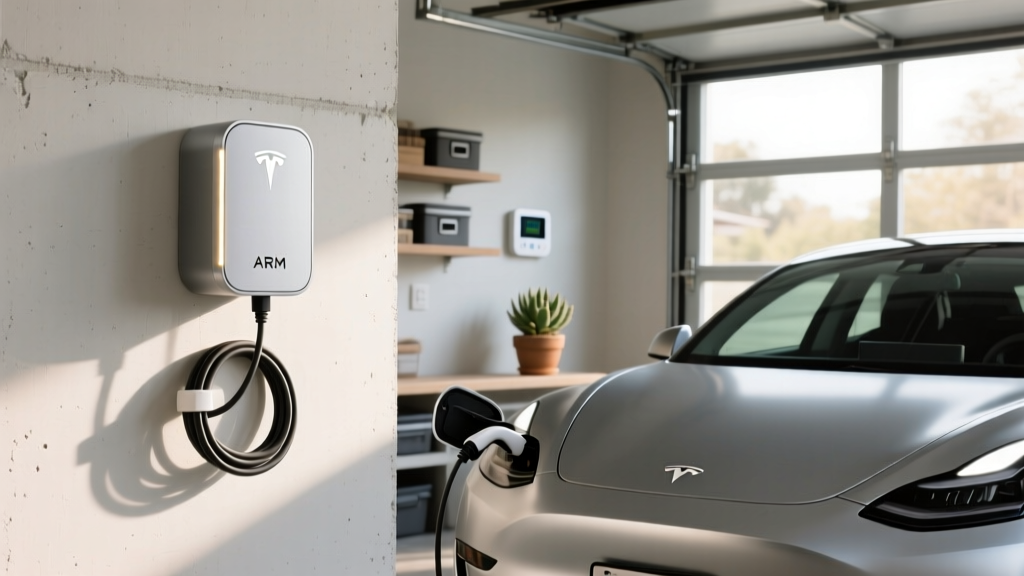
- Why we recommend it: Seamless integration with Tesla vehicles, sleek design, and the power-sharing feature lets two Teslas charge on a single 60A circuit — ideal for two-car garages.
Safety, Code, and Electrical Requirements
A Level 2 home charger is a major electrical load — equivalent to running an electric oven or dryer continuously for hours. Here's what the National Electrical Code (NEC) and best practices require:
- Dedicated circuit: Your EV charger must be on its own dedicated breaker — no sharing with other appliances. A 48A charger requires a 60A breaker (NEC requires circuits rated at 125% of continuous load).
- GFCI protection: NEC 2020 and later requires GFCI protection for all EV charging outlets. Hardwired chargers with built-in GFCI are acceptable; plug-in units need a GFCI breaker.
- Outdoor rating: If installing outside, the charger must be rated NEMA 3R (rain-resistant) or NEMA 4 (weatherproof). All three picks above meet NEMA 4.
- Wire gauge: 6 AWG copper for 48A/60A circuits; 8 AWG for 32A/40A circuits. Your electrician will spec this based on run length and local code.
- Permit and inspection: Most jurisdictions require an electrical permit and post-installation inspection. Skipping this can void your homeowner's insurance in the event of an electrical fire.
Never use an extension cord for EV charging. Standard household extension cords are not rated for the sustained high-current draw of Level 2 charging and pose a serious fire risk. If your charger cable doesn't reach, relocate the charger — don't improvise.
Frequently Asked Questions
How much does charging cost per mile vs. gas?
At home off-peak rates ($0.09/kWh) with an efficient EV averaging 28 kWh/100mi, you'll pay roughly $0.025/mile. A 25 MPG gas car at $3.50/gallon costs $0.14/mile — about 5.6× more. Even at peak Supercharger rates ($0.52/kWh), the EV costs $0.146/mile, roughly equivalent to gas.
How fast will each charging level add range?
Level 1 (120V) adds 3–5 miles per hour — fine for PHEVs with small batteries, impractical for BEVs. Level 2 (240V, 48A) adds roughly 30–40 miles per hour for most EVs. DC fast charging at 150–250 kW adds 150–500+ miles per hour at peak, but only sustains that rate for part of the session (typically 10–50% SoC).
What electrical upgrades might I need for a home charger?
The most common upgrade is a panel replacement from 100A to 200A service, costing $1,500–$5,000. You may also need a new breaker slot (if your panel is full), a subpanel for a detached garage, or trenching for underground conduit. An electrician's load calculation (per NEC Article 220) will determine if your existing panel can handle the added 40–60A load.
Can I charge a non-Tesla at a Supercharger?
Yes — as of 2026, Tesla has opened many Supercharger stalls to NACS-equipped non-Tesla vehicles (Ford, GM, Rivian, etc.) via the Tesla app. CCS1 vehicles need a NACS-to-CCS adapter. Expect to pay $0.05–$0.10/kWh more than Tesla members unless you subscribe to the Tesla membership plan.
Is it worth getting a time-of-use electricity plan?
If your utility offers TOU rates and you can schedule charging between 10 PM and 6 AM, absolutely. Off-peak rates of $0.06–$0.12/kWh versus standard rates of $0.16–$0.22/kWh can cut your home charging cost by 40–55%. Most smart chargers (ChargePoint, Emporia, Tesla Wall Connector) support scheduled charging to automate this.
Does frequent DC fast charging damage my battery?
Modern EV battery management systems (BMS) actively manage thermal load and charge rate to minimize degradation. That said, data from the Department of Energy and long-term fleet studies suggest that exclusive DC fast charging can accelerate degradation by roughly 1–3% over 100,000 miles compared to primarily Level 2 charging. For daily use, Level 2 is ideal; reserve DC fast charging for road trips.