If you've searched "how much does a fast charger cost" expecting a single number, you're about to learn why that question splinters into several. A Level 2 home wallbox and a public DC fast-charging station occupy entirely different price universes — one is a home appliance installation, the other is commercial infrastructure. This guide untangles both, with exact 2026 equipment prices, electrician labor ranges, panel-upgrade realities, and the per-mile math that determines whether your EV actually saves you money.
Charging Levels Explained: Speed, Power, and What You're Actually Buying
Before pricing anything, you need to separate kW (kilowatts — the rate of energy flow, like water pressure) from kWh (kilowatt-hours — the total energy stored or delivered, like gallons in a tank). A charger's kW rating tells you how fast it pushes energy; your battery's kWh capacity tells you how much it holds. Confusing these is the single most common EV mistake.
| Level | Voltage | Power (kW) | Miles of Range Added Per Hour | Typical Use Case |
|---|---|---|---|---|
| Level 1 | 120V AC | 1.2–1.9 kW | 3–5 mi/hr | Overnight trickle; PHEVs with small batteries |
| Level 2 (Home/Public AC) | 240V AC | 3.3–19.2 kW | 12–75 mi/hr | Daily home charging; workplace; destination |
| DC Fast Charging (DCFC) | 200–900V DC | 50–350+ kW | 150–1,200+ mi/hr (peak) | Road trips; quick top-ups on public networks |
Level 1 plugs into any standard household outlet. It's fine for plug-in hybrids with 20–40 miles of electric range (a Toyota RAV4 Prime at ~9.4 kWh battery fills overnight), but painfully slow for a full BEV like a Hyundai Ioniq 5 with an 84 kWh pack — that would take roughly 50+ hours from empty.
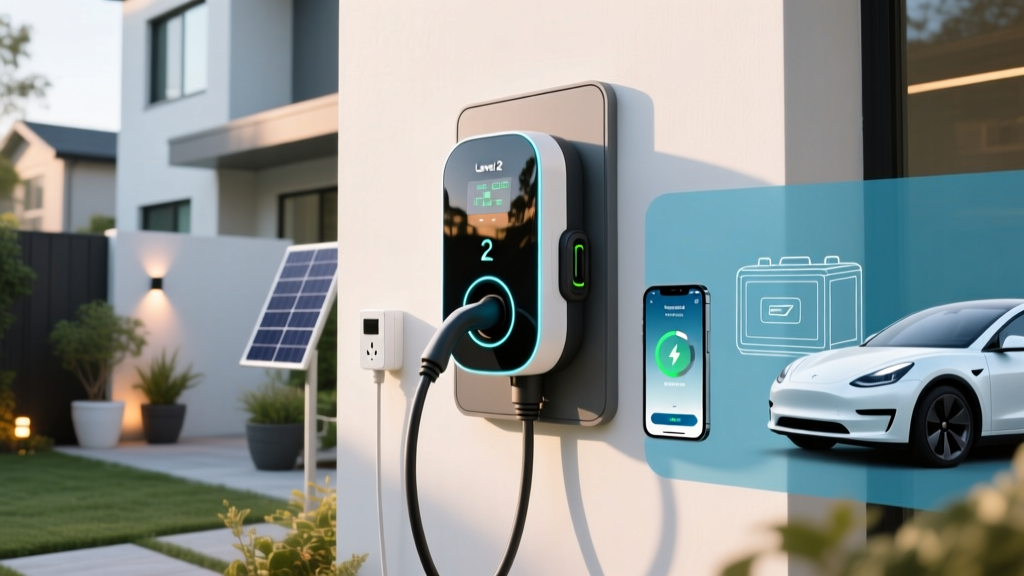
Level 2 is what most EV owners install at home. A 48-amp (11.5 kW) unit on a 60-amp dedicated circuit will add roughly 40–45 miles of range per hour in a midsize crossover, meaning an overnight session easily replenishes a day's driving and then some.
DC fast chargers bypass the vehicle's onboard AC-to-DC converter and feed DC directly to the battery. These are the units you find at Electrify America, EVgo, and Tesla Supercharger stations. They are not practical for home installation — residential electrical service rarely exceeds 200 amps total, and a single 150 kW DCFC would demand more than most entire homes are allocated.
How Much Does a Home Level 2 Charger Cost — Equipment and Installation?
The honest answer spans a wide range because your home's electrical panel is the wildcard. Here's the full breakdown:
| Component | Low End | High End | Notes |
|---|---|---|---|
| Level 2 EVSE Equipment (wallbox) | $300 | $750 | 32A–48A smart chargers; premium models with load management up to $900+ |
| Electrician Labor | $400 | $1,800 | Depends on run length from panel to garage/carport; conduit, drywall repair |
| Permit & Inspection | $50 | $300 | Varies by municipality; some jurisdictions waive for EV installs |
| Electrical Panel Upgrade (if needed) | $1,500 | $4,500+ | Upgrading from 100A to 200A service; older homes with 60A–100A panels often need this |
| Total (No Panel Upgrade) | $750 | $2,850 | |
| Total (With Panel Upgrade) | $2,250 | $7,350+ |
The best-case scenario: you have a modern 200-amp panel with spare capacity, your garage is adjacent to the panel, and the electrician runs a short 240V line. Total: under $1,000 all-in.
The worst case: a 1970s home with a 100-amp panel already near capacity, a detached garage 80 feet from the panel requiring buried conduit, and a municipal permit office that demands a full inspection. You could spend $5,000–$7,000+ before touching a charger.
What Electrical Upgrades Might I Need?
Most Level 2 chargers rated at 48 amps require a 60-amp dedicated circuit (the National Electrical Code requires circuits to be rated at 125% of continuous load). That means a double-pole 60A breaker occupying two slots in your panel. If your panel is full or your total calculated load is near your service amperage, a licensed electrician will recommend either:
- Panel upgrade: Replacing a 100A or 150A service panel with a 200A unit — the most common and costly upgrade.
- Load management device: A smart panel attachment (like the Emporia VUE or Span drive) that dynamically throttles the charger when other heavy loads (HVAC, electric oven, dryer) are running. This can avoid a panel upgrade entirely in some homes.
- Lower-amperage charger: Dropping to a 32-amp unit on a 40-amp circuit, which still delivers a very usable ~30 miles of range per hour.
How Much Does Public DC Fast Charging Cost?
When people ask "how much does a fast charger cost," they're often thinking about the public DC fast-charging stations they see along highways. You don't buy these — you pay per kWh or per minute to use them. Here's what that looks like in 2026:
| Scenario | Rate | Cost to Add 200 Miles (Approx. 60 kWh) | Typical Network |
|---|---|---|---|
| Home Level 2 (national avg. electricity) | $0.16/kWh | $9.60 | Your garage |
| Home Level 2 (off-peak / time-of-use rate) | $0.08–$0.11/kWh | $4.80–$6.60 | Your garage, overnight |
| Public Level 2 (workplace, mall, hotel) | $0.20–$0.35/kWh or free | $12.00–$21.00 | ChargePoint, Blink, Tesla Destination |
| DC Fast Charging (standard rate) | $0.35–$0.55/kWh | $21.00–$33.00 | Electrify America, EVgo, ChargePoint |
| Tesla Supercharger (member/non-Tesla) | $0.30–$0.45/kWh | $18.00–$27.00 | Tesla Supercharger network |
| DC Fast Charging (peak / idle fees) | $0.55–$0.75+/kWh | $33.00–$45.00+ | Urban stations, holiday travel peaks |
The takeaway is blunt: home charging is 3–5× cheaper than public DC fast charging. DCFC is a road-trip convenience, not a daily fueling strategy. Owners who rely exclusively on public fast charging often find their per-mile cost rivaling or exceeding a fuel-efficient hybrid.
Cost Per Mile: EV Charging vs. Gasoline
Let's ground this in real numbers. We'll compare a 2026 Hyundai Ioniq 5 (averaging 3.6 miles/kWh or roughly 120 MPGe combined per fueleconomy.gov) against a comparable gas crossover averaging 28 MPG combined.
| Scenario | Fuel/Energy Cost | Cost Per Mile |
|---|---|---|
| EV — Home charging (avg. $0.16/kWh) | $0.16/kWh ÷ 3.6 mi/kWh | $0.044/mi |
| EV — Home off-peak ($0.09/kWh) | $0.09/kWh ÷ 3.6 mi/kWh | $0.025/mi |
| EV — Public DCFC ($0.45/kWh avg.) | $0.45/kWh ÷ 3.6 mi/kWh | $0.125/mi |
| Gas car (28 MPG, $3.40/gal) | $3.40/gal ÷ 28 MPG | $0.121/mi |
At home rates, the EV costs one-quarter to one-third what the gas car costs per mile. At public DCFC rates, the advantage narrows dramatically — and in high-cost markets like California or the Northeast, exclusive DCFC use can actually exceed gas per-mile costs. This is why home charging access is the single biggest financial variable in EV ownership.
Charging Time: What to Expect from 10% to 80% State of Charge
Charging speed isn't linear. Every lithium-ion battery charges fastest at low states of charge and tapers significantly above 80% to protect cell health (this is the charge curve). That's why manufacturers quote 10–80% times rather than 0–100%. Here's how long common battery sizes take at each level:
| Battery (Usable kWh) | Example Vehicles | Level 1 (1.4 kW) | Level 2 (11.5 kW / 48A) | DCFC Peak Rate | DCFC 10–80% |
|---|---|---|---|---|---|
| ~18 kWh (PHEV) | Toyota RAV4 Prime | ~13 hrs | ~2 hrs | N/A (most PHEVs lack DCFC) | — |
| ~60 kWh (Standard BEV) | Chevrolet Equinox EV | ~43 hrs | ~5.5 hrs | 150 kW | ~22 min |
| ~77 kWh (Mid-Size BEV) | Ford Mustang Mach-E ER | ~55 hrs | ~7 hrs | 150 kW | ~28 min |
| ~84 kWh (Large BEV) | Hyundai Ioniq 5 (800V) | ~60 hrs | ~7.5 hrs | 240 kW (peak) | ~18 min |
| ~100 kWh (Full-Size/Luxury) | Rivian R1S, Tesla Model S | ~71 hrs | ~9 hrs | 250–350 kW | ~20–30 min |
The Hyundai Ioniq 5's 800-volt architecture allows it to sustain higher charge rates longer than 400V competitors, which is why its 10–80% time is competitive despite a larger battery. Vehicles on 400V systems (most non-Hyundai/Kia/Porsche/Lucid models) typically taper more aggressively above 60–70% SoC.
Connector Compatibility: Which Plug Fits Your EV?
The North American connector landscape shifted dramatically in 2024–2025 when most major automakers adopted the North American Charging Standard (NACS), developed by Tesla. By 2026, NACS is the dominant connector for new vehicles, but CCS1 and CHAdeMO remain in the wild on older models and public infrastructure.
| Connector | Brands Using It (New Vehicles) | Notes |
|---|---|---|
| NACS (Tesla-style) | Tesla, Ford, GM, Rivian, Volvo, Polestar, Mercedes, BMW, Honda, Nissan (new models) | Standard on most 2025+ EVs; compact, no separate CCS pins |
| CCS1 (Combo) | Hyundai, Kia, Volkswagen, some Stellantis models; most 2024 and older EVs | Still widely available at public DCFC stations; adapters to NACS available |
| CHAdeMO | Nissan Leaf (legacy), Mitsubishi Outlander PHEV (legacy) | Effectively discontinued; stations increasingly scarce |
If you buy a 2026 model-year EV from Ford, GM, Rivian, or Tesla, your car has a NACS port. If you buy a Hyundai Ioniq 5 or Kia EV6, you'll still find CCS1 — though both brands are expected to transition to NACS for 2027+ models. Adapters (NACS-to-CCS and CCS-to-NACS) are widely available for $150–$300 and let you access either network.
Equipment Picks: Recommended Home Level 2 Chargers for 2026
Not all Level 2 wallboxes are equal. Here are four well-regarded units spanning different budgets and feature sets:
Emporia Level 2 EV Charger
- Power: 48A / 11.5 kW (hardwired) or 40A / 9.6 kW (NEMA 14-50 plug)
- Connector: J1772 (NACS adapter included with newer models)
- Cable: 24 ft
- Smart Features: Wi-Fi, app scheduling, energy monitoring, solar integration
- Price: ~$399
- Best for: Budget-conscious buyers who want smart features and energy tracking
ChargePoint Home Flex
- Power: Up to 50A / 12 kW (adjustable via DIP switch for panel compatibility)
- Connector: J1772 or NACS (configurable)
- Cable: 23 ft
- Smart Features: Wi-Fi, app, Alexa/Google integration, flexible amperage
- Price: ~$649
- Best for: Homes with limited panel capacity that need adjustable amperage
Tesla Wall Connector
- Power: 48A / 11.5 kW (hardwired, 60A circuit)
- Connector: NACS native (J1772 adapter available)
- Cable: 24 ft
- Smart Features: Wi-Fi, OTA updates, power sharing (link multiple units on one circuit)
- Price: ~$475
- Best for: Tesla and NACS-equipped vehicle owners; multi-EV households
Grizzl-E Smart
- Power: 40A / 9.6 kW (NEMA 14-50) or 48A / 11.5 kW (hardwired)
- Connector: J1772 or NACS
- Cable: 24 ft
- Smart Features: Wi-Fi, OCPP compatibility, adjustable output
- Price: ~$499
- Best for: Cold-climate durability (rated to -40°F); outdoor installs
All four units are UL-listed (Underwriters Laboratories certified), which is non-negotiable for safety and often required for permit approval and utility rebate eligibility. Avoid uncertified import chargers sold on marketplace sites — they may lack proper GFCI protection and thermal management.
Safety, Code, and Installation Best Practices
A Level 2 charger draws significant continuous current — up to 48 amps for hours at a time. This isn't a phone charger; it's closer to an electric oven or welder in terms of electrical stress. Key code and safety requirements include:
- Dedicated circuit: Your EVSE must have its own double-pole breaker — no sharing with other outlets or appliances.
- GFCI protection: The 2023 NEC (National Electrical Code) requires GFCI protection for all EV charging outlets. Many modern EVSEs have built-in GFCI, but your electrician must verify compliance with your local adopted code cycle.
- Outdoor rating: If your charger is mounted outside (carport, driveway wall), the unit must carry a NEMA 4 or IP65 weather resistance rating. All four units above qualify.
- Hardwired vs. plug: Hardwired installations (no plug, direct connection inside the unit) allow full 48A on a 60A circuit. Plug-in units using a NEMA 14-50 outlet are limited to 40A on a 50A circuit per NEC continuous-load rules, and some jurisdictions now require GFCI breakers on 14-50 receptacles — adding $50–$120 to the breaker cost.
- Permit and inspection: Most municipalities require an electrical permit for a new 240V circuit. The inspection ensures proper wire gauge, breaker sizing, grounding, and GFCI compliance. Skipping the permit risks insurance denial if an electrical fire occurs.
Federal and State Incentives for Home Charger Installation
The federal Alternative Fuel Vehicle Refueling Property Credit (IRS Form 8911) covers 30% of the cost of home EV charging equipment and installation, up to $1,000, for equipment placed in service through 2032. This credit applies to both the charger hardware and electrician labor.
However, eligibility is geographically restricted: the installation must be in a census tract that is either classified as low-income or not in an urban area, per the Inflation Reduction Act's targeting provisions. Check the IRS's eligible census tract tool before assuming you qualify.
Many utilities also offer rebates ranging from $200 to $750 for installing a smart Level 2 charger — particularly models that support managed/demand-response charging. Contact your local utility before purchasing; some require pre-approval to qualify.
Frequently Asked Questions
Can I install a Level 2 charger myself?
Technically you can if you're experienced with 240V electrical work, but most jurisdictions require a licensed electrician to pull the permit, and insurance companies may deny claims for unpermitted electrical work. The labor cost ($400–$1,800) is worth the code compliance and safety assurance.
Do I need a Tesla Wall Connector if I own a Tesla?
No. Any NACS-equipped Level 2 charger will work with a Tesla. The Tesla Wall Connector is well-priced and supports power sharing (useful for two-EV households on one circuit), but third-party NACS chargers from ChargePoint or Grizzl-E work identically.
Is it cheaper to charge at home or use free public Level 2 chargers?
Home charging at off-peak rates ($0.08–$0.11/kWh) costs roughly $5–$7 for 200 miles of range. Free public Level 2 chargers are obviously cheaper in direct cost, but they're slower (often 6.6–7.2 kW), unreliable, sometimes ICE-blocked, and typically located at retail destinations — not where you sleep. Home charging is the practical daily solution; free public Level 2 is a bonus when available.
How fast will a Level 2 charger add range to my EV?
A 48-amp (11.5 kW) Level 2 charger adds roughly 40–45 miles of range per hour to a midsize crossover like the Ioniq 5 or Model Y. A 32-amp (7.7 kW) unit adds roughly 28–32 miles per hour. Your actual rate depends on your vehicle's onboard charger capacity and the battery's efficiency (miles per kWh).
Will a DC fast charger degrade my battery faster?
Occasional DCFC use has minimal impact on battery health. Frequent daily DCFC sessions — especially at high-power 350 kW stations — can accelerate degradation modestly over years. Modern battery management systems mitigate this with thermal preconditioning and charge-curve tapering. For daily use, Level 2 home charging is optimal for long-term battery State of Health.
What's the difference between kW and kWh?
kW (kilowatts) measures power — the rate at which energy flows, like the speed of water from a hose. kWh (kilowatt-hours) measures energy — the total amount delivered or stored, like the total gallons in a bucket. A 10 kW charger running for 5 hours delivers 50 kWh of energy. Your EV's battery is rated in kWh (capacity); your charger is rated in kW (speed).