How Many Kilowatt Hours Does a Tesla Actually Need?
If you're asking "how many kilowatt hours to charge a Tesla," you're really asking two things: how much energy (kWh) fills the battery, and how much power (kW) your charger delivers. These are not interchangeable. A kilowatt-hour (kWh) is a unit of energy — think of it as gallons in a gas tank. A kilowatt (kW) is a unit of power — think of it as the flow rate of the pump. You need both numbers to calculate charging time and cost.
Tesla's current 2025–2026 lineup uses batteries ranging from roughly 57 kWh usable (Model 3 RWD with LFP chemistry) to about 100 kWh usable (Model S/X). But you'll almost never charge from 0% to 100%. Most daily charging stops at 80% to preserve battery health, and DC fast charging tapers sharply above 80%, making the last 20% disproportionately slow.
Charging Levels Explained: kW, Miles Per Hour, and Time
Every Tesla sold today supports three charging tiers. The table below maps each level to its power output in kW and the approximate miles of range added per hour of charging. These figures assume a Model 3 Long Range at roughly 3.5 miles per kWh efficiency.
| Level | Voltage / Amperage | Max Power (kW) | Miles of Range per Hour | Best For |
|---|---|---|---|---|
| Level 1 (120V) | 120V / 12A | ~1.4 kW | ~3–5 mi/hr | Overnight trickle, emergencies, low-mileage days |
| Level 2 (240V) | 240V / 32–48A | 7.7–11.5 kW | ~25–44 mi/hr | Daily home charging, workplace |
| DC Fast Charge | 400V+ DC | 170–250 kW | ~200+ mi in 15 min | Road trips, Supercharger network |
Charge Time Examples: 10–80% by Model and Method
Here's how long a 10–80% session takes for common Tesla models. DC fast charge times reflect peak rates; actual sessions taper as the battery fills, especially above 50% SoC.
| Model | Usable Battery (kWh) | Level 2 at 11.5 kW (10–80%) | DC Fast (10–80%) | Peak DC Rate |
|---|---|---|---|---|
| Model 3 RWD (LFP) | ~57 | ~5.5 hours | ~28–32 min | 170 kW |
| Model 3 Long Range | ~82 | ~7.5 hours | ~25–30 min | 250 kW |
| Model Y Long Range | ~82 | ~7.5 hours | ~25–30 min | 250 kW |
| Model S | ~100 | ~9 hours | ~30–35 min | 250 kW |
Charging curve reality: A Model 3 Long Range at a V3 Supercharger may peak at 250 kW, but it only sustains that rate briefly (roughly 10–20% SoC). By 50%, power drops to ~120 kW; by 80%, it's under 50 kW. That's why manufacturers quote 10–80% times rather than 0–100% — the final 20% can take as long as the first 70%.
How Much Does It Cost to Install a Home EV Charger?
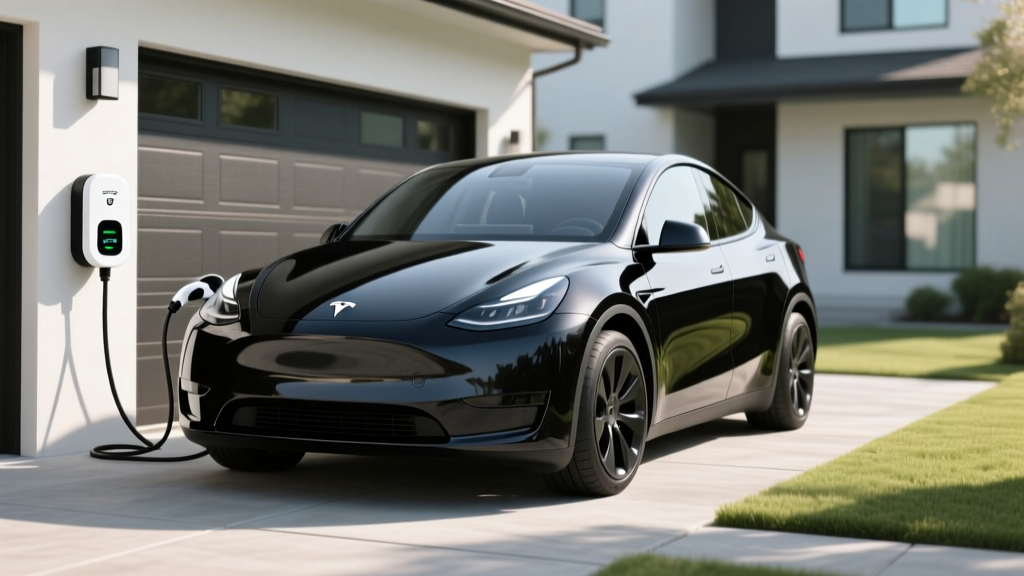
Level 2 home charging is the backbone of practical Tesla ownership. You're waking up every morning to a full battery, and your cost per mile undercuts gasoline by a wide margin. But installation costs vary enormously depending on your home's electrical panel, the distance from panel to charger location, and local permit fees.
Electrical Requirements
A typical Level 2 Tesla Wall Connector or third-party charger needs a dedicated 240V circuit. Common configurations:
- 40A circuit / 32A continuous: Delivers ~7.7 kW. Requires a NEMA 14-50 outlet or hardwired connection with 8 AWG copper wire. Suitable for most daily needs.
- 60A circuit / 48A continuous: Delivers ~11.5 kW. Requires hardwired connection with 6 AWG copper wire. Maximizes the Model 3/Y onboard charger capacity.
- 50A circuit / 40A continuous: Delivers ~9.6 kW. A middle ground using a NEMA 14-50 outlet or hardwire.
Panel upgrade warning: Most homes built before 2000 have 100A or 150A electrical panels. Adding a 60A EV circuit to a panel already running electric range, dryer, HVAC, and water heater may exceed 80% of the panel's rated capacity — the National Electrical Code threshold. An upgrade to 200A service typically costs $1,500–$3,500. Always have a licensed electrician perform a load calculation before committing to a circuit size.
| Component | Low End | High End | Notes |
|---|---|---|---|
| Level 2 Charger Equipment | $400 | $750 | Tesla Wall Connector ~$475; ChargePoint Home Flex ~$550–$700 |
| Electrician Labor | $500 | $2,500 | Depends on run length, conduit, drywall repair |
| Materials (wire, conduit, breaker) | $150 | $600 | Longer runs = more copper |
| Permit | $50 | $300 | Varies by municipality |
| Panel Upgrade (if needed) | $1,500 | $3,500 | 100A → 200A service upgrade |
| Total (no panel upgrade) | $1,100 | $4,150 | Most homes with 200A panels fall in $1,200–$2,000 |
| Total (with panel upgrade) | $2,600 | $7,650 | Older homes with 100A panels |
The IRS §30D credit does not cover home charger installation directly — that falls under the separate Residential Clean Energy Credit (25C/25E) and alternative fuel infrastructure credit, which have their own caps and eligibility rules. Consult a tax professional for your specific situation.
Which Connector and Charger Is Compatible with My Tesla?
Tesla uses the North American Charging Standard (NACS) connector — now simply called the Tesla connector — on all vehicles sold in North America. Since late 2024, Ford, GM, Rivian, Volvo, and others have adopted NACS as well, and Tesla Superchargers now welcome non-Tesla EVs via the Magic Dock adapter at select stations.
| Connector | Used By | Tesla Compatibility |
|---|---|---|
| NACS (Tesla) | Tesla (all), Ford, GM, Rivian, Volvo, others (2024+) | Native — no adapter needed |
| CCS1 | Most non-Tesla EVs (Hyundai, Kia, VW, BMW, legacy) | Tesla → CCS1: requires adapter (~$175–$250) for Electrify America, etc. |
| CHAdeMO | Nissan Leaf, Mitsubishi Outlander PHEV (legacy) | No practical adapter for Tesla; network is shrinking |
Adapter note: If you plan to use non-Tesla DC fast charging networks like Electrify America or EVgo while CCS1 stations are still common, budget for a Tesla-to-CCS1 adapter. Tesla sells an official adapter, and third-party options from Lectron and others are available. As networks transition to NACS through 2026–2027, this need will diminish.
How Much Does Charging Cost per Mile vs. Gasoline?
The cost advantage of electric charging depends heavily on your electricity rate, which varies by utility, time of day, and state. Below, we compare three common charging scenarios against a 30 MPG gasoline sedan using $3.40/gallon (2025–2026 national average).
| Scenario | Rate | Cost per kWh | Cost per Mile | Savings vs. Gas (30 MPG @ $3.40/gal) |
|---|---|---|---|---|
| Home (off-peak TOU) | $0.10/kWh | $0.10 | $0.029 | 87% cheaper ($0.113/mi for gas) |
| Home (standard rate) | $0.16/kWh | $0.16 | $0.046 | 59% cheaper |
| Tesla Supercharger (V3/V4) | $0.30–$0.40/kWh | $0.35 avg | $0.100 | 12% cheaper |
| Third-party DC fast (EA, EVgo) | $0.40–$0.55/kWh | $0.48 avg | $0.137 | More expensive than gas |
The takeaway: Home charging is where EV economics win decisively. If you charge 80% at home and 20% on public DC fast chargers (a typical road-trip-inclusive mix), your blended cost per mile is roughly $0.05–$0.06 — about half the cost of gasoline. If you rely exclusively on public DC fast charging, the savings narrow considerably, and in some markets, you'll pay more per mile than a fuel-efficient hybrid.
According to fueleconomy.gov, the 2025 Tesla Model 3 Long Range achieves 134 MPGe combined, translating to roughly 25 kWh per 100 miles. Use that figure to calculate costs for your specific utility rate.
Best Home Chargers for Tesla: Equipment Picks
Here are three Level 2 chargers that pair well with Tesla vehicles in 2025–2026, with their specs, smart features, and pricing. All deliver the full 48A/11.5 kW that Tesla's onboard charger supports on Model 3/Y Long Range and Model S/X.
Tesla Wall Connector (Gen 3)
- Power Output: Up to 11.5 kW (48A, 240V)
- Connector: NACS (native Tesla)
- Cable Length: 24 ft
- Smart Features: Wi-Fi for OTA updates, power sharing between two units, access control, integrated Tesla app monitoring
- Price: ~$475
- Best For: Tesla-only households wanting seamless integration
ChargePoint Home Flex
- Power Output: Up to 12 kW (50A, 240V) — configurable down to 16A
- Connector: NACS (J3400) or CCS1; NACS version now standard
- Cable Length: 23 ft
- Smart Features: ChargePoint app scheduling, Alexa integration, flexible amperage to match your circuit
- Price: ~$550–$700
- Best For: Multi-EV households (Tesla + non-Tesla) or future-proofing
Emporia Vue Level 2 Charger
- Power Output: Up to 11.5 kW (48A, 240V)
- Connector: NACS or J1772 (with adapter for Tesla on J1772 version)
- Cable Length: 24 ft
- Smart Features: Pairs with Emporia Vue energy monitor for whole-home load tracking, solar integration, TOU scheduling
- Price: ~$400–$500
- Best For: Solar-equipped homes and energy-monitoring enthusiasts
Safety, Code, and Installation Considerations
Level 2 EV charging draws sustained high current for hours — this is not the same as plugging in a dryer for a 45-minute cycle. The National Electrical Code (NEC) treats EVSE as a continuous load, meaning the circuit must be rated for 125% of the charger's maximum draw. A 48A charger requires a 60A breaker and wire rated for 60A continuous service.
- Dedicated circuit: Your EV charger must have its own dedicated circuit — no sharing with other appliances.
- GFCI protection: NEC 2020 and later require GFCI protection for outdoor receptacles used for EV charging. Hardwired installations with integrated ground-fault protection in the EVSE itself may satisfy this; check with your local inspector.
- Outdoor rating: If mounting outside, ensure the charger carries a NEMA 4 (weatherproof) rating. The Tesla Wall Connector and ChargePoint Home Flex are both rated for outdoor installation.
- Permit: Most jurisdictions require an electrical permit for new 240V circuits. Your electrician typically handles this, and an inspector will verify the installation before energizing.
- Cable management: A 24-foot cable on the ground is a trip hazard and degrades from UV/moisture exposure. Install a cable holster or retractable reel.
Always defer final electrical specifications to a licensed electrician who has inspected your panel, wire runs, and local code requirements. The cost ranges above are national averages; your market may differ.
Frequently Asked Questions
How many kWh does it take to fully charge a Tesla Model 3?
A Tesla Model 3 Long Range has approximately 82 kWh of usable battery capacity. To charge from 0% to 100%, you'll draw roughly 90 kWh from the wall due to ~10% charging losses. In practice, most owners charge from 10–20% to 80%, which pulls about 55–65 kWh per session. The Model 3 RWD with LFP chemistry has a smaller ~57 kWh usable battery; Tesla recommends periodic 100% charges for LFP to maintain cell calibration.
Is it cheaper to charge a Tesla at home or at a Supercharger?
Home charging is almost always cheaper. At the national average residential rate of ~$0.16/kWh (per EIA data), a full Model 3 LR charge costs about $13 for ~300 miles. A Supercharger session at $0.35/kWh for the same energy costs roughly $28–$30. Time-of-use plans can push home off-peak rates to $0.08–$0.10/kWh, cutting costs further.
Can I charge my Tesla with a regular 120V outlet?
Yes, using the Tesla Mobile Connector with a NEMA 5-15 adapter. Level 1 charging delivers about 1.4 kW, adding roughly 3–5 miles of range per hour. A full charge from 20% to 80% takes over 24 hours. It's viable for low-mileage drivers (under 30 miles/day) or as a backup, but most owners install Level 2 for daily convenience.
Do I need a Tesla Wall Connector, or can I use a third-party charger?
You can use any Level 2 charger with a NACS connector. The Tesla Wall Connector offers the tightest app integration, but third-party options like the ChargePoint Home Flex or Emporia charger provide comparable performance with additional smart-home features. Since Tesla's onboard charger handles the AC-to-DC conversion, the external charger simply supplies 240V AC — brand compatibility is determined by the connector, not the electronics.
What electrical upgrades might I need for a home charger?
The most common upgrade is a 100A-to-200A panel replacement if your existing panel lacks capacity for a dedicated 40–60A circuit. Homes with 200A panels usually accommodate a Level 2 charger without a panel upgrade, provided the electrician's load calculation confirms headroom. Other potential costs include trenching for detached garages ($15–$30/foot), conduit runs over 50 feet, or sub-panel installation. Budget $1,200–$2,000 for a straightforward install on a 200A panel; $3,000–$7,500 if a panel upgrade is required.
How fast does each charging level add range to a Tesla?
Level 1 (120V) adds 3–5 miles per hour. Level 2 at 11.5 kW (48A, 240V) adds roughly 40–44 miles per hour on a Model 3 Long Range. DC fast charging at a V3 Supercharger (250 kW peak) can add up to 200 miles in about 15 minutes, though the charge curve tapers significantly above 50% SoC. Preconditioning your battery (automatic when you navigate to a Supercharger) is essential for achieving peak DC charge rates.