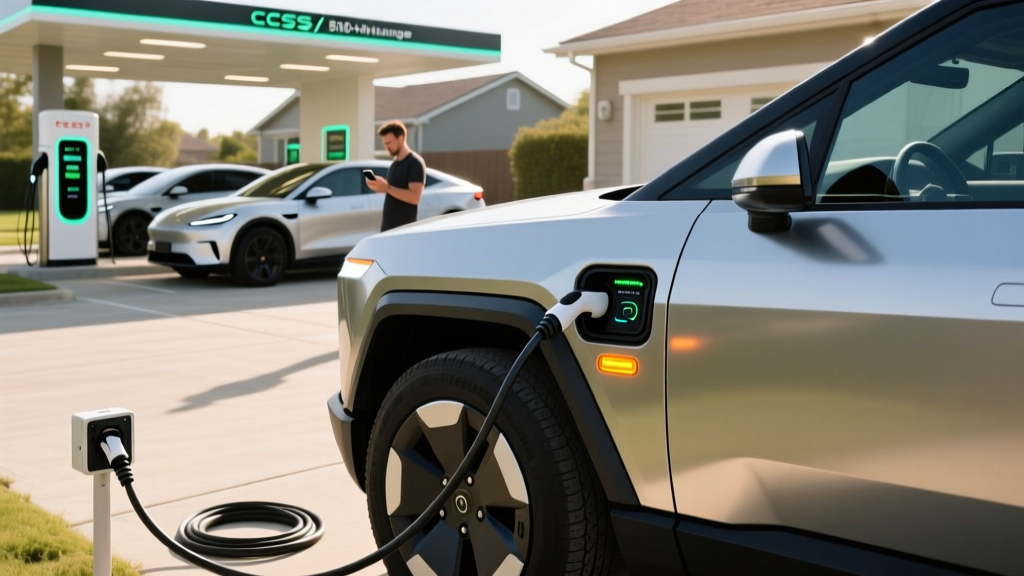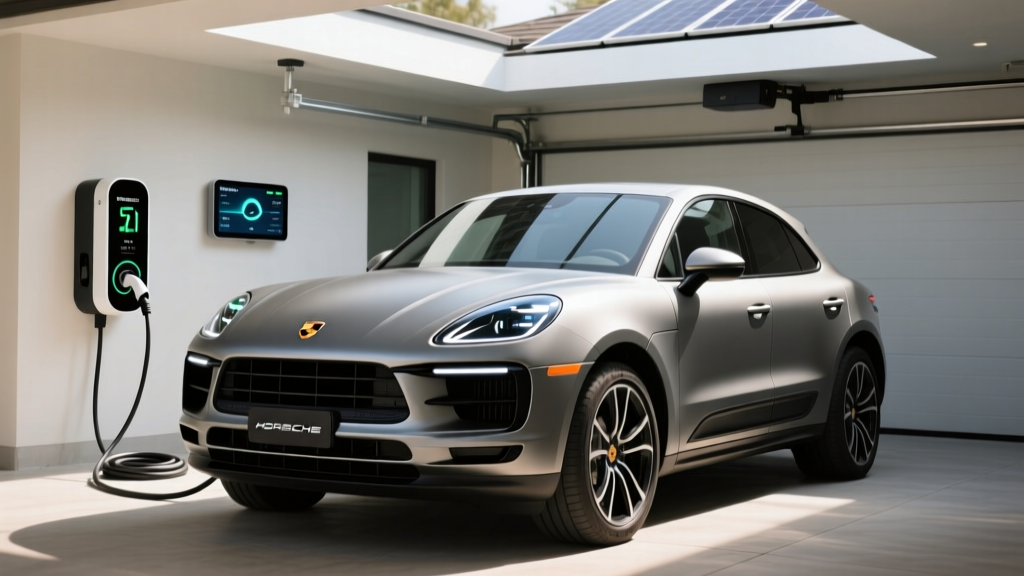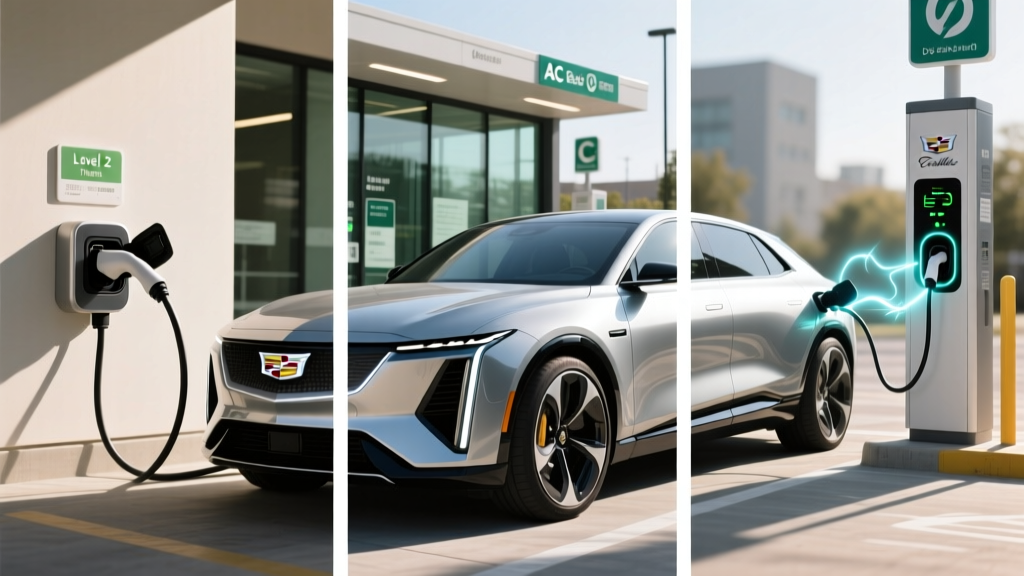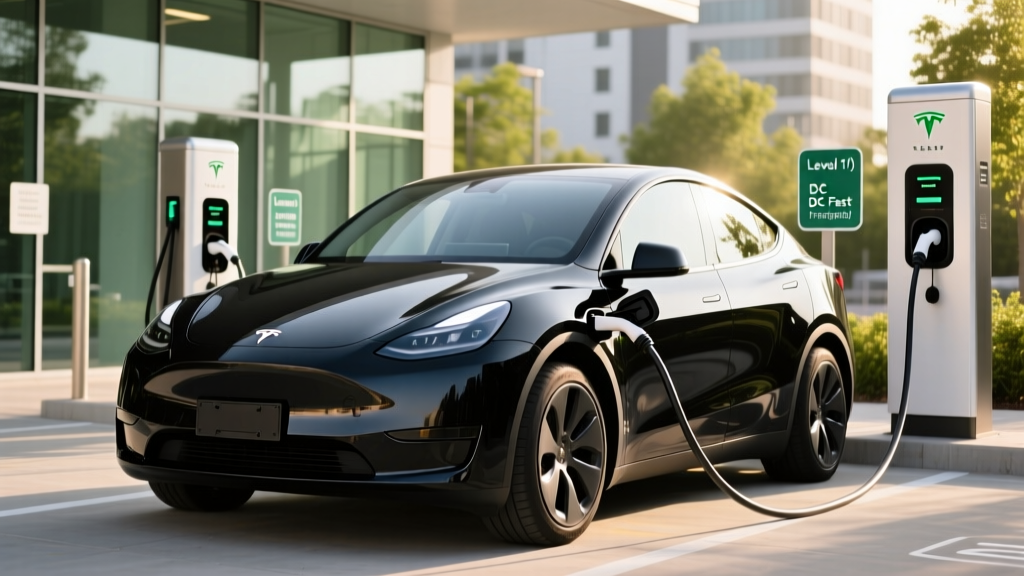
If you own a Tesla or are considering one, the most practical question after range is charging speed. The answer depends entirely on which charging level you use, the specific battery pack in your Tesla, and the state of charge (SoC) when you plug in. Below, we break down exactly how long to charge a Tesla at a charging station — from a standard wall outlet to a V4 Supercharger — with real numbers for every current Tesla model.
Understanding kW vs. kWh: The Two Numbers That Matter
Before looking at charging times, you need to separate two terms that get confused constantly:
- kWh (kilowatt-hours) measures energy — the size of your Tesla's battery. A Model 3 Long Range has roughly 79 kWh of usable capacity; a Model S uses about 95 kWh.
- kW (kilowatts) measures power — how fast energy flows into the battery. A Level 2 home charger might deliver 11.5 kW; a V4 Supercharger can peak at 250 kW or more.
Think of it like filling a pool: kWh is the pool's volume, kW is the hose's flow rate. Charging time is simply the volume divided by the flow rate — with one major caveat we'll cover below: the flow rate isn't constant.
Charging Levels Explained: Speed, Power, and Miles Per Hour
Every EV, including all Tesla models, charges at one of three levels. Here's how they compare with real-world numbers:
| Charging Level | Voltage | Typical Power (kW) | Miles of Range Added Per Hour | Best Use Case |
|---|---|---|---|---|
| Level 1 (120V outlet) | 120V | 1.0–1.4 kW | 3–5 miles/hr | Emergency / overnight trickle |
| Level 2 (240V home/public) | 240V | 7.2–19.2 kW | 25–55 miles/hr | Daily home & destination charging |
| DC Fast Charging (Supercharger) | 400V+ | 50–250+ kW | 200–1,000+ miles/hr (peak) | Road trips & rapid top-ups |
Tesla's onboard charger maxes out at 11.5 kW on AC power (48 amps on a 60-amp circuit) for the Model 3 and Model Y, and up to 16.5 kW (72 amps) on the Model S and Model X with the optional high-amperage charger. That means even if you install a 19.2 kW Level 2 station, a Model 3 will only accept 11.5 kW from it.
Exact Charging Times: Tesla Model by Model
Here's where the keyword question gets answered with precision. Charging time depends on battery size and the power source. All times below assume a 10% to 80% state-of-charge session, which is the standard fast-charging window (charging slows dramatically above 80% to protect the battery).
Level 1 Charging (120V Standard Outlet)
Every Tesla ships with a Mobile Connector that includes a 120V NEMA 5-15 adapter. At roughly 1.2 kW, expect:
- Model 3 Standard Range (60 kWh): ~38 hours for a 10–80% charge
- Model 3/Y Long Range (~79 kWh): ~46 hours for 10–80%
- Model S/X (~95 kWh): ~55 hours for 10–80%
Level 1 is practical only as a trickle for drivers who travel fewer than 30 miles per day and have no access to 240V. It is not a viable primary charging strategy for most owners.
Level 2 Charging (240V Home or Public Station)
This is where the majority of Tesla charging happens. At 11.5 kW (the Model 3/Y maximum on AC), a 10–80% session takes:
- Model 3 Standard Range: ~4 hours
- Model 3/Y Long Range: ~4.8 hours
- Model S/X (at 16.5 kW with high-amp charger): ~3.8 hours
- Model S/X (at 11.5 kW standard): ~5.5 hours
Plug in at 10 PM, and you'll wake up to a full daily charge by 6 AM — every time. This is the baseline experience that makes EV ownership effortless for homeowners with a garage or dedicated parking spot.
DC Fast Charging (Tesla Supercharger Network)
Tesla's Supercharger network is the gold standard for road-trip charging. Current V3 stalls deliver up to 250 kW; V4 cabinets deployed through 2025–2026 can deliver up to 350 kW to compatible vehicles. Here's what 10–80% looks like at a Supercharger:
- Model 3 Long Range (250 kW peak): ~25–28 minutes
- Model 3 Performance (250 kW peak): ~25 minutes
- Model Y Long Range (250 kW peak): ~27–30 minutes
- Model S Plaid (250 kW peak): ~30–33 minutes
- Model X (250 kW peak): ~33–36 minutes
Home Charger Installation: Requirements, Costs, and Gotchas
The single biggest variable in Tesla ownership cost is whether your home's electrical panel can support a dedicated 240V circuit. Here's what you need to know before calling an electrician.
Electrical Requirements
- Circuit: A 60-amp dedicated breaker is recommended for the Tesla Wall Connector at full 48-amp output (11.5 kW). A 50-amp circuit (40-amp continuous) delivers 9.6 kW and is sufficient for most daily needs.
- Wire gauge: 6 AWG copper for a 60-amp circuit; 8 AWG for 50-amp.
- Panel capacity: Your main service panel must have room for the additional breaker and sufficient total amperage. Most modern homes with 200-amp service handle this without issue. Older homes with 100-amp service often require a panel upgrade.
- GFCI protection: The National Electrical Code (NEC) requires GFCI protection for EV chargers installed in garages. The Tesla Wall Connector has built-in GFCI, which typically satisfies this requirement without a separate GFCI breaker.
- Permit: Most jurisdictions require an electrical permit for a new 240V circuit. Your electrician typically pulls this; cost is usually $50–$200.
Home Charger Installation Cost Breakdown (2026 Estimates)
| Component | Cost Range |
|---|---|
| Tesla Wall Connector (equipment) | $420–$475 |
| Electrician labor (standard install, panel nearby) | $500–$1,200 |
| Electrician labor (long wire run, conduit, wall penetration) | $1,200–$2,500 |
| Electrical permit | $50–$200 |
| Panel upgrade (100A to 200A, if needed) | $1,500–$4,000 |
| Total — straightforward install | $970–$1,875 |
| Total — with panel upgrade | $2,470–$5,875 |
Some utilities offer rebates of $250–$1,000 for Level 2 charger installation, and the federal Alternative Fuel Vehicle Refueling Property Credit (30C) covers up to 30% of equipment and installation costs (max $1,000) for eligible taxpayers in qualifying census tracts. Check irs.gov for current eligibility.
Connector Compatibility: NACS, CCS, and the Adapter Question
Tesla uses the North American Charging Standard (NACS) connector — the proprietary design that has now been adopted by nearly every major automaker starting in 2025. Here's the current compatibility landscape:
| Connector Type | Tesla Vehicles | Non-Tesla EVs (2025–2026) | Adapter Needed? |
|---|---|---|---|
| NACS (Tesla native) | All Tesla models — native port | Ford, GM, Rivian, Hyundai, others — native on new models | No adapter for Tesla; older non-Tesla EVs need CCS-to-NACS adapter |
| CCS1 | Tesla can use CCS stalls with a Tesla CCS adapter (~$175) | Most legacy non-Tesla EVs (2018–2024 models) | Tesla owners need CCS adapter for non-Tesla DCFC networks |
| CHAdeMO | Not compatible — no adapter available from Tesla | Nissan Leaf, older Mitsubishi | N/A — network is being phased out |
For Tesla owners, the NACS port means direct compatibility with the Supercharger network and, increasingly, with destination chargers and third-party stations adopting NACS. If you need to use Electrify America or other CCS-based networks, Tesla sells a CCS adapter that enables access — useful in areas where Supercharger coverage is sparse.
Cost to Charge a Tesla: Per-Mile Breakdown vs. Gasoline
Charging cost is where EV ownership economics shine — but the savings vary dramatically depending on where and when you charge.
| Charging Scenario | Average $/kWh | Cost to Add 200 Miles (Model 3 LR at ~4 mi/kWh) | Cost Per Mile |
|---|---|---|---|
| Home (off-peak utility rate) | $0.08–$0.14 | $4.00–$7.00 | $0.02–$0.035 |
| Home (standard residential rate) | $0.14–$0.20 | $7.00–$10.00 | $0.035–$0.05 |
| Tesla Supercharger (average 2026) | $0.28–$0.40 | $14.00–$20.00 | $0.07–$0.10 |
| Third-party DCFC (Electrify America, etc.) | $0.35–$0.55 | $17.50–$27.50 | $0.088–$0.138 |
| Gasoline comparison (30 MPG at $3.40/gal) | — | $22.67 | $0.113 |
Home charging on an off-peak rate is roughly one-quarter to one-third the per-mile cost of gasoline. Even Supercharging at $0.35/kWh undercuts the gas equivalent in most states. The worst-case scenario — frequent third-party DCFC use at $0.50+/kWh — can approach or exceed gas costs, which is why home charging access remains the single most important factor in EV economics.
Recommended Home Charging Equipment for Tesla Owners
Not all Level 2 chargers are equal. Here are the top options for Tesla owners in 2026, based on power output, build quality, and smart features:
Tesla Wall Connector (Gen 4)
- Power output: Up to 11.5 kW (48A on a 60A circuit)
- Connector: NACS (native Tesla)
- Cable length: 24 feet
- Smart features: Wi-Fi for OTA updates, load sharing between two units, access control, integrated cable management
- Price: ~$450
- Verdict: Best default choice for Tesla-only households. Seamless integration, excellent build, and the longest cable in its class.
ChargePoint Home Flex
- Power output: Up to 12 kW (50A, configurable down to 16A for lower-amp panels)
- Connector: NACS or J1772 (NACS version now standard)
- Cable length: 23 feet
- Smart features: App-based scheduling, Alexa integration, detailed energy tracking, flexible amperage configuration
- Price: ~$550–$650
- Verdict: Best for mixed-EV households or those who want granular energy tracking and scheduling via app.
Emporia Level 2 EV Charger
- Power output: Up to 11.5 kW (48A)
- Connector: NACS or J1772
- Cable length: 24 feet
- Smart features: Integration with Emporia home energy monitor, solar-aware charging, time-of-use scheduling
- Price: ~$350–$400
- Verdict: Best budget option with smart features. Excellent for solar-equipped homes that want to charge only on excess production.
Safety, Code, and Installation Best Practices
A Level 2 charger draws significant continuous current — often for 6–10 hours at a stretch. Cutting corners on installation creates fire risk and may void your homeowner's insurance coverage.
- Dedicated circuit: Your charger must be on its own dedicated breaker. Never share a circuit with other high-draw appliances.
- Continuous-load derating: NEC requires that continuous loads (3+ hours) use only 80% of a circuit's rated capacity. A 60-amp breaker supports 48 amps continuous — which is exactly the Tesla Wall Connector's maximum draw.
- Outdoor rating: If installing outdoors, ensure the unit is NEMA 4 rated (the Tesla Wall Connector and ChargePoint Home Flex both are). Use a weatherproof conduit entry.
- Licensed electrician: Always use a licensed, insured electrician. DIY 240V work is dangerous and typically violates code. Your electrician should pull the required permit and schedule the inspection.
- Wire quality: Ensure your electrician uses copper wire (not aluminum) at the correct gauge for the circuit amperage and run length.
Frequently Asked Questions
How long to charge a Tesla at a Supercharger on a road trip?
Expect 25–35 minutes for a 10–80% session at a V3 (250 kW) Supercharger, depending on your model and battery temperature. Tesla's navigation system preconditions the battery automatically when you route to a Supercharger, which is critical — arriving without preconditioning can double your charge time in cold weather.
Can I charge a Tesla on a regular 120V household outlet?
Yes, using the included Mobile Connector with a NEMA 5-15 adapter. You'll add roughly 3–5 miles of range per hour (about 1.2 kW). It's adequate for very low-mileage drivers or as a backup, but a full charge from 10–80% on a Model Y Long Range takes over 45 hours.
How much does it cost to install a home EV charger?
A straightforward Tesla Wall Connector installation on an existing 200-amp panel with a nearby garage typically costs $970–$1,875 including equipment, labor, and permit. If your home has a 100-amp panel and needs a service upgrade, total costs can reach $2,500–$5,900. The federal 30C tax credit may offset up to $1,000 (30% of equipment and installation) if you're in an eligible census tract.
Is it cheaper to charge a Tesla at home or at a Supercharger?
Home charging is significantly cheaper. At a national average residential rate of $0.16/kWh, adding 200 miles to a Model 3 Long Range costs about $8. The same 200 miles at a Supercharger averaging $0.34/kWh costs roughly $17 — more than double, though still less than gasoline in most states.
Do I need a panel upgrade to install a Tesla charger at home?
Maybe. If your home has a 200-amp electrical service (standard in most homes built after 1990), you almost certainly don't need an upgrade. If you have a 100-amp service (common in older homes), adding a 60-amp EV circuit may exceed your panel's capacity, requiring a $1,500–$4,000 upgrade. A licensed electrician can perform a load calculation to determine this before any work begins.
Does charging to 100% damage the Tesla battery?
For daily driving, Tesla recommends setting the charge limit to 80% on Long Range models (which use NMC chemistry). The Standard Range models with LFP batteries can and should be charged to 100% regularly — Tesla explicitly recommends this for LFP packs to maintain accurate state-of-charge readings. Occasional 100% charges before road trips are fine for any chemistry.
What connector do I need for non-Tesla charging networks?
Tesla's native NACS port works directly at all Superchargers and at the growing number of third-party stations adding NACS cables. For CCS-based networks like Electrify America, you'll need Tesla's CCS adapter (approximately $175 from the Tesla store). The CHAdeMO standard is being phased out and has no Tesla-compatible adapter.