The Short Answer: Tesla Supercharger Speeds in 2026
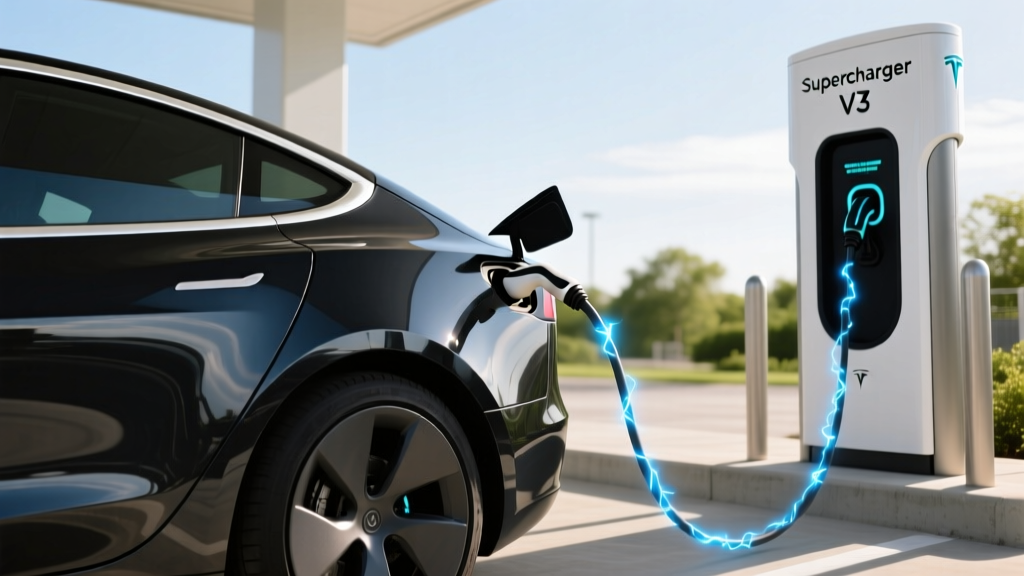
If you've ever wondered how fast is a Tesla Supercharger, the answer depends on the station generation and the vehicle you're plugging in. Tesla's North American Supercharger network now operates three tiers:
- V2 (150 kW): Legacy stations; peak delivery of ~150 kW, adding roughly 170 miles of range in 30 minutes on a Model 3 Long Range.
- V3 (250 kW): The current backbone; peak delivery of 250 kW, adding up to 200 miles in 15 minutes under ideal conditions.
- V4 (up to 350 kW for future vehicles): Newer cabinets deployed starting in 2024, currently delivering up to 250 kW to existing Teslas but engineered for higher throughput as next-gen architectures (800V+) arrive.
But peak kW is only half the story. Charging speed depends on battery state of charge (SoC), battery temperature, cell chemistry (LFP vs. NMC), and the vehicle's onboard charge acceptance curve. A Model 3 Long Range (75 kWh usable, NMC) hitting a V3 stall at 10% SoC with a preconditioned battery will see a peak of ~250 kW that quickly tapers. A realistic 10–80% session takes 25–30 minutes — not the 15 minutes marketing materials imply.
Charging Levels Explained: Level 1, Level 2, and DC Fast
Superchargers are DC fast chargers (Level 3 equivalent), but most EV charging happens at home on Level 1 or Level 2. Understanding the difference — and the critical distinction between kW (power, the rate of flow) and kWh (energy, the amount stored) — is foundational EV literacy.
| Level | Voltage | Max Power (kW) | Miles of Range Added per Hour | Typical Use Case |
|---|---|---|---|---|
| Level 1 | 120V AC | 1.4–1.9 kW | 3–5 mi/hr | Overnight top-up, PHEVs, low-mileage drivers |
| Level 2 (home) | 240V AC | 7.2–11.5 kW | 25–44 mi/hr | Daily home charging, the EV ownership standard |
| Level 2 (public) | 208/240V AC | 7.2–19.2 kW | 25–70 mi/hr | Workplace, retail, destination charging |
| DC Fast (Tesla V3) | 400–800V DC | Up to 250 kW | ~1,000 mi/hr (peak) | Road trips, rapid top-up |
| DC Fast (350 kW CCS) | 400–800V DC | Up to 350 kW | ~1,200 mi/hr (peak) | Hyundai/Kia E-GMP, Porsche Taycan, Lucid |
Why "miles per hour" at peak DC fast rates is misleading: That ~1,000 mi/hr figure at 250 kW only holds for a narrow SoC window (roughly 10–30%). Above 50% SoC, the charge curve tapers aggressively. By 80% SoC, you're typically pulling 60–80 kW — a fraction of peak. This is why we benchmark 10–80% times, not peak rates.
Real Charging Times: 10–80% at a Tesla Supercharger
Below are estimated 10–80% times for popular Tesla models at a V3 (250 kW) Supercharger with a preconditioned battery at moderate ambient temperature (65–80°F):
| Vehicle | Battery (kWh usable) | Chemistry | Peak kW | 10–80% Time |
|---|---|---|---|---|
| Model 3 RWD | 57.5 | LFP | ~170 kW | ~30 min |
| Model 3 Long Range AWD | 75 | NMC | ~250 kW | ~27 min |
| Model Y Long Range AWD | 75 | NMC | ~250 kW | ~28 min |
| Model S (2026) | 95 | NMC | ~250 kW | ~35 min |
| Model X (2026) | 95 | NMC | ~250 kW | ~37 min |
| Cybertruck AWD | 123 | NMC | ~250 kW | ~42 min |
What about non-Tesla EVs on Superchargers?
As of 2026, Tesla has opened thousands of Supercharger stalls to non-Tesla EVs via the NACS (North American Charging Standard) connector or a built-in Magic Dock CCS adapter. However, non-Tesla vehicles often charge slower on Superchargers because:
- The vehicle's onboard charge controller may cap acceptance below 250 kW.
- Adapter-related communication overhead can reduce handshake efficiency.
- Some non-Tesla EVs with 800V architectures (e.g., Hyundai Ioniq 5, Kia EV6) actually charge faster on 350 kW Electrify America or Ionity stations than on a 250 kW Supercharger.
How Much Does It Cost to Install a Home EV Charger?
Most EV owners do 80–90% of their charging at home on a Level 2 (240V) circuit. The total cost depends on your electrical panel's capacity, the distance from the panel to the charger location, and local permit fees. Here's a realistic breakdown:
| Component | Low Estimate | High Estimate | Notes |
|---|---|---|---|
| Level 2 Charger (hardware) | $400 | $750 | 40A–48A smart charger; Tesla Wall Connector, ChargePoint Home Flex, Emporia Level 2 |
| Electrician labor | $500 | $2,000 | Depends on run length, wall type, conduit needs |
| Electrical permit | $50 | $300 | Varies by municipality |
| Panel upgrade (if needed) | $1,500 | $4,000 | Required if your panel is 100A or lacks spare breaker slots; 200A service upgrade |
| Total (no panel upgrade) | $950 | $3,050 | |
| Total (with panel upgrade) | $2,450 | $7,050 |
Electrical Requirements for a Level 2 Home Charger
A typical Level 2 home charger requires:
- Voltage: 240V (same as a dryer or oven outlet)
- Amperage: 40A or 50A dedicated circuit (breaker rated at 125% of continuous load, so a 40A charger needs a 50A breaker)
- Wire gauge: 6 AWG copper (for 50A) or 4 AWG aluminum
- Outlet type: NEMA 14-50 (most common) or hardwired connection (preferred for 48A+ chargers to avoid plug overheating)
Safety and Code Considerations
- Dedicated circuit: Your EV charger must be on its own dedicated breaker — never shared with other appliances.
- GFCI protection: NEC 2020 and later require GFCI protection for outdoor receptacles; many jurisdictions extend this to indoor EV outlets. Hardwired chargers with built-in GFCI simplify compliance.
- Outdoor rating: If your charger is mounted outside, ensure it carries a NEMA 4 or NEMA 4X rating for weather resistance.
- Permit and inspection: Skipping the permit risks insurance claim denials and code violations discovered at home sale. Most jurisdictions require a post-install inspection.
- Federal incentive: The IRS §30C credit offers up to $1,000 (30% of cost, capped) for home EV charger installation through 2032, subject to census-tract eligibility. Check irs.gov for current qualification maps.
Which Connector and Charger Is Compatible With My EV?
The connector landscape in North America has consolidated significantly since 2024, when Ford, GM, Rivian, Volvo, and most major automakers adopted the NACS (Tesla) connector. By 2026, NACS is the dominant standard, though CCS1 chargers remain widely available.
| Connector | Brands Using It (native) | DC Fast Charging? | Adapter Needed? |
|---|---|---|---|
| NACS (Tesla) | Tesla, Ford, GM, Rivian, Volvo, Polestar, Mercedes, Hyundai (2025+), Kia (2025+) | Yes | None for native; CCS→NACS adapters available for older CCS vehicles |
| CCS1 | Hyundai/Kia (pre-2025), VW ID.4 (pre-2025), BMW iX, older Nissan, Lucid | Yes | NACS→CCS adapter needed for Tesla Superchargers (Magic Dock at some stalls) |
| CHAdeMO | Nissan Leaf (discontinued 2025), Mitsubishi Outlander PHEV (legacy) | Yes | CHAdeMO→CCS or CHAdeMO→NACS adapters (limited availability) |
| J1772 | All EVs (Level 2 AC standard) | No (AC only) | Tesla ships with J1772→NACS adapter; others use J1772 natively |
Adapter note: If you drive a CCS-equipped EV and want access to Tesla Superchargers, you'll need either a stall with a built-in Magic Dock or a third-party NACS-to-CCS adapter (e.g., Lectron, A2Z). These adapters are rated for specific kW limits — check that yours supports at least 150 kW DC to avoid bottlenecking your charge speed.
How Much Does Charging Cost Per Mile vs. Gas?
The economics of EV charging depend heavily on where and when you charge. Here's a cost-per-mile breakdown for a typical EV averaging 3.5 miles per kWh (e.g., Tesla Model Y, Hyundai Ioniq 5) compared to a 28 MPG gas car at $3.50/gallon:
| Charging Scenario | Cost per kWh | Cost per Mile (3.5 mi/kWh) | Annual Cost (12,000 mi) |
|---|---|---|---|
| Home, off-peak utility rate | $0.09 | $0.026 | $309 |
| Home, average US rate | $0.16 | $0.046 | $549 |
| Tesla Supercharger (avg) | $0.30 | $0.086 | $1,029 |
| Electrify America / EVgo (avg) | $0.38 | $0.109 | $1,303 |
| Gas car (28 MPG, $3.50/gal) | — | $0.125 | $1,500 |
Even at public DC fast-charger rates, EVs remain cheaper per mile than gasoline — but the savings gap narrows dramatically. The real economic win is home charging at off-peak rates, which delivers fuel costs roughly 80% lower than gasoline. If you rely exclusively on public Superchargers, your annual "fuel" cost is ~$1,029 vs. ~$1,500 for gas — a $471/year savings, not the $1,200+ you'd save charging at home.
Time-of-use (TOU) utility plans can further reduce home charging costs. Many utilities offer rates as low as $0.06–$0.09/kWh overnight (10 PM–6 AM), making a full Model Y charge (75 kWh) cost just $4.50–$6.75.
Recommended Home Level 2 Chargers (2026)
Here are three chargers we recommend based on reliability, smart features, and value:
Tesla Wall Connector
- Power: Up to 11.5 kW (48A)
- Connector: NACS (native); J1772 adapter included
- Cable length: 24 ft
- Smart features: Wi-Fi, OTA updates, power sharing (load-balance two units on one circuit)
- Price: ~$475
- Best for: Tesla owners; cleanest integration with Tesla app
ChargePoint Home Flex
- Power: Up to 12 kW (50A) — configurable down to 16A
- Connector: J1772 (NACS adapter available)
- Cable length: 23 ft
- Smart features: Wi-Fi, Alexa/Google Home, scheduling, detailed energy tracking
- Price: ~$550
- Best for: Non-Tesla EVs; flexible amperage for older panels
Emporia Vue Level 2 EV Charger
- Power: Up to 11.5 kW (48A)
- Connector: J1772 (NACS version available)
- Cable length: 24 ft
- Smart features: Wi-Fi, integrates with Emporia Vue energy monitor, solar-aware scheduling
- Price: ~$400
- Best for: Budget-conscious buyers; solar-panel households
Frequently Asked Questions
How fast will each charging level add range?
Level 1 (120V) adds 3–5 miles of range per hour — adequate for PHEVs with small batteries or BEV owners who drive under 30 miles daily. Level 2 (240V, 40–48A) adds 25–44 miles per hour, replenishing most EVs overnight in 6–9 hours. DC fast charging (150–350 kW) adds 150–200+ miles in 15–30 minutes, but only during the 10–80% SoC window; above 80%, speed drops sharply to protect battery health.
How much does it cost to install a home EV charger?
Expect $950–$3,050 for a standard Level 2 install on an existing 200A panel. If your home needs a panel upgrade from 100A to 200A service, add $1,500–$4,000. The federal §30C credit may offset up to $1,000 (30% of hardware + labor), subject to census-tract eligibility — verify at irs.gov.
Which connector/charger is compatible with my EV?
For 2025+ model-year vehicles from Ford, GM, Rivian, Volvo, Polestar, Hyundai, and Kia: NACS is native. For pre-2025 CCS vehicles (VW ID.4, older Hyundai/Kia, BMW iX): you'll need a NACS-to-CCS adapter to use Tesla Superchargers, or use Electrify America/EVgo CCS stalls natively. CHAdeMO is legacy — the Nissan Leaf ended production in 2025, and new CHAdeMO infrastructure is essentially nonexistent. All EVs accept J1772 for Level 2 AC charging.
How much does charging cost per mile vs. gas?
Home charging at the US average rate ($0.16/kWh) costs ~$0.046/mile in a typical EV. A 28 MPG gas car at $3.50/gallon costs ~$0.125/mile. That's a 63% per-mile savings charging at home. Public DC fast charging at $0.30–$0.38/kWh costs $0.086–$0.109/mile — still cheaper than gas, but the gap narrows to 13–31%.
What electrical upgrades might I need?
The most common upgrade is a 100A→200A panel service replacement, needed in older homes where the existing panel lacks spare breaker slots or total amperage headroom. You may also need: a new 50A double-pole breaker, 6 AWG copper wire run (cost scales with distance from panel to charger), a NEMA 14-50 outlet or hardwired junction box, and potentially a utility meter socket upgrade. A licensed electrician's load calculation (typically $100–$200 as a standalone service) will determine exactly what's required before you commit to hardware.
Does cold weather affect Supercharger speed?
Yes, significantly. Lithium-ion cells cannot accept high charge rates when cold. If you arrive at a Supercharger with a battery temperature below ~50°F without preconditioning, the BMS will limit intake to 30–80 kW until the battery warms — potentially doubling your 10–80% time. Always use Tesla's built-in navigation to route to a Supercharger; the car will automatically precondition the battery en route, bringing it to optimal temperature (~95°F) for maximum charge acceptance.
Is it bad to Supercharge frequently?
DC fast charging accelerates battery degradation modestly compared to Level 2 charging, but modern thermal management systems have minimized this effect. Tesla's own data and third-party studies (e.g., fueleconomy.gov) suggest that exclusive Supercharging may add ~2–4% additional degradation over 150,000 miles compared to home Level 2 charging. For daily use, Level 2 at home remains the longevity-optimal choice; Superchargers are best reserved for road trips and occasional rapid top-ups.