Level 1 vs. Level 2 vs. DC Fast: What Each Level Actually Delivers
If you've ever wondered how fast is Level 2 charging compared to plugging into a wall outlet or pulling up to a highway fast charger, the answer comes down to one number: kilowatts (kW). A kilowatt measures the rate of energy flowing into your battery, while a kilowatt-hour (kWh) measures the total energy stored. Confusing the two is the single most common EV mistake — think of kW as the size of the hose and kWh as the bucket.
Here's exactly what each level adds to your range per hour of charging, based on typical EV efficiencies of 3–4 miles per kWh:
| Level | Voltage | Power (kW) | Miles of Range Per Hour | Typical Use Case |
|---|---|---|---|---|
| Level 1 | 120V AC | 1.0–1.4 kW | 3–5 mi/hr | Overnight trickle; PHEVs; emergencies |
| Level 2 (home/public) | 208–240V AC | 3.3–19.2 kW | 12–75 mi/hr | Daily home charging; workplace; destination |
| DC Fast Charging | 400–800V DC | 50–350+ kW | 150–1,000+ mi/hr (burst) | Road trips; highway corridors |
For a 75 kWh battery (think Tesla Model Y Long Range or Hyundai Ioniq 5), a Level 2 charger delivering 11.5 kW (48 amps on a 60-amp circuit) will take roughly 6.5 hours from empty to full — easily covering overnight replenishment. A Level 1 outlet at 1.2 kW would need over 62 hours for the same job, which is why Level 2 is the practical baseline for battery-electric ownership.
How Fast Will Level 2 Charge My Specific EV?
The answer depends on two factors: your charger's output and your vehicle's onboard charger limit. The onboard charger is the bottleneck — it converts AC power from your Level 2 station into DC for the battery. If your EV's onboard charger maxes out at 11.5 kW, plugging into a 19.2 kW station won't speed things up.
Here are 10–80% charging times for several popular 2025–2026 EVs on a typical 48-amp (11.5 kW) home Level 2 charger:
| Vehicle | Battery (kWh usable) | Onboard Charger Limit | 10–80% Time | EPA Range |
|---|---|---|---|---|
| Tesla Model Y Long Range | 75 kWh (NMC) | 11.5 kW | ~4.5 hours | 320 mi |
| Hyundai Ioniq 5 (Long Range) | 77.4 kWh (NMC) | 10.9 kW | ~5 hours | 303 mi |
| Ford Mustang Mach-E (Ext. Range) | 91 kWh (NMC) | 10.5 kW | ~6 hours | 320 mi |
| Chevrolet Equinox EV 3RS | 85 kWh (NMC) | 11.5 kW | ~5.2 hours | 319 mi |
| Toyota bZ4X | 64 kWh (NMC) | 6.6 kW | ~4.8 hours* | 252 mi |
*The bZ4X's 6.6 kW onboard charger is the limiting factor — it charges slower despite the smaller battery.
According to fueleconomy.gov, the EPA rates these vehicles' efficiency between 2.8 and 3.8 miles per kWh. On a 48-amp Level 2 circuit, expect roughly 33–44 miles of range added per hour of charging, depending on your vehicle's efficiency.
Home Level 2 Installation: Electrical Requirements and Costs
Installing a Level 2 home charger isn't just buying a wall box — it's an electrical project. Here's what's involved and what you'll actually pay.
Electrical Requirements
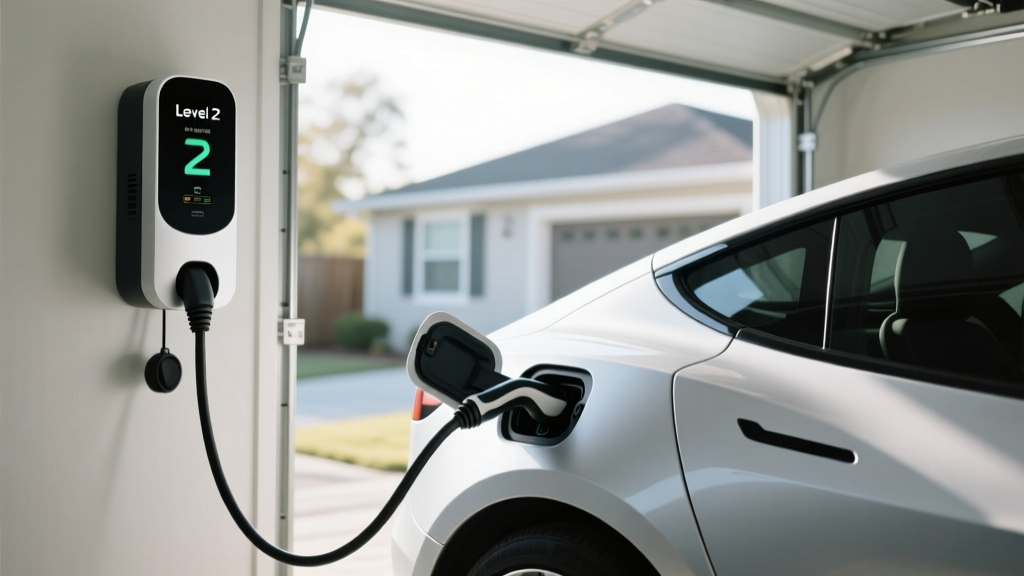
A Level 2 charger requires a dedicated 240-volt circuit, the same type of outlet your electric dryer or oven uses. The most common home setups:
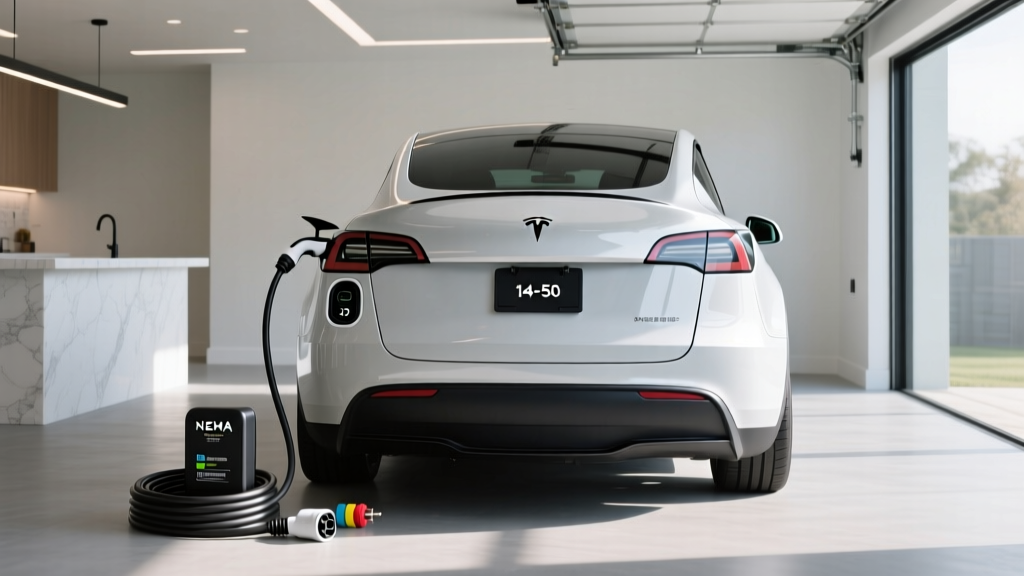
- 40-amp circuit (32A continuous): Delivers 7.7 kW. Sufficient for most EVs and works with a NEMA 14-50 outlet or hardwired connection.
- 50-amp circuit (40A continuous): Delivers 9.6 kW. The sweet spot for most homes — handles overnight charging for nearly any EV.
- 60-amp circuit (48A continuous): Delivers 11.5 kW. Ideal for larger batteries (90+ kWh) or if you want maximum future-proofing.
Installation Cost Breakdown
| Component | Low End | High End | Notes |
|---|---|---|---|
| Level 2 charger (hardware) | $300 | $700 | Smart Wi-Fi chargers cost more; dumb chargers are cheaper |
| Electrician labor (2–6 hrs) | $300 | $1,200 | Depends on run length from panel to garage/driveway |
| Materials (conduit, wire, breaker) | $100 | $400 | Longer runs and underground conduit increase cost |
| Electrical permit | $50 | $250 | Varies by municipality; some jurisdictions bundle inspections |
| Panel upgrade (if needed) | $1,500 | $3,500 | Only required for undersized panels; ~20% of homes |
| Total (no panel upgrade) | $750 | $2,550 | Most homeowners pay $1,000–$1,800 |
| Total (with panel upgrade) | $2,250 | $6,050 | Less common; older homes or high-load situations |
Many utility companies offer rebates of $250–$500 for installing a smart Level 2 charger, and the federal §30C tax credit covers up to 30% of charger hardware and installation costs (capped at $1,000) if you live in an eligible census tract. Check irs.gov for current eligibility rules, as census tract qualifications and income limits apply.
Which Connector and Charger Is Compatible With My EV?
The EV industry has largely converged on the North American Charging Standard (NACS), but your vehicle's connector still matters for home charger selection.
| Connector | Vehicles Using It | Home Charger Availability | Adapter Needed? |
|---|---|---|---|
| NACS (Tesla plug) | Tesla (all years); Ford, GM, Rivian, Volvo, Polestar (2025+); Hyundai/Kia (2026+) | Tesla Wall Connector, ChargePoint Home Flex (NACS), Emporia Vue | Older CCS vehicles need a NACS-to-CCS adapter (~$200–$250) |
| CCS1 (J1772 + DC pins) | Hyundai/Kia (pre-2026), VW ID.4 (pre-2025), BMW iX, Mercedes EQE/EQS | ChargePoint Home Flex, Enel X JuiceBox, Grizzl-E | NACS vehicles need a CCS-to-NACS adapter for non-Tesla public chargers |
| CHAdeMO | Nissan Leaf (legacy); Mitsubishi Outlander PHEV (older) | Limited home options; use J1772 for Level 2 | CHAdeMO is DC-only; Level 2 uses J1772 on these vehicles |
For 2025–2026 buyers: If you're purchasing a new Ford, GM, Rivian, or 2026+ Hyundai/Kia, your vehicle will have a NACS port. Buy a NACS-equipped home charger. If you're keeping an older CCS vehicle, a CCS (J1772-connector) charger is the right call — and you can always use an adapter later if you switch vehicles.
Equipment Recommendations: Top Level 2 Chargers for Home
Not all Level 2 chargers are equal. Here's what we recommend based on real installation experience, reliability data, and feature sets as of 2026:
Tesla Wall Connector (Gen 3)
- Power: Up to 11.5 kW (48A)
- Connector: NACS native
- Cable length: 24 ft
- Smart features: Wi-Fi, OTA updates, load sharing, power-sharing between units
- Price: ~$475
- Best for: Tesla owners and NACS-equipped vehicles; sleek design; best value for 48A output
ChargePoint Home Flex
- Power: Up to 12 kW (50A) adjustable
- Connector: NACS or J1772 (select at purchase)
- Cable length: 23 ft
- Smart features: Wi-Fi, app scheduling, Alexa integration, utility demand-response compatible
- Price: ~$550–$650
- Best for: Non-Tesla EV owners wanting a reliable smart charger; adjustable amperage fits any circuit
Emporia Vue Level 2
- Power: Up to 11.5 kW (48A)
- Connector: NACS or J1772
- Cable length: 24 ft
- Smart features: Wi-Fi, energy monitoring, solar integration, time-of-use scheduling
- Price: ~$400
- Best for: Budget-conscious buyers with solar panels; excellent energy tracking
For outdoor installations, verify your charger carries a NEMA 4 (weatherproof) rating. All three above are rated for outdoor use, but cable management matters — look for integrated cable holsters or plan for a separate hook.
Cost to Charge: Level 2 at Home vs. Public vs. Gas
The economic case for Level 2 home charging is where EV ownership gets compelling — but only if you understand your electricity rate structure.
| Scenario | Rate ($/kWh) | Cost to Add 200 mi* | Cost Per Mile |
|---|---|---|---|
| Home Level 2 (national avg. rate) | $0.16/kWh | $9.60 | $0.048/mi |
| Home Level 2 (off-peak TOU rate) | $0.08/kWh | $4.80 | $0.024/mi |
| Home Level 2 (high-cost state: CA/HI) | $0.30/kWh | $18.00 | $0.090/mi |
| Public Level 2 (ChargePoint, EVgo) | $0.25–$0.49/kWh | $15–$30 | $0.075–$0.15/mi |
| DC Fast Charging (Electrify America, Tesla SC) | $0.35–$0.55/kWh | $21–$33 | $0.105–$0.165/mi |
| Gas car (25 MPG avg., $3.40/gal) | — | $27.20 | $0.136/mi |
*Based on an EV averaging 3.0 mi/kWh (typical midsize crossover).
The numbers are clear: home Level 2 charging on an off-peak time-of-use (TOU) plan is roughly 5–6x cheaper per mile than gasoline. Even at the national average residential rate of ~$0.16/kWh, you're paying under $0.05 per mile. Public DC fast charging, however, can rival or exceed gas costs — which is exactly why home Level 2 is the economic backbone of EV ownership.
Most utilities offer TOU plans that drop rates to $0.06–$0.10/kWh between 11 PM and 6 AM. Set your charger's schedule (via its app or your EV's built-in scheduler) to charge during these windows, and you'll minimize cost while waking to a full battery every morning.
Safety, Code, and Installation Best Practices
Level 2 charging involves sustained high-current draw for hours at a time. This is not the same as briefly running a power tool — your wiring and breaker must be rated for continuous duty.
- Dedicated circuit: Your EV charger must be on its own dedicated breaker. Never share a circuit with other high-draw appliances.
- Continuous load derating: The National Electrical Code (NEC) requires that continuous loads (3+ hours) use only 80% of a breaker's rated capacity. A 50-amp breaker delivers 40 amps continuous — this is why a "50-amp circuit" yields 9.6 kW, not 12 kW.
- GFCI protection: NEC 2020 and later require GFCI protection for outdoor receptacles and, in some jurisdictions, indoor garage outlets. Hardwired chargers may bypass this requirement in certain areas — check local code.
- Wire gauge: A 60-amp circuit requires 4 AWG copper wire (or 2 AWG aluminum). Your electrician will size this correctly, but undersized wire is a fire risk — never cut corners here.
- NEMA 14-50 vs. hardwired: A NEMA 14-50 outlet gives you portability (take the charger when you move), but hardwired installations eliminate the outlet as a failure point and may not require GFCI breakers in some jurisdictions. Hardwired is generally preferred for permanent installations.
- Outdoor rating: If your charger is mounted outside, it must carry at minimum a NEMA 4 rating for weather resistance. Verify the connector holster also protects the plug from rain and debris.
Always pull a permit for your installation. Unpermitted electrical work can void your homeowner's insurance coverage in the event of a fire, and it will surface as a problem during a future home sale inspection.
Frequently Asked Questions
How much does it cost to install a home EV charger?
Most homeowners pay between $1,000 and $1,800 for a complete Level 2 installation (charger + electrician + permit + materials) when no panel upgrade is needed. If your home requires a 200-amp panel upgrade, add $1,500–$3,500. The federal §30C credit may cover up to 30% of costs (capped at $1,000) in eligible census tracts, and many utilities offer additional rebates of $250–$500.
Can I just use a regular outlet to charge my EV?
Yes, but slowly. A standard 120V outlet (Level 1) delivers about 1.2 kW — roughly 3–5 miles of range per hour. That's adequate for plug-in hybrids with 30–40 miles of electric range, but for a full BEV with a 75+ kWh battery, Level 1 would take 3+ days to fully charge. Level 2 is the practical minimum for daily BEV ownership.
What electrical upgrades might I need?
The most common upgrade is a new 240V circuit run from your panel to the charger location. If your panel is already near capacity (common in older homes with 100-amp service), you may need a panel upgrade to 200 amps. An electrician will perform a load calculation to determine this. Homes with solar panels or battery storage may need a different configuration — some chargers integrate directly with solar inverters for optimized charging.
Does a faster Level 2 charger charge my car faster?
Only up to your vehicle's onboard charger limit. If your EV accepts a maximum of 11.5 kW AC, a 19.2 kW charger won't speed things up. Check your vehicle's spec sheet for the onboard charger rating before overspending on a higher-amperage unit. That said, buying a 48-amp charger for a vehicle limited to 32A still makes sense — it future-proofs your installation for your next EV.
Is it safe to charge my EV in the rain?
Yes. EV charging connectors and properly rated outdoor chargers (NEMA 4 or higher) are designed for all-weather use. The connector only energizes after a secure connection and handshake protocol are confirmed. That said, avoid submerging the connector or charging during active flooding. Inspect your connector periodically for corrosion or debris.
How fast is Level 2 charging compared to DC fast charging on a road trip?
DC fast charging is dramatically faster for road trips — a 150–250 kW DC charger can add 150–200 miles in 15–20 minutes. But DC fast charging costs 3–5x more per kWh than home Level 2, and frequent DC fast charging can slightly accelerate battery degradation over time due to heat. The optimal strategy is Level 2 at home for daily use, DC fast charging only on road trips.