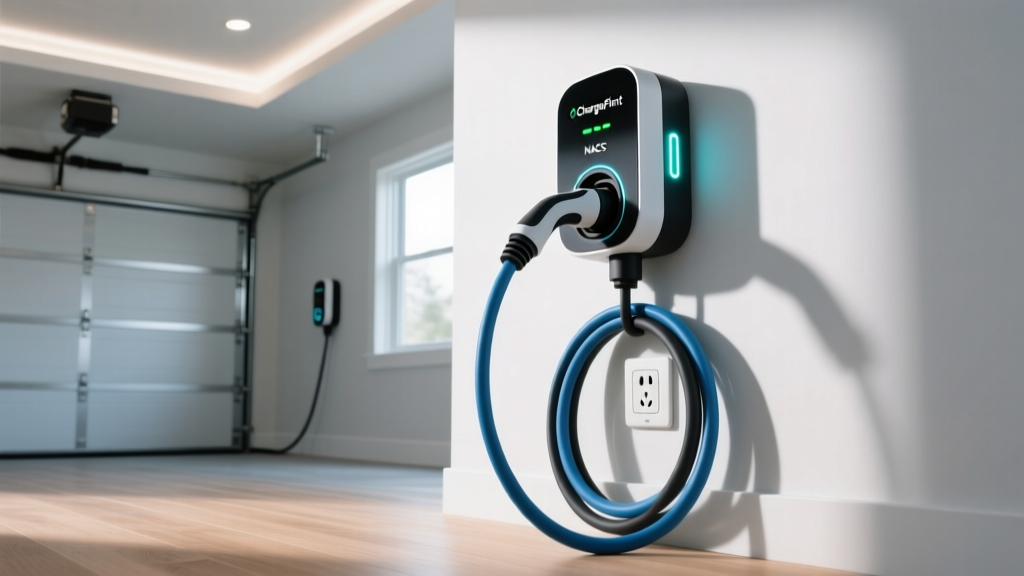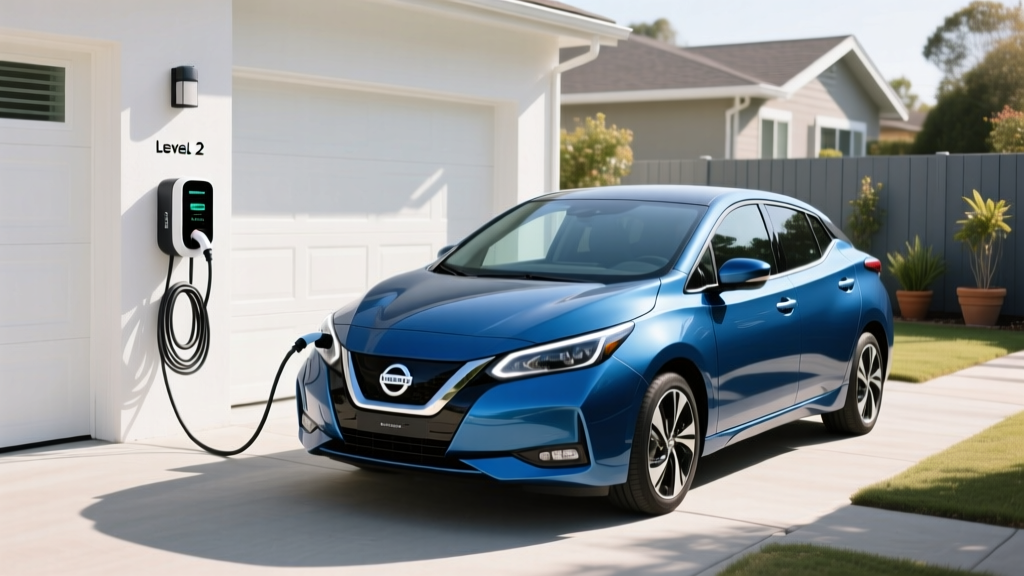
If you're shopping for your first EV or planning a home charging setup, the hardware and terminology can feel overwhelming. But the core question is simple: how do electric car chargers work, and what do you actually need to keep your vehicle powered? The answer depends on where you charge, how fast you need to replenish your battery, and what your home's electrical panel can handle.
This guide breaks down the three charging levels with exact power figures (kW), the miles of range each adds per hour, real installation costs, and connector compatibility across every major EV brand selling in the U.S. as of the 2026 model year. We'll also clarify the single most common EV confusion: the difference between kW (kilowatts), which measures charging power (the rate of flow), and kWh (kilowatt-hours), which measures battery energy (the tank size). A 60 kWh battery charged at 10 kW takes roughly 6 hours — the math is that straightforward once the terms are clear.
The Three Charging Levels Explained: Speeds, Power, and Use Cases
Every EV sold in the U.S. supports at least two of these three charging levels. The level you rely on most will depend on whether you charge primarily at home or on the road.
| Level | Voltage | Power (kW) | Miles of Range Added per Hour | Best For |
|---|---|---|---|---|
| Level 1 | 120V AC | 1.0–1.9 kW | 3–5 mi/hr | Overnight top-ups, PHEVs, low-mileage drivers |
| Level 2 | 240V AC | 3.3–19.2 kW | 12–75 mi/hr | Daily home and workplace charging |
| DC Fast Charging (Level 3) | 200–900V DC | 50–350+ kW | 150–1,200+ mi/hr (peak) | Road trips, commercial fleets, quick top-ups |
Level 1 uses a standard 120V household outlet and the portable cord that ships with most EVs. It delivers roughly 1.4 kW continuously (12 amps on a 15-amp circuit). For a battery-electric vehicle with a 75 kWh pack, a full Level 1 charge from empty takes 50+ hours — impractical as a primary method for BEVs, but adequate for plug-in hybrids with 10–15 kWh batteries that need only 5–8 hours overnight.
Level 2 is the workhorse of EV ownership. A 240V circuit — the same voltage your electric dryer uses — delivers between 3.3 kW (16A) and 19.2 kW (80A), though most home installations land between 7.7 kW (32A) and 11.5 kW (48A). At 11.5 kW, a 75 kWh battery charges from 10% to 80% in roughly 5 hours, making overnight charging effortless. According to the U.S. Department of Energy's fueleconomy.gov, over 80% of EV charging happens at home on Level 2 equipment.
DC Fast Charging bypasses the vehicle's onboard charger and feeds direct current straight into the battery at 50–350+ kW. On a vehicle like the 2026 Hyundai Ioniq 5 (84 kWh battery, peak 240 kW DC capability), a 10%–80% charge takes approximately 18 minutes at a 350 kW station under ideal conditions. However, charging speed is not linear: the charge curve tapers significantly above 80% State of Charge (SoC) to protect battery health, so charging from 80%–100% on DC fast can take as long as the first 70%.
Home Charger Installation: Electrical Requirements, Costs, and Panel Upgrades
A Level 2 home charger is the single biggest quality-of-life upgrade for EV ownership, but installation cost varies dramatically based on your home's electrical infrastructure. Here's what's involved.
Electrical Requirements
A typical Level 2 home charger requires a dedicated 240V circuit on a breaker rated for 125% of the continuous load. That means a 48-amp charger (11.5 kW) needs a 60-amp breaker, and a 32-amp charger (7.7 kW) needs a 40-amp breaker. The circuit must use appropriately gauged copper wire (6 AWG for 60A, 8 AWG for 40A in most jurisdictions) run through conduit where exposed.
If your home has a 200-amp electrical panel with available breaker slots and sufficient remaining capacity, a straightforward install runs a new 240V line from the panel to your garage or driveway. Homes with older 100-amp panels, or panels already near capacity (common in homes with electric heat, hot tubs, or workshop equipment), may need a panel upgrade to 200A or even 400A, which is the most expensive variable in the entire project.
Installation Cost Breakdown
| Component | Basic Install (Short Run) | Complex Install (Long Run / Panel Upgrade) |
|---|---|---|
| Level 2 Charger Equipment | $300–$500 | $500–$750 |
| Electrician Labor (2–6 hrs) | $300–$600 | $600–$1,500 |
| Materials (Wire, Conduit, Breaker) | $100–$250 | $250–$600 |
| Electrical Permit | $50–$150 | $50–$200 |
| Panel Upgrade (if needed) | $0 (not required) | $1,500–$4,000 |
| Total Estimated Cost | $750–$1,500 | $2,900–$7,050 |
The "short run" scenario assumes your panel is in the garage or adjacent wall, the charger mounts within 10–20 feet of the panel, and no drywall demolition or trenching is required. The "complex" scenario covers 50+ foot wire runs, panel upgrades, trenching to a detached garage, or installing an outdoor-rated pedestal mount.
Safety and Code Considerations
- Dedicated circuit: The charger must have its own breaker — never share a circuit with other large appliances.
- GFCI protection: NEC 2023 and later require GFCI (Ground Fault Circuit Interrupter) protection for all EV charging outlets, including hardwired units in garages.
- Outdoor rating: If your charger is mounted outside, the unit must carry a NEMA 4 (weatherproof) rating, and the receptacle must have an in-use weatherproof cover.
- Permit and inspection: Virtually all jurisdictions require an electrical permit and post-installation inspection. Skipping this can void your homeowner's insurance coverage for electrical fires.
- Load management: Some smart chargers (e.g., Emporia Vue with load management, or Enel X Way JuiceBox with CT clamp monitoring) can dynamically reduce charge rate to stay within your panel's capacity, potentially avoiding a costly panel upgrade.
EV Connector Types: NACS, CCS, CHAdeMO, and Adapter Requirements
The physical plug connecting your EV to a charger has undergone a significant consolidation since 2023. Here's where each connector stands for 2026 model-year vehicles.
| Connector | Brands Using It (Native) | DC Fast Charge Shape | Adapter Needed For |
|---|---|---|---|
| NACS (J3400) | Tesla, Ford, GM, Rivian, Volvo, Polestar, Mercedes, Nissan, Honda, Fisker, Lucid (2025+) | Integrated NACS | Legacy CCS stations (with OEM adapter) |
| CCS1 (Combo) | Hyundai, Kia, BMW, Volkswagen, Subaru, Toyota (bZ series), Stellantis | CCS1 Combo | Tesla Superchargers (with Magic Dock or NACS adapter) |
| CHAdeMO | Nissan Leaf (legacy only — discontinued) | CHAdeMO | NACS or CCS stations (limited adapter options) |
NACS (North American Charging Standard), originally Tesla's proprietary connector and now formalized as SAE J3400, has won the connector war in North America. As of 2026, the majority of new EVs ship with a native NACS port. Ford, GM, Rivian, and others that adopted NACS starting in 2025 include an adapter for legacy CCS-equipped public chargers. Tesla Superchargers with the "Magic Dock" built-in adapter also serve CCS-equipped vehicles without requiring the driver to carry a separate dongle.
If you own a CCS-equipped EV (Hyundai Ioniq 5/6, Kia EV6/EV9, VW ID.4, BMW iX), you can access Tesla Superchargers using a NACS-to-CCS adapter — Tesla sells one for approximately $250, and third-party options from Lectron and A2Z are available for $150–$200. Always verify adapter compatibility with your specific model year before purchasing.
CHAdeMO is effectively a legacy connector in the U.S. The Nissan Leaf, the last major CHAdeMO vehicle, was discontinued after the 2024 model year. CHAdeMO chargers remain at some public stations, but new infrastructure investment is overwhelmingly NACS and CCS.
How Much Does Charging Cost Per Mile vs. Gasoline?
Charging cost is one of the strongest economic arguments for EV ownership, but the savings depend heavily on where and when you charge. Electricity rates vary from $0.08/kWh in parts of the Pacific Northwest to $0.30+/kWh in California and the Northeast, and public DC fast chargers often charge $0.35–$0.60/kWh.
| Scenario | Rate ($/kWh) | Vehicle Efficiency | Cost Per Mile |
|---|---|---|---|
| Home Level 2 — Off-Peak TOU Rate | $0.10 | 3.0 mi/kWh (100 MPGe) | $0.033 |
| Home Level 2 — Standard Residential Avg. | $0.16 | 3.0 mi/kWh | $0.053 |
| Home Level 2 — High-Cost State (CA, Northeast) | $0.28 | 3.0 mi/kWh | $0.093 |
| Public Level 2 (Workplace / Shopping) | $0.20 | 3.0 mi/kWh | $0.067 |
| Public DC Fast Charging (Electrify America, EVgo) | $0.48 | 3.0 mi/kWh | $0.160 |
| Tesla Supercharger (Avg. National) | $0.30 | 3.5 mi/kWh (Tesla efficiency) | $0.086 |
| Gasoline Vehicle (30 MPG Combined, $3.40/gal) | — | 30 MPG | $0.113 |
At the U.S. residential average of roughly $0.16/kWh (per EIA data), a typical EV costs about $0.05 per mile to charge at home — less than half the per-mile fuel cost of a 30 MPG gasoline vehicle at $3.40/gallon. Even at peak public DC fast charging rates ($0.48/kWh), EV cost per mile is roughly on par with gasoline, which is why road-trip charging costs are worth factoring into your total cost of ownership calculations.
The cheapest charging strategy is Time-of-Use (TOU) rates offered by many utilities, where off-peak overnight electricity (typically 11 PM – 6 AM) drops to $0.08–$0.12/kWh. Set your charger's schedule to start charging at midnight, and you'll pay $0.03–$0.04 per mile — a fraction of gasoline.
Charging Time Examples: Real 10%–80% Times for Popular EVs
Manufacturer claims of "18-minute charging" assume peak-rate DC fast charging under ideal thermal conditions. Here are realistic 10%–80% times based on battery capacity, peak DC rate, and typical charge-curve tapering.
| Vehicle | Usable Battery (kWh) | Peak DC Rate (kW) | 10–80% DC Fast Time | Level 2 at 11.5 kW (10–80%) |
|---|---|---|---|---|
| Tesla Model Y Long Range | 75 kWh | 250 kW | ~25 min | ~4.5 hrs |
| Hyundai Ioniq 5 (Long Range) | 84 kWh | 240 kW | ~18 min | ~5.1 hrs |
| Ford F-150 Lightning (Ext. Range) | 131 kWh | 150 kW | ~44 min | ~8.0 hrs |
| Chevrolet Equinox EV (3RS) | 85 kWh | 150 kW | ~30 min | ~5.2 hrs |
| BMW iX xDrive50 | 105.2 kWh | 200 kW | ~34 min | ~6.4 hrs |
| Toyota bZ4X | 64 kWh | 150 kW | ~30 min | ~3.9 hrs |
Note that vehicles with 800V architectures (Hyundai Ioniq 5/6, Kia EV6/EV9, Porsche Taycan, Lucid Air) sustain higher charge rates for longer portions of the session, making their real-world charging times notably faster than the peak kW figure alone would suggest. A 350 kW-rated vehicle on a 350 kW charger does not charge at 350 kW for the entire session — expect the rate to taper to 100–150 kW above 50% SoC and below 50 kW above 85%.
Best Home Level 2 Chargers: Equipment Recommendations for 2026
Not all Level 2 chargers are equal. Here are four top picks based on power output, build quality, smart features, and connector options.
ChargePoint Home Flex
- Power: Up to 12 kW (50A), configurable down to 16A
- Connector: NACS or J1772 (CCS via adapter)
- Cable Length: 23 ft
- Smart Features: Wi-Fi, app scheduling, Alexa, load sharing
- Price: ~$549
- Best For: Most EV owners wanting a flexible, future-proof unit
Tesla Wall Connector
- Power: Up to 11.5 kW (48A)
- Connector: NACS (native Tesla); J1772 adapter included
- Cable Length: 24 ft
- Smart Features: Wi-Fi, OTA updates, Powerwall integration, load sharing (up to 6 units)
- Price: ~$475
- Best For: Tesla owners or NACS-adopting households
Emporia Level 2 EV Charger
- Power: Up to 11.5 kW (48A)
- Connector: J1772 (NACS adapter available)
- Cable Length: 24 ft
- Smart Features: Wi-Fi, app with energy monitoring, solar integration, load management with Emporia Vue panel monitor
- Price: ~$399
- Best For: Budget-conscious buyers wanting smart load management
Enel X Way JuiceBox Pro 48
- Power: 11.5 kW (48A)
- Connector: J1772 (NACS adapter sold separately)
- Cable Length: 25 ft
- Smart Features: Wi-Fi, app scheduling, energy tracking, utility demand-response programs
- Price: ~$499
- Best For: Utility program participants and commercial/workplace installs
All four units are UL-listed, carry at minimum a 3-year warranty, and support hardwired or NEMA 14-50 plug installation. Hardwired installations eliminate the GFCI breaker requirement at the panel (the charger's internal GFCI suffices), which can simplify the electrician's work and reduce nuisance trips.
Frequently Asked Questions
How much does it cost to install a home EV charger?
A straightforward Level 2 installation with a short wire run and no panel upgrade typically costs $750–$1,500 total (equipment, electrician, permit). If your home needs a panel upgrade from 100A to 200A, expect the total to reach $2,900–$7,050. Always get a site assessment from a licensed electrician before purchasing equipment.
How fast will each charging level add range?
Level 1 (120V) adds 3–5 miles per hour. Level 2 (240V) adds 12–75 miles per hour depending on amperage — a 48-amp (11.5 kW) unit adds roughly 37 miles per hour for an average EV. DC fast charging adds 150–1,200+ miles per hour at peak rate, though the rate tapers as the battery fills.
Which connector/charger is compatible with my EV?
Check your vehicle's charge port. If you have a 2025+ Tesla, Ford, GM, Rivian, Volvo, or Honda EV, you likely have a NACS port. If you have a Hyundai, Kia, BMW, VW, or Subaru EV, you likely have a CCS1 port. For home Level 2 charging, any J1772 or NACS charger will work with the appropriate adapter. CHAdeMO is limited to older Nissan Leafs.
How much does charging cost per mile vs. gas?
At the U.S. average residential electricity rate ($0.16/kWh), an efficient EV costs roughly $0.05 per mile to charge at home, compared to $0.11 per mile for a 30 MPG gas car at $3.40/gallon. Public DC fast charging at $0.48/kWh raises EV cost to roughly $0.16/mile — more expensive than gas per mile, which is why home charging is critical to EV economics.
What electrical upgrades might I need?
If your panel is 200A with open slots, you likely need only a new 240V breaker and wire run. If your panel is 100A, already near capacity, or uses a legacy fuse box, expect a panel upgrade ($1,500–$4,000). Some smart chargers with load-management features can reduce charge rate dynamically to avoid a panel upgrade entirely — ask your electrician about this option.
Can I use a regular outlet to charge my EV?
Yes — that's Level 1 charging, using a standard 120V outlet. It adds only 3–5 miles per hour, which is adequate for PHEVs or BEV owners who drive under 30 miles daily and can charge for 10+ hours overnight. For most BEV owners, Level 1 is a backup option, not a primary charging strategy.