If you're new to electric vehicles, the charging ecosystem can feel like learning a new language. Kilowatts, kilowatt-hours, connectors, charging curves — the terminology is dense, and the stakes are real: pick the wrong home charger, and you'll wait hours for a full battery; ignore your electrical panel's limits, and you're looking at a costly upgrade. This guide breaks down exactly how EV charging works at every level, what you'll actually pay to install and operate a home charger, and which equipment earns our recommendation in 2026.
First, a critical distinction that trips up even seasoned car buyers: kW (kilowatts) measures power — the rate at which electricity flows into your car, like water pressure from a hose. kWh (kilowatt-hours) measures energy — the total amount stored in your battery, like gallons in a tank. A 75 kWh battery charged at 7.5 kW takes roughly 10 hours from empty to full. A 250 kW DC fast charger can push a significant portion of that same battery in 20–25 minutes. Understanding this relationship is the foundation of everything below.
The Three Levels of EV Charging Explained
Every EV sold in the United States charges using one of three standardized levels. Each level defines the voltage, amperage, and power delivery available — and directly determines how fast you'll add range.
| Charging Level | Voltage | Power Output | Miles of Range Added Per Hour | Typical Use Case |
|---|---|---|---|---|
| Level 1 | 120V AC | 1.2–1.9 kW | 3–5 miles/hour | Overnight trickle, PHEVs, low-mileage drivers |
| Level 2 | 240V AC | 3.3–19.2 kW | 12–75 miles/hour | Home daily charging, workplace, public destination |
| DC Fast Charging | 400–900V DC | 50–350 kW | 150–1,200+ miles/hour (peak) | Road trips, highway corridors, quick top-ups |
Level 1 plugs into a standard household 120V outlet — the same one your phone charger uses. It's slow, but it works for plug-in hybrids with small batteries (10–18 kWh) or EV owners who drive under 30 miles daily and can recharge overnight. Expect a full charge of a 75 kWh battery to take 40–60 hours. It's a backup, not a primary strategy for most BEV owners.
Level 2 is the backbone of practical EV ownership. Using a 240V circuit — the same voltage as your electric dryer or oven — Level 2 chargers deliver enough power to fully replenish most EV batteries in 6–12 hours. This is what you'll install at home and what you'll find at shopping centers, hotels, and workplaces.
DC Fast Charging (DCFC) bypasses the vehicle's onboard charger and sends direct current straight to the battery at high voltage. Speeds vary enormously: a 50 kW charger adds roughly 100–150 miles in 30 minutes, while a 350 kW Electrify America or Tesla V4 Supercharger can add 200+ miles in 15–20 minutes on compatible vehicles. But there's a catch — the charging curve.
The Charging Curve: Why Peak kW Isn't Sustained kW
DC fast chargers advertise peak power — say, 250 kW — but your EV only accepts that rate within a specific state-of-charge (SoC) window, typically between 10% and 50%. Above 80%, the battery management system (BMS) dramatically slows charging to protect cell longevity. A session that starts at 250 kW might taper to 50 kW by 85% SoC and trickle to 15 kW above 95%.
This is why manufacturers quote 10–80% charging times rather than 0–100%. For a Hyundai Ioniq 5 (84 kWh usable battery, NMC chemistry) on a 350 kW charger, that 10–80% sprint takes roughly 18–20 minutes. But pushing from 80% to 100% could add another 20–25 minutes. On road trips, the smart play is charging to 80% and moving on — the time you save by not waiting for the final 20% usually exceeds the range you'd gain.
Home EV Charger Installation: Requirements, Costs & Panel Upgrades
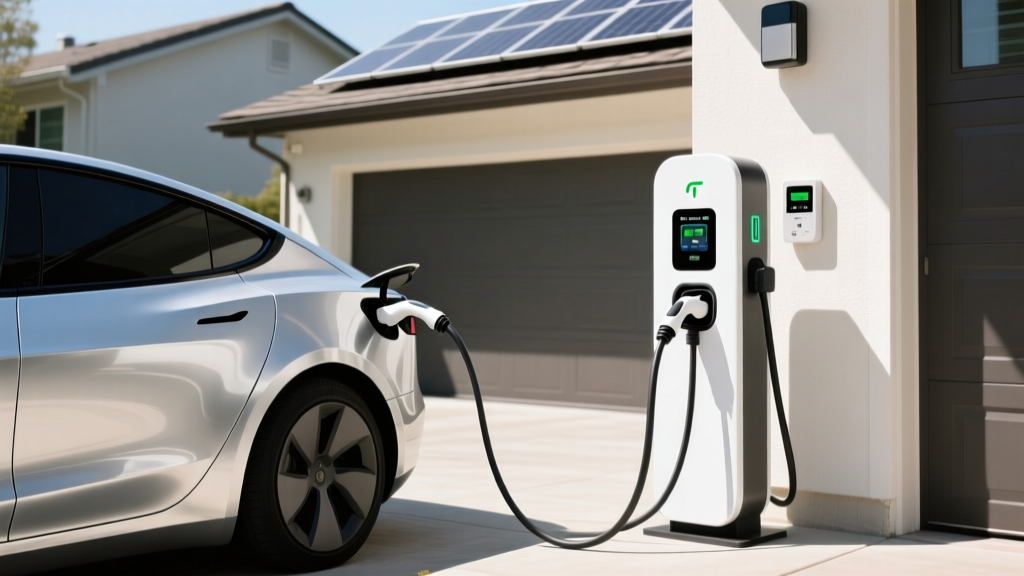
Installing a Level 2 home charger is the single highest-impact upgrade an EV owner can make. It transforms daily charging from a chore into something that happens passively while you sleep. But the electrical work is not trivial, and costs vary widely based on your home's existing infrastructure.
Electrical Requirements for Level 2 Charging
A typical Level 2 home charger requires a dedicated 240V circuit rated between 20A and 60A, depending on the charger's power output. The most common residential setups are:
- 40A circuit / 32A continuous — delivers 7.7 kW, sufficient for most EVs to fully charge overnight
- 50A circuit / 40A continuous — delivers 9.6 kW, faster charging for larger batteries (100+ kWh)
- 60A circuit / 48A continuous — delivers 11.5 kW, maximum for high-power home chargers like the ChargePoint Home Flex
National Electrical Code (NEC) requires that continuous loads (anything running 3+ hours, which includes EV charging) not exceed 80% of the circuit breaker rating. A 40A breaker therefore supports a maximum continuous draw of 32A (7.7 kW at 240V). A licensed electrician will size the wire gauge accordingly — typically 6 AWG copper for a 50A circuit or 4 AWG for 60A.
Do You Need a Panel Upgrade?
This is the question that can turn a $600 charger installation into a $3,000+ project. Most homes built after 2000 have a 200A electrical service panel. If your panel is already near capacity — running central AC, an electric oven, an electric dryer, and a water heater — adding a 40–60A EV circuit may exceed the panel's rated load.
An electrician will perform a load calculation per NEC Article 220 to determine whether your panel can handle the additional circuit. If it can't, you'll need either:
- A panel upgrade from 100A or 150A to 200A (typical cost: $1,500–$3,500 including permit)
- A service upgrade from 200A to 325A or 400A for larger homes (cost: $3,000–$5,000+)
- A smart load management system (e.g., Emporia VUE with load shedding) that throttles the EV charger when other high-draw appliances are running, avoiding a panel upgrade entirely (cost: $300–$600 for hardware + programming)
Home Charger Installation Cost Breakdown
| Cost Component | Simple Install (Panel Has Capacity) | Complex Install (Panel Upgrade Needed) |
|---|---|---|
| Level 2 Charger Equipment | $350–$700 | $350–$700 |
| Electrician Labor (2–4 hours) | $400–$900 | $800–$1,500 |
| Materials (wire, conduit, breaker) | $100–$300 | $200–$500 |
| Permit & Inspection | $50–$250 | $150–$400 |
| Panel Upgrade (if needed) | $0 | $1,500–$3,500 |
| Total Estimated Cost | $900–$2,150 | $3,000–$6,600 |
These figures reflect 2026 national averages. Labor rates vary significantly by region — expect higher costs in the Northeast and West Coast metros, lower in the Southeast and Midwest. Always get at least three quotes from licensed electricians, and confirm the quote includes permit and inspection fees. Some utility companies offer rebates of $250–$1,000 for Level 2 charger installations; check with your local provider before scheduling work.
EV Connector Types: NACS, CCS1, CHAdeMO & Adapter Compatibility
The connector landscape has consolidated significantly since 2023, when Ford and GM announced adoption of Tesla's North American Charging Standard (NACS). As of the 2026 model year, the vast majority of new EVs sold in the U.S. ship with a native NACS charge port. Here's where each standard stands:
| Connector | Brands Using It (2026 Models) | DC Fast Charge Compatibility | Adapter Availability |
|---|---|---|---|
| NACS (J3400) | Tesla, Ford, GM, Rivian, Volvo, Polestar, Mercedes, Nissan, BMW, Hyundai/Kia (select), Subaru | Tesla Superchargers, Electrify America (NACS stalls), EVgo, ChargePoint | CCS→NACS adapters from Lectron, A2Z (~$150–$250) |
| CCS1 | Legacy models (2024 and earlier), Stellantis, VW ID.4 (pre-2026), some Hyundai/Kia | Electrify America, EVgo, ChargePoint, most non-Tesla networks | NACS→CCS adapters available from Tesla (~$199), Lectron |
| CHAdeMO | Nissan Leaf (discontinued 2025), Mitsubishi Outlander PHEV (legacy) | Limited and declining infrastructure | No practical adapter; CHAdeMO stations increasingly rare |
For 2026 buyers, the decision is straightforward: if you're purchasing a new EV, it almost certainly uses NACS, giving you access to the Tesla Supercharger network — over 30,000 stalls across North America and widely regarded as the most reliable DC fast-charging infrastructure. If you own a CCS-equipped vehicle from a prior model year, the expanding adapter ecosystem and continued CCS infrastructure investment mean you won't be stranded, but NACS is the clear trajectory.
How Much Does EV Charging Cost? Home vs. Public vs. Gas
The economics of EV charging depend almost entirely on where you charge. Home charging on a residential electricity rate is dramatically cheaper than public DC fast charging — and both are typically cheaper than gasoline on a per-mile basis.
| Charging Scenario | Cost per kWh | Cost to Add 200 Miles (at 3.5 mi/kWh) | Cost per Mile |
|---|---|---|---|
| Home (national avg. residential, 2026) | $0.16/kWh | $9.14 | $0.046 |
| Home (off-peak TOU rate) | $0.08–$0.11/kWh | $4.57–$6.29 | $0.023–$0.031 |
| Public Level 2 (ChargePoint, EVgo) | $0.25–$0.49/kWh | $14.29–$28.00 | $0.071–$0.14 |
| DC Fast Charging (EA, EVgo, Tesla) | $0.35–$0.61/kWh | $20.00–$34.86 | $0.10–$0.17 |
| Gasoline (25 MPG combined, $3.30/gal) | — | $26.40 | $0.132 |
The math is compelling: charging at home on an off-peak time-of-use (TOU) rate plan costs roughly 3–4 cents per mile, compared to 13+ cents per mile for a 25 MPG gas car. Even public DC fast charging at $0.48/kWh is often cheaper than gasoline for the same distance. The key is maximizing home charging — the EV owners paying the least are the ones plugging in at home every night on a TOU plan.
According to fueleconomy.gov, most 2026 EVs achieve 3.0–4.0 miles per kWh in combined driving. Efficiency varies: a Lucid Air Grand Touring reaches 4.7 mi/kWh on the EPA cycle, while a GMC Hummer EV manages roughly 2.0 mi/kWh. Your actual efficiency depends on speed, temperature, terrain, and climate-control use — expect 15–30% range loss in sub-freezing weather due to battery resistance and cabin heating demands.
Charging Time Examples: What to Expect With Common Battery Sizes
Charging speed depends on two variables: the charger's power output (kW) and your vehicle's maximum charge acceptance rate (also in kW). A 350 kW Electrify America stall can't push 350 kW into a vehicle limited to 150 kW — the car's BMS dictates the ceiling. Here are real-world charging time estimates for popular 2026 EVs:
- Tesla Model 3 Long Range (79 kWh usable, NMC): Level 2 at 11.5 kW — 0–100% in ~7 hours. DC fast at 250 kW peak — 10–80% in ~22 minutes.
- Ford F-150 Lightning Extended Range (131 kWh usable, NMC): Level 2 at 11.5 kW — 0–100% in ~11.5 hours. DC fast at 150 kW peak — 15–80% in ~41 minutes.
- Hyundai Ioniq 5 (84 kWh usable, NMC, 800V architecture): Level 2 at 10.9 kW — 0–100% in ~7.7 hours. DC fast at 350 kW peak — 10–80% in ~18 minutes.
- Chevrolet Equinox EV (85 kWh usable, NMC): Level 2 at 11.5 kW — 0–100% in ~7.4 hours. DC fast at 150 kW peak — 10–80% in ~30 minutes.
For Level 2 home charging, most EV owners find that a 7–10 hour overnight window is more than enough to replenish a day's driving. The average American drives 37 miles per day according to the FHWA — that's roughly 10–12 kWh consumed, which a 7.7 kW Level 2 charger replaces in about 90 minutes.
Recommended Home EV Chargers for 2026
We evaluate home chargers on power output, connector options, cable length, smart features, build quality, and price. These are our top picks for 2026:
ChargePoint Home Flex (Best Overall)
- Power: Up to 11.5 kW (48A on a 60A circuit), adjustable down to 16A
- Connector: NACS (J3400) native; CCS adapter included
- Cable Length: 23 feet
- Smart Features: Wi-Fi, ChargePoint app scheduling, Alexa integration, energy tracking, TOU optimization
- Price: $599–$649
- Why: Flexible amperage lets you match your circuit exactly. UL-listed, NEMA 4-rated for outdoor use, and backed by a 3-year warranty. The adjustable output means one unit works whether you have a 30A or 60A circuit.
Tesla Wall Connector (Best for Tesla/NACS Owners)
- Power: Up to 11.5 kW (48A on a 60A circuit)
- Connector: NACS native; J1772 adapter available separately
- Cable Length: 24 feet
- Smart Features: Wi-Fi, Tesla app integration, over-the-air updates, power sharing (link multiple units on one circuit)
- Price: $475
- Why: The best value in high-power home charging. Seamless integration with Tesla vehicles and the expanding NACS ecosystem. Power-sharing feature lets two Teslas charge on a single 60A circuit, splitting the load dynamically.
Emporia Vue Smart EV Charger (Best Budget Smart Charger)
- Power: Up to 11.5 kW (48A on a 60A circuit)
- Connector: NACS (J3400) native
- Cable Length: 24 feet
- Smart Features: Wi-Fi, Emporia app, solar integration, whole-home energy monitoring compatibility, TOU scheduling
- Price: $399
- Why: Pairs with the Emporia VUE home energy monitor for granular solar and load tracking. Ideal for homes with solar panels — you can configure the charger to use only excess solar production, effectively charging for free.
Safety, Electrical Code & Installation Best Practices
EV charging is a high-draw, continuous electrical load — it runs at near-maximum capacity for hours at a time. This makes proper installation non-negotiable. Here are the key safety and code considerations your electrician should address:
- Dedicated circuit: NEC requires a dedicated breaker for the EV charger — it cannot share a circuit with other outlets or appliances. This prevents overloading and tripped breakers during long charge sessions.
- GFCI protection: The 2023 NEC revision (Article 625.54) requires ground-fault circuit-interrupter (GFCI) protection for all receptacles used for EV charging, including 240V outlets. Hardwired installations are exempt from the receptacle GFCI requirement but must still meet ground-fault protection standards. Many quality EVSEs (Electric Vehicle Supply Equipment) include built-in GFCI protection.
- Outdoor rating: If your charger is installed outdoors or in an unconditioned garage, ensure it carries a NEMA 4 or NEMA 4X rating for weather and dust resistance. NEMA 3R is acceptable for covered outdoor locations but not for direct rain exposure.
- Wire gauge and conduit: Your electrician will size wire based on circuit amperage and run length. For a 50A circuit under 100 feet, 6 AWG copper THHN in conduit is standard. Longer runs may require 4 AWG to minimize voltage drop.
- Permit and inspection: Virtually all jurisdictions require an electrical permit for a new 240V circuit. The inspection ensures the installation meets NEC and local code — don't skip this step. An unpermitted installation can void homeowner's insurance claims and complicate future home sales.
- Cable management: Use a wall-mounted cable organizer or retractable reel to keep the charge cable off the floor. This prevents trip hazards, cable damage, and connector contamination.
Frequently Asked Questions
How much does it cost to install a home EV charger?
A straightforward Level 2 installation on an existing 200A panel with available capacity typically costs $900–$2,150 including the charger, electrician labor, materials, and permit. If your panel needs upgrading from 100A or 150A to 200A, total project cost rises to $3,000–$6,600. Get three quotes and ask about utility rebates — many providers offer $250–$1,000 back for Level 2 installations.
How fast will each charging level add range?
Level 1 (120V) adds 3–5 miles per hour — adequate for PHEVs, not practical for full-size BEVs. Level 2 (240V) at 7.7–11.5 kW adds 25–44 miles per hour, fully recharging most EVs overnight. DC fast charging at 150–350 kW can add 150–300+ miles in 15–30 minutes, though the charging curve tapers significantly above 80% SoC.
Which connector and charger is compatible with my EV?
For 2026 model-year vehicles, NACS (J3400) is the dominant standard — Tesla, Ford, GM, Rivian, Volvo, BMW, Mercedes, and most others now ship with NACS ports. CCS1 is found on older models (2024 and earlier from VW, Hyundai, Kia). CHAdeMO is effectively discontinued. Check your vehicle's charge port and purchase a home charger with a matching connector, or use a certified adapter.
How much does charging cost per mile compared to gasoline?
Home charging on a national average rate of $0.16/kWh costs roughly 4.6 cents per mile in an EV averaging 3.5 mi/kWh. Off-peak TOU rates can drop this to 2.3–3.1 cents per mile. A comparable 25 MPG gasoline car at $3.30/gallon costs about 13.2 cents per mile. Even public DC fast charging at $0.48/kWh (~13.7 cents/mile) is comparable to or slightly cheaper than gasoline.
What electrical upgrades might I need for a home charger?
The most common upgrade is a panel replacement from 100A or 150A to 200A service ($1,500–$3,500). Older homes with 100A panels running multiple electric appliances are most likely to need this. Some homeowners opt for a smart load management system ($300–$600) that dynamically throttles EV charging when other high-draw appliances activate, avoiding a panel upgrade entirely. Your electrician will perform an NEC Article 220 load calculation to determine what's needed.
Can I use a regular 120V outlet to charge my EV?
Yes — every EV ships with a Level 1 mobile charging cord that plugs into a standard 120V household outlet. However, at 1.2–1.9 kW, you'll add only 3–5 miles of range per hour. A full charge of a 75 kWh battery takes 40–60 hours. Level 1 is viable for PHEVs with 10–18 kWh batteries or EV owners with very short commutes, but it's not practical as a primary charging solution for most battery-electric vehicles.
Does the federal tax credit cover home charger installation?
The residential clean energy credit (IRC §25D) previously covered 30% of home EVSE equipment and installation costs up to $1,000. As of 2026, this credit has expired for most taxpayers unless extended by Congress. Some states and utilities continue to offer their own EV charger rebates — check the Alternative Fuels Data Center for current state-level incentives. Federal EV purchase credits (§30D) are separate and cover the vehicle, not charging equipment.