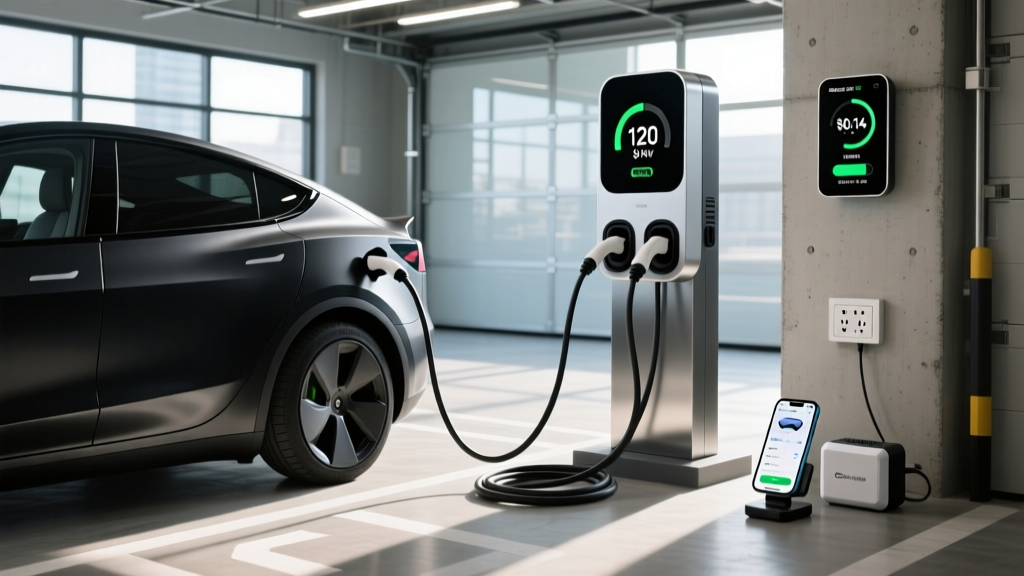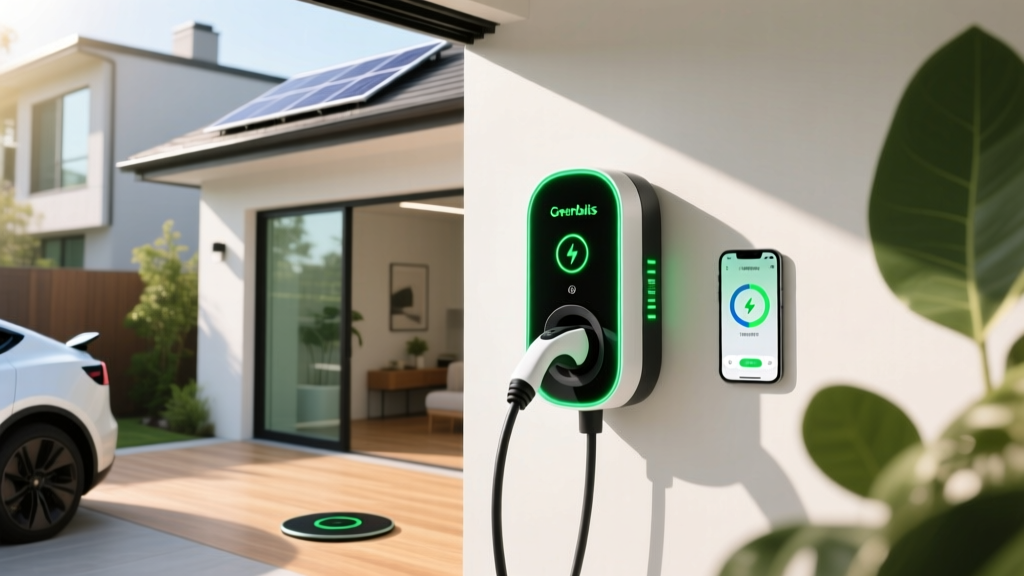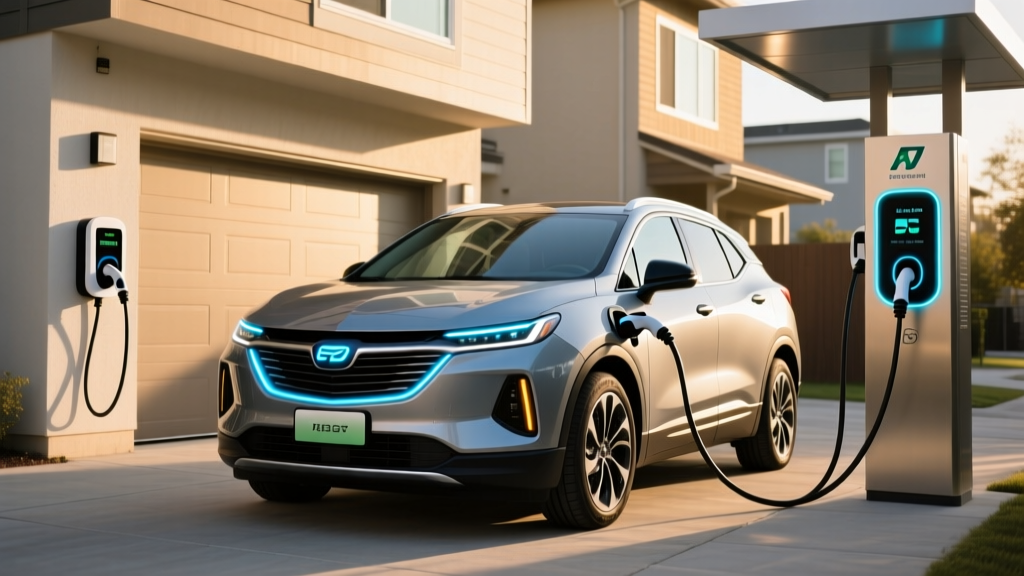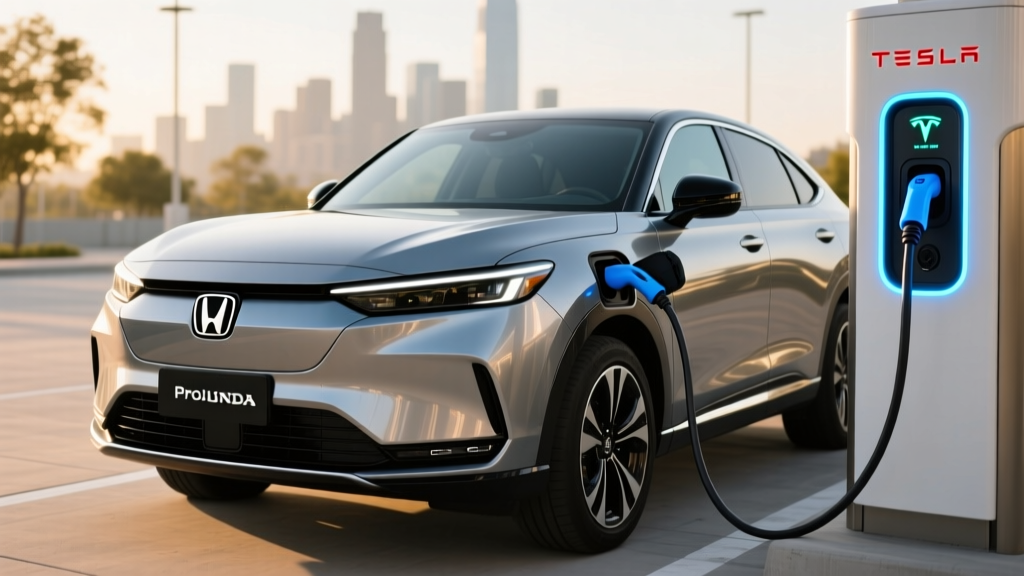
If you own or are shopping for a Honda Prologue, you've likely asked: can the Honda Prologue use a Tesla charger? The short answer is yes — but with important caveats about adapters, connector types, and which Tesla chargers actually work. This guide walks through every charging scenario for the Prologue, from Level 1 trickle charging to DC fast charging on Tesla Superchargers, plus home installation costs and equipment picks.
Honda Prologue Charging Hardware: What's On the Car
The 2024–2026 Honda Prologue ships with a CCS1 (Combined Charging System) port. This is the standard used by most non-Tesla EVs sold in North America. The Prologue's onboard charger accepts up to 11.5 kW on Level 2 AC, and its DC fast-charging capability peaks at approximately 155 kW.
| Spec | Value |
|---|---|
| Battery (usable) | 85 kWh (NMC lithium-ion) |
| EPA Range | 296 mi (FWD); 281 mi (AWD Elite) |
| Real-World Range Note | Expect ~245–265 mi highway; ~210–230 mi in sub-30°F cold |
| Max Level 2 AC Charge | 11.5 kW |
| Max DC Fast Charge | ~155 kW peak |
| 10–80% DC Fast Time | ~35–40 minutes (at a 150+ kW station) |
| Charge Port | CCS1 (native) |
| 0–60 mph | ~8.5 sec (FWD); ~7.5 sec (AWD) |
| Base MSRP | ~$47,400 (EX FWD) |
The critical takeaway: the Prologue does not have a native NACS (Tesla) port. Honda has signaled future models may adopt NACS directly, but as of the 2026 model year, every Prologue on the road requires an adapter to use Tesla Superchargers.
Can the Honda Prologue Use a Tesla Charger? Connector Compatibility Explained
Tesla operates two distinct charging ecosystems: the Tesla connector (now called NACS — North American Charging Standard) and the legacy proprietary network. Here's how the Prologue interfaces with each:
| Charger Type | Connector | Prologue Compatible? | Adapter Needed? |
|---|---|---|---|
| Tesla Supercharger (V3/V4) | NACS | Yes, with adapter | CCS1-to-NACS adapter (Honda-approved or Tesla's official CCS adapter) |
| Tesla Destination Charger | NACS (some have J1772) | Yes, with adapter or if J1772 equipped | NACS-to-J1772 adapter or CCS1-to-NACS for AC |
| Tesla Wall Connector (home) | NACS | Yes, with adapter | CCS1-to-NACS adapter |
| Electrify America / EVgo / ChargePoint DC | CCS1 | Yes, native | None |
| Public Level 2 (J1772) | J1772 | Yes (CCS1 includes J1772 inlet) | None |
| CHAdeMO stations | CHAdeMO | No | N/A — standard is retired |
CCS1-to-NACS Adapters: What You Need
In 2025, Tesla began selling a CCS1-to-NACS adapter that enables non-Tesla EVs to charge at Superchargers participating in the open network. Honda has also been working on providing adapters to Prologue owners. When shopping for an adapter, verify:
- DC fast-charge rated — some adapters only support AC Level 2; you want one rated for at least 150+ kW DC.
- Safety certified — look for UL or equivalent listing.
- Supercharger network access — Tesla requires non-Tesla EVs to use the Tesla app for activation at select Supercharger stalls. Confirm your adapter is whitelisted.
Adapter pricing typically runs $150–$250. Honda has periodically offered adapters at reduced cost or bundled with purchase — check with your dealer.
Charging Levels: How Fast Will Each Add Range to the Prologue?
Understanding the three charging levels is essential. Remember: kW (kilowatts) measures power — the rate of energy delivery. kWh (kilowatt-hours) measures energy — the total capacity of the battery. Think of kW as the speed of water flowing from a hose, and kWh as the size of the bucket.
| Level | Voltage / Amps | Max Power | Miles of Range Added per Hour | Prologue 10–80% Time (est.) |
|---|---|---|---|---|
| Level 1 (standard outlet) | 120V / 12A | ~1.4 kW | ~3–4 mi/hr | ~60+ hours (impractical for full charge) |
| Level 2 (home/public AC) | 240V / 48A | 11.5 kW (Prologue max) | ~28–32 mi/hr | ~6.5 hours (0–100%) |
| DC Fast Charging | 400V+ DC | ~155 kW peak | ~180–220 mi/hr (at peak) | ~35–40 min (10–80%) |
Home Charger Installation: Costs, Electrical Requirements, and Panel Upgrades
Most Prologue owners will want a Level 2 home charger. Here's what's involved electrically and financially.
Electrical Requirements
- Circuit: A dedicated 240V circuit is required. For a 48A charger, you need a 60-amp breaker (NEC requires the circuit to be rated at 125% of the continuous load: 48A × 1.25 = 60A).
- Wire gauge: Typically 6 AWG copper (or 4 AWG aluminum) for a 60A circuit, though longer runs may require thicker wire.
- Panel capacity: Your home's electrical panel must have enough spare capacity. Most modern 200-amp panels can accommodate an EV circuit. Older 100-amp panels often cannot.
- GFCI protection: NEC 2020 and later require GFCI protection for EV receptacles in garages. Hardwired chargers may or may not require GFCI depending on local code — your electrician will determine this.
- Outdoor rating: If installing outside, the charger must be NEMA 4 or NEMA 4X rated for weather resistance.
Panel Upgrade: The Hidden Cost
If your home has a 100-amp panel, or your 200-amp panel is near capacity (common in homes with electric heating, dryers, and ranges), you may need a panel upgrade to 200A or even 400A. This is the single biggest variable in home charging installation cost. A panel upgrade typically costs $1,500–$4,000 on top of the charger circuit work.
Alternatives to a full panel upgrade include:
- Load management devices (e.g., Emporia VUE with smart panel integration) that throttle charger power when other high-draw appliances are running.
- Lower-amperage charger — a 32A charger on a 40A circuit draws less from the panel while still adding ~20 miles of range per hour.
| Cost Component | Low Estimate | High Estimate | Notes |
|---|---|---|---|
| Level 2 Charger (hardware) | $350 | $700 | Varies by brand, power, cable length |
| Electrician labor (circuit + install) | $500 | $1,500 | Depends on run length from panel to garage |
| Permit & inspection | $50 | $300 | Varies by municipality |
| Panel upgrade (if needed) | $1,500 | $4,000 | 100A → 200A or 200A → 400A |
| Total (no panel upgrade) | $900 | $2,500 | Most common scenario for newer homes |
| Total (with panel upgrade) | $2,400 | $6,500 | Common for older homes |
The IRS §25C residential energy credit may cover up to 30% of home charger installation costs (capped at $1,000). Check current-year eligibility and consult a tax professional.
How Much Does Charging Cost? Prologue Per-Mile vs. Gas
The Prologue's 85 kWh battery means a full charge represents a meaningful amount of electricity. Here's what it costs across scenarios:
| Charging Scenario | $/kWh (typical) | Cost for 10–80% (60 kWh) | Cost per Mile (est.) |
|---|---|---|---|
| Home (off-peak utility rate) | $0.08–$0.14 | $4.80–$8.40 | $0.02–$0.04 |
| Home (standard rate, no TOU) | $0.15–$0.20 | $9.00–$12.00 | $0.04–$0.05 |
| Public Level 2 (ChargePoint, etc.) | $0.20–$0.35 | $12.00–$21.00 | $0.05–$0.08 |
| DC Fast (Electrify America, EVgo) | $0.35–$0.55 | $21.00–$33.00 | $0.09–$0.13 |
| Tesla Supercharger (open network) | $0.28–$0.45 | $16.80–$27.00 | $0.07–$0.11 |
| Gas equivalent (25 MPG avg, $3.50/gal) | — | — | $0.14 |
At home on off-peak rates, the Prologue costs roughly $0.02–$0.04 per mile — about one-quarter to one-third the per-mile cost of a comparable gas SUV at 25 MPG. Even on DC fast chargers, you'll typically pay less per mile than gasoline, though the gap narrows at premium-rate stations.
The Prologue achieves an EPA-rated 99 MPGe combined (FWD) according to fueleconomy.gov, translating to roughly 34 kWh per 100 miles driven.
Recommended Home Chargers for the Honda Prologue
Since the Prologue maxes out at 11.5 kW on Level 2, a 48-amp charger (on a 60A circuit) will extract its full AC charging speed. Here are top picks:
Emporia Vue Level 2 EV Charger
- Power Output: 48A / 11.5 kW (240V)
- Connector: J1772 (NACS version also available)
- Cable Length: 24 ft
- Smart Features: Wi-Fi, app scheduling, solar integration, load management with Emporia VUE panel monitor
- Price: ~$399
- Best For: Budget-conscious buyers who want smart load management to avoid panel upgrades
ChargePoint Home Flex
- Power Output: Configurable up to 50A / 12 kW (240V)
- Connector: J1772 (NACS adapter available)
- Cable Length: 23 ft
- Smart Features: Wi-Fi, app-based scheduling, Alexa integration, amperage adjustment to match your circuit
- Price: ~$549
- Best For: Flexibility — adjustable amperage lets you dial down if your panel is tight
Tesla Wall Connector
- Power Output: Up to 48A / 11.5 kW (240V)
- Connector: NACS (requires CCS1-to-NACS adapter for Prologue)
- Cable Length: 24 ft
- Smart Features: Wi-Fi, over-the-air updates, power sharing between multiple units, access control
- Price: ~$475
- Best For: Multi-EV households with both Tesla and non-Tesla vehicles (if you already have the adapter)
Grizzl-E Smart
- Power Output: 40A / 9.6 kW (240V)
- Connector: J1772
- Cable Length: 24 ft
- Smart Features: OCPP-compatible, app control, adjustable amperage (16/24/32/40A)
- Price: ~$449
- Best For: Cold-climate durability — rated to -40°F, built in Canada
Note: If you choose a NACS-connector charger (like the Tesla Wall Connector), you'll need a CCS1-to-NACS adapter every time you plug in at home. For convenience, a J1772 charger is the path of least resistance for a Prologue-only household.
Using Tesla Superchargers with the Prologue: What to Expect
Once you have a compatible CCS1-to-NACS adapter and the Tesla app set up, here's the real-world experience at a Tesla Supercharger:
- Check compatibility in the Tesla app — not all Supercharger stalls are open to non-Tesla vehicles. Tesla has been gradually expanding access, but some locations remain Tesla-only.
- Pull up, plug in with your adapter — the NACS connector is smaller and lighter than CCS1. The adapter adds some bulk but is manageable.
- Activate via the Tesla app — select the stall number and start the session.
- Expect peak speeds around 130–155 kW — the Prologue's charge curve limits it well below Tesla's 250 kW V3 capability. You won't extract the Supercharger's full potential.
- 10–80% in roughly 35–45 minutes — comparable to Electrify America or EVgo stations with 150 kW stalls.
The main advantage of using Tesla Superchargers is network reliability. Tesla's network consistently delivers higher uptime and fewer broken stalls than many third-party DC fast-charging networks, as documented in multiple J.D. Power EV charging satisfaction surveys. The trade-off is the adapter hassle and slightly higher per-kWh cost at some locations.
Safety, Electrical Code, and Best Practices
Whether you're installing at home or using public chargers, keep these safety considerations in mind:
- Dedicated circuit only: Never share the EV charger circuit with other appliances. EV charging is a continuous load (3+ hours), which the NEC treats differently from intermittent loads.
- Hardwired vs. plug-in: Hardwired chargers eliminate the NEMA 14-50 receptacle, which has been associated with overheating in some EV charging scenarios. Many electricians now recommend hardwiring for 48A+ chargers.
- GFCI breaker: Required for receptacle-based installs in garages under NEC 2020+. Note: some chargers have built-in GFCI protection, which can cause nuisance tripping with breaker-level GFCI. Consult your electrician.
- NEMA 4 rating for outdoor: If your charger lives outside, ensure both the unit and any junction boxes carry a NEMA 4 (splash-resistant) or NEMA 4X (corrosion-resistant) rating.
- Adapter care: Inspect your CCS1-to-NACS adapter pins regularly for heat damage, discoloration, or debris. Store it in a dry, protected location.
Frequently Asked Questions
Can the Honda Prologue use a Tesla Supercharger without an adapter?
No. The Prologue has a CCS1 port. Tesla Superchargers use the NACS connector. You must have a CCS1-to-NACS adapter rated for DC fast charging to use any Tesla Supercharger.
Does Honda provide a free adapter for Prologue owners?
Honda has offered adapter programs at various points — sometimes bundled with purchase or at a discount. Availability and terms vary by model year and region. Contact your Honda dealer or check Honda's owner portal for current adapter offers.
Will charging the Prologue at a Tesla Supercharger void the warranty?
Using a properly certified adapter at a Supercharger should not void your battery or powertrain warranty. Honda's EV battery warranty covers 8 years / 100,000 miles with a minimum 70% capacity retention threshold. However, if damage is directly caused by an uncertified or defective adapter, warranty coverage for that specific damage may be denied.
How fast does the Prologue charge on a Tesla V3 Supercharger?
The Prologue is limited by its own charge curve, not the Supercharger's 250 kW capability. Expect peak rates around 130–155 kW, with a 10–80% session taking approximately 35–45 minutes. Above 80% SoC, speed drops significantly.
Can I install a Tesla Wall Connector at home for my Prologue?
Yes, but you'll need a CCS1-to-NACS adapter for every charging session. If the Prologue is your only EV, a J1772 charger (like the ChargePoint Home Flex or Emporia Vue) is more convenient since no adapter is needed for daily plugging.
What electrical panel size do I need for a 48A home charger?
A 48A charger requires a 60A breaker and draws a continuous 48A at 240V. Your panel needs at least 60A of spare capacity. Most 200A panels in modern homes can accommodate this. If you have a 100A panel or a heavily loaded 200A panel, you may need a panel upgrade or a load-management device.
How much does it cost to charge the Prologue at home vs. gas?
At the US average residential rate of ~$0.16/kWh, a full 10–80% charge (about 60 kWh) costs roughly $9.60 and provides about 240 miles of range — approximately $0.04/mile. A comparable gas SUV at 25 MPG and $3.50/gallon costs about $0.14/mile. Home charging saves roughly 70% per mile.
Does the Prologue support Plug & Charge at Tesla Superchargers?
Not currently. Plug & Charge (automatic authentication when you plug in) at Tesla Superchargers requires NACS-native vehicles or specific adapter-network integration. Prologue owners must use the Tesla app to start and stop sessions manually.