Understanding EV Charging Levels: Speed and Power Explained
Before installing home charging equipment, you need to understand the three charging levels and what they deliver in real-world range recovery. The critical distinction is between kW (kilowatts = power/charge rate) and kWh (kilowatt-hours = energy/battery capacity). A 84 kWh battery charged at 7.2 kW takes roughly 12 hours from empty to full; at 11.5 kW, it takes about 7 hours.
| Level | Voltage | Power (kW) | Miles Added/Hour | Use Case |
|---|---|---|---|---|
| Level 1 | 120V | 1.4-1.9 kW | 3-5 miles | Overnight, low daily mileage |
| Level 2 | 240V | 3.3-19.2 kW | 14-75 miles | Daily home charging, workplace |
| DC Fast | 400-800V DC | 50-350 kW | 150-1,200 miles | Road trips, rapid top-ups |
Level 2 home charging is the sweet spot for most EV owners. A typical 11.5 kW home charger adds roughly 40-45 miles of range per hour, easily replenishing a day's driving overnight. DC fast charging peaks at high power but tapers significantly above 80% state of charge due to battery thermal management—expect a 10-80% charge in 18-25 minutes on modern 800V architectures, but 80-100% can take nearly as long.
Home Installation Costs: Equipment, Electrician, and Permits
The total cost to install a Level 2 home charger ranges from $500 to $2,500, with most installations falling between $1,000-$1,800. This breaks down into equipment, labor, permits, and potential electrical panel upgrades.
| Component | Cost Range | Notes |
|---|---|---|
| Level 2 Charger (Equipment) | $350-$750 | Smart WiFi-enabled units, 32-48A |
| Electrician Labor | $300-$1,200 | Depends on run length, conduit, complexity |
| Permit Fees | $50-$250 | Varies by municipality |
| Electrical Panel Upgrade | $1,500-$3,500 | Required if panel lacks capacity (older homes) |
| Total (No Panel Upgrade) | $700-$2,200 | Most common scenario |
| Total (With Panel Upgrade) | $2,200-$5,700 | Older homes with 100A service |
Electrical Requirements for Level 2 Charging
Level 2 chargers require a dedicated 240V circuit, typically 40-60 amps. The National Electrical Code (NEC) requires continuous loads like EV charging to use only 80% of circuit capacity, so a 40A circuit delivers 32A (7.7 kW) to the vehicle, while a 60A circuit delivers 48A (11.5 kW). Your electrician will assess:
- Panel capacity: Modern homes with 200A service usually have headroom. Older homes with 100A panels often need upgrades.
- Circuit run length: Longer runs from panel to garage require thicker wire gauge, increasing material costs.
- Conduit requirements: Exposed runs need metal conduit; finished walls may allow Romex cable.
- Outlet vs. hardwired: NEMA 14-50 outlets offer portability but hardwired units are more reliable and code-compliant in many jurisdictions.
A licensed electrician will perform a load calculation per NEC Article 220 to determine if your panel can handle the additional 7.7-11.5 kW continuous draw. If you're running multiple high-draw appliances (electric range, dryer, HVAC) simultaneously with EV charging, you may need a panel upgrade or load-management device.
Connector Compatibility: NACS, CCS, and CHAdeMO
North American EV charging uses three main connector standards. As of 2026, the Tesla NACS (North American Charging Standard) has been widely adopted by most automakers, but legacy CCS1 vehicles remain common.
| Connector | Compatible Brands | Adapter Needed For |
|---|---|---|
| NACS (Tesla) | Tesla, Ford, GM, Rivian, Volvo, Polestar, BMW, Hyundai (2025+) | CCS1 vehicles need NACS-to-CCS adapter (~$200) |
| CCS1 | VW, Audi, older Hyundai/Kia, Honda, Subaru | NACS vehicles need CCS-to-NACS adapter for Superchargers |
| CHAdeMO | Nissan Leaf (legacy) | Largely deprecated; adapters unavailable |
For home Level 2 charging, all vehicles use the J1772 connector (or NACS with J1772 adapter included with most Tesla wall connectors). Public DC fast charging is where connector choice matters most. If you own a CCS1 vehicle, verify your local Electrify America, EVgo, or ChargePoint stations offer CCS connectors before purchasing a NACS-only vehicle.
Cost to Charge: Home vs. Public vs. Gas Comparison
Electricity costs vary dramatically by location, time of day, and charging method. Home charging during off-peak hours is consistently the cheapest option, while DC fast charging approaches or exceeds gasoline costs per mile.
| Charging Method | $/kWh | Cost for 300-mile charge (75 kWh battery) | Cost per mile |
|---|---|---|---|
| Home (off-peak TOU rate) | $0.08-$0.12 | $6-$9 | $0.02-$0.03 |
| Home (standard rate) | $0.14-$0.18 | $10.50-$13.50 | $0.035-$0.045 |
| Public Level 2 | $0.20-$0.35 | $15-$26 | $0.05-$0.09 |
| DC Fast Charging | $0.30-$0.50 | $22.50-$37.50 | $0.075-$0.125 |
| Gasoline (25 MPG, $3.50/gal) | N/A | $42 | $0.14 |
Home charging during off-peak hours delivers fuel costs 70-80% lower than gasoline. Even standard-rate home charging saves 60-70% per mile. However, exclusive reliance on DC fast charging narrows the savings gap to 10-30%, and some high-cost networks (airport locations, premium providers) can exceed gasoline prices.
To maximize savings, enroll in your utility's time-of-use (TOU) rate plan and schedule charging for overnight hours (typically 10 PM - 6 AM). Many smart chargers integrate with utility demand-response programs, offering bill credits for allowing the utility to pause charging during peak grid events.
Charging Time Examples: Real-World Scenarios
Charging speed depends on battery size, charger power output, and the vehicle's onboard charger capacity. Here are realistic charging times for common scenarios:
Level 2 Home Charging (11.5 kW / 48A)
- Tesla Model Y (75 kWh battery, 330-mile EPA range): 0-100% in ~7 hours; daily 30-80% top-up in ~3.5 hours
- Ford F-150 Lightning (131 kWh extended-range battery, 320-mile range): 0-100% in ~12 hours; daily 30-80% top-up in ~6 hours
- Hyundai Ioniq 5 (84 kWh battery, 303-mile range): 0-100% in ~8 hours; daily 30-80% top-up in ~4 hours
DC Fast Charging (Peak Power, 10-80% SoC)
- Tesla Model 3/Y (250 kW peak): 10-80% in ~15-18 minutes at V3 Supercharger
- Hyundai Ioniq 5/Kia EV6 (800V architecture, 350 kW peak): 10-80% in ~18 minutes at Electrify America 350 kW station
- Ford Mustang Mach-E (150 kW peak): 10-80% in ~35-45 minutes
- Chevrolet Bolt EV (55 kW peak): 10-80% in ~60-75 minutes
Remember that DC fast charging follows a taper curve: the vehicle charges at peak power only until roughly 50-60% SoC, then progressively slows to protect battery health. The advertised "10-80% in 18 minutes" assumes optimal battery temperature (preconditioned) and a charger capable of sustaining the vehicle's peak power.
Recommended Level 2 Home Chargers (2026)
Based on reliability, smart features, and value, these are the top Level 2 chargers for home installation:
1. ChargePoint Home Flex (NEMA 14-50 or Hardwired)
- Power Output: Up to 12 kW (50A) adjustable down to 16A
- Connector: J1772 (NACS adapter included)
- Cable Length: 23 feet
- Smart Features: WiFi, app scheduling, Alexa/Google integration, utility demand-response compatible
- Price: $699 (frequently on sale for $549-$599)
- Best For: Flexibility across breaker sizes, excellent app
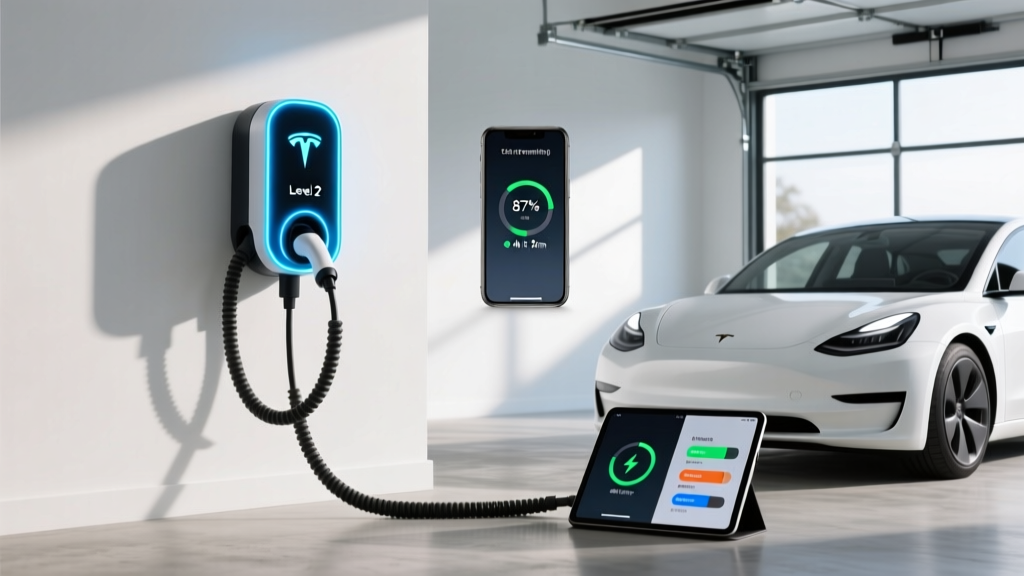
2. Tesla Wall Connector (Hardwired)
- Power Output: Up to 11.5 kW (48A)
- Connector: NACS (J1772 adapter available separately for $95)
- Cable Length: 24 feet
- Smart Features: WiFi, over-the-air updates, power sharing (multiple units on one circuit), Tesla app integration
- Price: $475
- Best For: Tesla owners, clean aesthetic, power-sharing for multi-EV households
3. Emporia Level 2 EV Charger (Hardwired or NEMA 14-50)
- Power Output: Up to 11.5 kW (48A)
- Connector: J1772
- Cable Length: 24 feet
- Smart Features: WiFi, energy monitoring, solar integration, load management with Emporia Vue panel monitor
- Price: $399
- Best For: Budget-conscious buyers, solar homeowners, load management without panel upgrade
4. Grizzl-E Smart (NEMA 14-50 or Hardwired)
- Power Output: Up to 10 kW (40A)
- Connector: J1772
- Cable Length: 24 feet
- Smart Features: WiFi, OCPP compatibility, extreme cold rating (-40°F), rugged aluminum case
- Price: $549
- Best For: Cold climates, outdoor installations, durability
Safety, Code Compliance, and Installation Best Practices
EV charging installations must comply with NEC Article 625 and local building codes. Key safety requirements include:
- Dedicated circuit: EV chargers require their own breaker—no sharing with other appliances.
- GFCI protection: Outdoor installations and garages require Ground Fault Circuit Interrupter protection (built into most modern breakers and chargers).
- Outdoor rating: Exterior-mounted chargers must be NEMA 3R or 4 rated for weather resistance.
- Proper wire gauge: 6 AWG copper for 50A circuits, 4 AWG for 60A circuits (longer runs may require larger gauge to prevent voltage drop).
- Permit and inspection: Most jurisdictions require an electrical permit and final inspection. Skipping this voids homeowner's insurance coverage for electrical fires.
Never use extension cords or adapters to plug a Level 2 charger into an undersized outlet. A NEMA 14-50 receptacle must be on a 50A breaker with 6 AWG wire; plugging into a 30A dryer outlet with an adapter creates a fire hazard.
Frequently Asked Questions
How much does it cost to install a home EV charger?
Most Level 2 home charger installations cost $700-$2,200 if your electrical panel has capacity. This includes $350-$750 for the charger, $300-$1,200 for electrician labor, and $50-$250 for permits. Older homes with 100A panels may need a $1,500-$3,500 panel upgrade, bringing total costs to $2,200-$5,700.
How fast will each charging level add range?
Level 1 (120V) adds 3-5 miles per hour. Level 2 (240V) adds 14-75 miles per hour depending on amperage (32A = ~28 miles/hr; 48A = ~42 miles/hr). DC fast charging adds 150-1,200 miles per hour at peak power, but tapers significantly above 80% SoC.
Which connector/charger is compatible with my EV?
For home Level 2 charging, all EVs use J1772 or NACS connectors (adapters are widely available). For public DC fast charging, check your vehicle's port: Tesla and most 2025+ vehicles use NACS; older non-Tesla EVs typically use CCS1; Nissan Leaf uses CHAdeMO. Adapters exist for CCS-to-NACS and NACS-to-J1772, but CHAdeMO has no adapter path.
How much does charging cost per mile vs gas?
Home charging during off-peak hours costs $0.02-$0.03 per mile (75-85% less than gas at $3.50/gallon and 25 MPG). Standard-rate home charging costs $0.035-$0.045 per mile. DC fast charging costs $0.075-$0.125 per mile, approaching but still below gasoline costs.
What electrical upgrades might I need?
If your home has a 100A electrical panel or you're already running multiple high-draw appliances (electric range, dryer, heat pump), you may need a panel upgrade to 200A service ($1,500-$3,500). Alternatively, smart load-management devices like the Emporia Vue can dynamically reduce charger power when other appliances are running, avoiding a panel upgrade.