Understanding EV Charging Levels: Speed, Power, and Real-World Expectations
Before you invest in home charging equipment, you need to understand the three charging levels and what they actually deliver in terms of range per hour. This isn't marketing fluff—these numbers determine whether you wake up with a full battery or scramble for a public charger.
| Level | Voltage | Power (kW) | Miles Added/Hour | Best Use Case |
|---|---|---|---|---|
| Level 1 | 120V AC | 1.4-1.9 kW | 3-5 miles | Overnight top-offs, PHEVs, low-mileage drivers |
| Level 2 | 240V AC | 3.3-19.2 kW | 12-75 miles | Primary home charging, daily use |
| DC Fast | 400-800V DC | 50-350 kW | 150-300+ miles (peak) | Road trips, rapid top-ups |
Critical distinction: kW (kilowatts) measures charging power—the rate at which energy flows. kWh (kilowatt-hours) measures battery capacity—the total energy stored. A 75 kWh battery charged at 7.5 kW takes roughly 10 hours from empty to full. Think of it like filling a 15-gallon tank: kW is your hose diameter, kWh is the tank size.
Real-World Charging Speeds vs. Peak Ratings
DC fast chargers advertise peak power (e.g., "350 kW"), but batteries can't sustain that rate. Most EVs hit peak speed between 10-30% state of charge, then taper to protect the battery. A 250 kW charger might deliver 150 kW average across a 10-80% session.
For a 75 kWh battery (typical midsize SUV):
- Level 1 (1.9 kW): 10-80% in ~30 hours
- Level 2 (11.5 kW): 10-80% in ~5 hours
- DC Fast (150 kW peak, ~100 kW avg): 10-80% in ~25-30 minutes
Home Level 2 Installation: Electrical Requirements and Costs
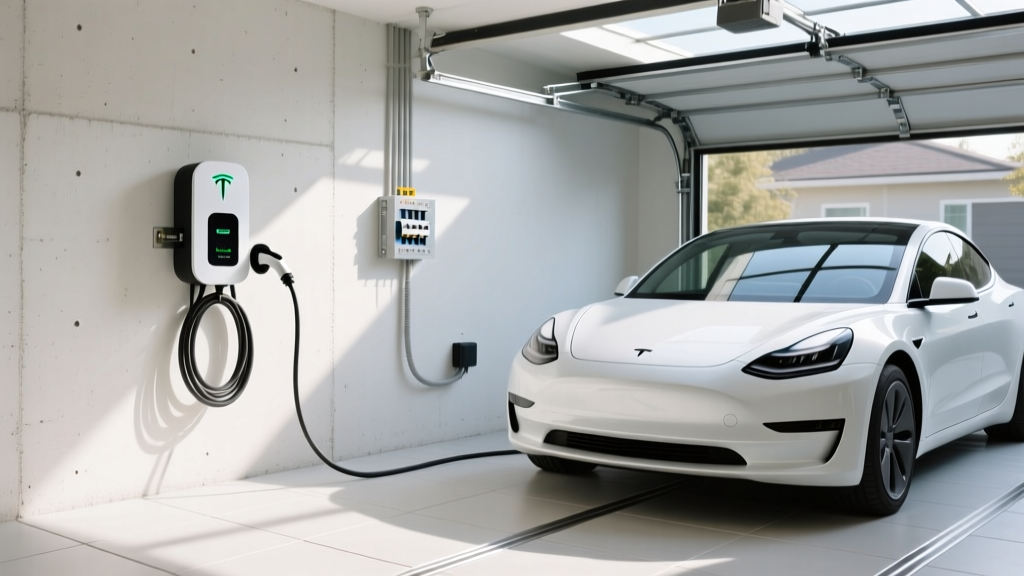
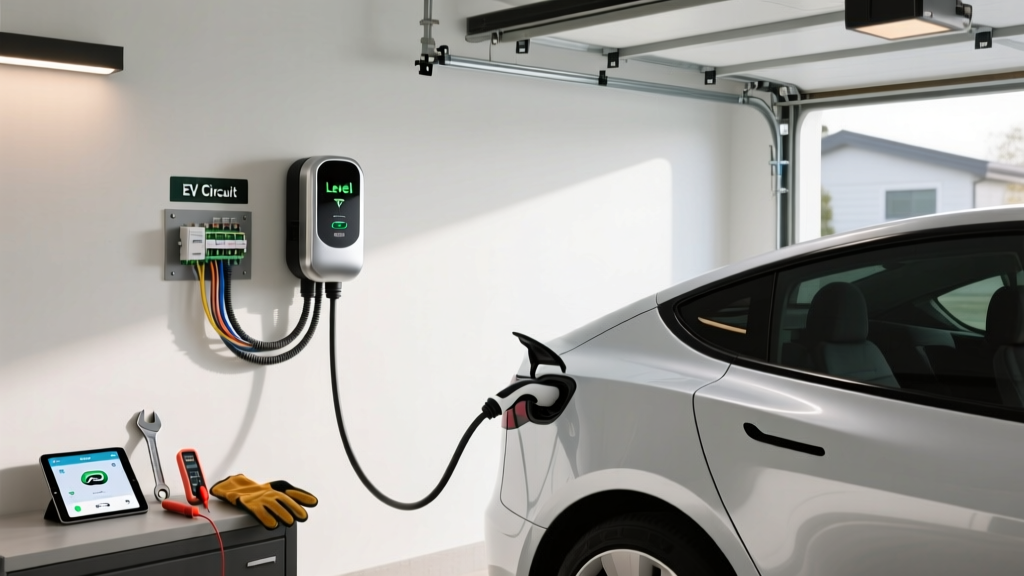
Most EV owners install a 240V Level 2 charger at home. This requires a dedicated circuit, proper wiring, and often an electrical panel assessment. Here's what you're actually paying for.
Electrical Specifications
A typical home Level 2 setup uses:
- Voltage: 240V (same as your dryer or oven)
- Amperage: 40A or 50A circuit (delivering 32A or 40A continuous to the vehicle)
- Power output: 7.7 kW (32A) or 9.6 kW (40A)
- Wire gauge: 6 AWG copper for 50A circuits, 8 AWG for 40A
The National Electrical Code requires circuits to operate at 80% of breaker capacity for continuous loads (3+ hours). So a 50A breaker delivers 40A continuous—this is why you'll see chargers rated "40A" on a "50A circuit."
| Component | Cost Range | Notes |
|---|---|---|
| Level 2 Charger (hardware) | $300 - $700 | Smart chargers with Wi-Fi/app: $500-$700 |
| Electrician Labor | $400 - $1,500 | Depends on run length, wall type, local rates |
| Permit Fees | $50 - $300 | Varies by municipality |
| Electrical Panel Upgrade | $1,500 - $4,000 | Required if panel is maxed out or <200A service |
| Total (no panel upgrade) | $750 - $2,500 | Average: $1,200-$1,800 |
| Total (with panel upgrade) | $2,250 - $6,500 | Older homes often need this |
Do You Need a Panel Upgrade?
Most homes built after 1990 have 200A electrical service, which typically supports a 50A EV circuit without upgrades. But if your panel is already near capacity (electric heat, AC, hot tub, EVSE), you may need:
- Load calculation: Electrician assesses your panel's available capacity ($100-$200)
- Panel upgrade to 200A or 400A: $1,500-$4,000 depending on complexity
- Alternative: Install a lower-amperage charger (24A or 32A) to avoid panel work
Homes with 100A service (common pre-1980) almost always need an upgrade for Level 2 charging. Budget accordingly.
Connector Compatibility: NACS, CCS, and CHAdeMO
As of 2026, the North American EV charging landscape has consolidated around two main standards, with legacy connectors still in use on older vehicles.
| Connector | Brands Using It (2026) | Adapter Needed? |
|---|---|---|
| NACS (Tesla) | Tesla, Ford, GM, Rivian, Volvo, Polestar, Mercedes, BMW, Hyundai/Kia (2025+) | CCS vehicles need NACS adapter ($200-$300) |
| CCS1 | VW, Audi, Porsche, older Hyundai/Kia, BMW (pre-2025), some Stellantis | NACS vehicles need CCS adapter ($200-$300) |
| CHAdeMO | Nissan Leaf (legacy), Mitsubishi Outlander PHEV (legacy) | Limited public infrastructure; no adapter to NACS/CCS |
Home Charger Connector Selection
Most Level 2 home chargers ship with a J1772 connector (the AC charging standard). Tesla vehicles include a J1772-to-NACS adapter in the glovebox. If you drive a non-Tesla with NACS (2025+ Ford, GM, etc.), you'll need a J1772-to-NACS adapter or buy a NACS-native home charger.
For future-proofing, choose a charger with a detachable cable or one that supports both J1772 and NACS via adapter.
Charging Cost: Home vs. Public vs. Gas
Electricity rates vary wildly by region, time of day, and utility plan. Here's the real math on what charging costs compared to gasoline.
| Charging Scenario | Cost per kWh | Cost per Mile (3 mi/kWh EV) | Annual Cost (12,000 mi) |
|---|---|---|---|
| Home (off-peak utility rate) | $0.08 - $0.15 | $0.03 - $0.05 | $360 - $600 |
| Home (standard rate) | $0.12 - $0.25 | $0.04 - $0.08 | $480 - $960 |
| Public Level 2 | $0.25 - $0.49 | $0.08 - $0.16 | $960 - $1,920 |
| DC Fast (Electrify America, Tesla Supercharger) | $0.35 - $0.55 | $0.12 - $0.18 | $1,440 - $2,160 |
| Gas vehicle (25 MPG, $3.50/gal) | N/A | $0.14 | $1,680 |
Key takeaway: Home charging at off-peak rates delivers 70-80% cost savings vs. gas. Exclusive DC fast charging erases most savings—use it for road trips, not daily charging.
Time-of-Use Plans and Smart Charging
Many utilities offer time-of-use (TOU) rates with super-cheap overnight electricity ($0.05-$0.10/kWh from 10 PM to 6 AM). Smart chargers can schedule charging to these windows automatically, cutting your annual fuel cost to $300-$500.
Equipment Recommendations: Top Home Chargers for 2026
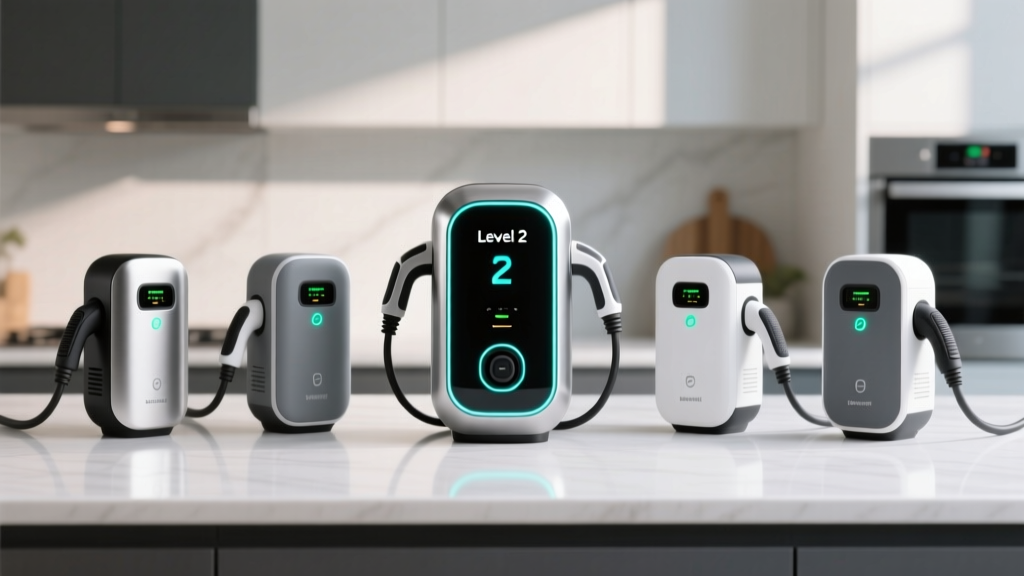
Here are proven Level 2 chargers with the specs that matter: power output, cable length, smart features, and price.
ChargePoint Home Flex
- Power: Up to 12 kW (50A circuit)
- Connector: J1772 (NACS adapter included for 2025+ models)
- Cable length: 23 feet
- Smart features: Wi-Fi, app scheduling, Alexa integration, energy tracking
- Price: $550-$650
- Best for: Most homes, flexible amperage settings (16A-50A)
Emporia Level 2 EV Charger
- Power: 11.5 kW (48A)
- Connector: J1772
- Cable length: 24 feet
- Smart features: Wi-Fi, app, solar integration, real-time energy monitoring
- Price: $400-$500
- Best for: Budget-conscious buyers, solar homes
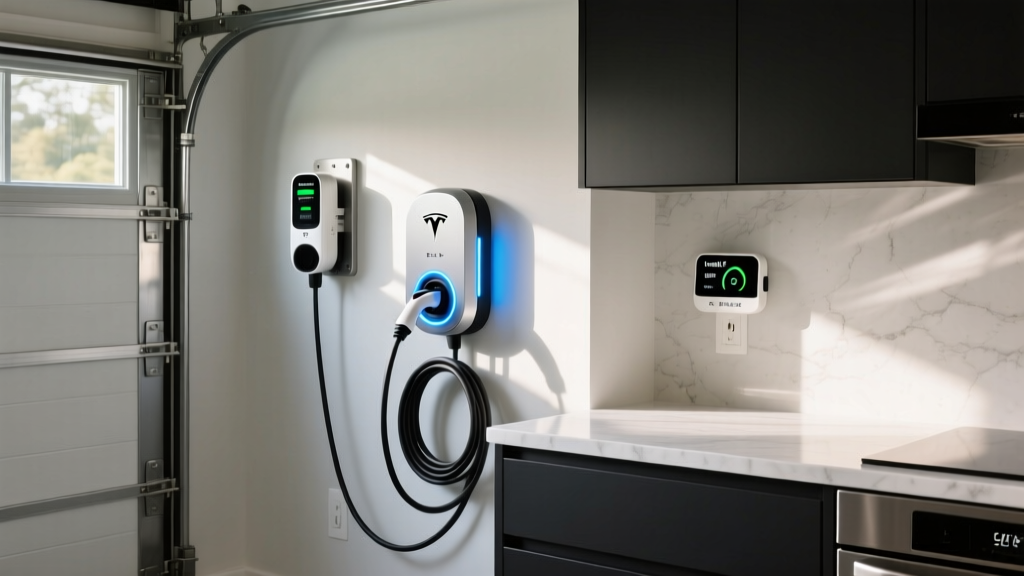
Tesla Wall Connector
- Power: 11.5 kW (48A)
- Connector: NACS native (J1772 adapter available)
- Cable length: 24 feet
- Smart features: Wi-Fi, OTA updates, power sharing (multiple units), load management
- Price: $450-$500
- Best for: Tesla owners, multi-EV households
Grizzl-E Smart
- Power: 10 kW (40A)
- Connector: J1772
- Cable length: 24 feet
- Smart features: Wi-Fi, app, adjustable amperage (16A-40A)
- Price: $500-$600
- Best for: Extreme weather (-40°F to 122°F rated), outdoor installs
Safety, Permits, and Code Compliance
EV charger installation isn't DIY territory (unless you're a licensed electrician). Here's what code requires and why it matters.
Electrical Code Requirements
- Dedicated circuit: Your EV charger needs its own breaker—no sharing with other outlets
- GFCI protection: Required for outdoor installations and some indoor locations (check local code)
- Outdoor rating: NEMA 4 or NEMA 4X enclosure for outdoor chargers (weatherproof)
- Wire sizing: Must match breaker amperage (undersized wire = fire hazard)
- Disconnect switch: Some jurisdictions require a visible disconnect within sight of the charger
Permits and Inspections
Most municipalities require an electrical permit ($50-$300) and a post-installation inspection. Skipping this can:
- Void your homeowner's insurance if there's an electrical fire
- Cause issues when selling your home (unpermitted work must be disclosed)
- Result in fines if discovered
Your electrician typically pulls the permit and schedules inspection. Budget 1-2 weeks for the full process.
Frequently Asked Questions
How much does it cost to install a home EV charger?
Average cost is $1,200-$1,800 for a standard installation (charger + electrician + permit) if your electrical panel has capacity. If you need a panel upgrade (common in homes built before 1990 or with 100A service), total cost jumps to $2,250-$6,500. Get 2-3 quotes from licensed electricians.
How fast will each charging level add range?
Level 1 (120V): 3-5 miles per hour. Level 2 (240V, 40A): 25-30 miles per hour. DC Fast (150 kW): 150-200 miles in 20-30 minutes (10-80% state of charge). Actual speeds depend on your vehicle's onboard charger capacity and battery chemistry.
Which connector/charger is compatible with my EV?
Check your vehicle's charge port. Tesla and most 2025+ vehicles from Ford, GM, Rivian, Hyundai, Kia use NACS. Older non-Tesla EVs typically use CCS1. Nissan Leaf uses CHAdeMO. For home charging, most Level 2 chargers use J1772; Tesla includes an adapter, and NACS vehicles can use J1772-to-NACS adapters.
How much does charging cost per mile vs gas?
Home charging at off-peak rates: $0.03-$0.05 per mile. Public DC fast charging: $0.12-$0.18 per mile. Gas vehicle at 25 MPG and $3.50/gallon: $0.14 per mile. Home charging saves 60-80% vs. gas; exclusive public fast charging costs about the same as gas.
What electrical upgrades might I need?
If your home has 100A electrical service (pre-1980 construction), you'll likely need a panel upgrade to 200A ($1,500-$4,000). If your 200A panel is near capacity (electric heat, AC, hot tub), you may need a load calculation and possibly a 400A upgrade or a lower-amperage charger (24A-32A) to avoid panel work.
Can I install a Level 2 charger myself?
Only if you're a licensed electrician. EV chargers draw significant continuous current (32A-48A for 3+ hours), and improper installation creates fire risk. Most jurisdictions require a permit and inspection. DIY installation also voids most charger warranties and may violate your homeowner's insurance policy.
Do I need a smart charger with Wi-Fi?
Not required, but recommended. Smart chargers ($500-$700) let you schedule charging during off-peak hours, track energy use, receive OTA updates, and integrate with solar systems. Basic non-smart chargers ($300-$400) work fine if you just need plug-and-charge functionality.
Final Considerations
Home Level 2 charging transforms EV ownership from "planning around chargers" to "waking up with a full battery every morning." The upfront cost ($1,200-$2,500 typical) pays for itself in convenience and fuel savings within 2-4 years for most drivers.
Before you buy equipment, get an electrician assessment of your panel capacity. Choose a charger that matches your vehicle's connector (or budget for adapters), and factor in permit costs. The math almost always favors home charging over gas—especially if your utility offers time-of-use rates.
For more on EV charging infrastructure and costs, see the Department of Energy's EV technology resources and your local utility's EV rate programs.