Why Your EV's Range Dictates Your Home Charging Setup
If you're shopping electric cars by range—whether a 200-mile commuter hatchback or a 400-mile long-haul SUV—the vehicle you choose directly determines the charging hardware you need at home. A 75 kWh battery in a short-range EV and a 130 kWh pack in a heavy-duty electric truck don't just differ in how far they go; they differ in how long they occupy your driveway at Level 2 power, whether your existing electrical panel can handle the load, and what your per-mile fuel cost actually looks like versus gasoline.
This guide maps the three charging levels to real-world speeds, breaks down the true cost of a Level 2 home installation (including the panel-upgrade scenario many older homes face), clarifies the NACS versus CCS connector transition underway in 2025–2026, and runs the per-mile math against a 27 MPG gas car. Every figure is grounded in current EPA data, manufacturer specs, and IRS §30D rules where relevant.
Charging Levels Explained: kW Speed and Miles Added Per Hour
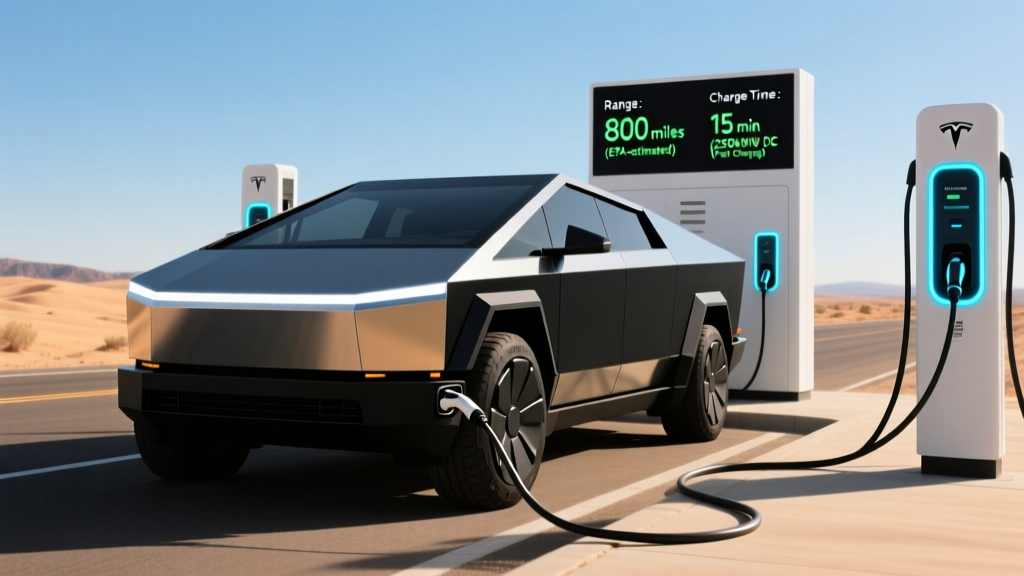
The single most common EV literacy gap is confusing kW (kilowatts), which measures power—how fast energy flows—with kWh (kilowatt-hours), which measures energy capacity—how much the battery holds. Think of kW as the diameter of a hose and kWh as the size of the bucket. A Level 2 charger delivering 11.5 kW fills a 75 kWh battery in roughly 6.5 hours; a DC fast charger at 150 kW can add 80% in about 25 minutes.
| Level | Voltage | Typical kW | Miles of range / hour | Best use case |
|---|---|---|---|---|
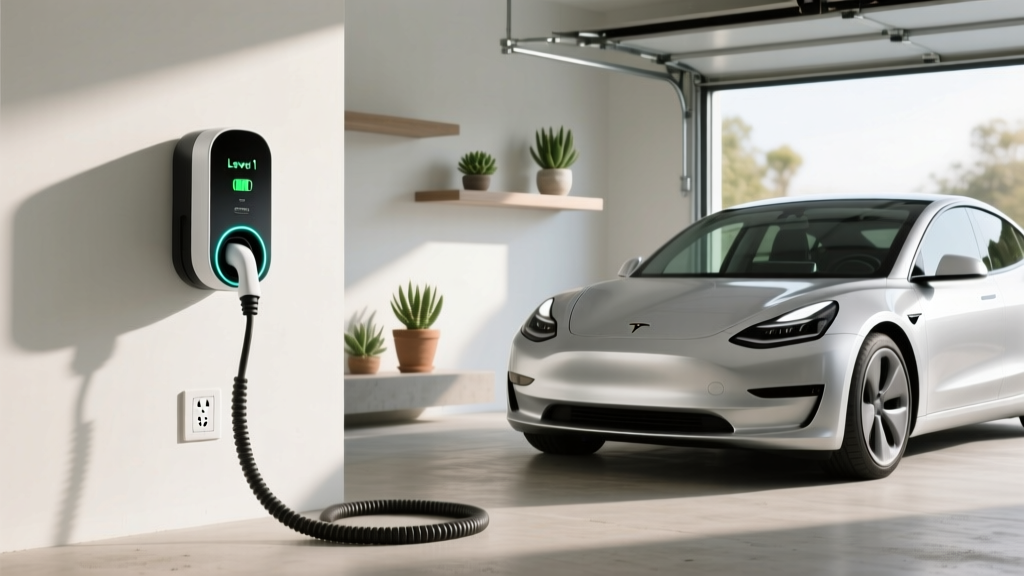
| Level 1 | 120V AC | 1.0–1.4 kW | 3–5 mi/hr | Overnight top-up for short commutes (<30 mi/day) |
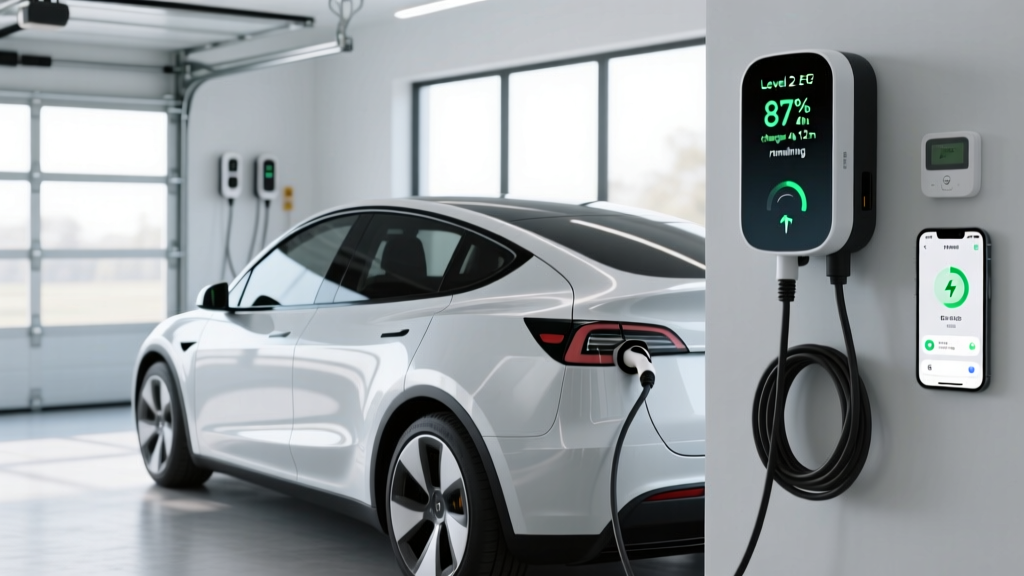
| Level 2 | 240V AC | 7.2–11.5 kW | 25–44 mi/hr | Primary home charging; full overnight refill |
| DC Fast | 400–800V DC | 50–350 kW | 150–1,200+ mi/hr* | Road trips; 10–80% in 18–40 min depending on vehicle |
*Miles-per-hour figures at DC fast chargers are theoretical averages; real charging curves taper significantly above 80% State of Charge. A vehicle peaking at 250 kW typically sustains that rate for only the middle portion of the charge, then slows to protect the battery.
Real 10–80% Charging Times by Battery Size
| Battery (usable kWh) | Vehicle class example | Level 2 (11.5 kW) | DC Fast (peak kW / 10–80%) |
|---|---|---|---|
| 54 kWh | Compact EV (e.g., Chevy Equinox EV) | ~4 hr 40 min | 150 kW peak → ~26 min |
| 77 kWh | Mid-size SUV (e.g., Hyundai Ioniq 5) | ~6 hr 40 min | 238 kW peak → ~18 min |
| 100 kWh | Large SUV / sedan (e.g., Tesla Model S) | ~8 hr 40 min | 250 kW peak → ~25 min |
| 131 kWh | Electric truck (e.g., Ford F-150 Lightning Ext.) | ~11 hr 20 min | 150 kW peak → ~42 min |
Note: Level 2 times assume continuous delivery at rated kW. In practice, thermal management, ambient temperature, and the final taper above 90% add 30–60 minutes to a true 0–100% fill.
Home Level 2 Installation: Electrical Requirements and True Cost
A Level 2 home charger is the backbone of practical EV ownership—roughly 80–90% of all EV charging happens at home according to fueleconomy.gov. But "plug it in" glosses over the electrical reality: you're adding a continuous 32A–48A load to your home's panel, and the cost varies enormously based on your home's age, panel capacity, and the distance from panel to parking spot.
Electrical Requirements
- Circuit: Dedicated 240V circuit, typically 40A (for a 32A charger) or 60A (for a 48A charger). NEC 2023 requires continuous loads to use no more than 80% of the circuit rating.
- Wire gauge: 6 AWG copper for 40A–50A runs; 4 AWG for 60A. Longer runs (>100 ft) may require upsizing to limit voltage drop.
- Outlet vs. hardwired: A NEMA 14-50 receptacle offers portability; hardwired units allow higher amperage and avoid GFCI nuisance trips common on 14-50 outlets under NEC 2017+.
- GFCI protection: Required for receptacle installations in garages per NEC; hardwired units are exempt and generally more reliable for EV use.
- Permit: Nearly all jurisdictions require an electrical permit and final inspection for a new 240V circuit. Budget $50–$250 for the permit itself.
Installation Cost Breakdown
| Component | Low end | High end | Notes |
|---|---|---|---|
| Level 2 charger (hardware) | $350 | $750 | 32A–48A smart charger, 18–25 ft cable |
| Electrician labor (short run, <30 ft) | $400 | $900 | Panel adjacent to garage; standard conduit |
| Electrician labor (long run, 30–100 ft) | $900 | $2,200 | Attic/crawlspace routing, longer conduit |
| Permit and inspection | $50 | $250 | Varies by municipality |
| Panel upgrade (100A → 200A) | $1,800 | $4,500 | Required on many pre-1990 homes; biggest variable |
| Total (no panel upgrade) | $800 | $3,100 | Most modern 200A-panel homes |
| Total (with panel upgrade) | $2,600 | $7,600 | Older homes or those with high existing loads |
Panel-upgrade gotcha: Homes built before the 1990s often have 100A or 125A main panels. Adding a 48A continuous EV load on top of existing HVAC, electric dryer, and range loads may exceed the panel's capacity. A licensed electrician will perform a NEC Article 220 load calculation before quoting. If you're told you "need more room," ask specifically whether a panel upgrade or a load-management device (which throttles the charger when other appliances draw heavily) is the more cost-effective solution.
Connector Compatibility: NACS, CCS1, and CHAdeMO in 2026
The North American connector landscape shifted dramatically in 2023–2025 when Ford, GM, Rivian, Volvo, BMW, and most major automakers committed to adopting Tesla's North American Charging Standard (NACS) for new vehicles. By the 2026 model year, the split looks like this:
| Connector | Brands using it (2026 models) | Adapter needed? |
|---|---|---|
| NACS (Tesla plug) | Tesla (all), Ford (2025+), GM (2025+), Rivian (2025+), Volvo/Polestar (2025+), BMW, Mercedes (selected) | CCS → NACS adapter for legacy CCS vehicles; included or ~$200–$400 aftermarket |
| CCS1 | Hyundai/Kia (select carryover models), VW ID.4 (pre-2026), Stellantis, Honda Prologue (2024–2025) | NACS → CCS1 adapter required to access Tesla Superchargers |
| CHAdeMO | Nissan Leaf (legacy only; discontinued in US after 2025) | No adapter available for DC fast charging; CHAdeMO stations declining |
Home charger connector choice: If you own or plan to buy a NACS-equipped vehicle (the majority of new EVs from 2025 onward), buy a NACS-terminated Level 2 charger. If you currently own a CCS vehicle and plan to keep it, a CCS-terminated charger or a universal charger with a swap-able connector (like the Telepod or Grizzl-E with configurable plug) is the pragmatic play. Avoid CHAdeMO-only home equipment unless you exclusively drive a Nissan Leaf and have no plans to change.
Cost to Charge: Per-Mile Math vs. Gasoline
The economic case for EV charging hinges on your electricity rate and where you charge. Here are three real scenarios, benchmarked against a comparable 27 MPG gasoline car at $3.40/gallon:
| Scenario | Rate ($/kWh) | Efficiency (kWh/100 mi) | Cost per mile | Gas equivalent (27 MPG, $3.40/gal) |
|---|---|---|---|---|
| Home off-peak (utility TOU rate) | $0.09 | 30 kWh | $0.027 | $0.126 |
| Home standard rate (national avg.) | $0.17 | 30 kWh | $0.051 | $0.126 |
| Public Level 2 (ChargePoint, EVgo) | $0.35 | 30 kWh | $0.105 | $0.126 |
| DC fast charging (Electrify America, Tesla) | $0.48 | 30 kWh | $0.144 | $0.126 |
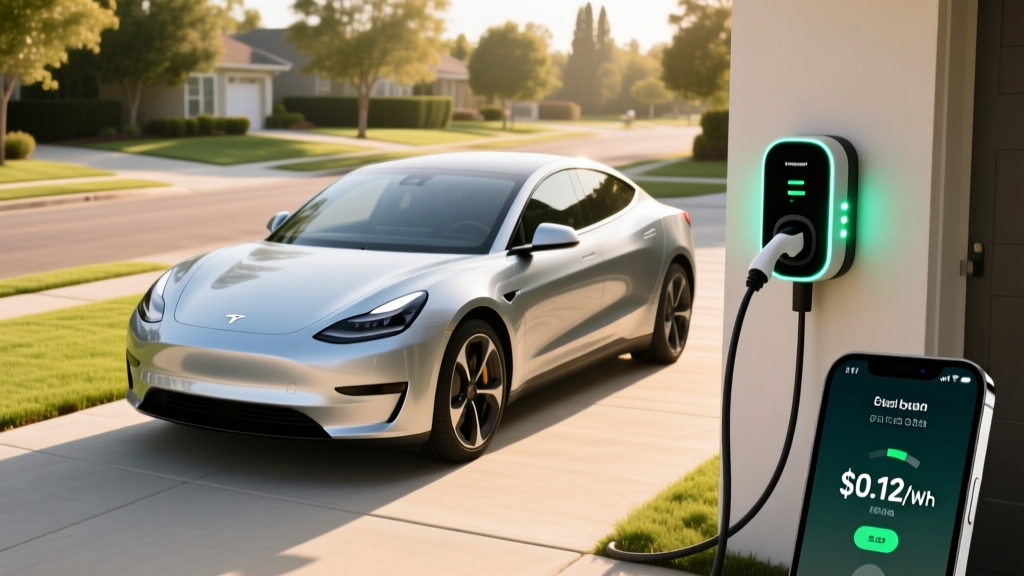
Key takeaway: Home charging at off-peak rates delivers fuel costs roughly one-fifth of gasoline. Even at standard residential rates, you save 60% per mile. But frequent reliance on DC fast charging—common for apartment dwellers without home access—erases the cost advantage and can actually exceed gasoline per mile. This is why home Level 2 installation isn't just a convenience; it's the economic foundation of EV ownership.
Efficiency varies by vehicle: a compact EV like the Tesla Model 3 achieves ~25 kWh/100 mi (better), while a large electric truck like the Rivian R1T may consume 42–48 kWh/100 mi (worse). Adjust the math to your specific vehicle's EPA efficiency rating.
Recommended Level 2 Home Chargers (2025–2026)
Every charger below is UL-listed or ETL-listed (a non-negotiable safety requirement—skip Amazon no-name units lacking certification), supports scheduled/TOU charging, and includes a minimum 3-year warranty.
Best overall: ChargePoint Home Flex (2nd Gen)
- Power output: Up to 11.5 kW (48A) on a 60A circuit; configurable down to 16A for smaller panels
- Connector: NACS or CCS1 (select at purchase)
- Cable length: 23 ft
- Smart features: Wi-Fi, app scheduling, TOU optimization, Alexa/Google Home, energy reports
- Price: ~$550–$650 (hardware only)
- Outdoor rating: NEMA 4 (suitable for exterior wall mounting)
Best value: Emporia Level 2 EV Charger
- Power output: Up to 11.5 kW (48A)
- Connector: NACS or J1772/CCS1
- Cable length: 24 ft
- Smart features: Wi-Fi, app control, solar integration (pairs with Emporia Vue energy monitor for solar-excess charging)
- Price: ~$350–$400
- Outdoor rating: NEMA 4
Most durable (hardwired): Grizzl-E Smart
- Power output: Up to 10 kW (40A) on a 50A circuit
- Connector: J1772 (CCS1 compatible); NACS version available
- Cable length: 24 ft
- Smart features: OCPP-compatible, adjustable amperage, works with utility demand-response programs
- Price: ~$450–$550
- Outdoor rating: NEMA 4X (extreme cold/heat rated to -40°F)
Tesla owners: Tesla Wall Connector
- Power output: Up to 11.5 kW (48A)
- Connector: NACS (native); includes J1772 adapter tip for non-Tesla guests
- Cable length: 24 ft
- Smart features: Wi-Fi, OTA updates, Power Sharing (link up to 6 units on one circuit for multi-EV garages)
- Price: ~$450
- Outdoor rating: NEMA 3R (rain-resistant; not fully sealed for horizontal exposure)
Safety, Code, and the Outdoor Installation Checklist
EV charging places a sustained high-amperage load on your home's wiring—more akin to running an electric furnace for 8 hours than plugging in a phone. The following safety practices are non-negotiable:
- Dedicated circuit only: Never share the EV charger circuit with other outlets or appliances. NEC 625 mandates a dedicated branch circuit.
- Hardwired over receptacle for reliability: NEMA 14-50 outlets, while convenient, are prone to overheating under continuous EV loads if not installed with industrial-grade (not residential-grade) receptacles. Many electricians now recommend hardwiring as the default.
- Outdoor-rated enclosure: If your charger is mounted outside, it must carry a NEMA 4 or NEMA 4X rating. NEMA 3R handles rain but not hose-directed water or ice.
- Cable management: Use a holster or retraction system. A 24-ft cable lying on a garage floor or driveway is a trip hazard and degrades faster from abrasion.
- Surge protection: A Type 2 surge protective device (SPD) at the panel is inexpensive insurance ($150–$300 installed) against grid transients damaging your charger's power electronics.
- Inspection: Do not skip the final inspection. An uninspected installation may void your homeowner's insurance coverage in the event of a fire.
Frequently Asked Questions
How much does it cost to install a home EV charger?
For a home with an existing 200A electrical panel and a short wire run (<30 ft from panel to parking spot), expect $800–$1,500 all-in (charger + electrician + permit). If your panel needs upgrading from 100A to 200A, add $1,800–$4,500. Long wire runs through finished walls or attics push the total to $2,000–$3,500 even without a panel upgrade.
How fast will each charging level add range?
Level 1 (120V) adds 3–5 miles per hour—adequate only for very short commutes. Level 2 (240V, 32A–48A) adds 25–44 miles per hour, enough to refill most EVs overnight. DC fast charging adds 150–1,200+ miles per hour in the peak portion of the curve, with 10–80% fills taking 18–42 minutes depending on vehicle and peak kW acceptance.
Which connector/charger is compatible with my EV?
For 2026 model-year vehicles, NACS is now the dominant standard (Tesla, Ford, GM, Rivian, Volvo, Polestar, BMW). Hyundai, Kia, and some Stellantis models still use CCS1. If you own a CCS vehicle and want Supercharger access, you'll need a NACS-to-CCS adapter ($200–$400). Match your home charger's connector to your vehicle's native port to avoid daily adapter hassle.
How much does charging cost per mile vs gas?
At home off-peak rates (~$0.09/kWh), an average EV costs about $0.027/mile to fuel—roughly one-fifth of a 27 MPG gas car at $3.40/gallon ($0.126/mile). At national average residential rates ($0.17/kWh), the EV still saves ~60%. Public DC fast charging at $0.48/kWh slightly exceeds gasoline cost per mile, which is why home charging access is the critical economic variable.
What electrical upgrades might I need?
The most common and costly upgrade is a panel replacement from 100A or 125A to 200A service, required when your existing panel lacks capacity for a 40A–60A continuous EV load on top of HVAC, range, and dryer loads. A less expensive alternative is a load-management device ($200–$400 + install) that dynamically reduces charger amperage when other appliances activate. Your electrician's NEC Article 220 load calculation will determine which path is required.
Does the federal tax credit apply to home charger installation?
The §30D credit covers the vehicle, not the charger. However, the separate Alternative Fuel Vehicle Refueling Property Credit (IRS Form 8911) can cover up to 30% of home charger hardware and installation costs, capped at $1,000, subject to census-tract eligibility requirements. Check current IRS guidance as eligibility criteria have been updated for 2025–2026 and are location-dependent.
Can I just use the Level 1 cord that came with my EV?
You can, but it's practical only if you drive fewer than 30–40 miles per day and have 10–12 hours between drives. A 77 kWh battery takes roughly 55–65 hours to fill from empty on Level 1. For most owners, Level 1 is a backup or travel cord; Level 2 is the daily driver.