Why Now Is the Time to Upgrade Your Home Charging Setup
Mercedes-Benz has been making headlines with its DRIVE PILOT system — the first certified Level 3 autonomous driving capability available in the U.S. on select EQS and S-Class models. While the industry inches toward hands-off highway driving, the more immediate question for most EV owners and prospective buyers remains practical: how do I charge at home efficiently, safely, and affordably?
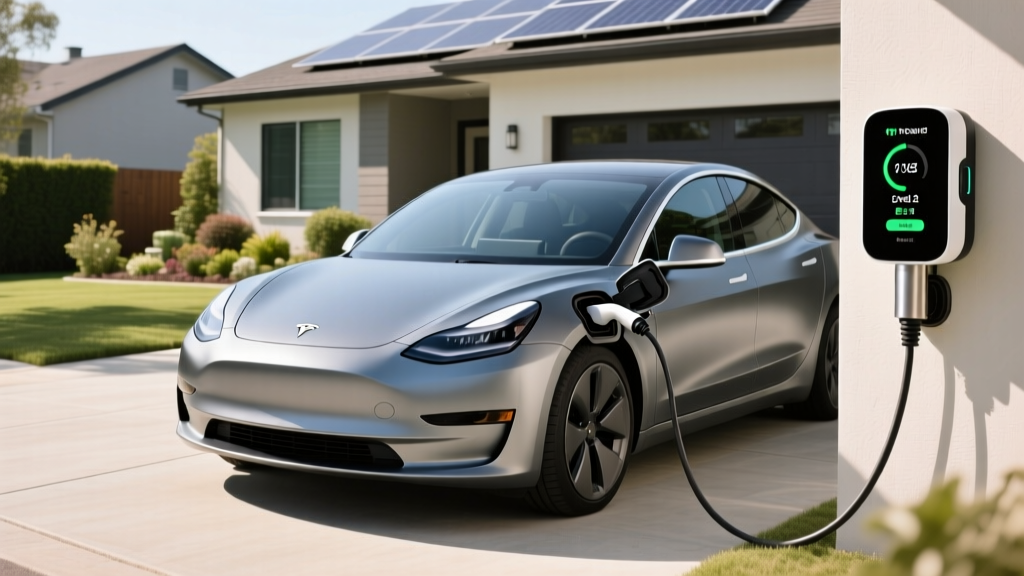
Whether you're waiting for Mercedes-Benz Level 3 autonomous driving to reach your state or you've already taken delivery of an EQE, EQS, or any other electric vehicle, a properly installed home Level 2 charger is the single highest-impact ownership upgrade you can make. This guide covers exactly what's involved — electrical requirements, real costs, equipment picks, and charging speeds — with the precision you need to plan your installation.
Understanding Charging Levels: kW Speeds and Miles Per Hour
The most common mistake new EV owners make is confusing kW (kilowatts — the rate of power delivery, like water pressure from a hose) with kWh (kilowatt-hours — the total energy stored in your battery, like the size of the tank). Your charger's kW rating determines how fast energy flows into your vehicle's battery, measured in kWh.
| Level | Voltage / Amperage | Max Power (kW) | Miles of Range Added Per Hour | Best Use Case |
|---|---|---|---|---|
| Level 1 | 120V / 12A | 1.4 kW | 3–5 mi/hr | Overnight top-off, PHEVs, low-mileage drivers |
| Level 2 | 240V / 32–48A | 7.7–11.5 kW | 25–44 mi/hr | Primary home charging, daily use |
| DC Fast Charging | 400–800V DC | 50–350 kW | 150–1,200+ mi/hr (peak) | Road trips, rapid top-ups |
For context, a Mercedes-Benz EQS 450+ with its 108.4 kWh (usable) battery charging on a 48-amp Level 2 station at 11.5 kW would gain roughly 35 miles of range per hour, or fully replenish from 10% to 80% in approximately 7 hours. That same session on a 200 kW DC fast charger takes roughly 31 minutes from 10–80%, though the charge curve tapers significantly above 80% State of Charge to protect battery longevity.
Home Installation: Electrical Requirements and Real Costs
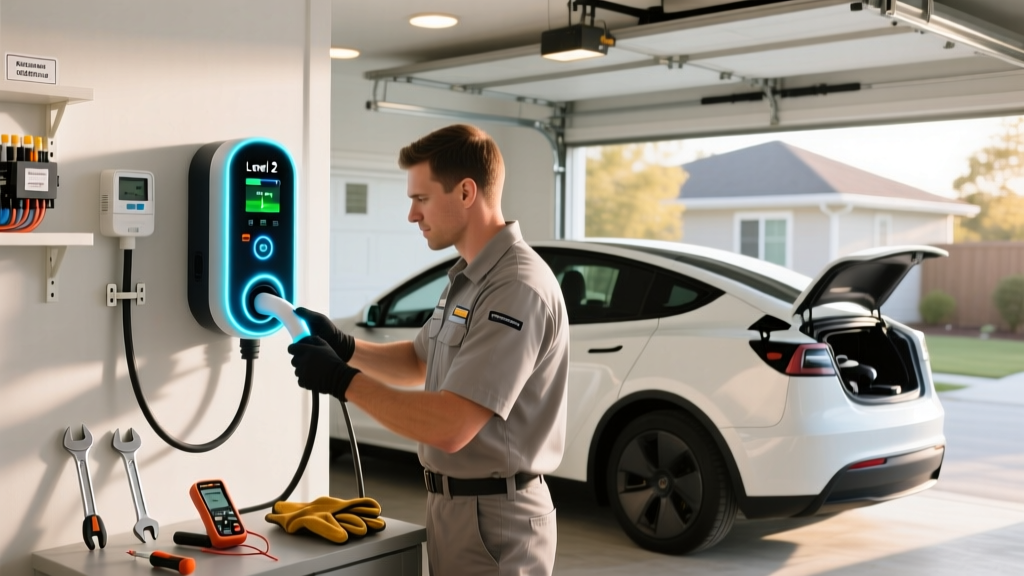
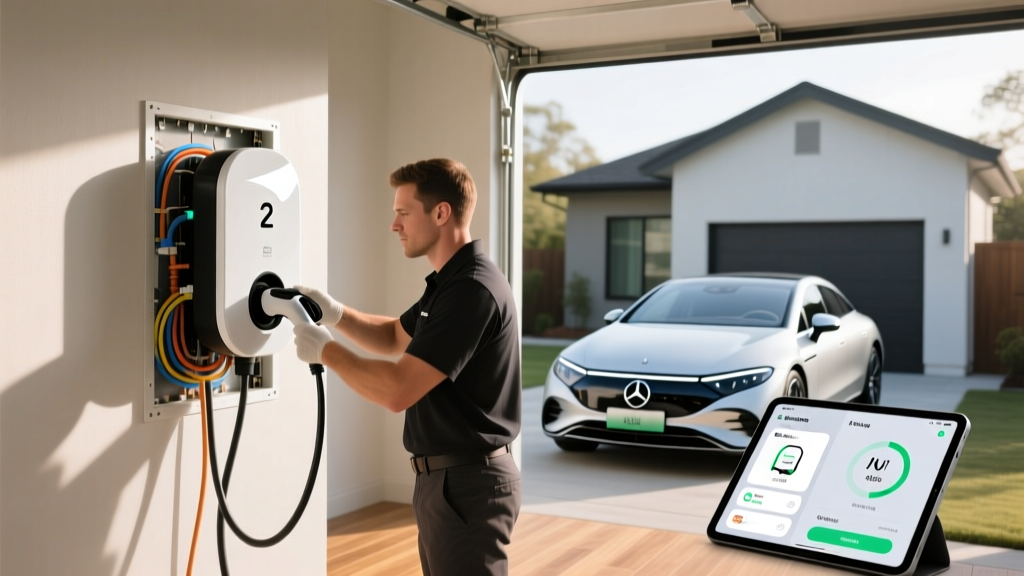
Installing a Level 2 home charger is an electrical project, not a plug-and-play consumer setup. Here's what's actually involved and what it costs in 2026.
Electrical Specifications
- Circuit requirement: A dedicated 240V circuit, typically 40A or 50A (breaker rated at 125% of continuous load, so a 40A charger needs a 50A breaker)
- Wire gauge: 6 AWG copper for 50A circuits; 8 AWG for 40A — run through conduit if exposed
- Hardwired vs. plug: NEMA 14-50 outlet (plug-in flexibility) or hardwired junction box (cleaner install, often required for 48A+ units)
- GFCI protection: Required by NEC 2020+ for outdoor receptacles; many hardwired EVSEs have built-in ground-fault protection
- Panel capacity: Your main electrical panel must have sufficient spare amperage — most Level 2 installs require 50A of headroom on a 200A service panel
Do You Need a Panel Upgrade?
This is the cost variable that catches homeowners off guard. If your home has a 100A or 150A main service panel — common in homes built before 2000 — adding a 50A EV circuit may exceed safe load calculations, especially if you already run electric range, dryer, and HVAC. A licensed electrician will perform a load calculation per NEC Article 220.
If a panel upgrade is needed (typically to 200A service), expect the following additional cost:
| Component | Low Estimate | High Estimate | Notes |
|---|---|---|---|
| Level 2 EVSE equipment (charger unit) | $350 | $750 | 32A–48A smart chargers |
| Electrician labor (standard install) | $400 | $1,200 | Depends on run distance, conduit, drywall work |
| Materials (wire, conduit, breaker, outlet) | $100 | $400 | Longer wire runs increase cost |
| Permit and inspection | $50 | $250 | Varies by municipality |
| Electrical panel upgrade (if needed) | $1,500 | $4,000 | 100A→200A service upgrade |
| Total (no panel upgrade) | $900 | $2,600 | Typical scenario |
| Total (with panel upgrade) | $2,400 | $6,600 | Older homes |
Always hire a licensed electrician and pull a permit. Unpermitted electrical work can void your homeowner's insurance and create fire risk. Some utilities offer rebates of $250–$500 for permitted Level 2 installations — check with your local provider before scheduling.
Connector Compatibility: NACS, CCS1, and What Your EV Needs
The connector landscape shifted dramatically between 2023 and 2026. Here's where things stand for new vehicles sold in the U.S. market:
| Connector | Brands Using It | Adapter Needed? |
|---|---|---|
| NACS (J3400) | Tesla, Ford, GM, Rivian, Volvo, Polestar, Mercedes-Benz (2025+), Hyundai/Kia (2025+), BMW, Toyota, Subaru, Lucid | CCS1→NACS adapter for older non-Tesla DC fast chargers |
| CCS1 | Legacy: pre-2025 VW ID.4, pre-2025 Hyundai Ioniq 5, older BMW i4/iX, Stellantis EVs | NACS→CCS1 adapter for Tesla Superchargers |
| CHAdeMO | Nissan Leaf (discontinued), Mitsubishi Outlander PHEV (legacy) | No practical adapter; network-dependent |
For Mercedes-Benz owners: 2025 and newer EQE, EQS, and EQB models shipped in the U.S. now feature the NACS port natively. If you own a 2022–2024 Mercedes EQ model with CCS1, you'll need a CCS-to-NACS adapter (approximately $200–$250) to access the Tesla Supercharger network, which now numbers over 30,000 stalls nationwide.
For home Level 2 charging, the connector is less of a concern — all Level 2 EVSEs use the J1772 connector (or NACS with J1772 signaling), and every non-Tesla EV sold in the U.S. accepts J1772 for AC charging. Tesla vehicles include a J1772-to-NACS adapter in the glovebox.
Cost to Charge: Home vs. Public vs. Gas Per Mile
The economic case for home charging is overwhelming when you compare it to both public charging and gasoline. Here are realistic 2026 numbers based on national averages from the U.S. Energy Information Administration and AAA fuel price tracking:
| Scenario | Rate ($/kWh) | Vehicle Efficiency | Cost Per Mile |
|---|---|---|---|
| Home Level 2 (off-peak utility rate) | $0.09/kWh | 3.0 mi/kWh (typical sedan) | $0.030 |
| Home Level 2 (standard residential rate) | $0.16/kWh | 3.0 mi/kWh | $0.053 |
| Public Level 2 (network pricing) | $0.25/kWh | 3.0 mi/kWh | $0.083 |
| DC Fast Charging (Electrify America, EVgo) | $0.43/kWh | 3.0 mi/kWh | $0.143 |
| Gasoline vehicle (30 MPG combined, $3.45/gal) | — | 30 MPG | $0.115 |
The takeaway is clear: home charging on an off-peak rate costs roughly one-quarter what gasoline costs per mile. Even DC fast charging at peak public rates is only marginally more expensive than gas — and you'd never use DC fast charging as your primary fueling method. According to fueleconomy.gov, a Mercedes-Benz EQS 450+ achieves 97 MPGe combined, translating to roughly 3.1 miles per kWh.
For a driver covering 12,000 miles annually, home charging at $0.12/kWh saves approximately $1,050 per year compared to a 30 MPG gas vehicle at $3.45/gallon.
Recommended Level 2 Home Chargers for 2026
Based on sustained real-world performance, build quality, and smart features, here are the chargers we recommend for home installation:
ChargePoint Home Flex
- Power output: Up to 11.5 kW (48A) on a 60A circuit, or configurable down to 16A
- Connector: J1772 (NACS adapter available)
- Cable length: 23 feet
- Smart features: Wi-Fi, scheduling, energy tracking, Alexa integration
- Price: $549 (unit only)
- Best for: Flexibility across amperage; works with any panel capacity
Emporia Vue Level 2 EV Charger
- Power output: Up to 11.5 kW (48A)
- Connector: J1772
- Cable length: 24 feet
- Smart features: Energy monitoring, solar integration, time-of-use scheduling
- Price: $399
- Best for: Budget-conscious buyers wanting smart features; solar-home integration
Tesla Wall Connector
- Power output: Up to 11.5 kW (48A)
- Connector: NACS native (J1772 adapter included)
- Cable length: 24 feet
- Smart features: Wi-Fi updates, load sharing (multiple units on one circuit), Powerwall integration
- Price: $475
- Best for: Tesla and NACS-equipped vehicles (including 2025+ Mercedes EQ models)
All three units are UL-listed, rated for indoor and outdoor installation (NEMA 4 enclosure), and support both hardwired and plug-in (NEMA 14-50) configurations. Hardwired installation is recommended for 48A units, as NEMA 14-50 outlets are limited to 40A continuous load per NEC.
Charging Time Examples for Common Battery Sizes
Here's how long a 10% to 80% charge session takes at each level for popular EV battery capacities. Note that DC fast charging times reflect sustained average power, not peak kW — the charge curve tapers significantly above 50% SoC to protect cell health:
| Vehicle (Battery kWh Usable) | Level 1 (1.4 kW) | Level 2 (11.5 kW) | DC Fast (avg. sustained kW) |
|---|---|---|---|
| Mercedes EQS 450+ (108.4 kWh) | ~54 hours | ~7 hours | ~31 min (200 kW avg) |
| Tesla Model Y LR (75 kWh) | ~37 hours | ~4.8 hours | ~22 min (170 kW avg) |
| Hyundai Ioniq 5 (77.4 kWh) | ~39 hours | ~5 hours | ~18 min (235 kW avg, 800V) |
| Ford F-150 Lightning Ext. (131 kWh) | ~65 hours | ~8.5 hours | ~42 min (150 kW avg) |
The practical implication: Level 1 is only viable for plug-in hybrids with small batteries (10–20 kWh) or BEV owners who drive under 30 miles daily and can charge over 10+ hours nightly. For full-size BEVs like the EQS or F-150 Lightning, Level 2 is the minimum practical home solution.
Safety, Code, and Best Practices
EV charging involves sustained high-current electrical loads — far beyond what a typical household appliance draws. Follow these non-negotiable safety requirements:
- Dedicated circuit: Your EV charger must be on its own dedicated breaker — never share a circuit with other loads
- GFCI protection: Required for all outdoor receptacles per NEC 625.54; hardwired EVSEs typically include integrated ground-fault protection
- Outdoor rating: If mounted outside, the unit must carry a NEMA 4 (weather-resistant) rating — all recommended units above qualify
- Cable management: Use a wall-mounted cable organizer to prevent tripping hazards and cord damage; never run charging cables across driveways or sidewalks
- Load management: If your panel is near capacity, consider a smart EVSE with load-sensing capability (e.g., Emporia with the Vue energy monitor) that dynamically adjusts charge rate to stay within panel limits
- Permit and inspection: Required in virtually all jurisdictions — your electrician should pull the permit, and the local inspector will verify wire gauge, breaker sizing, and grounding
Frequently Asked Questions
How much does it cost to install a home EV charger?
A standard Level 2 home charger installation costs between $900 and $2,600 when no panel upgrade is needed — this includes the charger unit ($350–$750), electrician labor ($400–$1,200), materials ($100–$400), and permit ($50–$250). If your home requires an electrical panel upgrade from 100A to 200A service, add $1,500–$4,000. Total project cost for older homes can reach $6,600.
How fast will each charging level add range?
Level 1 (120V) adds 3–5 miles of range per hour. Level 2 (240V, 48A) adds 25–44 miles per hour depending on vehicle efficiency. DC fast charging at 150–350 kW can add 150–1,200+ miles per hour at peak, though sustained rates taper above 50% State of Charge. For daily use, Level 2 is the practical standard — most EVs fully replenish overnight in 6–9 hours.
Which connector/charger is compatible with my EV?
For 2025 and newer vehicles, most major brands (Tesla, Ford, GM, Mercedes-Benz, Hyundai, Kia, Rivian, Volvo, BMW) now use the NACS (J3400) connector for both AC and DC charging. Older CCS1-equipped vehicles can use a CCS-to-NACS adapter (~$200–$250) for Tesla Supercharger access. For home Level 2 charging, all EVs accept the J1772 connector, and NACS vehicles include a J1772 adapter. CHAdeMO is effectively discontinued in the U.S. market.
How much does charging cost per mile vs. gas?
Home Level 2 charging at the national average residential rate of $0.16/kWh costs approximately $0.053 per mile for a typical EV achieving 3.0 mi/kWh. Off-peak utility rates ($0.09/kWh) drop this to $0.030/mile. A comparable 30 MPG gasoline vehicle at $3.45/gallon costs $0.115 per mile. Even the most expensive DC fast charging ($0.43/kWh) at $0.143/mile is only slightly above gas — and most EV owners do 85%+ of their charging at home.
What electrical upgrades might I need?
The most common upgrade is a new 50A or 60A double-pole breaker and a dedicated 240V circuit run from your main panel to the charger location. If your panel lacks spare capacity (common with 100A or 150A service), you may need a panel upgrade to 200A — costing $1,500–$4,000. Homes with Federal Pacific or Zinsco panels will require full replacement regardless of capacity. A licensed electrician will perform a NEC Article 220 load calculation to determine your exact needs.
Will Mercedes-Benz Level 3 autonomous driving affect my charging needs?
Not directly — DRIVE PILOT (Level 3) is a driving-assistance feature, not a powertrain change. However, Mercedes-Benz vehicles equipped with DRIVE PILOT tend to be higher-trim EQS and S-Class models with larger battery packs (108.4 kWh for the EQS). Larger batteries benefit more from 48A Level 2 chargers (11.5 kW) versus 32A units (7.7 kW), reducing overnight charge times by roughly 30%. Plan your installation around your vehicle's maximum AC charge acceptance rate.