Why Your Garage Needs an EV Charging Strategy (Whether You Drive a Battery-Electric Daily or Park a Ford Shelby GT500 Supercharged Next to It)
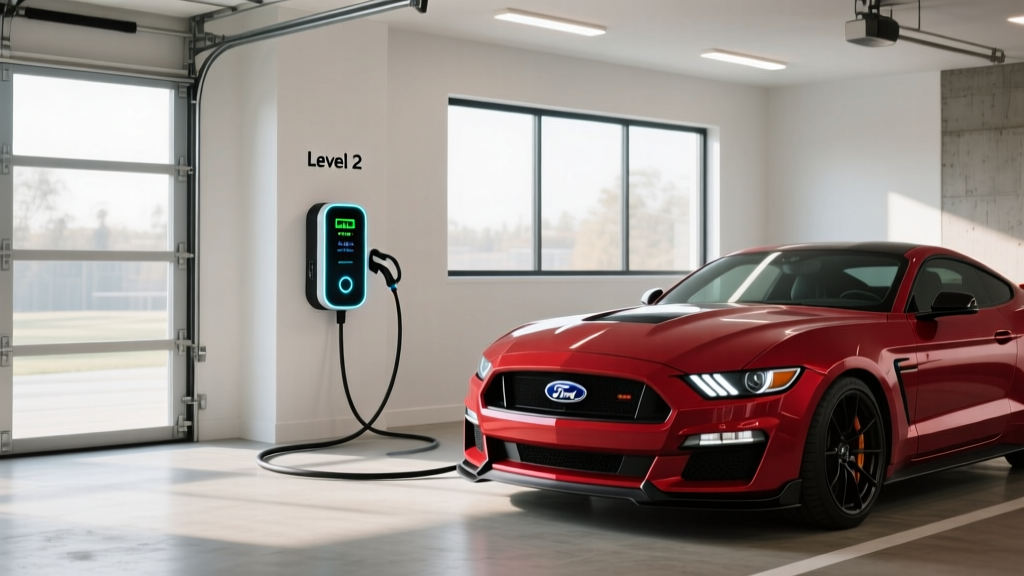
Most EV buyers focus on the vehicle — EPA range, 0-60 times, tax credit eligibility — and treat home charging as an afterthought. That's a mistake. Your home charging setup determines whether you wake up every morning with a "full tank" or scramble to find a public DC fast charger before work. Whether you're plugging in a Tesla Model Y, a Hyundai Ioniq 5, or sharing a two-car garage with a Ford Shelby GT500 Supercharged (760 hp of supercharged V8 that will never see a charging cable), understanding EV charging levels, electrical requirements, and real costs is essential before you spend a dollar on equipment.
This guide breaks down every charging level with exact kW speeds, walks through home installation requirements and realistic costs, maps connector compatibility across 2026 model-year EVs, and runs the math on what charging actually costs per mile compared to gasoline.
Charging Levels Explained: Level 1, Level 2, and DC Fast Charging
EV charging is categorized into three levels based on power delivery. The critical distinction: kW (kilowatts) measures power — how fast energy flows into the battery. kWh (kilowatt-hours) measures energy — how much the battery holds. A 77 kWh battery charged at 11.5 kW takes roughly 6.7 hours from 0–100% (minus taper at high state of charge).
| Level | Voltage | Power (kW) | Miles of Range Added per Hour | Typical Use Case |
|---|---|---|---|---|
| Level 1 | 120V AC | 1.0–1.4 kW | 3–5 mi/hr | Overnight top-up, PHEVs, emergency |
| Level 2 | 240V AC | 3.3–19.2 kW | 12–75 mi/hr | Home daily charging, workplace |
| DC Fast (Level 3) | 200–900V DC | 50–350+ kW | 150–1,000+ mi/hr (peak) | Road trips, highway corridors |
Level 1 uses a standard 120V household outlet. Every EV ships with a Level 1 cord. For a PHEV with a 15–20 kWh battery, Level 1 adds enough range overnight. For a BEV with a 75–100 kWh battery, Level 1 is impractical as a primary strategy — a full charge can take 3+ days.
Level 2 is the home charging standard. A 240V circuit (same voltage as a clothes dryer) delivers 7–11.5 kW with a typical 40A or 48A circuit, replenishing 25–44 miles of range per hour for most EVs. An 8-hour overnight session adds 200–350 miles — more than enough for nearly any daily driving pattern.
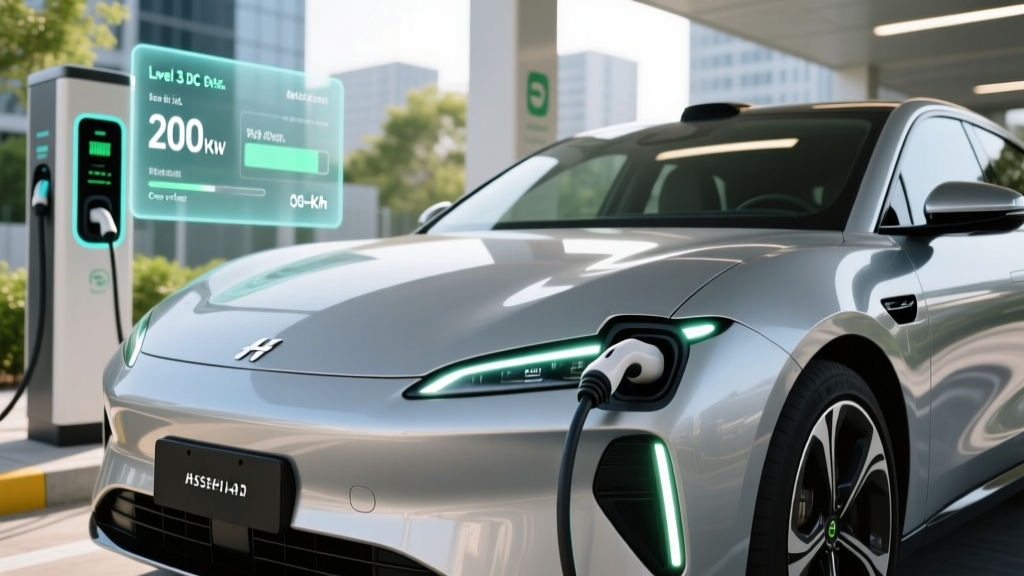
DC Fast Charging bypasses the vehicle's onboard charger and sends direct current straight to the battery. Peak rates reach 350 kW on 800V architectures (Hyundai Ioniq 5, Kia EV6, Porsche Taycan). However, peak kW is not sustained kW — charging speed tapers significantly above 80% state of charge (SoC) to protect battery health. A "10–80% in 18 minutes" claim applies only to that middle band.
Home Level 2 Installation: Electrical Requirements and What Your Panel Can Handle
Before buying a charger, assess your home's electrical capacity. A Level 2 charger requires a dedicated 240V circuit. The most common residential setups:
- 40A circuit / 32A continuous — delivers 7.7 kW. Sufficient for most daily charging needs. Requires a NEMA 14-50 outlet or hardwired connection.
- 48A circuit / 40A continuous — delivers 9.6 kW. Common for higher-capacity home chargers. Hardwired connection required by code at this amperage.
- 60A circuit / 48A continuous — delivers 11.5 kW. Maximum for most residential chargers (e.g., ChargePoint Home Flex at max config, FLO Home X8). Hardwired only.
- 80A circuit / 64A continuous — delivers 15.3–19.2 kW. Requires a robust panel and is typically only necessary for EVs with large batteries and high onboard charger acceptance (e.g., Hummer EV, some Tesla configurations with dual chargers).
Do You Need a Panel Upgrade?
Most modern homes with 200A electrical service can accommodate a 40–60A EV circuit without a panel upgrade. Older homes with 100A service, or homes already running high-draw appliances (electric range, dryer, HVAC, hot tub), may need a service upgrade to 200A — or a smart load-management system that shares capacity.
A licensed electrician will perform a load calculation per NEC Article 220 to determine whether your panel has headroom. If an upgrade is needed, expect to add $1,500–$3,500 to the project. Some utilities offer rebates for panel upgrades tied to EV adoption.
Permits and Code Requirements
Most jurisdictions require an electrical permit for a new 240V circuit. The electrician typically pulls this. Key code considerations:
- Dedicated circuit: The EV charger must have its own breaker — no sharing with other appliances.
- GFCI protection: NEC 2020 and later requires GFCI protection for outdoor receptacles. Hardwired chargers may not require a GFCI breaker in all jurisdictions, but many inspectors now require it.
- Outdoor rating: If the charger is installed outside (driveway, exterior wall), it must carry a NEMA 3R or NEMA 4 rating for weather resistance.
- Cable management: The NEC requires that the charging cable not create a trip hazard — some inspectors require a cable retractor or hook.
How Much Does It Cost to Install a Home EV Charger?
Installation cost varies enormously based on the distance from your panel to the charger location, whether conduit is needed, and local labor rates. Here's a realistic breakdown for a 2026 installation:
| Component | Simple Install (panel near garage) | Complex Install (long run, conduit) | Panel Upgrade Needed |
|---|---|---|---|
| Level 2 Charger (hardware) | $400–$700 | $400–$700 | $400–$700 |
| Electrician labor | $300–$600 | $800–$1,800 | $800–$1,800 |
| Permit fee | $50–$150 | $50–$200 | $50–$200 |
| Panel upgrade (if needed) | — | — | $1,500–$3,500 |
| Materials (conduit, wire, breaker) | $50–$150 | $200–$500 | $200–$500 |
| Total | $800–$1,600 | $1,450–$3,200 | $2,950–$6,700 |
The federal Residential Clean Energy Credit (IRS §25D) does not cover EV chargers directly, but some states and utilities offer rebates of $250–$1,000 for equipment and installation. Check your utility's EV program page — many offer time-of-use (TOU) rate plans that pair with charger scheduling for lower electricity costs.
Connector Compatibility: NACS, CCS1, and CHAdeMO in 2026
The connector landscape has consolidated significantly since Ford, GM, Rivian, and most major automakers adopted the North American Charging Standard (NACS) — originally developed by Tesla. Here's where things stand for 2026 model-year vehicles:
| Connector | Brands Using Natively | Adapter Needed For | Notes |
|---|---|---|---|
| NACS (Tesla standard) | Tesla, Ford (2025+), GM (2025+), Rivian, Volvo, Polestar, Nissan (2026 Ariya refresh) | Older CCS vehicles visiting Superchargers | Dominant North American standard as of 2025–2026 |
| CCS1 (Combo) | Hyundai, Kia, BMW, VW, Audi, Mercedes, Stellantis, Subaru Solterra | NACS-to-CCS adapter for Tesla Supercharger access | Still common; adapters widely available ($150–$250) |
| CHAdeMO | Nissan Leaf (legacy only) | No adapter to NACS/CCS for DC fast charging | Effectively discontinued for new vehicles |
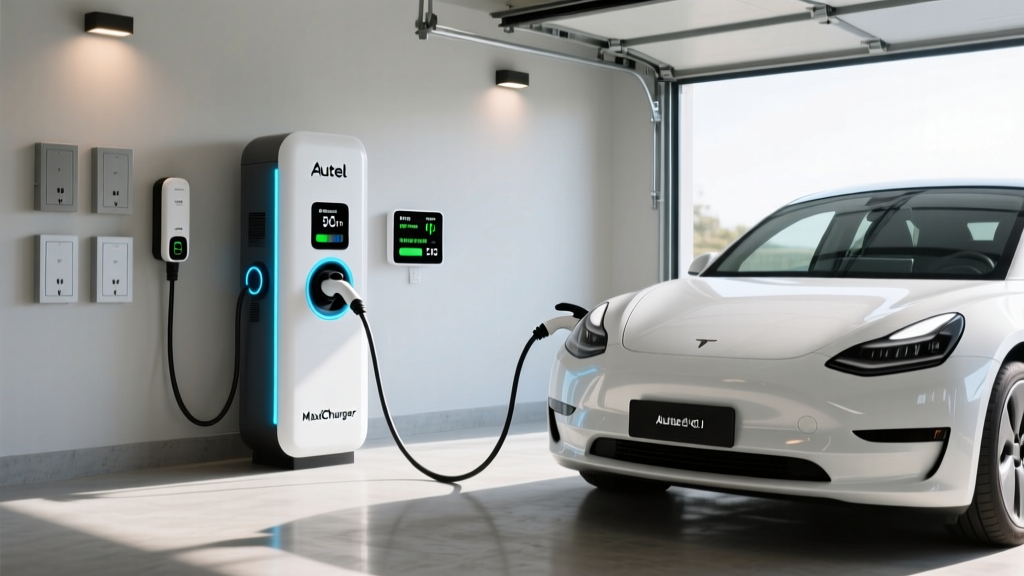
For home Level 2 charging, the J1772 connector is still the standard plug for non-Tesla home chargers. Tesla vehicles include a J1772-to-NACS adapter in the glovebox. If you own a Tesla and buy a third-party charger (ChargePoint, Emporia, Wallbox), you'll use that adapter — or choose a charger with a native NACS plug, which several manufacturers now offer.
What Does Charging Cost per Mile vs. Gas?
Electricity pricing varies by region, time of day, and charging location. Here's a comparison using realistic 2026 figures:
| Scenario | Rate | Vehicle Efficiency | Cost per Mile |
|---|---|---|---|
| Home charging (off-peak TOU rate) | $0.12/kWh | 3.5 mi/kWh (286 Wh/mi) | $0.034 |
| Home charging (standard rate) | $0.18/kWh | 3.5 mi/kWh | $0.051 |
| Public Level 2 (network pricing) | $0.35/kWh | 3.5 mi/kWh | $0.10 |
| DC fast charging (Electrify America, EVgo) | $0.48/kWh | 3.2 mi/kWh (highway) | $0.15 |
| Gasoline vehicle (25 MPG combined) | $3.40/gal | 25 mi/gal | $0.136 |
| Performance gas vehicle (e.g., Shelby GT500, 14 MPG combined) | $3.40/gal | 14 mi/gal | $0.243 |
Home charging at off-peak rates is the cheapest way to "fuel" any vehicle on the road. Even public DC fast charging is cost-competitive with a fuel-efficient gas car, and dramatically cheaper than filling a high-performance vehicle. For context, the Ford Shelby GT500 Supercharged returns roughly 14 MPG combined per the EPA, meaning every mile costs about $0.24 at current fuel prices — roughly 7× the cost of home EV charging.
Of course, the Shelby GT500 isn't bought for fuel economy. But if that car shares a garage with an EV, the contrast in running costs is stark and worth factoring into a household's total transportation budget.
Equipment Recommendations: Best Home Level 2 Chargers for 2026
Here are four proven home chargers covering different budgets and feature sets. All are UL-listed, support 240V, and work with any EV using the appropriate connector or adapter.
Emporia Vue Smart EV Charger — Best Value
- Power output: 48A / 11.5 kW (hardwired) or 40A / 9.6 kW (NEMA 14-50 plug)
- Connector: J1772 (NACS version available)
- Cable length: 24 feet
- Smart features: Wi-Fi scheduling, solar integration with Emporia Vue energy monitor, load balancing
- Price: ~$399
ChargePoint Home Flex — Most Versatile
- Power output: Adjustable 16A–50A (3.8–12 kW) via DIP switch
- Connector: J1772 or NACS
- Cable length: 23 feet
- Smart features: App-based scheduling, Alexa integration, detailed session history
- Price: ~$649
Wallbox Pulsar Plus — Compact and Powerful
- Power output: 40A / 9.6 kW
- Connector: J1772 (NACS adapter included in 2026 kits)
- Cable length: 25 feet
- Smart features: Wi-Fi + Bluetooth, Power Sharing (two chargers on one circuit), Eco-Smart mode
- Price: ~$599
Tesla Wall Connector — Best for Tesla Owners
- Power output: 48A / 11.5 kW
- Connector: Native NACS (J1772 adapter available separately for ~$50)
- Cable length: 24 feet
- Smart features: Wi-Fi updates, load sharing between multiple Wall Connectors, power-level adjustment
- Price: ~$475
Charging Time Examples: How Long Does a Full Session Actually Take?
Charging time depends on battery size (kWh), onboard charger acceptance rate (kW), and the circuit available. Here are real-world scenarios for popular 2026 EVs charging at home on a 48A / 11.5 kW Level 2 circuit:
- Tesla Model Y Long Range (81 kWh battery, 11.5 kW onboard charger): 10–80% in ~5.5 hours. Adds ~44 mi/hr.
- Hyundai Ioniq 5 (77.4 kWh, 10.9 kW onboard): 10–80% in ~5.5 hours. Adds ~37 mi/hr.
- Ford F-150 Lightning Extended Range (131 kWh, 19.2 kW onboard with dual charger): 10–80% in ~6.5 hours on 11.5 kW circuit. Adds ~30 mi/hr (more on a 19.2 kW / 80A circuit).
- Chevrolet Equinox EV (85 kWh, 11.5 kW onboard): 10–80% in ~5.8 hours. Adds ~38 mi/hr.
- Toyota bZ4X (71.4 kWh, 6.6 kW onboard): 10–80% in ~5.5 hours (limited by onboard charger, not circuit). Adds ~22 mi/hr.
Notice the Toyota bZ4X example: even on a powerful 11.5 kW circuit, the car's onboard charger caps acceptance at 6.6 kW. This is why knowing your vehicle's onboard charger spec matters — oversizing the home circuit beyond the car's acceptance rate doesn't speed up Level 2 charging (though it does future-proof for your next EV).
For DC fast charging on road trips, the EPA's fueleconomy.gov database lists each model's fast-charge capability. Most modern EVs with liquid-cooled batteries can charge 10–80% in 18–30 minutes at a compatible DC fast station, assuming the charger can deliver the vehicle's peak kW rate and the battery is preconditioned.
Frequently Asked Questions
How much does it cost to install a home EV charger?
A straightforward installation with the panel near the garage typically runs $800–$1,600 total (charger + electrician + permit + materials). Longer wire runs with conduit push costs to $1,450–$3,200. If your home needs a panel upgrade from 100A to 200A service, add $1,500–$3,500, bringing the total to $2,950–$6,700. Always get 2–3 quotes from licensed electricians.
How fast will each charging level add range?
Level 1 (120V): 3–5 miles per hour. Level 2 (240V, 48A): 25–44 miles per hour depending on vehicle efficiency and onboard charger capacity. DC Fast Charging: 150–1,000+ miles per hour at peak rate, but only sustained in the 10–80% SoC band — expect a 20–30 minute stop for meaningful range on a road trip.
Which connector/charger is compatible with my EV?
For 2026 model-year vehicles: Tesla, Ford, GM, Rivian, Volvo, and Polestar use NACS natively. Hyundai, Kia, BMW, VW, and most legacy EVs use CCS1 — a $150–$250 NACS-to-CCS adapter unlocks Tesla Supercharger access. For home Level 2 charging, any J1772 charger works with all EVs (Tesla includes a J1772 adapter). NACS-equipped home chargers are increasingly available and eliminate the adapter for Tesla/NACS vehicles.
How much does charging cost per mile vs. gas?
Home charging at off-peak rates ($0.12/kWh) costs roughly $0.03–$0.05 per mile. Public DC fast charging ($0.48/kWh) runs about $0.15 per mile. A typical gas car at 25 MPG and $3.40/gallon costs $0.14 per mile. High-performance vehicles like the Ford Shelby GT500 Supercharged at ~14 MPG cost $0.24+ per mile — making an EV in the same household a significant offset to total fuel spending.
What electrical upgrades might I need?
The most common upgrade is adding a new 240V circuit with a 40–60A breaker. Homes with 100A service may need a panel upgrade to 200A ($1,500–$3,500). If your panel is full but service is adequate, a tandem breaker or sub-panel may solve the issue for less. Smart load-management devices (e.g., Emporia Smart Load Center, Wallbox Power Sharing) can share an existing high-amperage circuit (like a dryer outlet) between the dryer and EV charger, avoiding a panel upgrade entirely in some cases. Consult a licensed electrician for a proper NEC Article 220 load calculation before committing to equipment.